

The sunseeker v3 vs eufy e15 robot mower matchup pits a compact, random-pattern camera mower for smaller yards against a systematic, parallel-striping camera mower built for slightly larger lawns. Both models skip buried boundary wires and external RTK antennas by relying on onboard vision systems to detect grass edges and yard obstacles. Choosing between them comes down to your yard’s layout, whether you prefer striped mowing patterns, and how much app-based mapping control you want.
The short answer
- Yard size and slope: According to manufacturer pages the Sunseeker V3 covers up to 0.15 acres (6,400 sq. ft.) on slopes up to 42% (22 degrees), while the Eufy E15 maps up to 0.2 acres (8,700 sq. ft.) on slopes up to 40% (18 degrees).
- Cutting pattern: The Sunseeker V3 uses a random-pattern mowing principle without storing a permanent lawn map, whereas the Eufy E15 builds a saved map to mow in uniform parallel stripes.
- Boundary accessories: Both use camera vision to recognize clear borders, though the Sunseeker V3 relies on physical magnetic strips or RFID tags to mark open edges and separate zones, while the Eufy E15 uses virtual walls and no-go zones in its app.
- Cutting deck specs: The Sunseeker V3 offers a 7-inch cutting width and 0.8 to 2.4-inch cutting height, compared to the Eufy E15’s 8-inch cutting width and 1 to 3-inch motorized height range.
- Weather and security: The Sunseeker V3 carries an IPX5 water rating and basic PIN security, while the Eufy E15 steps up to IPX6 waterproofing for both mower and base station plus GPS anti-theft tracking.
How navigation and mapping differ
Although both machines use dual-camera vision rather than boundary wires or satellite base stations, they handle yard layout and path planning in fundamentally different ways.
According to Sunseeker’s official product specifications, the Sunseeker V3 relies on its Vision AI system to distinguish grass from hard borders like sidewalks, fences, patios, and driveways. Rather than driving a perimeter loop to build a digital floor plan, it operates on a random-path principle. Reviewers at TechReviewer noted that this approach avoids unmowed patches when run regularly, though the app does not display a live map view or let you pick mowing angles. When a yard has open borders without clear visual edges, or multiple disconnected grass patches, the V3 uses physical green magnetic strips and RFID tags to define boundaries and zone transitions.

By contrast, Eufy’s E15 documentation describes a pure-vision V-FSD 1.0 system that performs hands-free auto mapping. During setup—which Eufy notes typically takes two to three hours for an 8,700-square-foot yard—the mower drives the property and generates an editable map inside the smartphone app. Once mapped, the E15 mows in straight parallel lines, tracks coverage so sections are not skipped, and lets owners draw virtual walls, no-go zones, and multi-zone pathways up to 60 meters long without staking down physical strips. Because both mowers depend on optical cameras, neither works in the dark; Eufy specifically advises scheduling runs from half an hour after sunrise to half an hour before sunset.
Heads up
Camera-only mowers rely on visual contrast and clear sightlines. Both manufacturers advise clearing toys, branches, and stones before mowing, and keeping grass trimmed below the maximum deck height—Eufy specifies keeping grass under 3.5 inches (9 cm) and notes the E15 is not recommended for dense Zoysia or St. Augustine grass.
Side-by-side specifications
Comparing core hardware numbers shows how each brand balances compact weight against battery runtime, cutting width, and weather resistance.
| Specification | Sunseeker V3 | Eufy E15 |
|---|---|---|
| Maximum lawn area | Up to 0.15 acres (6,400 sq. ft.) | Up to 0.2 acres (8,700 sq. ft.) |
| Navigation method | Binocular Vision AI (random path) | V-FSD 1.0 pure vision (auto-mapped parallel stripes) |
| Maximum slope rating | 42% (22 degrees) | 40% (18 degrees) |
| Cutting width | 7 inches (18 cm) | 8 inches (203 mm) |
| Cutting height range | 0.8 to 2.4 inches (20 to 60 mm) | 1 to 3 inches (25 to 75 mm), motorized |
| Mower weight | 20.3 lbs (9.2 kg) | 27 lbs (12.5 kg) |
| Noise rating | 55 dB(A) | 56 dB |
| Waterproof rating | IPX5 (mower) | IPX6 (mower and base station) |
| Battery runtime / charge | Approx. 65 min runtime / 30 min recharge (per TechReviewer) | 90 to 110 min runtime / 90 to 110 min recharge |
| Anti-theft and connectivity | Bluetooth, Wi-Fi, PIN lock (no GPS) | Wi-Fi, optional 4G, GPS tracking, boundary alarm |
Setup, mowing quality, and daily operation
Both mowers prioritize quick out-of-the-box setup, yet their physical footprints and cutting systems create different day-to-day routines.
The Sunseeker V3 is built around minimal initial configuration: you anchor the charging station, connect power and Wi-Fi, and press start. Its 20.3-pound chassis carries a floating cutting disc with three pivoting blades that follow minor ground dips. In TechReviewer’s testing, the V3 maintained strong Wi-Fi range and trimmed within roughly 5 centimeters of borders, though the reviewer noted that the included ground anchors can snap in hard clay and the green magnetic zone markers stand out visually in a manicured garden. While the Sunseeker app supports scheduling, work logs, and remote-control driving, it lacks map editing and cutting-direction controls.
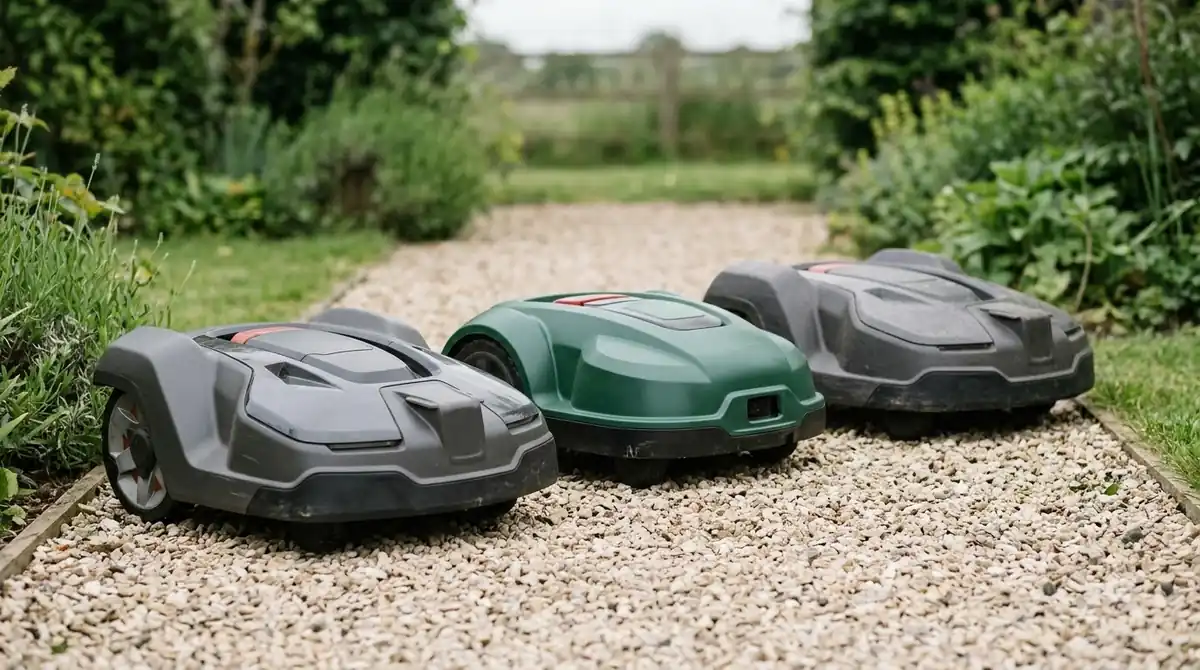
The Eufy E15 is heavier at 27 pounds and ships with a covered base station garage that requires a straight 5-meter clearance path in front for reliable docking. Reviewers at TechRadar and The Independent praised its automated mapping, motorized cutting-height adjustments, and neat parallel lawn stripes. Eufy’s ride-on-edge feature helps trim borders, though Eufy’s FAQ notes that grass within 4 inches (10 cm) of solid walls still requires manual trimming, and each base station stores only one map—meaning separated front and back yards without a drivable path require an extra base station. Both units include rain sensors that send the mower back to charge during wet weather, and both operate quietly enough for early morning or daytime neighborhood schedules.
Pros and cons from manufacturer data and reviews
Looking across official manuals and independent reviews highlights clear trade-offs in convenience, lawn aesthetics, and hardware features.
Sunseeker V3
- Pro — Fast three-minute start: Requires no mapping run before its first cut, making it easy to drop onto a fenced or clearly bordered lawn and start immediately.
- Pro — Lightweight and nimble on slopes: At 9.2 kg with a 22-degree slope rating, it is easy to carry for cleaning and handles moderate inclines well.
- Pro — Quiet operation and fast turnaround: Rated at 55 dB with quick recharge cycles that keep small lawns maintained through frequent top-up runs.
- Con — No saved map or striping: Random mowing leaves no striped pattern, and the app cannot display mower position on a yard map or set virtual no-go boundaries.
- Con — Physical markers and no GPS tracking: Complex lawns require visible magnetic strips or RFID tags, and theft protection is limited to a PIN code without GPS.
Eufy E15
- Pro — Automated mapping and striped finish: Builds a full yard map hands-free and mows in uniform parallel rows with app-based virtual boundaries.
- Pro — Higher deck height and IPX6 build: Cuts up to 3 inches high for taller cool-season turf and resists high-pressure water jets on both mower and dock.
- Pro — GPS anti-theft protection: Includes boundary alerts, locking, and GPS tracking via optional 4G connectivity.
- Con — Longer initial mapping and single-map dock: Mapping takes two to three hours on a full-size lot, and separate disconnected yards require a second base station.
- Con — Grass type and edge limits: Not recommended for dense Zoysia or St. Augustine turf, and grass right against walls still needs string trimming.

Who it suits
Neither model fits every property, so matching each mower’s strengths to your yard’s geometry and grass type is the best way to decide.
The Sunseeker V3 suits homeowners with compact, straightforward yards under 0.15 acres that already have crisp physical edges like fences, brick borders, or concrete walkways. If you want to avoid multi-hour mapping runs, prefer a lighter 20-pound robot you can easily lift, or have moderate slopes up to 22 degrees, its plug-and-play Vision AI design keeps daily lawn care simple without extra base station bulk.
The Eufy E15 suits homeowners with lawns up to 0.2 acres who want neat parallel stripes and app-based virtual boundaries. It makes more sense if you mow cool-season grasses at heights up to 3 inches, want to draw no-go zones around garden beds without staking down green magnetic strips, or value GPS theft tracking and a covered charging garage.
Frequently asked questions
Do the Sunseeker V3 or Eufy E15 need buried boundary wires or an RTK antenna?
No. Both models use onboard optical cameras and vision software to detect grass boundaries and obstacles without buried perimeter wires or satellite RTK reference stations.
Can either the Sunseeker V3 or Eufy E15 mow at night?
No. Because both mowers rely on cameras to see lawn edges and obstacles, they require daylight to navigate safely. Eufy specifically recommends operating the E15 from 30 minutes after sunrise until 30 minutes before sunset.
How do the Sunseeker V3 and Eufy E15 handle multiple lawn zones?
The Sunseeker V3 uses physical magnetic markers and RFID tags to transition between separate grass areas. The Eufy E15 allows you to create virtual multi-zone pathways up to 60 meters long inside its app, though completely disconnected yards without a drivable path require a second base station.
What grass types and heights work best with these two mowers?
The Sunseeker V3 adjusts from 0.8 to 2.4 inches, which favors shorter, regularly maintained turf. The Eufy E15 adjusts from 1 to 3 inches and handles taller cool-season lawns well, though Eufy advises against using it on dense Zoysia or St. Augustine grass.
Sources
- V3 Wireless AI Robot Lawn Mower for Small Yards | 0.15 Acre (Sunseeker Tech): Official specifications for mowing area, slope rating, Vision AI, noise level, and boundary setup.
- eufy Robot Lawn Mower E15 (eufy): Official specifications, V-FSD 1.0 mapping details, grass type restrictions, and maintenance guidelines.
- Sunseeker V3 review – Simply park and start mowing (TechReviewer): Independent review findings on battery runtime, random-path mowing, magnetic markers, and app limitations.
- Eufy E15 robot lawn mower review (TechRadar): Independent review insights on automated mapping, parallel striping, obstacle avoidance, and multi-zone behavior.
 Up next6 min readReviews & CompareSegway Navimow H2 Pros and Cons: Wire-Free Navigation ExplainedUpdated Nov 16, 2026
 8 min readReviews & Compareeufy E15 vs Worx Landroid Vision: Lawn Size, Slope and SpecsUpdated Nov 12, 2026
 7 min readReviews & CompareSunseeker V3 Review: Complete Specs and Slope GuideUpdated Nov 16, 2026
 7 min readReviews & CompareAnthbot Genie vs eufy E15: Specs ComparedUpdated Nov 11, 2026
 7 min readReviews & CompareHusqvarna vs Mammotion: Specs, Wire and Slope ComparedUpdated Nov 16, 2026
 7 min readReviews & CompareEufy E15 Alternatives: How the Main Options Compare on SpecsUpdated Nov 12, 2026