
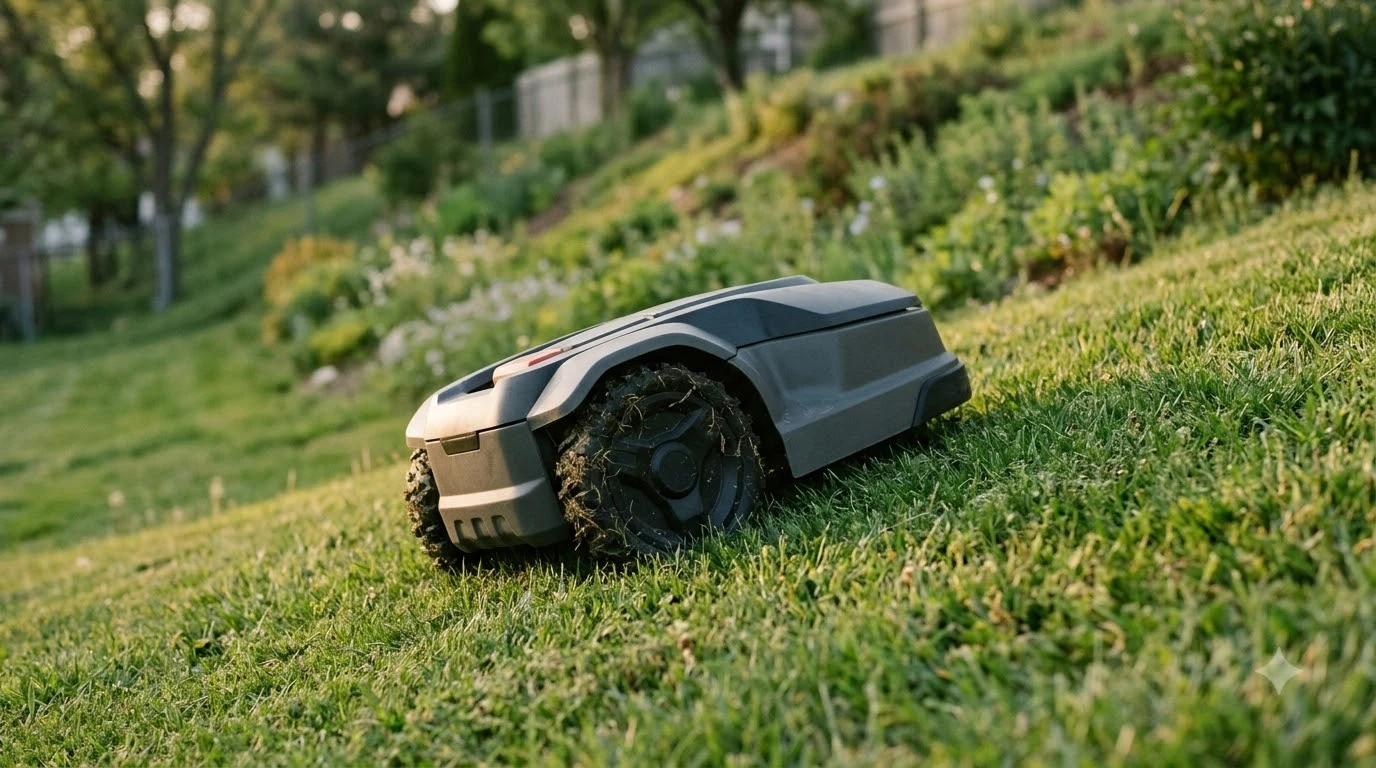

Do robot mowers slide on wet slopes? Yes. Wet grass and damp soil reduce wheel grip, so a mower can slip on a hill that sits inside its dry-ground rating. Husqvarna says steep slopes raise slipping risk, especially in wet conditions, so a wet slope should be treated as a tighter limit than the spec sheet suggests.
The short answer
- Can it slide? Yes. Eufy says wet grass reduces tyre grip even when the slope is within the rated limit.
- Is there a wet rating? Not in the manufacturer pages we read. The published slope limits describe dry, firm ground.
- How long to wait? Husqvarna advises at least 24 hours after rain before mowing, and longer after heavy rain.
- What helps? Clean the wheels, mow straight up the slope where possible, keep obstacles off steep ground, and use AWD or a tread designed for mud on steep, wet lawns.
Why do robot mowers slide on wet slopes?
A wet slope is harder for a robot mower because soft, saturated soil gives the wheels less to bite into, and wet grass offers less grip underfoot. Mammotion notes that soft ground can cause wheel slip, wheel marks and difficulty holding a planned path. Eufy’s slope guidance makes the same point from the traction side, adding that a mower can slide on damp turf even inside its rating.
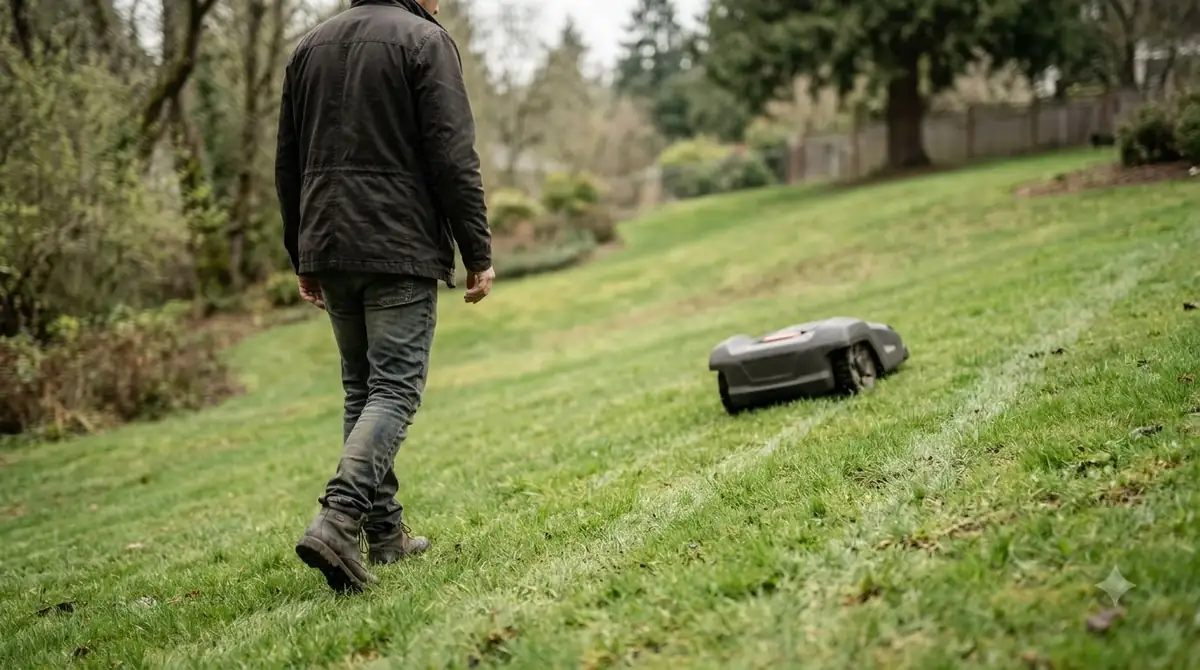
Our reading is that the risk is not just a loss of forward motion. When one drive wheel loses contact, the mower can stall, miss patches or stop partway up the slope. Honda’s guidance says losing wheel contact can cause missed areas, stalling or stopping, and that turning across a slope, mowing near edges and moving on wet grass are all more demanding than climbing straight up.
- Honda lists turning across a slope and mowing near edges as more demanding than climbing straight up.
- Honda also lists moving on wet grass as more demanding, which is why wet days need the most caution on the steepest sections.
- Eufy warns that running a mower at the top of its incline strains the motor and increases tyre slip.
Slope ratings assume dry, firm ground
A percent rating describes what a mower can climb in good conditions, and it is the starting point when you ask whether robot mowers slide on wet slopes. Husqvarna’s support page lists standard Automower models at 25 to 50 percent (14 to 26 degrees), with AWD models such as the 435X AWD reaching 70 percent (35 degrees). The same page separates the limit for the work area from the limit near the boundary wire, which is often lower. Those are dry-ground figures, and the page does not give a separate number for wet grass.
| Husqvarna model group | Max slope, work area | Max slope, near boundary |
|---|---|---|
| 305, 310, 315, 315X | 40% | 15% |
| 320 NERA, 430X NERA, 450X NERA | 50% | 25% |
| 435X AWD, 435X AWD NERA | 70% | 50% |
Percent and degrees are not the same scale. Our calculation, using the arctangent of the grade, gives about 14 degrees for 25 percent, 24 degrees for 45 percent and 35 degrees for 70 percent. For hand-mowing context, Iowa State Extension treats slopes of 20 percent or more as steep, and says turf on slopes around 30 percent or more is too steep to mow. That guidance is for people with push mowers, not robots, but it shows where a lawn starts to become a problem.
Drivetrain and wheels decide how much slip you get
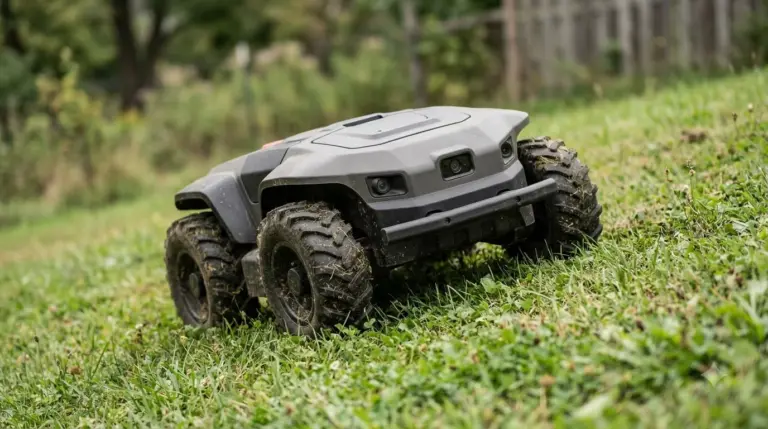
Drive layout matters more when a robot mower has to climb a wet hill than when the same hill is dry. The drive type is one of the main reasons some robot mowers slide on wet slopes while others hold their line. Mammotion says two-wheel-drive mowers can lose grip on slick inclines, spin in place and leave wheel-burn marks, and that they suit dry, firm, mostly flat lawns. Sunseeker’s comparison says front-wheel-drive mowers perform poorly on wet grass, while AWD gives the most consistent grip. Lymow adds that on a 2WD model the unpowered front wheels limit recovery when the rear wheels slip.
These are vendor claims, and each brand has a reason to favour its own drivetrain, so treat them as direction rather than measurement. Tread design is a separate factor. Honda says its HRM models use broad-tread rear wheels designed to shed mud and keep grip in wet conditions. Husqvarna says most of its models offer an optional Terrain Kit with heavy rear wheels and wheel brushes for better grip. Lymow gives a rough vendor estimate that wet conditions cut capability by about 20 to 30 percent, but it names no test method, so use it as a margin and not a rule.
Layout and obstacles that reduce slipping
Where you put the wire and the mowing pattern changes how often wheels lose contact. The steps below use Husqvarna’s advice and cover the points that apply to any brand.
- Clean the wheels. Husqvarna says slopes become harder to manage when wheels are clogged with grass, and recommends a soft brush or a water hose to keep them clear.
- Set the pattern straight up the slope. Husqvarna says this gives better traction and less grass wear, where the layout allows it.
- Check the wire direction for your model. Husqvarna’s steep-slope guide advises laying the guide wire diagonally across the slope for better traction and less grass wear. Wire layout depends on the model, so confirm the exact placement in the manual.
- Keep obstacles off steep ground. Husqvarna says obstacles on steep slopes increase slipping risk, especially in wet conditions. If the problem continues, it suggests a boundary wire island or a stay-out zone for that area.
When to keep the mower off a wet slope
Dry the lawn before mowing a steep section, and treat rain as the trigger for a wait. Husqvarna’s US guide advises waiting at least 24 hours after rain before mowing, and longer after heavy rain or on overcast days. Strong sun can dry a lawn within a few hours, so the 24-hour figure is a general guide rather than a fixed rule. Mammotion says there is no universal number of hours to wait, and that a fixed two-hour rule is less reliable.
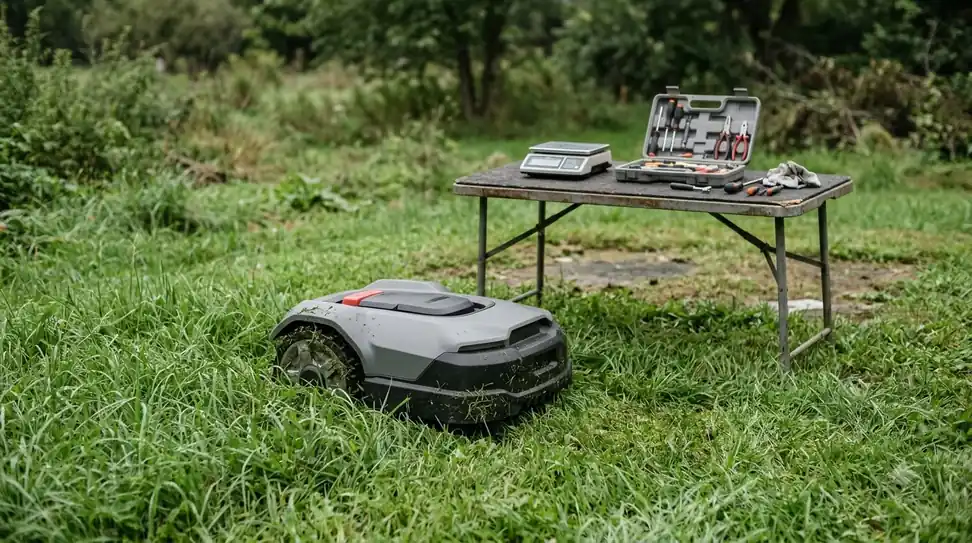
Two field checks help before you start the mower. The bounce test works like this: if the grass feels damp or clumps when you press on it, it is too wet to mow. The footprint test works like this: if footprints stay visible on the lawn, wait longer. Eufy also advises against bypassing a rain sensor except on a very flat lawn with excellent drainage, so a sloped yard should keep its rain delay active.
Frequently asked questions
Do robot mowers slide on wet slopes even if the slope is within their rating?
Yes. Eufy says wet grass reduces tyre grip even when the slope is within the rated limit, and that a mower can slide on damp turf.
Is there a wet-grass slope rating for robot mowers?
Not in the manufacturer pages we read. Husqvarna and Eufy publish dry-ground limits and warn that wet conditions increase the risk on steep ground.
Which drivetrain handles wet slopes best?
Vendors such as Mammotion and Sunseeker favour AWD for wet grass, and say 2WD models can lose grip on slick inclines. These are vendor claims, so check the drive type and slope specs for the exact model.
What should I do if my mower keeps slipping on a wet hill?
Stop mowing the slope until it dries, clean the wheels, and check the pattern and wire direction in the manual. Husqvarna suggests excluding a problem area with a boundary wire island or a stay-out zone if slipping continues.
Sources
- Husqvarna support: optimise an Automower installation for steep slopes (manufacturer): slope limits by model, wet-condition slipping risk, wire and pattern direction, wheel cleaning, Terrain Kit.
- Husqvarna: can you mow wet grass (manufacturer): 24-hour wait after rain, bounce and footprint tests.
- Eufy: robot lawn mower slope limits (manufacturer blog): wet grass reduces grip within the rating, rated maximum is a limit not a target.
- Honda: can robotic lawn mowers handle slopes (manufacturer blog): broad-tread wheels, turning and wet grass, loss of wheel contact.
- Mammotion: 2WD vs 4WD robot mower (manufacturer blog): 2WD slip on wet or soft ground.
- Sunseeker: FWD vs RWD vs AWD robot mowers (manufacturer blog): grip on wet grass by drivetrain.
- Lymow: robot mowers on hills, slope ratings and stuck prevention (manufacturer blog): 2WD recovery limits and a wet-condition estimate.
- Iowa State University Extension: gardening on slopes and hillsides (university extension): slope thresholds for mowing, hand-mowing context.
 Up next7 min readBy YardRobot Lawn Mower for 70 Percent Slope: What the Limit Really MeansUpdated Nov 11, 2026
 8 min readBy YardWill a Robot Mower Get Stuck on a Clay Soil Lawn That Stays Wet?Updated Nov 11, 2026
 7 min readBy YardRobot Mower Wet Grass: Can You Cut It and When to WaitUpdated Nov 11, 2026
 8 min readBy YardRobot Mower for a Clay Soil Lawn That Stays Wet: What to Look ForUpdated Nov 12, 2026
 9 min readBy YardRobot Mower for Hillside Lawn: Ratings and LimitsUpdated Nov 11, 2026
 9 min readBy YardCan a Robot Mower Cut Zoysia? Height and LimitsUpdated Nov 11, 2026