
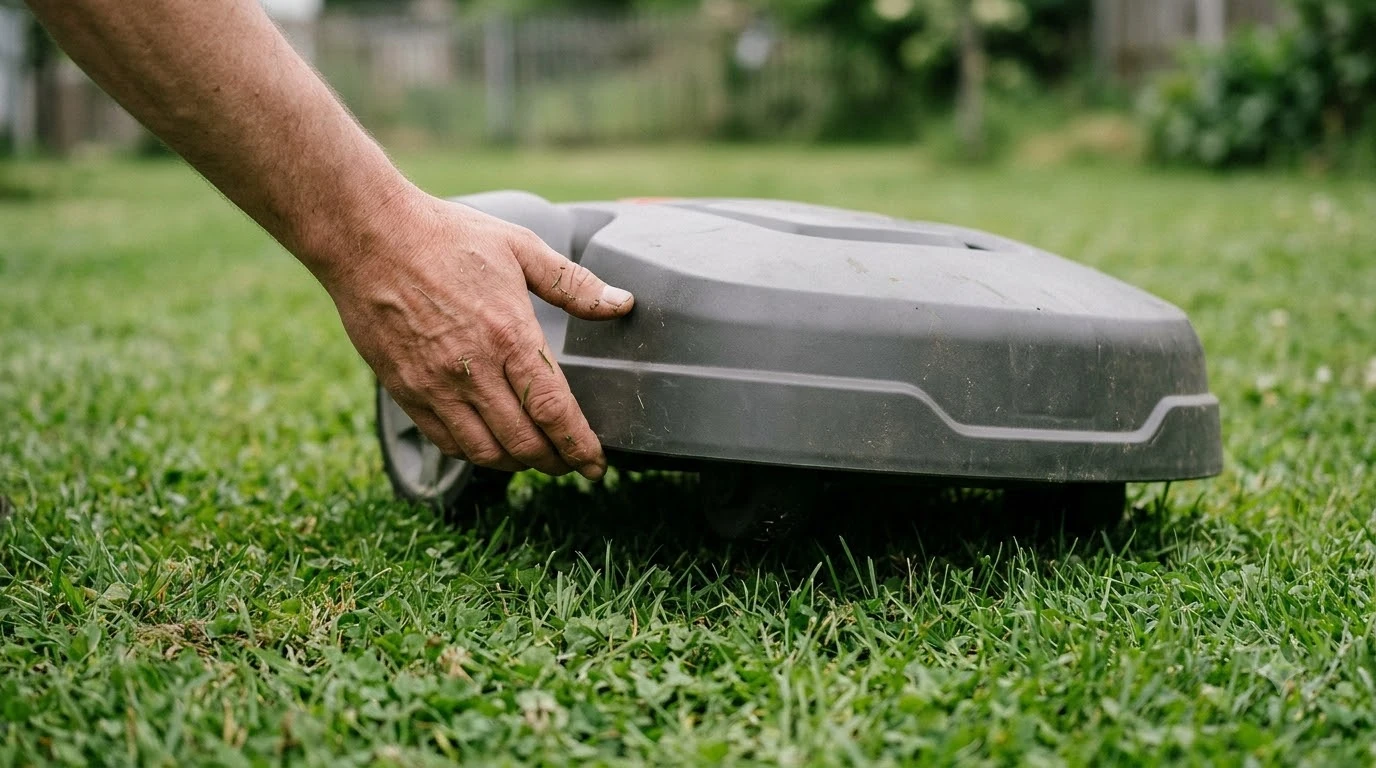

Is the Ecovacs GOAT A1600 RTK worth it? It can be, if your lawn fits its published limits. The official product page lists a slope limit of 50% (27°), a cutting height range of 3 to 9 cm and coverage of 500 m² per charge. The global page does not list cutting width, noise, battery capacity, runtime, weight or warranty (the Swedish page covers some of these, below), so those gaps matter before you spend money. As of 2026-11-10, we did not read a current price.
The short answer
- Worth a look for an open yard with a clear sky view, slopes up to 27° and a lawn near its per-charge coverage figure.
- Weaker fit under dense tree cover or beside tall walls, where RTK positioning can drop out.
- Not confirmed on the official page: cutting width, noise, battery capacity, runtime, weight, warranty and price.
- Check first: the exact model name, because Ecovacs sells more than one GOAT model.
What the official Ecovacs page says
The table lists the figures we could confirm on Ecovacs’ global product page for the GOAT A1600 RTK, read on 2026-11-10. The last column shows where a figure is a vendor claim or needs a closer look. Ecovacs publishes these numbers on its own site, so treat them as the manufacturer’s position, not an independent test.
| Spec | Ecovacs figure | Our note |
|---|---|---|
| Cutting height | 3 to 9 cm, adjusted in 1 cm steps in the app | Set from the phone app, not on the body |
| Maximum slope | 50% (27°) | Compare against your steepest section |
| Coverage | 500 m² per charge | Per-charge capacity, not total lawn size |
| Mowing rate | 400 m² per hour (footnote), plus a 500 m² in 2 hours claim | Two rates on one page; the footnote gives 400 m²/h |
| Navigation | LiDAR-enhanced RTK, up to 45 satellites, 2 cm positioning precision | Vendor claim, no test conditions shown |
| Obstacles | AI vision and 3D ToF LiDAR, 200+ obstacles including hedgehogs, crosses 4 cm | Vendor claim |
| Battery and charging | 32 V platform, recharge in 45 minutes with a 180 W charger | Battery capacity in Ah is not on the page |
| Boundary | No boundary wire, wire-free setup in about 15 minutes | Setup time is a vendor claim |
| Weather rating | IPX6 | The page does not explain what the rating covers in use |
| Blades | Dual blade discs, 3,000 rpm, 0.7 m/s | Speed figure from the same page |
Coverage: read the 500 m² figure carefully
Ecovacs lists 500 m² of coverage per charge and a mowing rate of 400 m² per hour. Per-charge capacity is not the same as the size of the lawn. A robot mower that returns to its base, charges and resumes can cover more ground than one charge allows, but the page we read does not say how the mower handles a large lawn in one day or whether it resumes on its own. Check the manual for that behavior before you size the purchase.
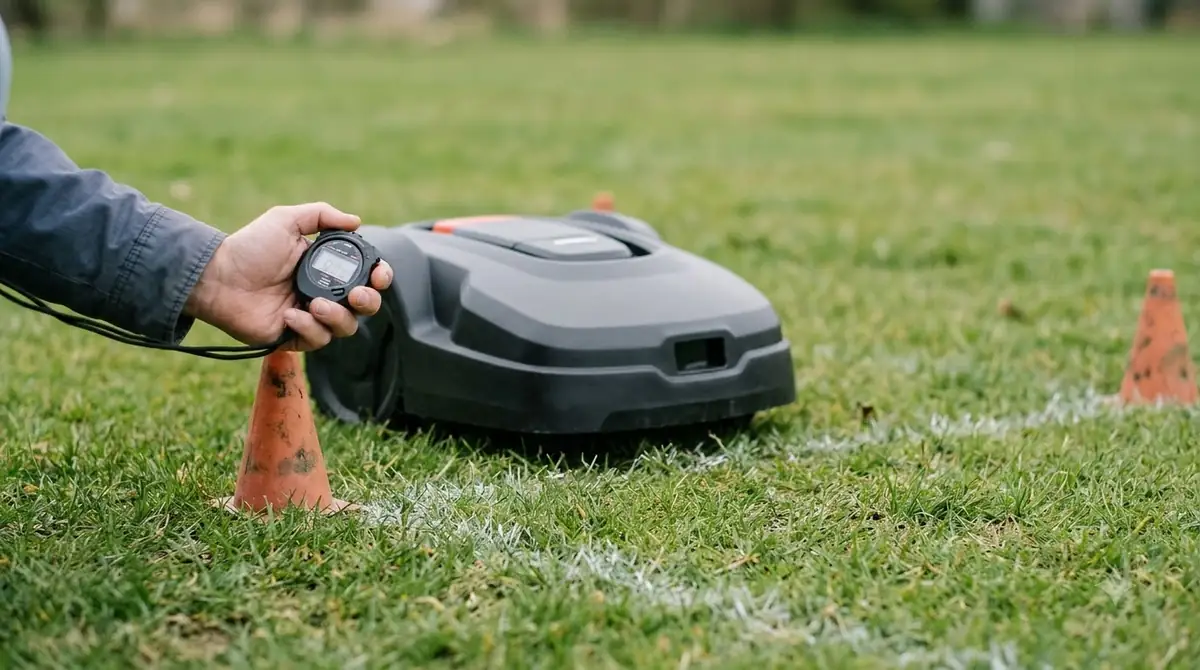
Our reading: before you decide whether the Ecovacs GOAT A1600 RTK is worth it for your lawn, measure the lawn first, then compare the total area with the per-charge figure and the mowing rate. A yard well above 500 m² needs a clear answer about recharging and resuming, and that answer should come from the manual or Ecovacs support, not from the per-charge number alone. The page also claims three times the mowing efficiency of the previous generation. That is a comparison against Ecovacs’ own older model, so it does not tell you how the A1600 compares with other brands.
Slope and cutting height in practice
The A1600 RTK is rated for slopes up to 50%, which the page converts to 27 degrees. Slope percent is rise over run, so 50% is a steep grade by most residential standards. Measure the steepest part of your lawn, not the average, and check that spot against the rating. A slope inside the rating is necessary but not enough, because wet grass and uneven ground can reduce traction. The page we read does not give a wet-grass limit, so check the manual.
The cutting height range of 3 to 9 cm is adjustable in 1 cm steps from the app. Look up the recommended mowing height for your grass species, since the right height depends on the grass, not the mower. If your lawn needs a height outside 3 to 9 cm, this model is not a fit.
Navigation: RTK, LiDAR and camera sensing
RTK positioning uses a base station that calculates satellite errors at a known spot and sends corrections to the mower, which can bring position accuracy to within a few centimeters. Ecovacs claims 2 cm positioning precision for the A1600 RTK, which is the figure that matters most when you ask whether the A1600 RTK is worth it for a shaded or open yard, and a different manufacturer states that RTK often reaches within 1 to 2 cm without giving test conditions. Both are vendor claims, and the real accuracy depends on the sky view at your yard.
The weak point is the sky. Mammotion’s own comparison notes that RTK degrades when satellite visibility is poor, under dense trees or near tall structures, and it also says that LiDAR does not rely on light and works in shade and under tree cover. Yarbo’s reliability article adds that RTK can drop out for a moment under cover and that the mower falls back to vision and odometry sensors. The A1600 uses LiDAR and 3D ToF sensing alongside RTK, which is the reason Ecovacs gives for its shaded-yard claim: a stability boost of up to 130% in shade, based on Ecovacs lab tests that the page does not describe in detail.
Our reading: a yard with open sky over most of the lawn is the best case for this model. A yard under a large oak or beside a two-story house needs a more careful look before you buy, and the 130% shade figure should be treated as a lab result, not a promise for your yard.
Installation: wire-free, but the base still matters
Ecovacs describes a wire-free setup in about 15 minutes. That claim covers the perimeter, not the base station. A typical suburban boundary-wire install takes about 2 to 5 hours according to one vendor blog and 4 to 8 hours according to an independent installation guide, so skipping the wire saves real time. An RTK base usually takes 1 to 2 hours to set up in total, according to MowerBot Lab’s installation guide.
Base placement is where setup time is spent. Mammotion’s RTK station guide says to keep the station at least 3 m from walls and trees, to avoid the corner of an L-shaped building, a narrow path between two structures and a spot under a tree, and to use a wall or roof for lawns with an O or U shape. The same principle applies to Ecovacs’ base, but check the manual for its exact placement rules.
What the page does not tell you
Several figures a buyer needs were not on the global Ecovacs page we read, so this section does not state them; the Swedish page supplies some, covered above. Search snippets listed some values that the official page does not confirm, and we left those out.
- Noise: no dBA figure on the page. Ask Ecovacs or check the manual before judging it against a quiet-hours rule.
- Cutting width: not stated, so compare decks only after you have the figure in writing.
- Battery capacity and runtime: the page gives a 32 V platform and a 45-minute recharge, but no Ah rating or runtime per charge.
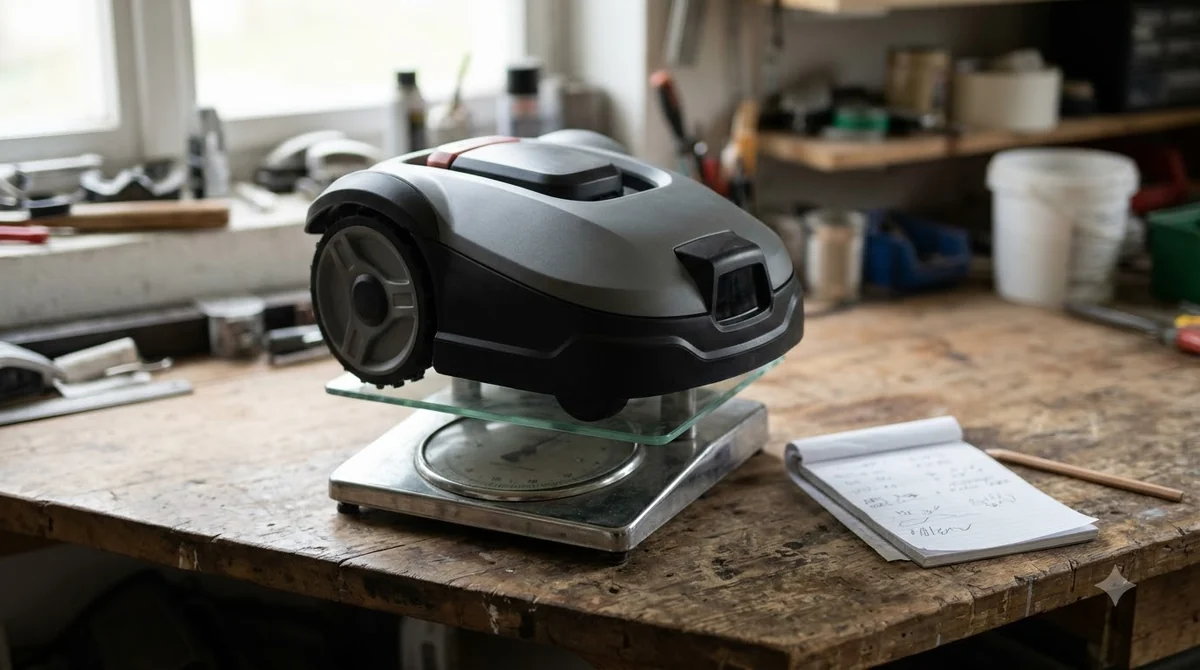
- Weight and dimensions: not on the page, which matters if you need to lift the mower to a storage spot.
- Warranty term: not on the page. Check the Ecovacs warranty page or the retailer before you buy.
- Price: not read in this review, so the value question cannot be answered in dollars from our side.
What the Swedish Ecovacs page adds, and where sources disagree
The global page leaves several figures blank, but Ecovacs’ Swedish product page for the same mower, read on 2026-11-11, lists more. It gives a 33 cm cutting width, a 3000 mAh (3 A) Li-ion battery, an IPX6 rating for the mower and IPX4 for the charging station, and a net weight of 15.8 kg (gross 26.2 kg). The mower measures 680 × 460 × 310 mm, and Ecovacs says it cuts up to 5 cm from walls, fences and hedges. Neither page prints a runtime or a warranty length. The Swedish page only links to a warranty section.
Some sources conflict, and the manufacturer pages are the ones we rely on. Retailer listings in search results showed up to 1,600 m², a 30 to 60 mm cutting height and a 2- or 3-year warranty. We did not confirm those on a page we read, so this article does not use them. Some regional Ecovacs sites also list a GOAT A1600 LiDAR PRO, so confirm the exact model code before you compare specs. The Swedish page says no boundary wire or navigation beacon is required, yet it also references a beacon accessory, so check what is in the box.
Ecovacs GOAT A1600 RTK pros and cons at a glance
Here is how the sourced figures line up on paper, with every number coming from Ecovacs or the UF/IFAS extension.
| On paper, a plus | Gap or caution |
|---|---|
| Up to 500 m² per charge, with a 45-minute recharge at 180 W | No runtime figure, so the 500 m² claim cannot be checked against the 3000 mAh battery |
| 50% (27°) slope limit | Manufacturer figure only, with no wet-grass limit on the pages we read |
| 3 to 9 cm height in 1 cm steps, and edge cutting up to 5 cm from walls | The 9 cm top setting is about 3.5 inches, the lower half of the 3 to 4 inch average UF/IFAS cites for warm-season grasses |
| IPX6 rating for the mower | The charging station is only IPX4. UF/IFAS advises grounding docks or using surge protection against lightning, and treating for fire ants near a dock |
| 2 cm positioning precision, up to 45 satellites, 200+ obstacle types | Vendor claims with no independent test data, and RTK still depends on sky view |
| 33 cm cutting width | The 15.8 kg net weight is about 35 lb, a noticeable lift for storage or a car trunk |
Is the Ecovacs GOAT A1600 RTK worth it for your yard?
Our reading: the question “is the Ecovacs GOAT A1600 RTK worth it” has a yes-or-no answer only for a specific lawn. The A1600 RTK fits an open suburban yard that stays inside its slope rating and has a clear sky view for the base. It fits less well on a shaded or heavily treed lot, or on a yard that needs a published noise or warranty figure before purchase.
- Likely a fit: open lawn, steepest section at or under 27°, lawn size you can match against the per-charge and per-hour figures, and a base spot at least 3 m from walls and trees.
- Reconsider: canopy over much of the lawn, tall walls on the edge, a slope steeper than 27°, or a height requirement outside 3 to 9 cm.
- Pass for now: any buyer who needs noise, width or warranty numbers in writing and cannot get them from Ecovacs.

Before you buy: a checklist
Use this checklist to test whether the Ecovacs GOAT A1600 RTK is worth it before you pay, not after the base is in the ground.
- Confirm the model name. Match the box, the app listing and the product page to the GOAT A1600 RTK before you compare figures.
- Measure the lawn and the steepest slope. Compare the total area with the coverage figures, and the steepest section with 27°.
- Check the sky view at the base spot. Walk the planned spot and look for trees and walls within 3 m.
- Get the missing numbers in writing. Ask for noise, cutting width, battery capacity and warranty term before you pay.
- Compare the full kit price on the day you buy. Include the base station, charging station and any accessories in the total.
Frequently asked questions
Can the GOAT A1600 RTK handle a 40% slope?
On paper, yes. The official page lists a maximum slope of 50% (27°), so a 40% section falls inside that rating. Check the manual for wet-grass limits, because the page we read does not give one.
Does the Ecovacs GOAT A1600 RTK need a boundary wire?
The official page says no boundary wire is needed and gives a wire-free setup time of about 15 minutes. That is a vendor claim. You still need to place and set up the RTK base, which usually takes longer than the perimeter step.
How much lawn can it cover?
The official page lists 500 m² of coverage per charge and 400 m² per hour of mowing. Those figures measure capacity, not total lawn size. Confirm in the manual how the mower handles recharging and resuming on a large lawn.
Is it quieter than other robot mowers?
We cannot say from the page we read, because it gives no noise figure. Ask Ecovacs for a dBA rating, and compare it with other models only when both figures come from the same test method.
What are the GOAT A1600 RTK cutting width and weight?
The Ecovacs Swedish page lists a 33 cm cutting width and a net weight of 15.8 kg (gross 26.2 kg). The global page does not list either, so check which regional page you are reading.
Sources
- Ecovacs GOAT A1600 RTK product page (manufacturer): slope, height, coverage, navigation, battery and charging, and the claims in the spec table.
- Mammotion support: how to install an RTK reference station (manufacturer): 3 m clearance from walls and trees and locations to avoid.
- Mammotion: AI vision vs RTK vs LiDAR (manufacturer blog): RTK limits under trees and near tall structures, and LiDAR performance in shade.
- Yarbo: can you trust an RTK robot mower (manufacturer blog): RTK drop-outs under cover and the sensor fallback.
- Ecovacs GOAT A1600 RTK product page (Swedish) (manufacturer): cutting width, battery, IP ratings, weight, dimensions, edge cutting and warranty link.
- Robot mowers, UF News (University of Florida IFAS): cutting height guidance and dock advice.
- Lymow: robot mower setup time, wire vs wireless (manufacturer blog): typical boundary-wire installation time.
 Up next8 min readReviews & CompareEcovacs GOAT O1000 RTK vs Ecovacs GOAT A1600 RTK: What the Specs ShowUpdated Nov 11, 2026
 7 min readReviews & CompareEcovacs GOAT A1600 RTK vs Dreame A1 Pro: Sourced Spec ComparisonUpdated Nov 11, 2026
 7 min readReviews & CompareEcovacs GOAT A1600 RTK Review: Published Specs and GapsUpdated Nov 17, 2026
 9 min readReviews & CompareMammotion Luba 3 AWD vs Ecovacs GOAT A1600 RTK: Which Fits Your Lawn?Updated Nov 11, 2026
 9 min readReviews & CompareEcovacs GOAT A1600 RTK Problems and Complaints: Known Issues and GapsUpdated Nov 14, 2026
 9 min readReviews & CompareEcovacs GOAT O1000 RTK Review: What the Published Specs SayUpdated Nov 11, 2026