
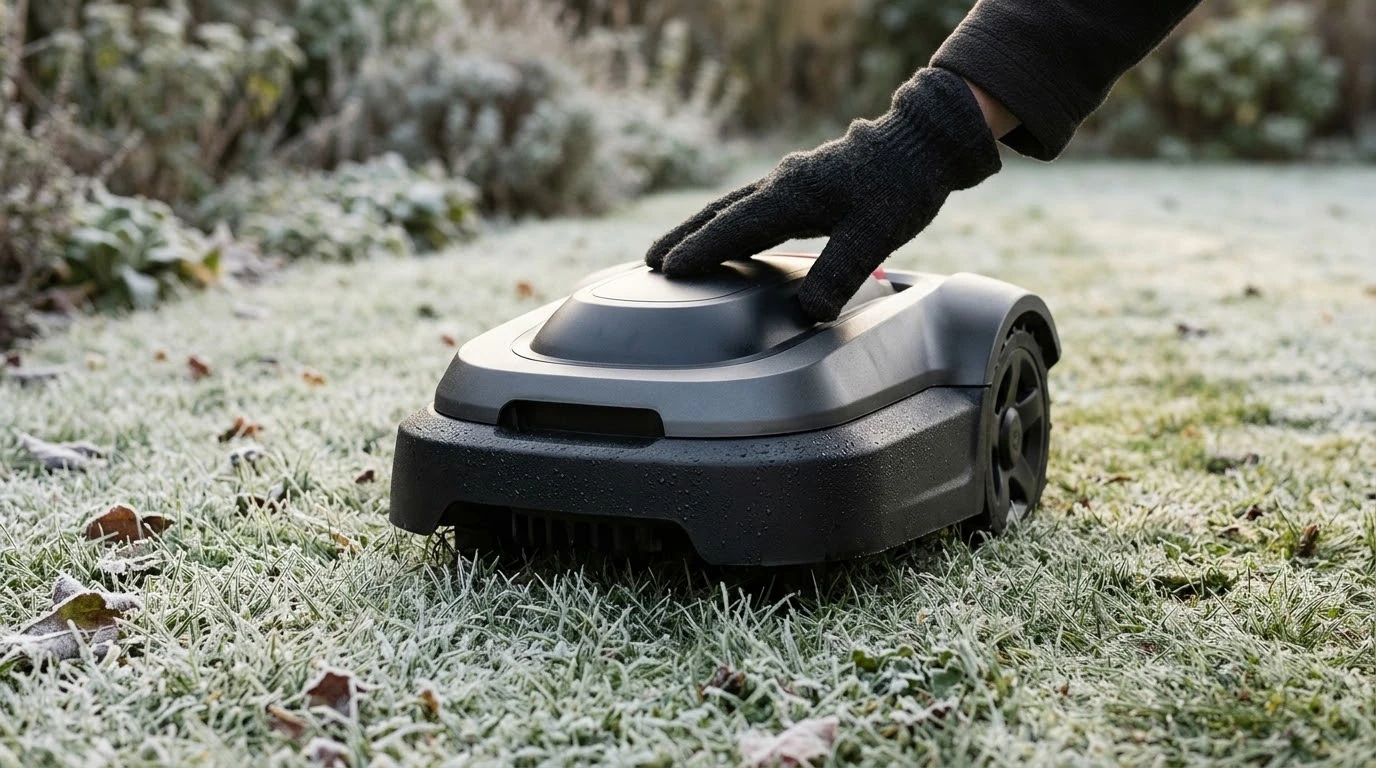

A robot mower for a snowy region needs a model whose temperature limits, frost settings and storage plan fit a winter season. Husqvarna’s Automower documentation lists an operating range of 0 to 50 °C (32 to 122 °F) and says the mower will not start outside it, so the cold limit comes before any mowing spec. The sources below cover what to check, and where they are silent.
The short answer
- Operating floor: Husqvarna’s operating range starts at 0 °C (32 °F), as of Nov 2026.
- Charging floor: Husqvarna’s charging range is 0 to 45 °C (32 to 113 °F), a narrower band than operation.
- Frost rule: Husqvarna’s Frost Guard parks the mower at 5 °C (41 °F) or below.
- Snow: the manufacturer pages we read give no snow-depth limit for robot mowers.
- Storage: bring the mower indoors to a dry place above freezing, then charge it before storing.
Check the temperature limits before the mowing specs
For a robot mower for a snowy region, the first number to find is the operating range in the manual, because it decides how much of the year the mower can run at all. Husqvarna’s support article gives 0 to 50 °C (32 to 122 °F) for operation and storage, and says the mower will not start outside that range. The same page puts charging at 0 to 45 °C (32 to 113 °F) and advises putting the charging station somewhere protected from the sun to avoid overheating. Husqvarna’s temperature guidance is the clearest published set of these figures that we found.
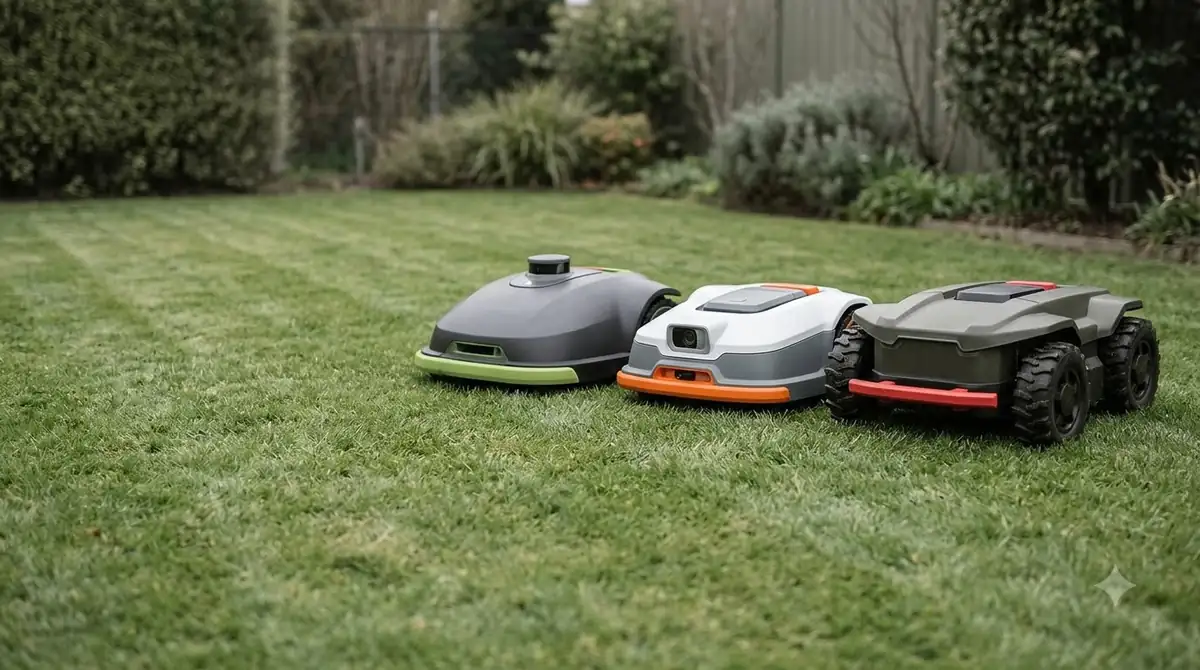
Growth matters as much as the limit. The same Husqvarna page says mowing is usually unnecessary below about 8 °C (40 °F), when grass more or less stops growing, though Husqvarna says the threshold may vary with grass type. Our reading is that in a snowy region the active mowing season is shorter than the calendar suggests, because the grass stops growing well before the first hard freeze. The page also warns that grass is extra sensitive to wear when the lawn is covered with frost.
Heads up
The operating and charging ranges are different numbers. A mower can be in operating range on a day when charging is not allowed, so check both lines in your model’s manual.
Frost protection for a robot mower for a snowy region
Husqvarna’s Frost Guard keeps the mower parked when the temperature is 5 °C (41 °F) or below at the scheduled start. The option you can use depends on the model. Models with a built-in temperature sensor use the sensor setting, while connected models without a sensor use the Smart Routine, which parks the mower when the weather forecast predicts temperatures below 5 °C (41 °F). The Frost Guard support page sets out both options.
The two options behave differently, and the difference matters in a snowy region. With the sensor setting, the mower delays its start by one hour if the temperature is at or below 5 °C (41 °F) when it is due to start. While parked, it rechecks every hour and starts only once the temperature is above 5 °C (41 °F). The sensor sits inside the chassis, so its reading can differ slightly from the air temperature. The Smart Routine depends on a forecast, which may not match the actual ground conditions. The page gives no fixed delay for the Smart Routine.
What the manufacturer sources say about snow and ice
The manufacturer pages we read give no snow-depth limit for a robot mower, and Husqvarna’s frost and winter pages do not mention snow at all. The most direct snow guidance comes from Mammotion’s Canadian maintenance blog, which tells owners to avoid exposing batteries to snow, ice or damp floors. It also says the mower should be reactivated only after all the snow has melted and the ground is no longer frozen.
The same Mammotion article says the right time to stop mowing in autumn depends more on climate than on the calendar, and its advice is to stop slightly early rather than risk frozen ground or hidden frost. It says that stopping too late increases the risk of frost damage, soil compaction and drive system wear. It gives no specific date or temperature for stopping, so treat that as a principle, not a rule. Our reading is that snow cover and frozen ground are the practical limits to watch, even when no manufacturer publishes a snow depth.
Charging in freezing weather
Charging is the cold-weather rule most likely to damage a battery. Mammotion’s Canadian blog says never to charge batteries in freezing conditions, and that lithium-ion batteries must never be charged below freezing. It also says sub-zero exposure can permanently damage a lithium-ion battery, and that anything below 0 °C is generally unsafe for long-term storage. Husqvarna’s charging range of 0 to 45 °C (32 to 113 °F) gives the same floor from a different source. If a mower seems to lose charge quickly in the cold, see why a robot mower battery drains fast.
Charge level before storage is where the sources disagree. Mammotion’s US support page says to charge the robot to at least 80% before storing it. The Canadian blog, for a removable battery, says to charge to 40 to 60% and to avoid storing the battery fully charged or fully drained. Both are manufacturer pages, so the practical step is to follow the guide for the exact model and region you own, not to pick one number from a search result.
Heads up
The two Mammotion sources give different storage charge levels. Use the manual that came with your model, and check the regional guide if you bought outside the US.
Boundary wire, charging station and power supply
Husqvarna’s winter storage guide says boundary and guide wires stay in the ground through winter, so the wire layout does not need to be dug up each year. If the charging station stays outdoors, the guide says to keep it connected to mains power and keep the wires connected. It also says to label wires and organise connectors, and to check the charging contacts on the mower and station for corrosion or debris.
If the charging station must stay outdoors, Husqvarna says to keep it connected to mains power and keep the wires connected. For storage, it says to disconnect the power supply and keep it in a dry, frost-free location. For models in the NERA series, only the top of the charging station comes indoors, and the baseplate can stay outside. The EPOS reference station is weatherproof and can stay outdoors year-round, with a storage range of -20 to 70 °C (-4 to 158 °F). Our reading is that a snowy yard needs a power route that stays dry, because the power supply is the part to bring in or keep out of freezing weather.
Where to store the mower through the snow season
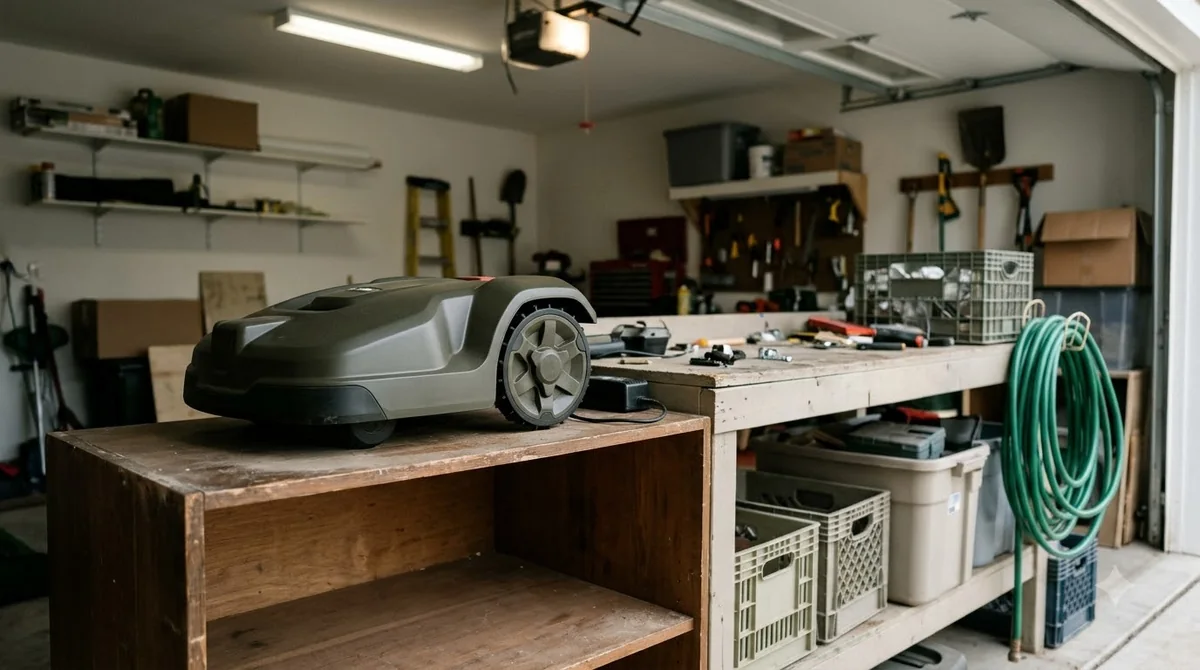
A robot mower for a snowy region usually goes indoors when the weather turns cold, and the two main manufacturers set different triggers. Husqvarna’s winter guide asks for a dry environment with temperatures above freezing (above 0 °C or 32 °F). Mammotion’s US support page gives a storage range of -10 to 40 °C (14 to 104 °F) and says to move the mower indoors once the outdoor temperature drops below -10 °C (14 °F). The table compares the figures from each page.
| Source | Storage temperature | Move indoors when | Charge before storage |
|---|---|---|---|
| Husqvarna Automower (winter storage guide) | 0 to 50 °C (32 to 122 °F) | Dry place above freezing (above 0 °C / 32 °F) | Fully charge and switch off; most models need no charging in storage |
| Mammotion (US winter storage page) | -10 to 40 °C (14 to 104 °F) | Outdoor temperature below -10 °C (14 °F) | At least 80% |
| Mammotion (Canadian winter guide) | The blog gives an ideal range that is not consistent within the article; check your manual | Below 0 °C is generally unsafe for long-term storage | 40 to 60% for a removable battery |
The table shows why the storage question has more than one answer. Husqvarna’s threshold is simply above freezing, while Mammotion’s US page allows storage down to -10 °C (14 °F). Our reading is that the safer approach in a snowy region is the stricter line: store indoors above freezing, which is the Husqvarna requirement, and do not rely on a storage range that goes below zero. The question comes up often enough to have its own answer on whether a robot mower can stay outside in winter.
What to check in a robot mower for a snowy region
Before buying a robot mower for a snowy region, check the operating and charging ranges in the manual, because those set the start and end of the season. Confirm which frost settings the model supports, and whether it has a built-in temperature sensor. Read the winter storage guide for the model, and check whether the charging station can stay outside with its power supply in a frost-free place. For the indoor spot itself, compare a robot mower storage shelf for a garage or a garage for a Mammotion Luba.
- Operating and charging temperature ranges, from the manual
- Frost protection: built-in sensor or forecast-based Smart Routine
- Storage temperature and the outdoor temperature that triggers moving indoors
- Battery charge level before storage, and whether the battery is removable
- Whether the charging station and power supply can stay outdoors
- Boundary wire route, and whether it stays in the ground through winter
Frequently asked questions
Can a robot mower work in snow?
The manufacturer pages we read give no snow-depth limit for robot mowers. Mammotion’s Canadian guide says to keep batteries away from snow, ice and damp floors, and to reactivate the mower only after the snow has melted and the ground is no longer frozen. Check the manual for your model before running it in snow.
Does Frost Guard stop the mower when it snows?
Frost Guard works on temperature, not snow. It parks the mower when the temperature is 5 °C (41 °F) or below at the scheduled start, and the Husqvarna Frost Guard page does not mention snow. A cold day with snow on the ground can still meet the temperature rule, so check the setting for your model.
Should I bring the robot mower indoors for winter?
Yes, the winter guides point that way. Husqvarna asks for a dry place above freezing, and Mammotion’s US page says to move the mower indoors once the outdoor temperature falls below -10 °C (14 °F). Store it indoors if you are unsure, because the stricter line protects the battery and drive system.
Do all robot mower brands have the same winter limits?
No. The sources we read give different figures for storage temperature and for the charge level to hold before storage. Husqvarna and Mammotion publish different storage ranges, and Mammotion’s US and Canadian pages differ on the charge level. Use the manual and regional guide for your exact model.
Sources
- At what temperature can I use, charge and store my Automower (Husqvarna): operating, charging and storage ranges, mowing threshold near 8 °C (40 °F).
- Protect your lawn with Automower Frost Guard options (Husqvarna): 5 °C (41 °F) threshold, one-hour delay, sensor and Smart Routine models.
- Complete winter storage guide for your Automower (Husqvarna): indoor storage above freezing, charge before storage, boundary wire and charging station care.
- Winter storage (Mammotion support): storage range -10 to 40 °C (14 to 104 °F), move indoors below -10 °C (14 °F), charge to at least 80%.
- Robot lawn mower winter maintenance guide (Mammotion Canada blog): snow and ice exposure of batteries, charging below freezing, reactivation after snowmelt, frost damage from late mowing.
 Up next9 min readBy YardCan a Robot Mower Cut Warm Season Grass? Heights and LimitsUpdated Nov 11, 2026
 7 min readBy YardRobot Lawn Mower for 70 Percent Slope: What the Limit Really MeansUpdated Nov 11, 2026
 8 min readBy YardCan a Robot Mower Cut Centipede Grass? Heights and LimitsUpdated Nov 11, 2026
 9 min readBy YardRobot Mower for a Sloped Front Yard: Limits, Edges and SetupUpdated Nov 11, 2026
 9 min readBy YardCan a Robot Mower Cut Zoysia? Height and LimitsUpdated Nov 11, 2026
 9 min readBy YardRobot Mower for Hillside Lawn: Ratings and LimitsUpdated Nov 11, 2026