
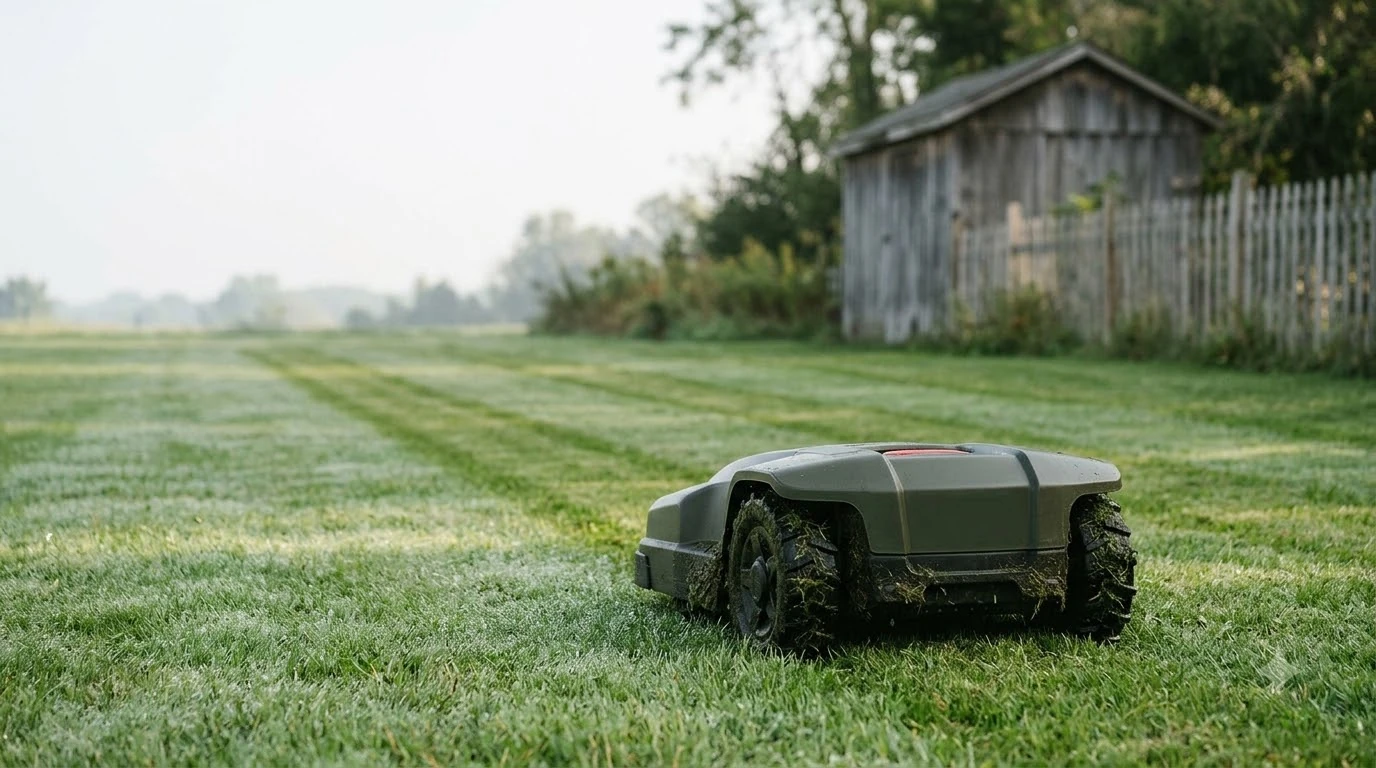

Anthbot vs Navimow does not have a single winner. Among the models whose listings we could read, the Navimow i206 AWD lists the steepest slope and a 0.15 acre rated area, the Navimow i105N lists a smaller area and a 30% slope, and the ANTHBOT Genie 600 has a rated area that the sources state inconsistently. The figures below come from published listings, reviewer pages and the manufacturer spec page. We did not test any of these mowers ourselves, and where the sources disagree we say so.
The short answer
- Area: Navimow i206 AWD about 0.15 acre (607 m²) and i105N about 0.13 acre (506 m²) on listed figures; the Genie 600 is listed at either about 600 m² or 900 m² depending on the source.
- Slope: i206 AWD 45% (about 24 degrees); i105N 30%; we could not confirm a slope figure for the Genie 600 on a page we could read.
- Navigation: all three are wire-free and use RTK with vision or cameras.
- Battery: the Navimow models list 2.55 Ah and 60 minutes of runtime; the Genie 600 buying-guide listing gives 2,500 mAh.
- Warranty: the Navimow i105N review cites 3 years; the sources we read do not state a warranty term for the i206 AWD, and the ANTHBOT banner we saw is not tied to a model.
Anthbot vs Navimow rated lawn area: three numbers that do not line up
Rated area is the first figure most buyers compare when they weigh anthbot vs navimow, and it is the one the sources disagree on most. Because the Navimow pages list one clear number each, the gap is mainly on the ANTHBOT side.
| Model | Listed rated area | Where it appears |
|---|---|---|
| Navimow i105N | 0.13 acre (506 m²) | SmartHomeCompared spec table |
| Navimow i206 AWD | 0.15 acre (607 m²) | SmartHomeCompared spec table |
| ANTHBOT Genie 600 | About 600 m² (0.22 acre) | Electrek review of the Genie line |
| ANTHBOT Genie 600E | 900 m² (0.22 acre) | ANTHBOT EU buying guide |
The Genie figures do not agree with each other (our ANTHBOT Genie review covers the line more broadly). Electrek gives about 600 m² and also 0.22 acre, but 0.22 acre is about 890 m², so the two numbers in that article do not match. The EU buying guide lists the 600E at 900 m². Until the ANTHBOT product page can be read, we would treat the Genie 600 area as somewhere between 600 and 900 m² and check the exact model name on the box or in the app before you compare it with a lawn size.
Slope and drive: AWD against rear-wheel drive
Slope decides whether a mower can handle a bank or a long hill, and drive layout is part of that answer. In an anthbot vs navimow comparison, this is the spec that most often changes the choice for a sloped yard.
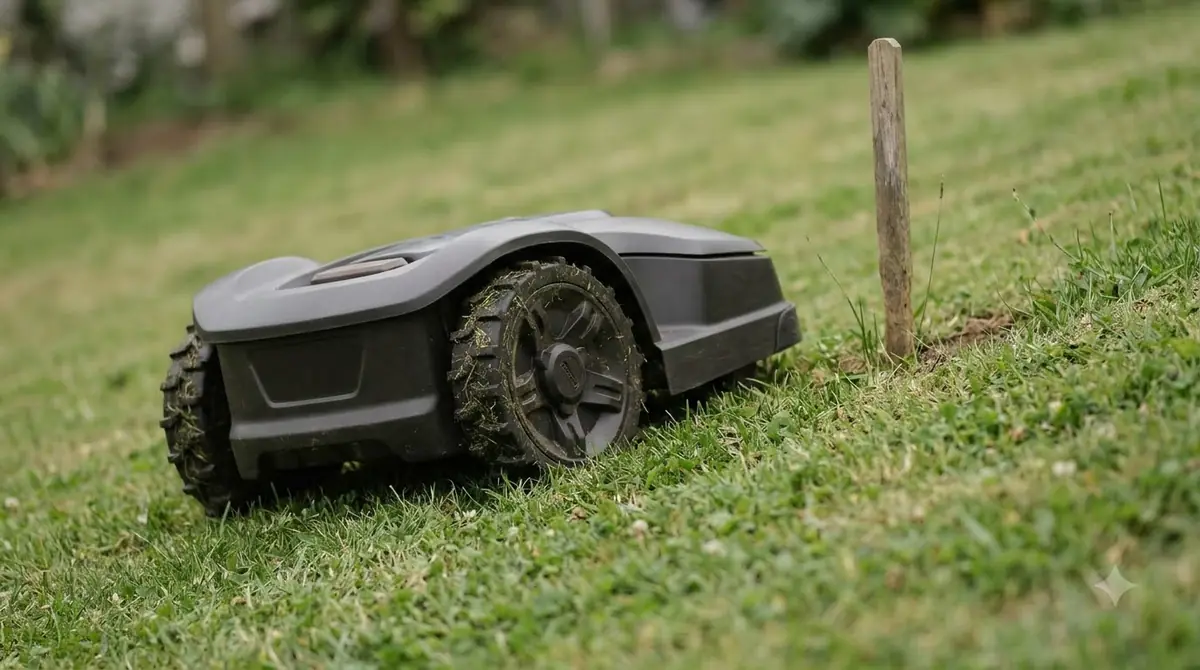
The Navimow i206 AWD, covered in our Navimow i206 AWD review, is listed with all-wheel drive (3WD, with a third on-demand wheel) and a 45% limit, roughly 24 degrees, on dry grass with no obstacles. The Navimow i105N (see our Segway Navimow i105N review) is listed as rear-wheel drive with a 30% limit and no degree value. The official Navimow i-series page lists 45% (24 degrees) for its i2 AWD series, which matches the i206 figure, but it does not show the i206 or i105N rows, so we rely on the listing for those two models.
That gap matters more than it first appears. A 30% grade is roughly 17 degrees and a 45% grade is roughly 24 degrees, so a yard with a bank close to 30% would leave little margin on the i105N.
We could not open the ANTHBOT product page, so we list the Genie 600 slope as unconfirmed and do not repeat figures from search snippets. For a yard with a steep bank, the gap between 30% and 45% is large in practice, and it is worth measuring the slope of your own lawn before you decide on an anthbot vs navimow pairing.
Cutting height and cutting width
The two Navimow models share the same cutting range: 2 to 3.6 inches (51 to 91 mm), set manually on the mower, with a 7.1 inch (18 cm) cutting width. The Genie height range is different in the source we read. Electrek lists an electric deck adjustable from 30 to 70 mm (1.25 to 2.75 inches) and states that this is a shared spec across the Genie line. That review is about the Genie 3000, so the figure is a line-wide claim rather than a value confirmed for the 600.
In practice, the Navimow range sits higher and narrower, while the Genie range reaches lower. Which one is better depends on how short you want the grass and whether the mower’s height adjustment is manual or electric, which is a convenience point more than a cut-quality point.
Navigation: RTK and camera on all three, no boundary wire
All three mowers in this comparison are wire-free, so none needs a buried perimeter wire. The Navimow i105N and i206 AWD both use RTK positioning with a vision system, which the listings call EFLS. Neither lists LiDAR. The Genie 600 is described as using full-band RTK GPS plus four AI-driven cameras, but that description comes from a line-wide review, not from a Genie 600 spec sheet.
Since all three are described as using satellite positioning (see what RTK stands for on a robot mower), open sky matters more than the brand. Our reading is that trees, a wall or a garage close to the lawn can reduce RTK accuracy for any of them, so this is a setup check you should do on your own property, not a reason to prefer one model.
Battery, runtime and charging
The two Navimow models list the same 2.55 Ah battery and 60 minutes of runtime per charge. The i105N lists a 90 minute charge time, while the i206 AWD lists 60 minutes. The Genie 600 buying-guide listing gives 2,500 mAh for the 600E, and the sources we read do not give a runtime or charge time for the Genie 600 specifically.
A 60 minute runtime is a short cycle, so a larger lawn depends on the mower returning to its dock and resuming. The rated area is therefore the more useful planning figure, and it is the one the sources disagree on for the Genie.
Warranty: what the sources state
The Navimow i105N review cites a 3 year warranty, though that figure appears in the pros list rather than the spec table.
The i206 AWD listing we read does not state a warranty term. For the Genie 600, where our ANTHBOT Genie warranty guide goes deeper, the ANTHBOT EU buying guide shows a 3-year warranty banner that is not tied to a specific model. We did not read a warranty policy page for either brand, so ask the seller for the written terms before you buy. Warranty terms can also differ by country and reseller, so a buyer in the United States should check the seller’s own policy page as well as the brand’s.
Who each mower suits (our reading)
For an anthbot vs navimow decision, our reading of the listed figures is that the Navimow i206 AWD fits a yard that needs more slope and traction, the i105N fits a smaller, gentler lawn where the listed area is enough, and the Genie 600 suits buyers who want a larger rated area and are willing to confirm the exact model and warranty first. This is a judgment from the numbers, not from field use, and the right choice still depends on your lawn’s size, slope and sky view.

What to check before you buy
Treat every figure in this article as a listed value, not a measured one. Product pages change, and the number on the seller’s page at checkout is the one you will be held to. The steps below are the checks that matter most when you compare anthbot vs navimow for your own yard.
- Confirm the exact model name. Genie 600 and 600E are sold under different area figures, and the i105N and i206 AWD have regional suffixes.
- Measure your lawn and its steepest slope. Compare the area with the rated figure, then compare the slope with the listed limit.
- Check the sky view. RTK needs open sky. Note trees and walls that cover the lawn.
- Ask for the written warranty. Get the term in writing for the exact model you are buying.
Frequently asked questions
Anthbot vs Navimow: which is better?
In an anthbot vs navimow choice, neither is better on the figures we could read. The Navimow i206 AWD lists a 45% slope and 0.15 acre, and the Genie 600 area is listed inconsistently.
Do any of these mowers need a boundary wire?
No. In this anthbot vs navimow pairing, all three are described as wire-free and rely on RTK positioning with vision or cameras.
Which has the steeper slope limit?
The Navimow i206 AWD lists 45% (about 24 degrees). The i105N lists 30%. We could not confirm a Genie 600 slope figure on a page we could read.
How big a lawn can the Genie 600 cover?
The sources disagree, with figures between about 600 and 900 m². Check the exact model and the rated area in its written specifications before you buy.
Sources
- SmartHomeCompared, Navimow i105N (aggregator): rated area, slope, cutting range, battery, runtime, drive type, warranty in pros.
- SmartHomeCompared, Navimow i206 AWD (aggregator): rated area, 45% slope, cutting range, navigation, drive type, charge time.
- Segway Navimow i-series specifications (manufacturer): i2 AWD and i2 LiDAR series slope 45% (24 degrees), i2 LiDAR Pro 55%.
- Electrek, Anthbot Genie 3000 review: Genie line rated area (about 600 m²), 30 to 70 mm cutting range, RTK and camera navigation.
 Up next8 min readReviews & CompareNavimow i206 AWD Review: Specs, Slope and Who It SuitsUpdated Nov 16, 2026
 8 min readReviews & CompareNavimow i206 AWD vs i210 AWD: Which Model Fits Your YardUpdated Nov 16, 2026
 8 min readReviews & CompareDreame A1 Pro vs Mammotion LUBA 3 AWD: Listed Specs ComparedUpdated Nov 13, 2026
 7 min readReviews & CompareAnthbot Genie Alternatives: What the Specs ShowUpdated Nov 15, 2026
 8 min readReviews & CompareAnthbot M5 vs Anthbot Genie: Smart Spec ComparisonUpdated Nov 14, 2026
 7 min readReviews & CompareAnthbot Genie vs eufy E15: Specs ComparedUpdated Nov 11, 2026