
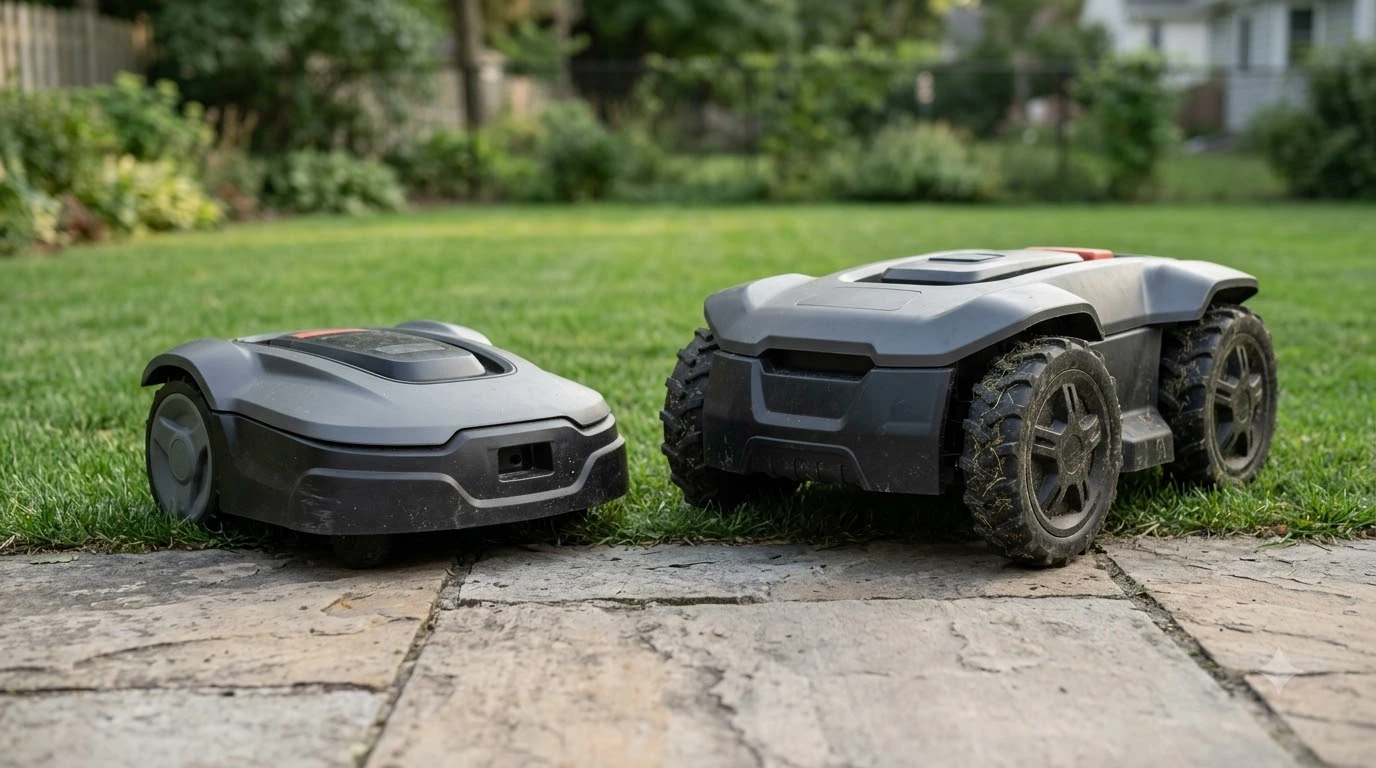

The best robot lawn mower for townhouses is the one that fits a narrow, often irregular yard, not the one with the largest acreage rating. Small lots fail for different reasons than big ones, so passage width, boundary type, slope, noise, and your association’s rules matter more than the headline coverage number, as of November 2026.
The short answer
- Size: Mammotion places lawns up to 500 m² (about 5,380 sq ft), including townhouse yards, in its entry-level band.
- Passage: Husqvarna recommends at least 2 m (6 ft 6 in) between boundary wires for a passage without a guide wire.
- Boundary: wire-free navigation is easier to change later, while a buried wire needs installation and is hard to move.
- Noise: the Ecovacs GOAT spec pages list 57 to 61 dBA for the main body, and some pages list no dB figure at all.
- Rules: your association’s governing documents come before any purchase.
Narrow passages matter more than lot area
A townhouse yard is judged by its narrowest passage, not its total area, because the mower has to pass through that gap to reach the rest of the lawn. The gap between your grass and a fence, wall, or shared side path often decides fit before size does.
According to Husqvarna’s passage guidance, the recommended minimum distance between boundary wires on each side of a passage is 2 m (6 ft 6 in) when no guide wire is used. With a guide wire, the minimum falls to 60 cm (24 in), and the guide wire should sit at least 30 cm (12 in) from the boundary wire. The same page says systematic passage mowing, which improves cutting in narrow passages, requires a guide wire.
The same guidance says that if a mower gets stuck in a passage, adjusting the corridor width is the suggested fix. That means the width you measure at install time is the number that counts, so plan the layout before you buy the mower. Our guide to how a robot mower handles narrow side yard passages goes deeper on tight strips.
Heads up
Measure the gap at its narrowest point, such as a side gate or a strip beside a fence. Measure again after you add planters, a bin, or a bench, because those objects reduce the usable width.
Size bands and what a townhouse lot usually needs
Mammotion groups lawns up to 500 m² (about 5,380 sq ft) under small courtyards, townhouses, and compact suburban lawns, and says entry-level models with shorter mowing cycles are usually sufficient there. The company’s buying guide on choosing a robot lawn mower is a manufacturer’s view, not an independent test, so treat its bands as a starting point.
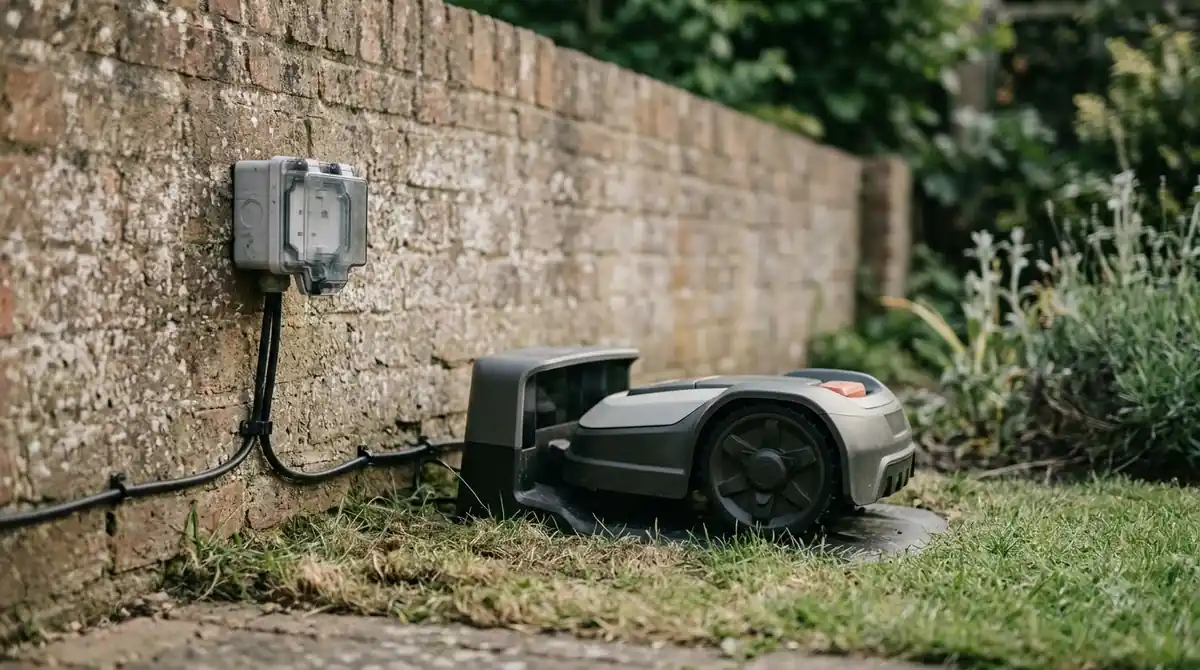
The table below pairs each Mammotion size band with a square-foot conversion. The conversions are our arithmetic at roughly 10.76 sq ft per square meter, not figures from the source.
| Size band (m²) | Approx. sq ft (our conversion) | Mammotion’s description |
|---|---|---|
| Up to 500 | Up to about 5,380 | Small courtyards, townhouses, compact suburban lawns; entry-level models usually sufficient |
| 500 to 1,000 | About 5,380 to 10,760 | Average suburban family homes; mid-range models with longer battery life |
| 1,000 to 2,000 | About 10,760 to 21,530 | Larger residential properties; higher mowing capacity and faster charging |
| Over 2,000 | Over about 21,530 | Acreage and rural properties; premium models for large or multi-zone areas |
Area alone is a weak guide for a townhouse. In our reading, a lot of 4,000 sq ft with a long, narrow side strip can be harder to mow than a square lot of the same size. Pair the size band with the passage check above before you decide.
Boundary wire or wire-free navigation
A buried boundary wire defines the mowing area, while wire-free models use satellite positioning and onboard sensors and are easier to change later. Mammotion describes a perimeter wire as reliable but notes that it requires installation and can be hard to change if the garden layout changes.
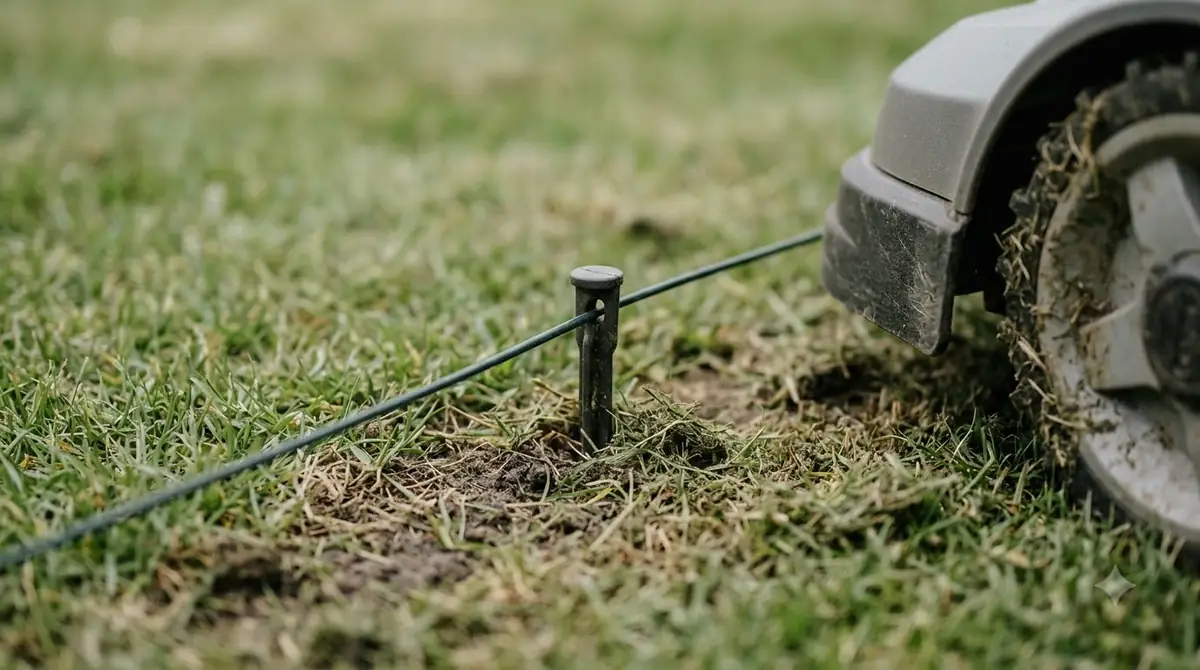
Mammotion also says the market has largely shifted toward wire-free navigation, with RTK, vision, and LiDAR options offering more flexibility and easier setup. The same article adds that the best choice depends on lawn layout, tree cover, and complexity, not the technology alone. Husqvarna’s robotic mower page lists both physical wire and virtual wire boundary options, so check which one a model uses before you buy. For the setup trade-off, see our comparison of boundary wire versus RTK installation time.
In a townhouse, a wire that runs along a shared fence or through a neighbor’s strip may need more planning, and your association may have a say in where it goes. In our reading, a wire-free model is the simpler choice when the yard has several corners or changes often, but confirm that the specific model works with your layout before you treat it as the best robot lawn mower for townhouses with your lot.
Slope and grade changes near patios
Mammotion sorts slopes into bands: up to 20 percent for flat or gently sloping lawns, 35 to 50 percent for steeper residential blocks, and over 50 percent for only certain all-wheel-drive models. The guide also places 20 to 35 percent in a moderate band, where it advises looking for good traction and stable navigation.
Husqvarna lists its 435X AWD model at up to 70 percent slope in the work area and 50 percent at the boundary, so read the figure that applies to the edges of your lawn, where the mower turns and docks, not only the headline number. Many townhouse yards have a grade change near a patio or a low retaining wall, and that spot deserves its own measurement.
Noise, run hours, and neighbors
The Ecovacs GOAT O1000 RTK lists 57 dBA for noise, and its LiDAR PRO variant lists 61 dBA for the main body and 81 dBA for the trimmer, according to Ecovacs’s US product pages. Husqvarna’s 435X AWD lists 60 dB(A) in its Australian product listing. These are manufacturer specs with their own test conditions, so compare them only on the same basis.
Townhouse walls and patios carry sound more than open lots, so for the best robot lawn mower for townhouses, noise is the item most likely to draw a neighbor’s complaint. Some spec pages do not list a dB figure at all, so a missing number is a reason to ask the seller, not proof that a model is quiet. Our guide on how to reduce robot mower noise covers what you can change after you buy.
Run time matters for scheduling. Ecovacs lists about 65 minutes of continuous mowing and a 100-minute charge for the RTK model, and about 90 minutes of mowing with a 70-minute charge for the LiDAR PRO. For a small yard, that is usually enough to finish in a few sessions, and you can schedule sessions outside quiet hours.
Association rules come before the purchase
Your association’s governing documents decide whether a robot mower is allowed, when it can run, and what happens after a violation. Florida shows how state law can limit those penalties: under Florida Statutes 720.305, a fine is capped at $100 per violation unless the governing documents set another amount, and the owner must get at least 14 days written notice of the right to a hearing.
The same statute caps a continuing violation at $1,000 in aggregate unless the documents provide otherwise. It does not mention yard equipment, so the rules for a robot mower sit in your own documents. Check your state’s rules and your declaration before you buy, because the limits differ outside Florida. For a townhouse, those documents are often the first filter for the best robot lawn mower for townhouses you can actually use. If your community has an association, our guide to the best robot lawn mower for HOA neighborhoods covers the same rule checks.
Checklist for the best robot lawn mower for townhouses
Work through these five checks before you shortlist any model, so the quick ones come first and the measurements come last. You can compare finalists in the best robot lawn mowers section afterward. Use the same checklist for every best robot lawn mower for townhouses candidate you compare.
- Association rules. Read the governing documents for bans, quiet-hour limits, or rules about outdoor equipment.
- Narrowest passage. Measure the tightest gap in the yard and compare it with the 2 m and 60 cm figures above.
- Boundary type. Choose wire or wire-free based on how often the layout changes and whether a wire would cross shared space.
- Slope where the mower runs. Measure the grade at the edges, docking spot, and turns, then compare it with the model’s listed slope figure.
- Noise basis. Compare dBA figures only when the sources and test conditions match, and ask the seller for a figure if none is listed.
Frequently asked questions
Can a townhouse use a robot lawn mower?
Yes, if your association’s governing documents allow it and the yard fits the mower’s passage and slope limits. Read the documents first, then measure the narrowest passage. Florida’s statute does not mention yard equipment, so in that state your own documents decide the question.
How narrow a passage can a robot mower use?
Husqvarna recommends at least 2 m (6 ft 6 in) between boundary wires for a passage without a guide wire, and 60 cm (24 in) when a guide wire is used. The guide wire should sit at least 30 cm (12 in) from the boundary wire. Measure the narrowest point of your yard and compare it with those figures.
Is a wire-free robot mower better for a townhouse?
It is often easier to change later, because Mammotion notes that a buried perimeter wire is hard to move once the layout changes. Mammotion also says the best choice depends on layout, tree cover, and complexity, not the technology alone. Check the specific model’s navigation method against your yard before you buy.
What noise level is quiet enough for close neighbors?
No official threshold was found in the sources checked. Ecovacs lists 57 dBA for the GOAT O1000 RTK and 61 dBA for the LiDAR PRO main body, but these are manufacturer figures under their own test conditions. Compare models on the same basis and check your association’s quiet-hours rule.
Sources
- Husqvarna passage guidance (Husqvarna): passage widths and guide wire distances.
- Mammotion robot lawn mower buying guide (Mammotion): size bands, slope bands, boundary wire versus wire-free.
- Husqvarna robotic mowers (Husqvarna): boundary options and navigation.
- Husqvarna Automower 435X AWD (Husqvarna): slope and sound level.
- Ecovacs GOAT O1000 RTK (Ecovacs): noise, runtime, slope.
- Ecovacs GOAT O1000 LiDAR PRO (Ecovacs): noise and navigation without boundary wires.
- Florida Statutes 720.305 (Florida Legislature): fine limits and notice.
 Up next8 min readBest Robot MowersBest Robot Mower with Mulching Blades: What to Check Before You BuyUpdated Nov 11, 2026
 10 min readBest Robot MowersBest Robot Lawn Mower for Elderly Parents: What to Check Before You BuyUpdated Nov 11, 2026
 8 min readBest Robot MowersBest Robot Mower With Ultrasonic Sensors: 5 Checks Before You BuyUpdated Nov 11, 2026
 8 min readBest Robot MowersBest Robot Mower That Works in the Rain: What to Check Before You BuyUpdated Nov 11, 2026
 10 min readBest Robot MowersBest Robot Lawn Mower for Busy Families: What to Check Before You BuyUpdated Nov 11, 2026
 8 min readBest Robot MowersBest Robot Lawn Mower for 5 Acres: What to Check Before You BuyUpdated Nov 11, 2026