
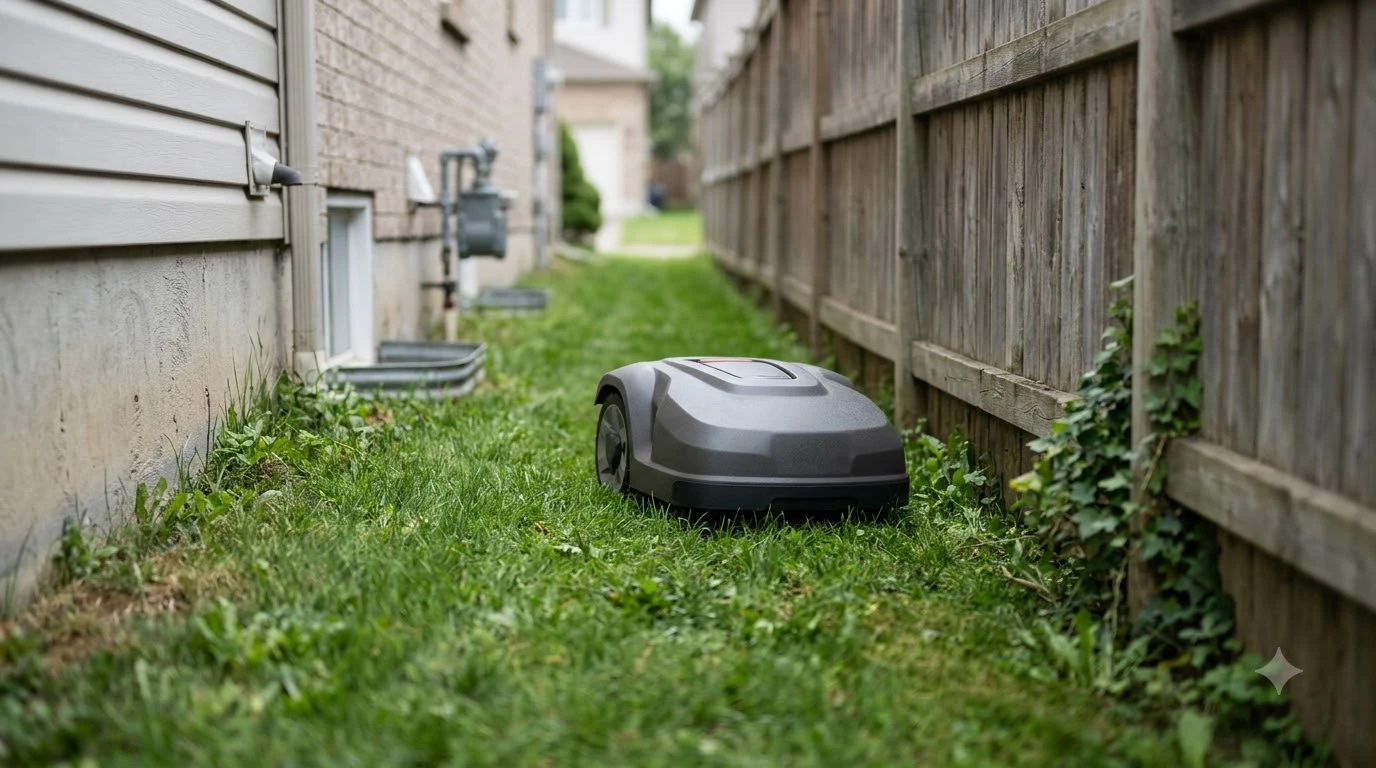

Choosing the best robot lawn mower for yards with zero sky visibility comes down to eliminating satellite dependency through 3D LiDAR, AI camera vision, or a physical boundary wire. Standard RTK-GPS units rely on an unobstructed view of overhead satellites and will pause, drift, or lose their map when trapped beneath dense forest canopies or wedged between multi-story walls. Evaluating onboard sensors, lighting tolerances, and perimeter containment methods ensures reliable cutting where sky signals never reach.
The short answer
- Skip pure RTK-GPS: Satellite-dependent mowers require an open sky view for both the rover and reference antenna, making them unsuitable for total canopy cover.
- Prioritize 3D LiDAR: Laser-based point-cloud mapping builds a local 3D map from trees, fences, and walls without needing satellites or ambient sunlight.
- Consider AI vision (VSLAM) with caution: Camera-driven mowers see grass edges under heavy shade, though performance can degrade at dusk or in uniform lawns lacking visual landmarks.
- Remember physical boundary wires: Buried perimeter loops and hybrid wire-support systems remain immune to overhead blockages and multipath signal reflections.
- Match sensors to yard geometry: Open, uniform turf under a solid tree roof favors 3D LiDAR or wire loops, while cluttered courtyard lawns benefit from LiDAR-plus-vision fusion.
Why satellite mowers fail under dense canopies and tall structures
Real-Time Kinematic (RTK) positioning achieves centimeter-level accuracy only when both the mower and its reference station maintain a steady line of sight to multiple overhead satellites.
According to Husqvarna EPOS documentation, a stationary satellite reference station typically requires a clear 135-degree view of the sky in all upper directions to broadcast reliable correction data. When mature evergreens, overlapping deciduous branches, or narrow side yards between two-story houses block that arc, the rover loses its fixed satellite lock.
Signal blockage is only half the problem. Leaves—especially when wet after rain—and brick or metal walls scatter incoming radio waves, creating multipath errors where the mower miscalculates its position by several feet. In a yard with zero sky visibility, an RTK-only mower repeatedly halts, triggers error codes, or wanders across flowerbeds and driveways.
Heads up
A mower that maps cleanly in early spring before leaves emerge can fail completely by mid-summer. Always evaluate your yard’s canopy density at peak foliage rather than during dormant months.
Navigation technologies that work without sky visibility
To operate reliably without satellite fixes, a robot mower must anchor itself using local physical features or an embedded ground signal rather than overhead constellations.
Three primary architectures handle zero-sky environments without falling back on GPS coordinates:
- 3D LiDAR (Light Detection and Ranging): Omnidirectional laser sensors emit rapid light pulses to construct a live three-dimensional point-cloud map of surrounding trunks, fences, walls, and terrain slopes. Because LiDAR carries its own active light source, it functions identically under thick forest cover, in deep shadow, and after dark.
- AI Vision and VSLAM: Visual Simultaneous Localization and Mapping uses wide-angle or binocular cameras paired with onboard neural processors to distinguish turf from mulch, stone, and obstacles. Vision excels in shaded urban courtyards filled with distinct visual landmarks, though low light, glare, or featureless expanses of grass can reduce tracking stability.
- Physical Boundary Wire and Hybrid Loops: A low-voltage perimeter cable staked or buried along the lawn edge creates a closed electromagnetic boundary that works regardless of tree density or roof overhangs. For properties that mix open lawns with zero-sky pockets, hybrid systems like Husqvarna’s EPOS Support by Wire let owners run physical wire loops specifically through shaded dead zones.
Comparing sky-independent navigation systems
Each non-satellite guidance method trades off setup labor, lighting sensitivity, and landmark requirements depending on how your property is laid out.
| Navigation Method | How It Localizes | Strengths in Zero-Sky Yards | Key Limitations |
|---|---|---|---|
| 3D LiDAR | Active laser scanning builds a 3D structural map | Works in total shade and complete darkness; no wires or sky view needed | Needs nearby physical features (trees, walls, fences) to anchor orientation |
| AI Vision / VSLAM | Cameras track visual landmarks and grass boundaries | Recognizes small ground hazards like toys, hoses, and pets; simple setup | Struggles at night, in heavy fog, or on large, featureless lawns |
| LiDAR + Vision Fusion | Combines 3D laser geometry with camera object recognition | Redundant tracking maintains straight lines and avoids low-profile clutter | Higher battery draw and steeper upfront hardware tier |
| Physical Boundary Wire | Mower senses an electromagnetic loop along the perimeter | 100% immune to canopy density, weather, and dark corners | Requires trenching or staking; vulnerable to aerators and spades |
Key specs to check beyond the navigation sensor
Sensor architecture keeps the mower oriented, but chassis design, connectivity, and obstacle handling determine whether it actually finishes the cut under heavy cover.
- Docking station placement rules: Many wireless mowers still require their charging base to sit under open sky to initialize a map or calibrate sensors. Look for LiDAR-first models—such as the Segway Navimow i2 LiDAR—that allow you to place the charging dock under a deck, inside a carport, or directly beneath dense trees without an external antenna.
- Local Wi-Fi and cellular coverage: Even when navigation does not rely on satellites, cloud-connected apps require a stable Wi-Fi or 4G signal across the yard for firmware updates, schedule edits, and anti-theft alerts. Thick tree cover and masonry walls attenuate 2.4 GHz and 5 GHz Wi-Fi signals rapidly.
- Traction and wheel drive on damp turf: Shaded lawns stay wet longer after morning dew or rain, encouraging moss and slick soil. Prioritize aggressive off-road tread, rear-wheel stability control, or all-wheel drive if your shaded yard includes slopes, exposed tree roots, or soft ground.
- Sensor self-cleaning and weather sealing: Low-hanging branches drop sap, pollen, pine needles, and wet leaves directly onto optical lenses and spinning laser windows. Verify an ingress protection rating of IPX6 or IP66 so you can safely rinse debris off the sensor housing with a garden hose.
What to check before you buy
Walking your property with a critical eye before ordering prevents return headaches and uncovered dead zones.
- Audit your property’s vertical landmarks. LiDAR mowers anchor their 3D maps against solid vertical surfaces like tree trunks, retaining walls, fences, and house siding. If your yard sits under a high canopy with no walls or trunks near the perimeter, verify the maximum laser scanning range in the spec sheet.
- Measure narrow corridors and gate clearances. Side yards hemmed in by tall fences and house walls are classic zero-sky zones. Check the manufacturer’s minimum corridor width specification—typically several feet wide—so the mower can pass between zones without bouncing endlessly.
- Test wireless signal strength at the dock location. Stand at the exact shaded outlet where you plan to plug in the charging base and check your phone’s Wi-Fi or cellular bars. If your home router cannot reach the back fence, factor in an outdoor Wi-Fi extender or a model with built-in 4G data.
- Verify how stay-out zones behave during signal dips. Confirm whether the mower relies on local LiDAR/vision geometry or satellite coordinates to enforce virtual boundaries near pools, drop-offs, and garden beds.
Frequently asked questions
Can a standard GPS or RTK robot lawn mower work under heavy tree cover?
No, standard RTK-GPS mowers struggle severely under dense, continuous tree canopies because leaves and branches block and reflect satellite signals. While some hybrid RTK models use onboard cameras or inertial sensors to bridge brief shaded gaps for a few seconds, a yard with near-zero sky visibility requires 3D LiDAR, dedicated AI vision, or a physical boundary wire.
Does 3D LiDAR work at night or in heavy shade?
Yes, 3D LiDAR is an active sensing system that emits its own infrared laser pulses rather than relying on ambient sunlight or overhead satellites. As a result, a 3D LiDAR mower maintains consistent spatial mapping and obstacle detection in deep canopy shade, overcast weather, and complete darkness.
Are boundary-wire robot mowers still worth buying for wooded yards?
Yes, physical boundary-wire mowers remain one of the most predictable choices for heavily wooded or tightly enclosed properties. Because the mower navigates by detecting a low-voltage signal inside the perimeter cable, overhead foliage and tall buildings have zero effect on boundary accuracy, provided you are willing to stake or bury the wire during initial setup.
Can I put a LiDAR robot mower charging station inside a garage or under a deck?
In most cases, yes, because pure LiDAR and vision-based mowers do not need the charging station or an external reference antenna to see overhead satellites. You still need to maintain clearance on both sides of the dock for clean entry and exit, and ensure the mower’s laser or cameras can see familiar landmarks immediately upon leaving the shelter.
Sources
- Husqvarna EPOS – Virtual boundaries. Endless possibilities. (Husqvarna US): Used for reference station sky-visibility requirements (135-degree clear view) and hybrid wire-support behavior.
- Navimow i2 LiDAR | LiDAR Navigation, No Signal Loss (Segway Navimow): Used for solid-state LiDAR plus Vision AI dual-fusion specs, antenna-free installation, and IP66 ingress protection benchmarks.
- Wire-free Robot Mower RTK Accuracy Guide for Precise Boundary (RTKdata): Used for RTK fix-versus-float degradation and multipath signal reflection behavior near trees and buildings.
 Up next10 min readBest Robot MowersChoosing the Best Robot Lawn Mower for Lawns with Heavy Pine Cone DropUpdated Nov 19, 2026
 9 min readBest Robot MowersChoosing the Best Robot Lawn Mower for Lawns With Flush Flagstone PathsUpdated Nov 19, 2026
 8 min readBest Robot MowersHow to Choose the Best Robot Lawn Mower for Sandy Coastal YardsUpdated Nov 19, 2026
 6 min readBest Robot MowersBest Robot Mower for a Yard with a Rain Garden: What to CheckUpdated Nov 14, 2026
 8 min readBest Robot MowersBest Robot Lawn Mower for a Yard With Pine Needles: What to CheckUpdated Nov 14, 2026
 8 min readBest Robot MowersWhat Is the Best Robot Lawn Mower for a Small Yard?Updated Nov 13, 2026