
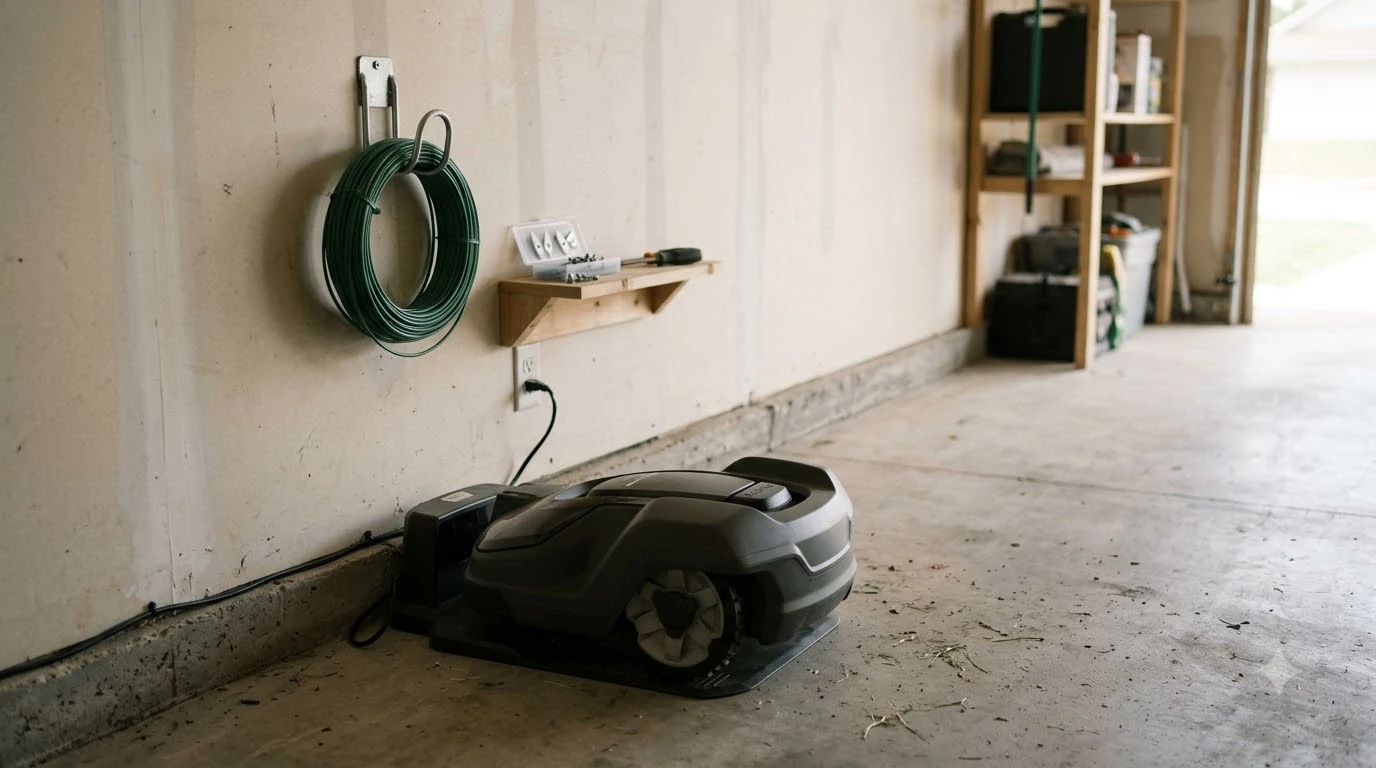

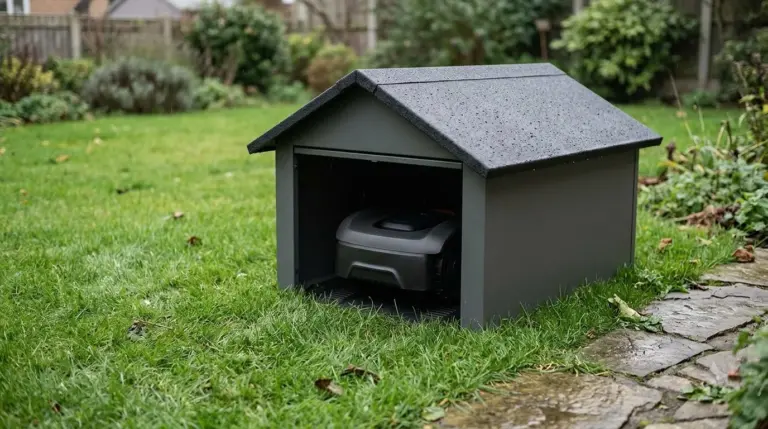
A robot mower garage is a shelter over or beside the charging station that cuts down on sun, rain, debris and temperature swings at the dock. Most yards do not strictly need one, but it is worth considering when the dock sits in full sun, collects standing water, or faces frequent rain or freezing winters. Before you buy, check the width clearance for your mower, the roof and airflow, the ground and drainage, and the winter storage limits in your manual.
The short answer
- What it does: it reduces sun, rain and debris exposure. It does not make the dock fully weatherproof.
- Width: allow the mower width plus at least 4 to 6 inches on each side, and go slightly bigger rather than tighter.
- Front: keep the front fully open, with a straight approach path so the mower can dock on the first try.
- Winter: a garage alone does not protect against frost. Store the mower indoors above freezing, as the manual describes.
What a robot mower garage actually protects against
A garage mainly addresses wear that builds up slowly. Eufy’s garage guide says sunlight “slowly weakens and discolours plastic parts,” and that leaves, dust and debris “settle into small gaps.” Eufy also notes that a garage “doesn’t eliminate these factors entirely, but it reduces their impact,” which is the most honest way to frame it. If you are weighing a simple cover instead, robot mower rain cover vs garage compares the two.
Water is the subtle part. Eufy describes its IPX6 rating as “designed for rain and splashes, not constant direct exposure to the elements,” and adds that water resistance “doesn’t prevent long-term degradation.” Standing water around the charging contacts is the specific risk it names, because repeated wetting can corrode them over time. Mammotion makes a similar point: constant sun can degrade plastic housings and seals, and that internal temperatures rise quickly when the mower sits on the charging dock.
When a garage is worth considering
A robot mower garage earns its place most clearly in a few situations. Eufy lists open gardens, frequent rain and strong summer heat as the conditions where it helps most. Mammotion notes that in humid regions the main issue is constant moisture rather than rain itself, so drainage and airflow matter more than a roof alone.
| Yard condition | What to focus on | Source-backed note |
|---|---|---|
| Dock in full sun | Block the hottest part of the day | Mammotion says to block afternoon sun, the hottest part of the day, and to avoid full-day direct exposure in hot climates |
| Frequent rain or humidity | Roof overhang, drainage, airflow | Mammotion says humid areas depend more on drainage than on rain protection |
| Coastal or salty air | Corrosion-resistant materials | Mammotion says a garage is optional there, but materials matter |
| Freezing winters | Indoor storage, not just a shelter | Robomow says garages do not give adequate frost protection |
Sunseeker’s global storage article makes the same point from another angle: install the charging station in a sheltered location, where a covered garage or compact shed can provide the cover. If your dock already sits under a roof or eave, the case for a full garage is weaker, and if strong afternoon sun is the main worry, the checks for a robot mower garage for hot sun go deeper.
How much space the garage needs
Size comes down to two numbers: the mower’s footprint and the room the dock needs. Mammotion’s rule is the mower width plus at least 4 to 6 inches on each side.
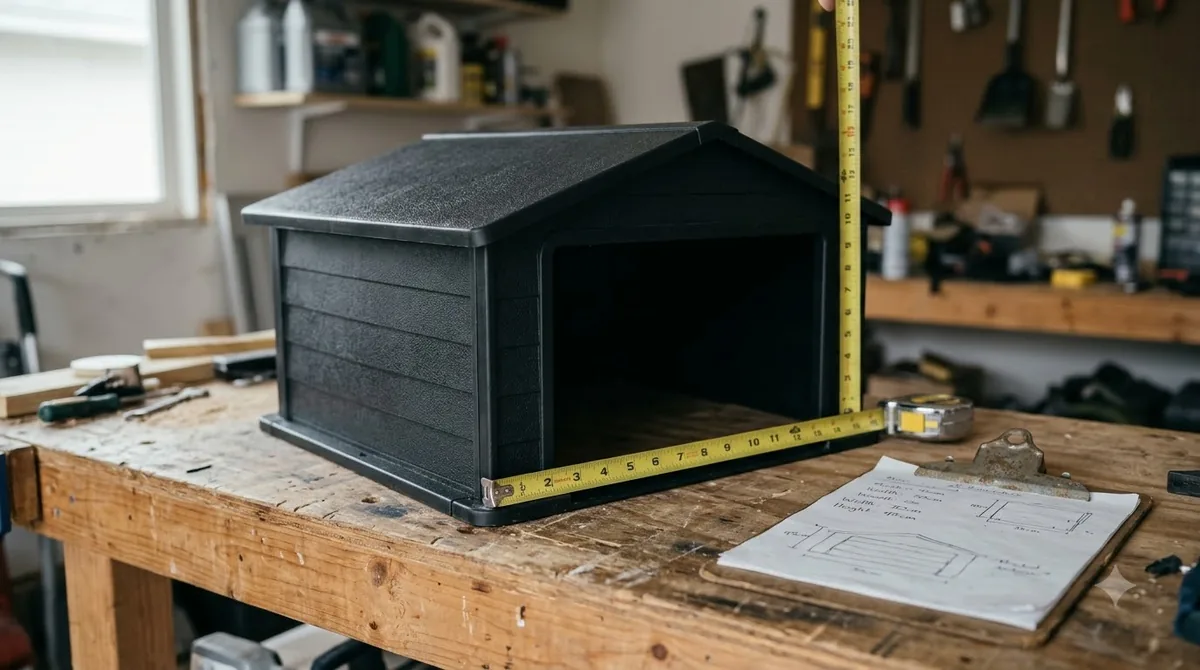
For height, the same guide asks for enough clearance for the tallest point of the mower and dock together, and for depth it says the garage should fully cover the docked mower. It also advises leaving several feet between the garage and walls, though it gives no exact figure.
Brand examples show how wide the margins vary. Ecovacs’ installation guide for the GOAT O1000 RTK asks for about 15.75 inches of clearance on each side of the station and 6.56 feet in front. Husqvarna’s wired charging station needs 3 m (10 ft) of free space in front, 150 cm (60 in) to each side of centre and 60 cm (2 ft) behind. Its EPOS wire-free station needs at least 6 m (20 ft) in front. These are station figures, not garage dimensions, so a garage must leave that approach zone open.
Heads up
Dock footprints differ by model and by generation. The figures above are examples from specific brands, not a universal rule. Check the mower’s manual before you measure, and measure the actual station rather than relying on a catalogue number.
Roof, ventilation and materials
A roof helps with rain and sun, but a closed box can cause problems of its own. Mammotion recommends a lightweight, non-metal roof angled slightly for runoff, extended far enough to cover the dock. It describes polycarbonate as UV-resistant and says it will not interfere with signals. For RTK mowers, it advises avoiding metal roofing.
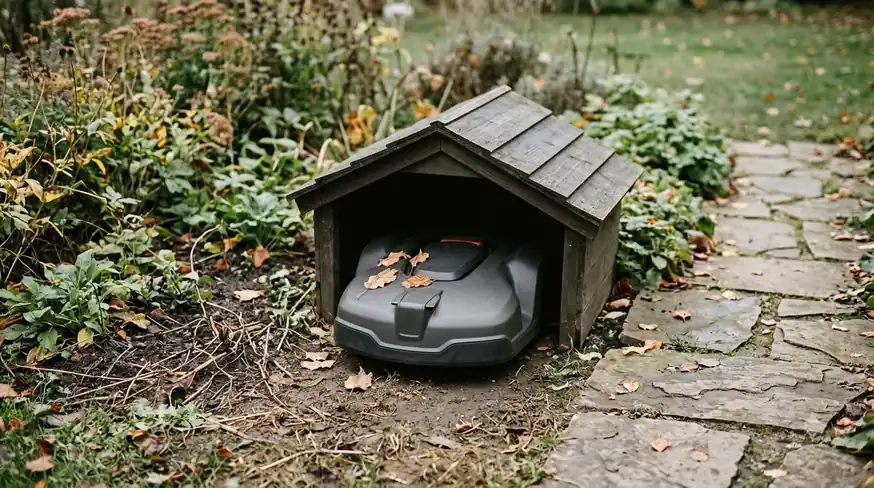
Airflow is the other half of the design. Mammotion’s summary is that shade is good but heat traps are not, so the garage should stay open and ventilated, with no fully enclosed dark materials. Husqvarna gives the same advice for its charging station: keep the sides open and let heat escape. Husqvarna also warns against putting the power supply inside an enclosed box, which is a useful reminder when you build or buy a shelter that has to house electrical parts.
Husqvarna’s placement guide adds that a station can sit under a roof, provided the area in front keeps a clear view of the sky. For garages with a solid roof, the front approach therefore matters as much as the roof itself.
Ground, drainage and placement
A garage works only if the ground under it stays dry and level. Mammotion advises avoiding low spots where water collects, using gravel, pavers or a concrete slab as a base, and elevating the garage slightly so water runs off. It also recommends keeping the docking area stable and free of mud. It also asks for level ground and a docking area that is stable and free of mud.
Placement is also about the dock. Mammotion suggests positioning the garage directly over or slightly in front of the charging station. Its checklist warns about a tight entry angle, which is a common reason docking attempts fail. Eufy adds that sensors and cameras should stay unobstructed, so a garage wall or roof edge should not sit where it blocks the mower’s view when it returns.

Temperature and winter storage
A garage shelters the mower from sun and rain, but it does not control temperature. Eufy says most systems operate best between 0 and 45 C (32 and 113 F). Husqvarna gives different limits for its own mowers: operation at 0 to 50 C, charging at 0 to 45 C, and storage at 0 to 50 C. Mammotion recommends storage around 10 to 20 C (50 to 68 F), and its support page says the mower should be moved indoors when temperatures fall below -10 C (14 F).
The winter rule that matters most is simple. Husqvarna’s winter guide says storage should be dry and above freezing, in a spot such as a garage, shed or basement. Before storage, it recommends fully charging the mower and switching it off, then resting it on all wheels on a flat surface. Robomow goes further and says a garage does not provide adequate frost protection, so the mower should be stored indoors once temperatures drop below zero.
The thresholds in these sources do not line up exactly, so our reading is to follow the manual for your model and to move the mower indoors well before freezing, rather than waiting for the lowest figure to be reached. For a closer look at the cold-weather question, see whether a robot mower can stay outside in winter.
Model fit: check the brand’s own garage
A robot mower garage is usually designed for a specific model family. Sunseeker’s US garage page says its product is sized specifically for the X5, X5 Gen 2, X7 and X7 Gen 2 series. eufy’s E15 bundle includes a garage that attaches to the base station with screws. Worx publishes its garage dimensions per model; the WA0810 garage, for example, is about 71 cm high, 55 cm wide and 40 cm deep. The lesson is that a garage’s listed size only helps if it matches your mower and dock. Brand-specific guides such as the garage for Husqvarna Automower and the garage for Segway Navimow cover those model checks in more detail.
What to check before you buy
Our reading is that a careful buyer works through a short list before comparing any robot mower garage:
- Measure the mower and dock. Take the width and height of the mower, and the dock footprint from the manual, not from memory.
- Add the clearance. Use the mower width plus at least 4 to 6 inches on each side, and leave room for the tallest point.
- Keep the front open. Confirm there is a straight approach path with no tight entry angle.
- Check the roof and airflow. Look for a non-metal, ventilated roof, and avoid enclosed heat traps.
- Plan drainage. Choose a level, elevated base such as gravel or pavers, and avoid low spots.
- Confirm the winter plan. Decide where the mower will go when temperatures fall, because a garage alone is not frost protection.
Frequently asked questions
Do I need a robot mower garage?
Not always. Eufy says a garage reduces the impact of sun, rain and debris but does not eliminate them. It is most useful in open gardens, frequent rain and strong summer heat. A dock that already sits under a roof with a clear approach may not need one.
How big should a robot mower garage be?
Mammotion’s general rule is the mower width plus at least 4 to 6 inches on each side, with room for the tallest point of the mower and dock. When in doubt, go slightly bigger rather than tighter, and check the dock footprint in your manual.
Can a garage keep my mower safe through winter?
Not on its own. Robomow says garages do not provide adequate frost protection, and Husqvarna advises storing the mower indoors, dry and above freezing, after a full charge and power-off.
Can the dock sit in full sun under a garage?
It is better to avoid it. Mammotion says constant sun can degrade plastic housings and seals, and that internal temperatures rise quickly when the mower sits on the charging dock. Blocking the afternoon sun is the most useful step in hot climates.
Sources
- Mammotion garage guide (manufacturer): width rule, roof, ventilation, drainage, sun and approach advice.
- eufy garage guide (manufacturer): what a garage protects against, IPX6 wording, 0 to 45 C operating range, corrosion from standing water.
- Husqvarna charging station placement guide (manufacturer): free-space figures, roof with sky view, ventilation, power supply.
- Husqvarna winter storage guide (manufacturer): indoor storage above freezing, charging and power-off steps.
- Robomow garage guide (manufacturer): frost protection limits and garage fit.
- Mammotion winter storage support (manufacturer): indoor threshold of -10 C (14 F).
- Ecovacs installation guide (manufacturer): station clearance for the O1000 RTK.
- Sunseeker US garage collection (manufacturer): models the garage is sized for.
 Up next7 min readGearRobot Mower Rain Cover vs Garage: Which Protects Better?Updated Nov 11, 2026
 9 min readGearBest Anti-Theft Lock for Robot Mower: What Actually Protects ItUpdated Nov 12, 2026
 8 min readGearBest Garage for Anthbot Robot Mowers: Size, Roof and Airflow ChecksUpdated Nov 11, 2026
 8 min readGearBest Garage for Sunseeker Mowers: 6 Fit and Clearance ChecksUpdated Nov 11, 2026
 8 min readGearBest Garage for eufy E15: Fit, Airflow and Drainage ChecksUpdated Nov 11, 2026
 9 min readGearBest Robot Mower Storage Shelf for Garage: What to Check FirstUpdated Nov 14, 2026