
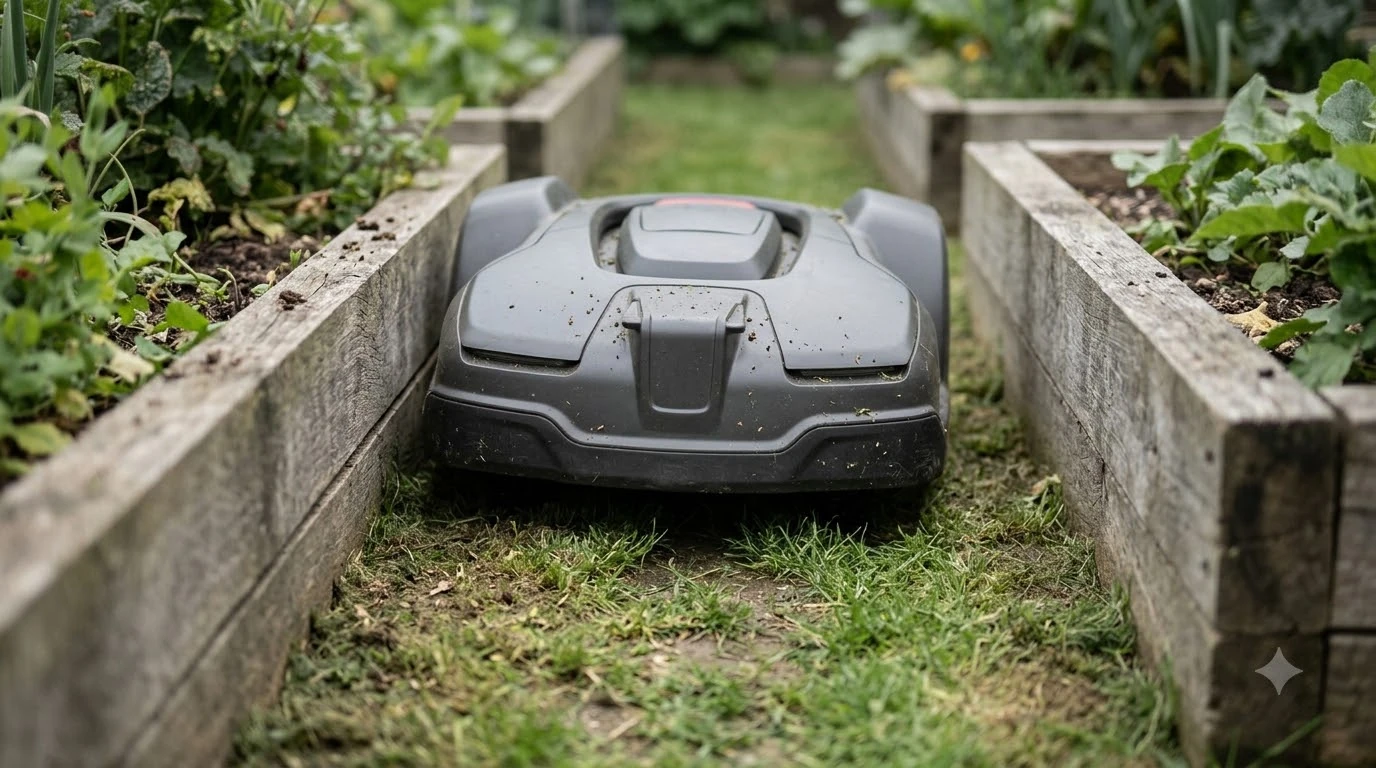

Can a robot mower detect black garden edging in low light? Only reliably when it uses non-visual navigation—such as a buried boundary wire, RTK-GPS virtual borders, or LiDAR—or when a camera-based model pairs its vision sensor with onboard LED headlights or infrared illumination. Standard RGB camera-only mowers rely on visible color and brightness contrast between green turf and adjacent materials, which collapses at dusk, in deep tree shade, or after sunset. Because dark plastic or rubber edging blends into shadowed soil and dim grass, relying on passive camera detection alone often leads to crossed borders or stranded wheels.
The short answer
- Passive RGB cameras struggle in dim light: Camera-only mowers depend on visible contrast to tell grass apart from mulch, stone, or edging, and low light washes out that boundary line.
- Black edging lowers contrast even further: Dark plastic, composite, or rubber strips absorb light and visually merge with dark soil or shadowed turf at dusk.
- Active lighting or infrared restores vision: Models with built-in headlights (such as Worx Landroid Vision with the optional FiatLux module) or infrared sensors (such as Husqvarna Automower NERA VE models) can keep detecting edges and objects after dark.
- Non-visual systems ignore lighting completely: Boundary wires, magnetic strips, RTK-GPS coordinates, and LiDAR sensors track borders without needing visible light.
- Raised physical height helps bump and depth sensors: Edging installed at least 20 mm (about 0.8 inches) to 6 cm (about 2.4 inches) above the turf gives stereo cameras, ultrasonic sensors, or physical bumpers a clear ridge to register.
Why low light and black edging challenge camera-based mowers
Vision-driven robot mowers identify lawn boundaries by measuring color, texture, and brightness differences between grass blades and surrounding surfaces, a contrast that drops sharply as ambient light fades.
According to Mammotion’s technical guide on AI vision navigation, visual systems rely on ambient light to separate turf from pavement or flowerbeds, and low-light conditions or heavy shadows reduce recognition accuracy unless supplemental lighting is present. When daylight drops at dusk or under dense tree canopies, an RGB camera sensor increases its exposure or gain, introducing image noise and blurring fine textures.
Black garden edging compounds that problem. Unlike light gray concrete pavers or pale gravel, black plastic, metal, or rubber edging reflects very little light. In dim conditions, the dark strip looks nearly identical in brightness to dark mulch, wet soil, or deep grass shadows. Without a sharp luminance edge for the neural network to lock onto, a vision-only mower may treat the edging as part of the lawn and drive straight over it into a flowerbed.
Flush-mounted black edging is especially tricky. When a dark border sits level with the soil so a trimmer wheel can roll over it, a camera loses both color contrast and geometric depth cues at the same time.
How different mower navigation systems handle dark borders at night
Whether your mower respects a black garden border after sunset depends on which sensor technology controls its perimeter rather than the color of the edging itself.
| Navigation technology | Relies on visible light? | Behavior at black edging in low light | Key manufacturer requirement |
|---|---|---|---|
| Passive RGB camera only | Yes | High risk of crossing flush black edging once daylight fades; many models pause or return to dock at dusk. | Needs daylight and clear visual contrast or a raised border. |
| Camera with LED headlights or IR | No (self-illuminated) | Illuminates the border directly ahead so the vision system can separate turf from dark edging after sunset. | Keep the camera lens and emitter clean of grass sap and dust. |
| RTK-GPS + AI vision | Partially (for fine edge trim) | Follows centimeter-level satellite coordinates along the mapped perimeter, though vision-assisted edge hugging may soften in the dark. | Needs clear sky view for satellite lock near trees or walls. |
| Buried boundary wire | No | Detects the electromagnetic loop signal regardless of darkness, shadows, or edging color. | Wire must be pegged or buried at the specified offset from the border. |
| Magnetic strip | No | Triggers an onboard magnetic sensor to turn around before reaching the edging, day or night. | Must be laid flat along the grass side at the manual’s setback distance. |
Manufacturer documentation confirms how sharply models diverge once the sun goes down. Bosch notes on its VISIMOW18V product page that its SmartVision WDR camera requires daylight and automatically returns to dock at dusk. Similarly, Husqvarna’s support documentation for AI vision explains that while its 405VE, 410VE, 430V, and 450V NERA models include infrared sensors to detect and avoid objects at night, vision features on models without infrared support do not function in the dark.
For camera-first mowers built to work around the clock, manufacturers add active illumination. Worx offers the optional FiatLux LED headlight module for its Landroid Vision lineup specifically because standard cameras go blind after sunset, restoring forward visibility so the mower can see borders and nocturnal wildlife at night.
Edging height and contrast guidelines from mower manufacturers
If you rely on a vision-based mower, giving the sensor a physical step or a bright visual buffer next to black edging improves boundary detection during dawn and dusk runs.
According to LawnMaster’s OcuMow vision navigation guide, camera-based boundary detection performs reliably when the lawn perimeter includes either distinct color contrast or a raised kerb or edging strip with a height difference of at least 20 mm (about 0.8 inches). In its broader compatibility guidelines, the same manufacturer notes that raised borders of 6 cm (about 2.4 inches) or higher provide an ideal physical and visual stop for optical grass recognition.
That vertical lip matters in low light because stereo cameras and downward-facing terrain sensors can detect a sudden elevation change or shadow cast by a raised lip even when color saturation fades. Conversely, if your black edging sits flush with the dirt, adding a narrow 2-to-4-inch band of light-colored crushed stone, brick, or tan mulch between the turf and the black strip creates a high-contrast stripe that remains readable deeper into twilight.
Heads up
Before installing tall edging, check your mower’s bumper clearance and blade-to-edge offset. A raised border that stops the mower’s body cleanly will also leave an uncut strip of grass—often 1 to 4 inches wide depending on deck design—that you will need to trim manually.
How to keep your robot mower from crossing black edging in low light
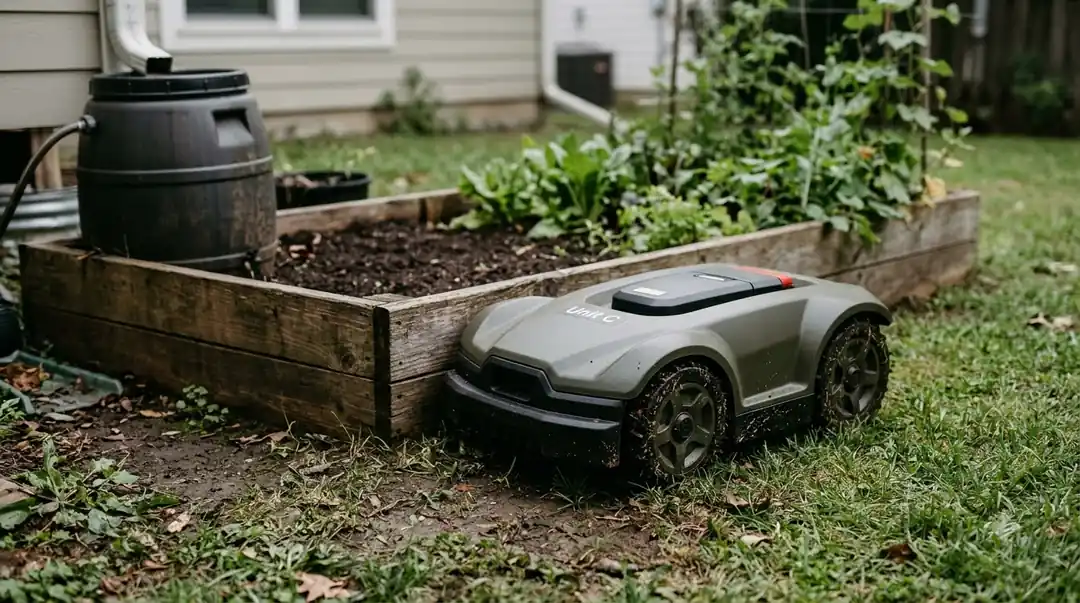
You can prevent evening border overruns without ripping out existing black edging by adjusting schedules, adding physical cues, or pairing a secondary perimeter marker.
- Schedule vision mowing for full daylight. Set your mowing window to finish at least 30 to 45 minutes before sunset, and exclude heavily shaded north-facing beds from early morning runs if your mower lacks headlights or infrared.
- Clean the camera lens and emitters weekly. Fine grass dust, pollen, and morning dew scatter light across the lens, turning dim scenes into a milky blur where black edging disappears completely.
- Raise the edging lip or add a contrasting buffer strip. Lift sunken plastic or metal edging so at least 20 mm sits above the soil line, or lay a narrow border of light gravel or pavers along the grass side of the black strip.
- Install a magnetic strip along problem borders. For vision mowers that support magnetic accessories—such as Worx Landroid Vision, whose manual specifies placing magnetic strips 32 cm (about 12.6 inches) from protected borders—laying a strip along dark, shaded beds gives the mower a light-independent stop signal.
- Use RTK virtual stay-out zones with a safety buffer. If you own a hybrid RTK-GPS and vision mower, map the garden bed boundary a few inches inside the lawn edge during bright midday light so satellite positioning turns the mower before its wheels touch the black edging at night.
Frequently asked questions
Can a camera-only robot mower run at night if I turn on backyard landscape lights?
Standard landscape path lights rarely provide even enough illumination across an entire lawn for a passive RGB camera to track borders reliably. Bright pools of light surrounded by deep shadows can actually confuse auto-exposure sensors, making dark edging in the dim gaps harder to detect than at twilight.
Does black rubber or plastic edging interfere with a buried boundary wire?
No. Plastic, rubber, and composite edging materials do not block the low-frequency electromagnetic signal from a buried boundary wire, so a wired mower will stop at the exact same spot day or night. Only thick continuous metal barriers close to the wire can alter the signal field.
Why does my robot mower detect black edging in the afternoon but drive over it at dusk?
In bright afternoon sun, the camera easily separates green grass blades from the smooth black surface of the edging. As light drops at dusk, color contrast fades and shadows lengthen across the border, causing the vision algorithm to mistake the dark strip for shaded turf or soil.
What height should garden edging be for a vision robot mower to see it?
According to LawnMaster’s vision navigation guidelines raised borders should have a height difference of at least 20 mm (about 0.8 inches) for reliable detection, with 6 cm (about 2.4 inches) or higher recommended as ideal for optical edge recognition.
Sources
- How AI Vision Robot Lawn Mowers to See, Decide, and Navigate (Mammotion): Used for how AI vision systems distinguish grass boundaries via color and texture contrast, low-light limitations, and RTK-GPS sensor fusion.
- In-Depth Look at LawnMaster OcuMow Vision Navigation (Cleva / LawnMaster): Used for visual contrast requirements and minimum raised border height thresholds (20 mm minimum, 6 cm ideal).
- Object detection and avoidance with AI vision technology (Husqvarna): Used for infrared sensor behavior during nighttime operation on Automower NERA VE models and camera visibility settings.
- Landroid Vision Cloud Robotic Lawn Mower (Worx): Used for stereo-vision border detection, RTK-GPS integration, and optional FiatLux nighttime illumination.
 Up next9 min readLearnCan a Robot Mower Run Over a Garden Hose Without Cutting It?Updated Nov 19, 2026
 6 min readLearnDo Robot Mowers Detect Obstacles at Night? 3 Key FactsUpdated Nov 14, 2026
 6 min readLearnHow to Trim Edges a Robot Mower Misses: A Hand-Edging GuideUpdated Nov 14, 2026
 7 min readLearnWhat Do Robot Mower Charging Station Lights Mean?Updated Nov 12, 2026
 8 min readLearnCan Robot Lawn Mowers Mow in the Rain? Light vs Heavy RainUpdated Nov 11, 2026
 8 min readLearnWhy Does My Robot Mower Struggle on Freshly Topdressed Lawns?Updated Nov 19, 2026