
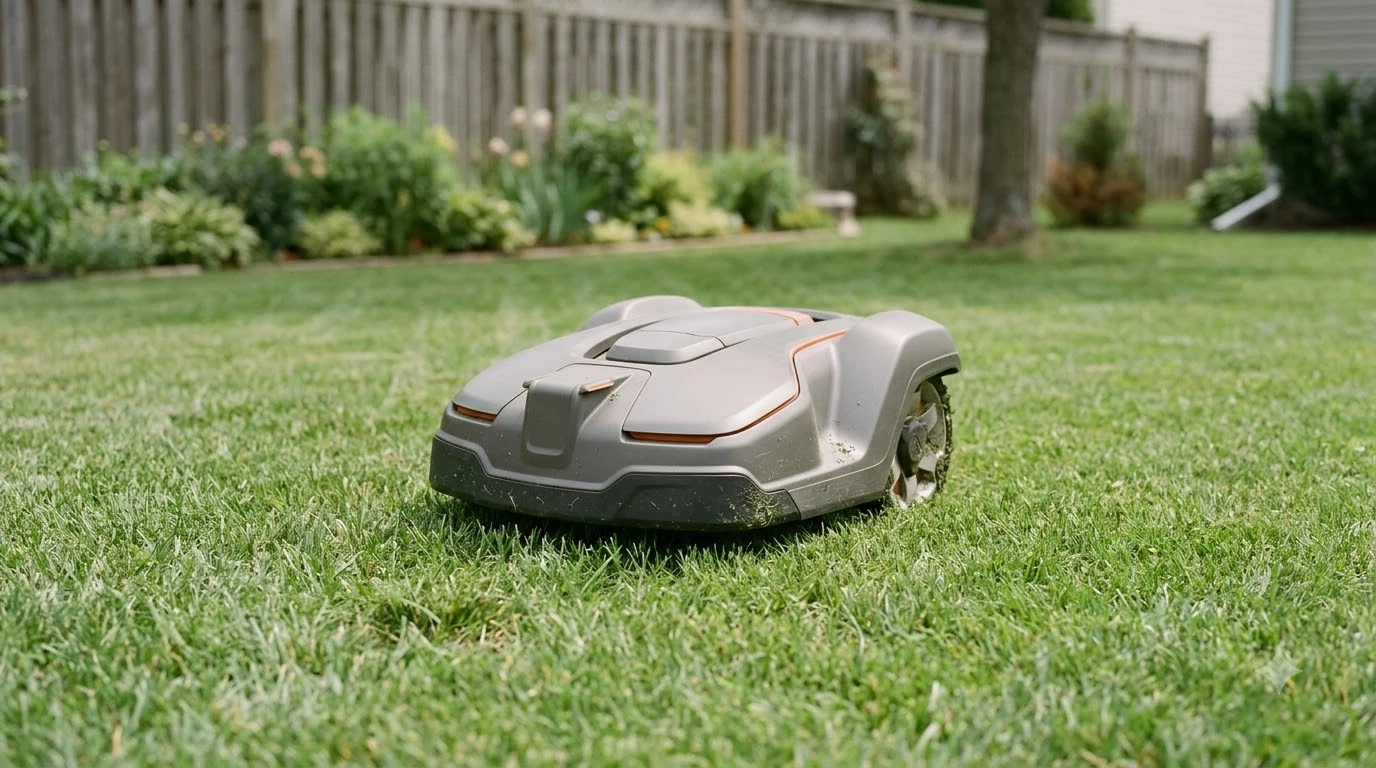

RTK vs vision robot mower which is better depends on what your yard is missing. RTK tells the mower where it is using satellite signals, while vision uses cameras to spot obstacles. RTK needs a clear view of the sky, and vision needs good light, so the right pick depends on your lawn layout and sun exposure.
The short answer
- Open, sunny lawn: RTK is the stronger base for positioning, with vendors citing accuracy of about 1 to 3 cm in open areas.
- Busy yard with toys, pets and furniture: vision helps because it can classify obstacles, not just detect them.
- Trees or tall walls: RTK loses satellite visibility, so check the sky view before you buy.
- Mixed yard: many robot mowers combine both sensor types, which is often the practical answer.
How RTK and vision do different jobs
RTK and vision answer different questions, which is why buyers compare them. RTK corrects standard GPS with reference data so the mower knows where it sits on the lawn. Vision uses one or more cameras with computer vision algorithms to recognize what is in front of the mower.
The vendors quote different RTK accuracy figures. Mammotion’s technical blog says RTK “often” lands within 1 to 2 cm, while Sunseeker’s guide says it can pinpoint position within 1 to 3 cm. Neither article gives the test conditions behind its number, so treat both as vendor claims rather than measurements from your own yard.
Where RTK fits: open sky and a clear satellite view
RTK works best when the mower has a clear view of the sky, because satellite visibility drives its accuracy. Mammotion’s blog says performance can degrade in areas with poor satellite visibility, such as under dense trees or near tall structures. Sunseeker’s guide says the same thing, noting that performance may be affected by heavy tree cover, tall buildings or narrow passages.
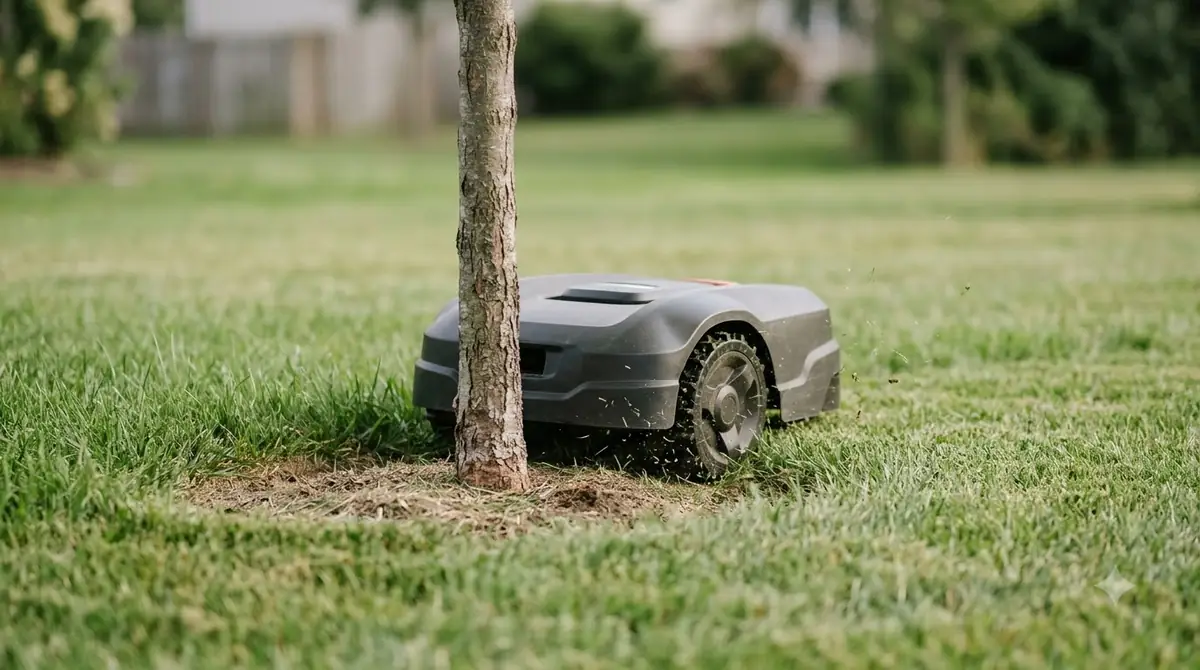
Yarbo’s reliability article describes suburban and rural lawns as the ideal case, and says urban courtyards may need more careful base placement. Our reading is that RTK suits a lawn where you can stand in the middle and see most of the sky. If you are unsure, our guide on whether robot mowers need a clear view of the sky explains how to check.
Heads up
Dense canopy over the whole yard is the case where RTK is least likely to work well. Sunseeker also lists heavy rain and thick fog as conditions that can weaken satellite signals, so weather can matter even on a sunny-sky lot.
Where vision fits: obstacles, toys and changing yards
Vision suits yards with many small objects because it can detect and classify obstacles such as pets, toys, hoses and furniture. Mammotion’s AI vision article lists living obstacles like pets or wildlife, temporary objects like toys and garden tools, and permanent features like posts and outdoor furniture. That is useful in a family yard where a toy can appear between mowing sessions.
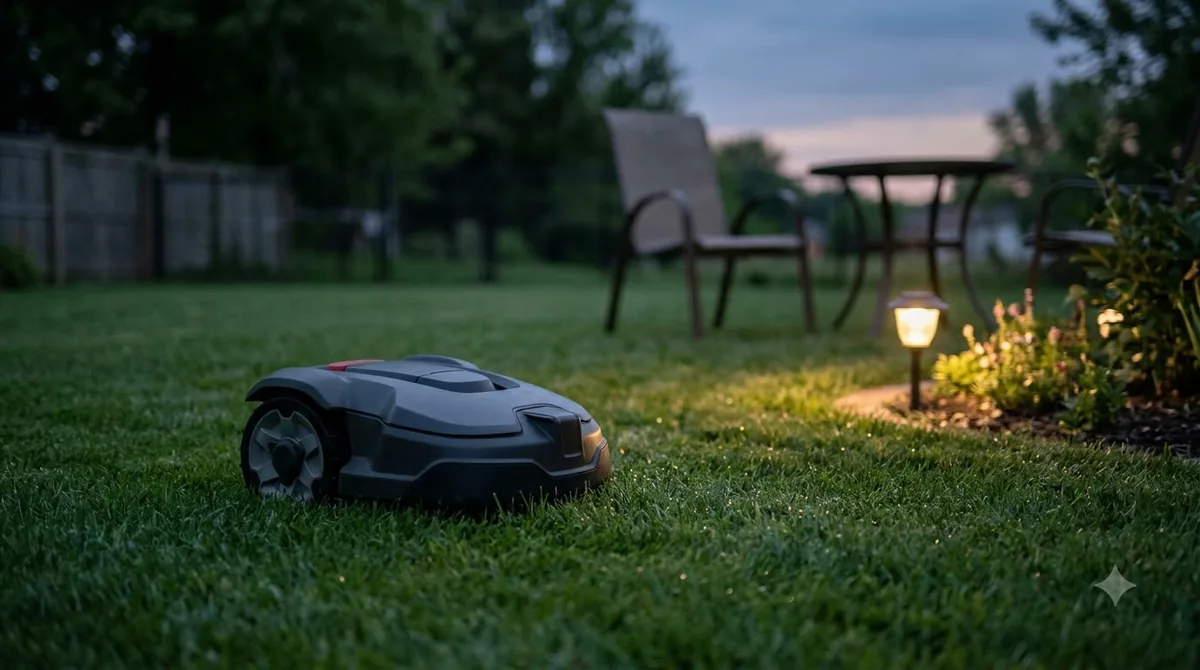
The limitation is light. The same article says low light or night operation can reduce detection accuracy unless extra illumination is provided, and that shadows and glare can confuse the system. Rain, fog or snow can obscure the visual cues it relies on. It also notes that vision can lead to slightly less consistent edge precision than RTK, which matters for a boundary you want neat.
Seasonal change is another factor. The article says changes in grass color, such as drought or seasonal browning, can reduce edge detection accuracy, and that fallen leaves or mulch may be read as obstacles. Dirty or scratched camera lenses can also affect detection, so the mower needs routine cleaning.
Base station and setup: what each one asks of you
RTK usually needs a reference station or a strong correction signal, so setup means placing a base unit with a clear view of the sky. Sunseeker describes the base as a stationary unit in your yard that calculates satellite signal errors and sends corrections to the mower by radio. It also calls initial installation and calibration more involved than simpler navigation systems.
Moving the base is not a small change. Yarbo says that if the base station moves even by a few inches, the mower may need to re-map the whole lawn. Treat that as a vendor statement, not an independent measurement, and plan the base location before you lay out the boundary. Our notes on where to place an RTK antenna in a yard with trees and on a robot mower with base station vs without cover the setup side.
Vision is usually simpler to set up. Mammotion’s blog says AI vision systems often require the least setup of the approaches it compares. Sunseeker also points out that network RTK, an alternative to a local base, depends on strong cellular coverage in your yard.
What happens when one system fails: fallback navigation
Many robot mowers that use RTK keep another sensor running as a backup. Yarbo describes fallback navigation using vision, IMU and odometry when the RTK signal drops. A mower built that way can keep working through a short signal loss rather than stop.
Fallback is not the same as full accuracy. Mammotion’s blog says RTK offers minimal obstacle awareness and depends heavily on secondary sensors, so an RTK-only design can struggle with objects it cannot see. Our reading is that the question to ask a seller is which sensor leads during a dropout, and what happens to the map when it does. For shaded lots, see our page on a robot mower that works under trees without RTK. In the end, rtk vs vision robot mower which is better is a question about your own sky view and clutter.
Side-by-side comparison
The table below puts rtk vs vision robot mower which is better into side-by-side form and compares the factors that most often decide the choice. Values come from the vendor pages read for this article. The LiDAR column is included only because it is the usual third option.
| Factor | RTK | Vision | LiDAR (for reference) |
|---|---|---|---|
| Positioning source | Satellite signals with correction | Cameras plus computer vision | Laser distance mapping |
| Sky view needed | Yes, degrades under dense trees | Not for positioning | Works under tree cover |
| Obstacle handling | Minimal on its own | Detects and classifies objects | Detects shapes but does not inherently understand what they are, according to Mammotion |
| Light and weather | Heavy rain or thick fog can weaken signals | Sensitive to low light, shadows, glare | Does not rely on light |
| Setup | Base station or correction signal | Often the least setup | Minimal installation and no base station, according to Sunseeker |
| Edge precision | Strong in open areas | Slightly less consistent | Not rated in the sources read |
RTK vs vision robot mower which is better: who each option suits
For most buyers, the rtk vs vision robot mower which is better answer comes down to sky view and clutter. RTK suits an open lawn with a clear sky, few obstacles and a simple boundary. Vision suits a busy yard with toys, pets and furniture, provided the lawn gets reasonable daylight. Our reading is that a yard with both heavy shade and clutter may need a system that combines sensors rather than a single one.
- Pick RTK-led if most of the lawn sees open sky and you can place a base with a clear view.
- Pick vision-led if your yard has many objects and mostly direct, even light.
- Pick a combined system if you have trees, obstacles and changing light across the year.
Frequently asked questions
RTK vs vision robot mower which is better under trees?
Neither is ideal in heavy shade, but RTK is the one most affected by tree cover because satellite visibility drops under dense canopy. Mammotion’s blog and Sunseeker’s guide both say RTK performance can degrade under dense trees, so check how much of the lawn is covered.
Does vision work in low light?
Mammotion’s AI vision article says low light or night operation can reduce detection accuracy unless extra illumination is provided. Shadows and glare can also confuse the system, so vision is a weaker fit for yards mowed mainly in the dark.
Does vision need an RTK base station?
Vision on its own does not need an RTK base station, because it is an obstacle-sensing method. RTK systems do need a reference station or correction signal, which is why many combined mowers include both.
Which one is easier to set up?
Mammotion’s blog says AI vision systems often require the least setup. RTK adds base station placement, and Yarbo says moving the base even by a few inches can require re-mapping the lawn.
Sources
- AI Vision vs RTK vs LiDAR for robot lawn mowers (Mammotion): RTK accuracy, satellite visibility, vision conditions and setup.
- AI vision in robot lawn mowers (Mammotion): camera limits in low light, shadows, seasonal grass change and obstacle types.
- RTK vs LiDAR robot lawn mowers (Sunseeker): RTK accuracy, base station role, tree cover and weather limits.
- RTK robot mower reliability: can you trust it? (Yarbo): satellite obstructions, base placement and fallback sensors.
 Up next7 min readReviews & CompareWorx Landroid vs Segway Navimow: Slope, Navigation and SpecsUpdated Nov 11, 2026
 7 min readReviews & CompareBoundary Wire vs RTK Installation Time: What the Guides SayUpdated Nov 11, 2026
 8 min readReviews & CompareDreame A2 Review: Specs, Navigation and Reviewer FindingsUpdated Nov 11, 2026
 9 min readReviews & CompareMammotion Luba 3 AWD vs Ecovacs GOAT A1600 RTK: Which Fits Your Lawn?Updated Nov 11, 2026
 10 min readReviews & CompareWired vs Wireless Robot Mower Pros and Cons: Which Setup Fits Your YardUpdated Nov 11, 2026
 7 min readReviews & CompareBest Alternative to Mammotion Luba: How to Choose by YardUpdated Nov 11, 2026