

Do robot mowers need a clear view of the sky? Satellite-guided models do. GPS and RTK mowers need open sky at their reference station and docking point, and they work best when most of the lawn is open too. Wire-guided mowers follow a buried boundary wire and do not depend on satellite signals, so the answer depends on how the mower navigates, not only on the brand.
The short answer
- Satellite mowers need an open sky view over the lawn, the docking point and the reference station.
- Wire-guided mowers do not need satellite signals, so sky view is not a limit for them.
- The numbers differ by brand: Husqvarna asks for at least 135 degrees of clear sky above its reference station, and Mammotion asks for at least 90 degrees of open sky over the lawn.
- Trees and narrow passages cause most problems, and moving the station is often the fix.
Do robot mowers need a clear view of the sky? What it means in practice
A satellite-guided robot mower works out where it is from GPS or RTK signals, so it needs a clear path between the antenna and the satellites. RTK adds a fixed reference station that sends correction data, which is why the station’s position matters as much as the mower’s. Husqvarna states that satellite installations need an open sky view to work under optimal conditions, and that buildings or trees in or around the lawn can block the signals.
A wire-guided mower does not need that view, so the question of whether a robot mower needs a clear view of the sky has a different answer for each type. It follows a boundary wire, so a tree that blocks the sky will not stop it from finding its way. The trade-off is the work of laying the wire, which is why many owners choose satellite models for open yards and wire models for shaded ones.
How much sky view a satellite mower needs
The required sky view is set by each manufacturer, not by an industry standard, so the figures below come from two brands and should be read as examples. Husqvarna’s UK planning guide says at least 135 degrees of clear sky above the reference station is needed for reliable operation on the lawn. Mammotion’s guidance for its LUBA mower and RTK station is at least 90 degrees of open-sky view of the lawn.
The table shows where each requirement applies.
| Item | Requirement | Source |
|---|---|---|
| Reference station (Husqvarna EPOS) | At least 135 degrees of clear sky above it | Husqvarna |
| Lawn (Mammotion LUBA with RTK station) | At least 90 degrees of open-sky view | Mammotion |
| Docking point (Husqvarna EPOS) | Open area with clear sky, not under trees or a roof | Husqvarna |
| Line of sight from every lawn point to the station | Not required, according to both brands | Husqvarna, Mammotion |
Our reading: the docking point is the spot people overlook, and our guide on where to put a robot mower charging station covers it in more depth. The mower may cut well across a lawn, but a docking point under a tree can still cause missed returns and stops, so check that spot first.
Trees, buildings and narrow passages
Do robot mowers need a clear view of the sky when the yard is full of trees? Tree canopy and tall walls are the most common cause of weak satellite signal. Mowrator, a robot mower vendor blog, says trees can block, weaken and reflect satellite signals, and that a dense, continuous canopy is far more likely to reduce accuracy than light or broken cover. It also says signals can bounce off a trunk, fence or wall, which the mower may read as a delayed copy of the real signal.
Mammotion gives some practical thresholds for its satellite mowers. It does not recommend a setup where tall walls or trees cover more than 30 percent of the lawn, or where a boundary runs along tall trees or walls for more than 50 percent of its length. For a tree with a crown wider than 2 meters, it recommends a no-go zone that follows the crown outline. Tall buildings raise the same issue, which we cover in RTK robot mower near tall buildings.
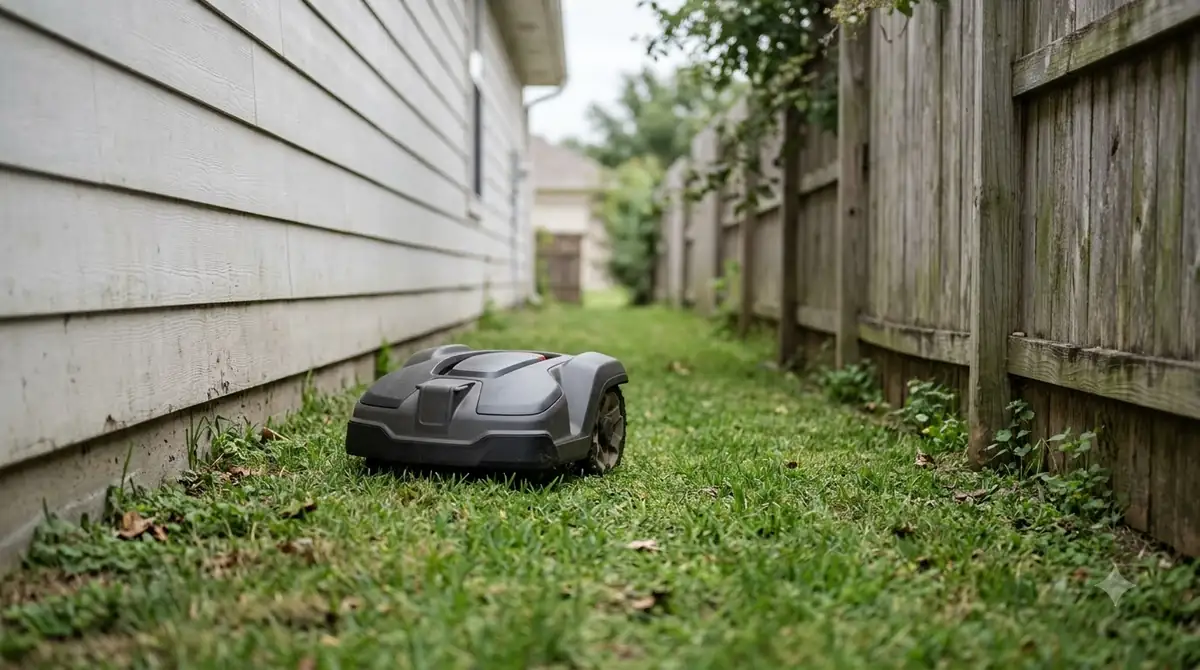
- Docking point: Husqvarna asks for the docking point to sit at least 6 meters from elevated objects such as hedges or buildings, so the signal to the satellites is not blocked.
- Narrow passages: Husqvarna flags passages narrower than 4 meters with elevated objects on either side, and a tree whose crown is less than 4 meters from the boundary.
- Stay-out zones: Husqvarna recommends stay-out zones around trees, roots and stones, each at least 30 by 30 centimeters.
Heads up
Mowrator says that if performance gets worse after rain or during peak growth, the cause is likely seasonal change in the canopy, with wet leaves and dense foliage, rather than a fault in the mower.
Which mowers avoid the sky problem
If the answer to do robot mowers need a clear view of the sky is yes for your model, wire-guided mowers and vision-plus-RTK hybrids are the two usual alternatives when a yard has heavy cover. Our page on a robot mower that works under trees without RTK goes deeper. Mowrator says boundary-wire mowers give consistent performance when satellite signals are unreliable, and that a vision-plus-RTK system may cope better than RTK alone in yards with frequent interference. The table below compares the three types in general terms.
| Type | Needs open sky | Usual trade-off |
|---|---|---|
| RTK-only satellite mower | Yes, over the lawn and the reference station | Strong in open yards, weaker under dense canopy |
| Vision plus RTK mower | Partly, because the camera helps when satellites drop out | May reduce interruptions when satellite signals drop out, according to Mowrator |
| Boundary-wire mower | No | Wire must be laid and maintained around the lawn |
Mowrator treats excessive canopy coverage as a barrier to RTK-only mowing. That is a vendor opinion, so test the claim against the manual of the model you are considering.
What to check before you buy
So, do robot mowers need a clear view of the sky in your yard? Before you buy a satellite mower, check the spots that matter most for the sky view: the docking point, the reference station and the areas under trees. A short walk with a phone can show whether those spots have open sky, and the answer usually decides whether the mower will work well. For a wire-based comparison, see boundary wire vs RTK installation time.
- Pick the docking point. Choose a spot with a clear sky view, not under trees or a roof, as Husqvarna recommends.
- Measure the clearance. Keep hedges and buildings at least 6 meters from the docking point where you can.
- Estimate the cover. If tall walls or trees cover more than 30 percent of the lawn, ask the maker about the setup before you buy.
- Check the passages. Where trees or buildings sit on both sides of a path narrower than 4 meters, plan a transport path or a stay-out zone.
- Read the model’s manual. Look for the sky-view figure for that exact model, because the figures above come from different brands.
Frequently asked questions
Can a satellite robot mower work in heavy shade?
It can work in light shade, but heavy shade weakens the signal. Mammotion does not recommend setups where tall walls or trees cover more than 30 percent of the lawn. If your yard is mostly shaded, a vision-plus-RTK or wire-guided model is usually the safer choice.
Do robot mowers need a clear view of the sky over the whole lawn?
Husqvarna says satellite installations need an open sky view across the lawn. Mammotion says the mower does not need a line of sight from every point to the station. So partly covered areas can still be mowed, but the lawn as a whole should have open sky.
Do wire-guided robot mowers need a clear view of the sky?
No. A wire-guided mower follows a buried boundary wire, so it does not depend on satellite signals. Mowrator describes boundary-wire mowers as consistent when satellite signals are unreliable, though the wire takes time to install.
Can I fix weak signal by moving the base station?
In many cases, yes, and our guide on where to place an RTK antenna in a yard with trees shows how. Mowrator calls base station placement one of the biggest factors in signal quality. Husqvarna asks for the reference station to be mounted within reach of a power supply and with an open view of the sky, so moving it to a clearer spot is the first thing to try.
Sources
- Plan a wire-free lawn mower installation (Husqvarna): sky view, 135-degree reference station, docking point and passage rules.
- Set up work areas, stay-out zones and transport paths with EPOS (Husqvarna): stay-out zones around trees and their minimum size.
- Can LUBA get a good RTK signal in my lawn (Mammotion): 90-degree sky view, the 30 and 50 percent cover guidance and crown-outline no-go zones.
- RTK robot mower signal loss and trees (Mowrator, vendor blog): canopy effects, seasonal changes and mitigations.
 Up next8 min readBy YardHow Much Boundary Wire Do You Need for a Robot Mower?Updated Nov 11, 2026
 9 min readBy YardHow Does a Robot Mower Handle Garden Furniture?Updated Nov 11, 2026
 8 min readBy YardWhere to Place RTK Antenna in a Yard With TreesUpdated Nov 11, 2026
 8 min readBy YardHow Does a Robot Mower Handle a Trampoline?Updated Nov 11, 2026
 8 min readBy YardCan a Robot Mower Work in a Yard With a Detached Garage?Updated Nov 11, 2026
 8 min readBy YardCan a Robot Mower Work in a Yard With Gravel Path Crossings?Updated Nov 11, 2026