
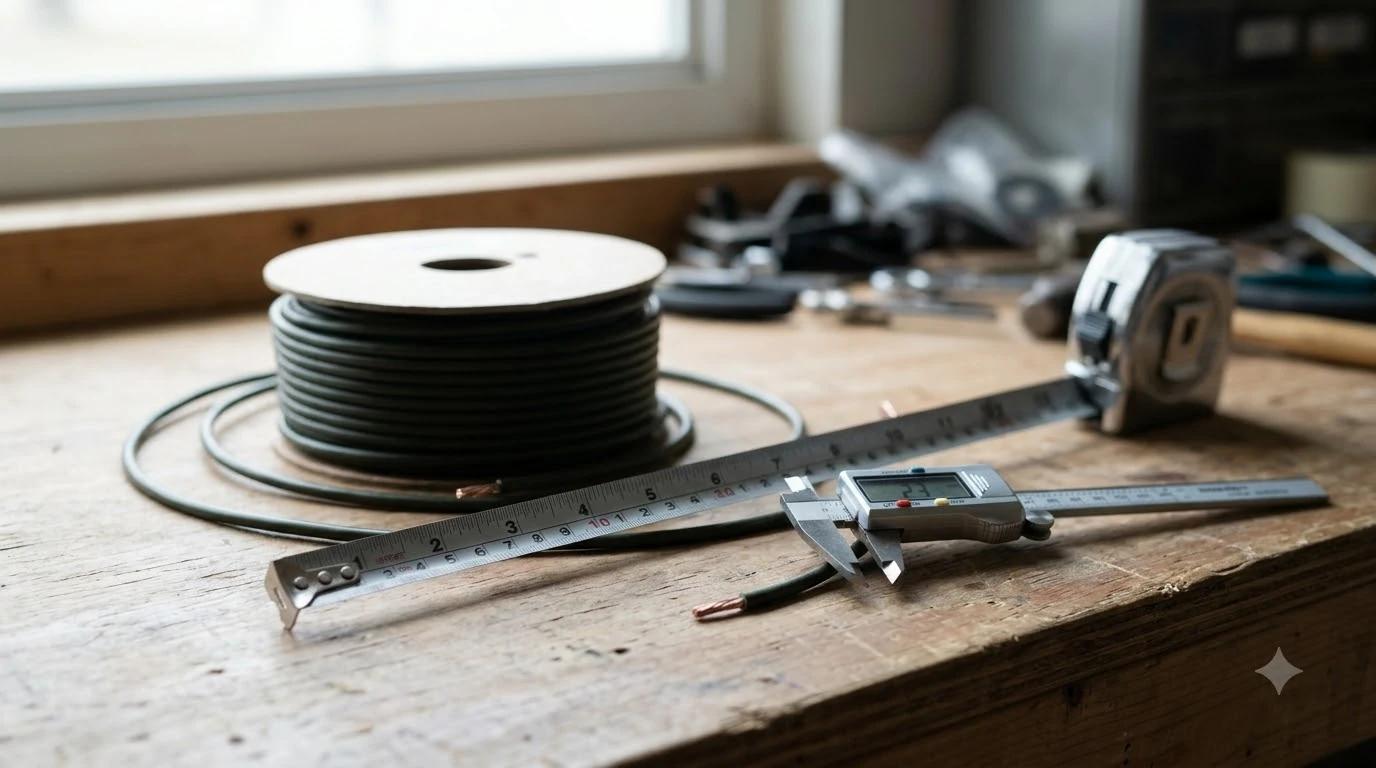

How much boundary wire do you need for a robot mower? Add up the perimeter, every obstacle loop, the dock lead and 10 to 15 percent slack, then check the total against your model’s maximum loop length. The arithmetic is simple. The model limit matters more than most buyers expect, because some Husqvarna models cap the total loop at 800 m (2,625 ft). If the total looks too large to manage, wire-free robot mowers avoid the loop altogether. Work out the number before you order, since a roll that runs short stops the install halfway through the yard.
The short answer
- Perimeter: for a rectangle, 2 × (length + width); for a circle, π × diameter.
- Islands: add each obstacle loop, counted out and back.
- Dock and connectors: add the dock lead, guide wire and a small connector allowance.
- Slack: add 10 to 15 percent, then compare the total with your mower’s maximum loop length.
How much boundary wire do you need: start with the perimeter
The perimeter is the largest share of the total, so measure it first. A rectangular lawn 100 feet long and 50 feet wide has a perimeter of 300 feet, because 2 × (100 + 50) = 300. A round lawn 60 feet across has a perimeter of about 188 feet, because π × 60 is roughly 188.5. Irregular lawns are easier to handle when you break the edge into straight runs and add them together. It is easy to underestimate this number when you measure only the house side instead of the open edge.
| Shape | Perimeter formula | Example |
|---|---|---|
| Rectangle or square | 2 × (length + width) | 100 × 50 ft = 300 ft |
| Circle | π × diameter | 60 ft across = about 188 ft |
| Triangle | side A + side B + base | 40 + 50 + 60 ft = 150 ft |
Measure along the line where you plan to lay the wire rather than the grass edge, and write each run on a sketch with its length in feet. Our reading is that a sketch with every number written down prevents most double counting, especially where a fence line and a path meet the same edge. A complete sketch also makes it easier to total the wire for the whole yard, not only the outer loop.
Add wire for each obstacle island
Each tree, flower bed or pond you fence off needs its own loop (see laying wire around trees and obstacles for the routing), and that loop is counted twice because the wire leaves the main boundary and returns to it. A common calculator method adds island wire as the island count multiplied by the average island perimeter plus two times the average one-way lead. For example, three beds with an average perimeter of 30 feet and a one-way lead of 10 feet need 3 × (30 + 2 × 10) = 150 feet of wire.
Obstacles also need clearance. Husqvarna’s guidance for the satellite-assisted KA 70234 says to lay the loop at least 2 meters (7 feet) outside a problem area, so the mower can reconnect with satellites and establish an accurate position. Our reading is that this figure applies to satellite-assisted models, so for a standard wire-only mower use the clearances in your own manual and add them to the size of each island.
Two-zone yards need a slightly different count. Husqvarna’s secondary area setup lays one boundary loop around both the main area and the secondary area, so the mower can reach both from a single charging station. In that layout the second zone shares the loop with the main area instead of needing its own installation, which changes the total for the whole property.
Count the dock lead, guide wire and connectors
The dock lead, guide wire and connectors add a smaller, more predictable amount, but they are easy to leave out of a first estimate. Include each of the items below.
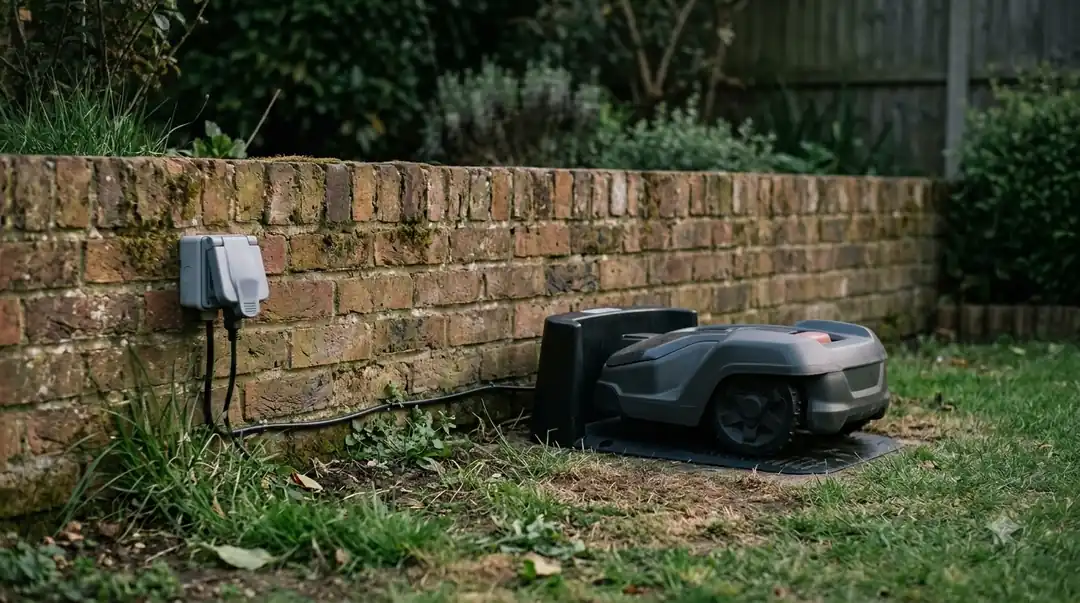
- Dock lead. The calculator method enters the dock lead once, and suggests about 3 to 10 feet for most setups. Where the dock sits changes that figure, so see where to put a robot mower charging station.
- Charging station connection. Husqvarna allows 50 cm (20 in) of extra wire for the connection to the charging station.
- Guide wire. Gardena says its boundary wire also acts as a guide wire, leading the mower back to the station. The calculator method counts guide wire in the total, but not in the loop limit check.
- Connectors. Cut the wire 1 to 2 cm (0.4 to 0.8 in) above each connector, and use waterproof wire connectors, since Robomow notes that exposed screw connections can rust.
Add slack and compare with your mower’s limit
When you ask how much boundary wire do you need to buy, the answer is the total plus slack, not the perimeter alone. Add 10 to 15 percent slack to the total. The calculator method describes that range as common and offers options from 0 to 25 percent. Using the example above, a 300-foot perimeter plus 150 feet of islands and a 10-foot dock lead gives 460 feet. With 10 percent slack that becomes about 506 feet, and with 15 percent about 529 feet, so a 500-foot roll would fall short.
Robomow notes that a delivery usually includes a basic set of several hundred meters of perimeter wire, so part of the answer may already be in the box. Check the length in your kit before you buy more, because the total you need is the number that counts.
Then compare the total with the maximum in your model’s manual. The limit is set by the mower maker, and the figures differ widely:
| Mower | Stated maximum | Source |
|---|---|---|
| Husqvarna Automower KA 70234 | 800 m (2,625 ft) total loop, including extensions | Husqvarna support |
| Husqvarna Aspire R4 | 300 m (980 ft) | Husqvarna support |
The Husqvarna figures show why the check matters. A yard that fits comfortably on one model can exceed the limit on another, so read the number for your exact model before you buy the wire. Robomow also says the maximum length is finite and is listed in the instruction manual, with limits that vary by model, from mowers for roughly 300 square meters (about 3,200 sq ft) of lawn up to those for about 2,000 square meters (about 21,500 sq ft).
Pack sizes matter too. Gardena sells its boundary wire in 150 m packs, which is about 492 feet. A 506-foot loop therefore needs more than one pack, and a 150 m roll is not enough for a loop of that size, so count the pack length against your total before you shop.
Why wire length affects the signal
Longer wire has more electrical resistance, and past a certain point the signal can become unreliable. For that reason, the answer to how much boundary wire do you need should be a planned total under the model’s limit, not a rounded-up guess. Robomow explains that resistance rises with cable length and that signal errors and interference become possible beyond that point. Thicker wire has lower resistance, which helps on larger lawns.
The same logic applies to repairs and additions. Robomow advises that any extension must match the original wire in material, diameter and resistance, and that the manufacturer’s wire should be used. Our reading is that mixing wire types is one reason a later extension can behave differently from the original loop.
Lay and secure the wire
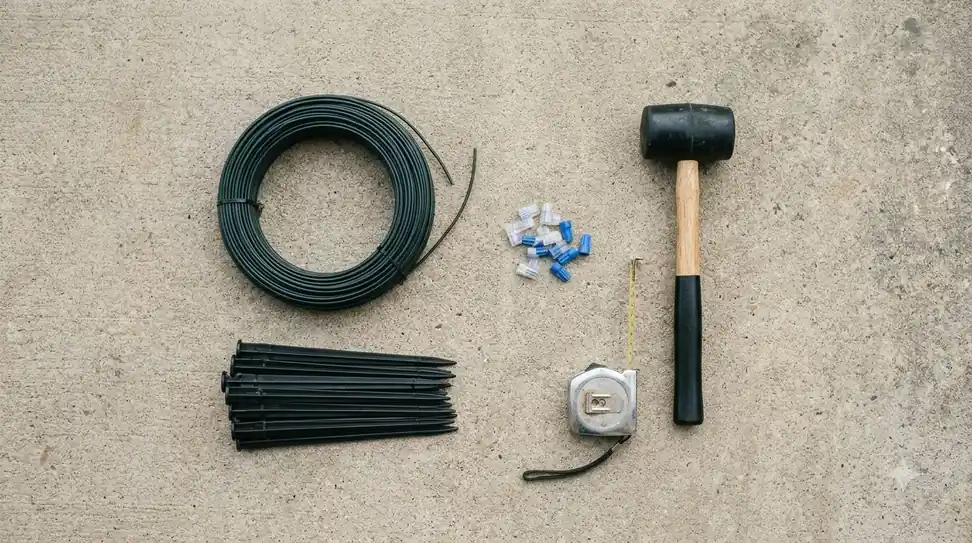
Staking the wire holds it in place and keeps the loop where you planned it. Work through the steps below, and test before you bury anything; our boundary wire installation guide covers the full layout. Once you know the total, the staking pattern is the next thing to plan, since it decides how many staples and connectors to buy.
- Plan the route. Mark the perimeter and every island on your sketch, and add the clearance your manual calls for, such as the 2 m (7 ft) Husqvarna gives for satellite problem areas.
- Stake the wire. Husqvarna’s guidance uses staples about 75 cm (2.5 ft) apart.
- Join with connectors. Use waterproof connectors and cut 1 to 2 cm (0.4 to 0.8 in) above each one.
- Test the signal. Check the signal at the charging station before you secure or bury the wire, as Robomow advises for extensions.
Frequently asked questions
How many feet of boundary wire do most yards need?
It depends on the perimeter and the islands, so there is no single answer to how much boundary wire do you need for every yard. A 100 by 50 ft lawn with no islands and a 10 ft dock lead needs about 340 ft once 10 percent slack is included. Add island loops and the total rises quickly.
Can I add more wire later?
Yes, but the extension must match the original wire in material, diameter and resistance, and the total must stay within the model’s maximum loop length. Robomow recommends using the manufacturer’s wire and waterproof connectors for any join.
Does the guide wire count toward the loop limit?
The calculator method counts guide wire in the total you need to buy, but leaves it out of the boundary loop limit check. Because limits differ by model, confirm the rule in your owner’s manual.
What is the safest way to avoid running out of wire?
Calculate the total with slack before you start, and buy the full length in one order. Gardena sells its boundary wire in 150 m packs, and it says you can add the required length on top of the supplied wire for larger areas.
Sources
- Husqvarna support: EPOS support by wire installation and tips (Husqvarna): loop limit of 800 m (2,625 ft), 2 m clearance, staple spacing, charging station allowance and connector cut length.
- Husqvarna support: how to create a secondary area (Husqvarna): recommended maximum of 800 m, and 300 m for the Aspire R4.
- Is it possible to extend the perimeter wire or change it later? (Robomow): resistance rises with length, wire thickness and extension rules.
- Boundary wire 150 m (GARDENA): pack length, the wire also acts as guide wire, and adding length for larger areas.
- Robot lawn mower boundary wire length calculator (DIY Smart Home Hub): the total-wire formula, rectangle and circle perimeters, island formula, dock lead and slack ranges.
 Up next9 min readBy YardHow to Lay Boundary Wire Around Trees and ObstaclesUpdated Nov 11, 2026
 8 min readBy YardShould You Bury or Peg Robot Mower Boundary Wire?Updated Nov 11, 2026
 8 min readBy YardDo Robot Mowers Need a Clear View of the Sky?Updated Nov 11, 2026
 9 min readBy YardHow Long Does a Robot Mower Take to Mow an Acre?Updated Nov 11, 2026
 7 min readBy YardBest Mowing Height for Shade Grass: What Extension Sources RecommendUpdated Nov 11, 2026
 8 min readBy YardQuarter Acre Lawn Size in Square FeetUpdated Nov 11, 2026