


Wire free vs boundary wire robot mowers differ in four main ways: setup, navigation, obstacles and zones, and repairs. A boundary wire mower follows a buried or pegged cable, while a wire-free mower builds a map with GPS, RTK, LiDAR or cameras. Each system has trade-offs, so the right choice depends on your lawn shape, its size and how often the layout changes.
The short answer
- Boundary wire: a low-voltage cable defines the lawn edge. It takes time to lay, but needs no map.
- Wire-free: the mower maps the lawn with an app. Setup is quicker, and a base station or clear sky may matter for RTK models.
- Obstacles: grass-sensor models need physical barriers. Boundary wire covers beds inside its loop.
- Repairs: a broken wire can stop a wired mower and is hard to locate. Wire-free maps are changed by driving the edge again.
How a boundary wire works
A boundary wire mower reads a low-voltage signal from a cable that runs around the lawn. The wire starts and ends at the charging station and must make a complete loop around the lawn area. Flower beds and other obstacles are included in that loop rather than cut out of it, which is why the wire often winds around them.

The return section of the loop must run parallel to the outbound section without crossing it. According to Robomow’s guide on boundary wire and grass sensors, the gap between the two runs should not be more than 10 cm. Keeping that spacing tight is one of the main points of accuracy in a wired layout.
How wire-free navigation works
A wire-free mower does not need a perimeter cable because it knows where the lawn is. RTK models use a stationary base station in the yard that sends correction signals, which Sunseeker says can improve positioning from several meters to 1 to 3 cm. The base station performs best in open areas with a clear view of the sky, and our guide to how RTK works on a robot lawn mower explains the correction step.
Vision and LiDAR models work differently. Cameras identify grass against pavement, mulch and beds, and Sunseeker notes that vision systems need clearly defined visual borders and can be affected by low light. LiDAR uses rotating lasers to build a 3D map and works in all lighting, though the laser lenses need to be kept clean. Each navigation type has different limits, so check the one used by the model you are considering, or read our RTK vs LiDAR vs vision comparison first.
Wire free vs boundary wire robot mowers: the setup difference
Setup is where many buyers feel the difference first. Boundary wire installation is the slowest part of owning a wired mower. Mammotion describes wired setup as time-consuming and tedious, and Robomow says the wire can be pegged to the surface with lawn nails or buried. Robomow states that burial can go up to 20 cm deep, and that burying the wire is the safer choice if you plan to scarify the lawn.
| Setup step | Boundary wire | Wire-free (RTK or grass sensor) |
|---|---|---|
| Preparation | Lay the loop, with pegs or burial | Place the base station (RTK), or none (grass sensor) |
| Mapping | Not needed, the wire sets the edge | Drive the edge in the app to build a map |
| Time | Not given in sources read | Sunseeker says 30 to 60 minutes for app mapping |
| Charging | Wall socket needed for the station | Wall socket needed for the station |
Sunseeker describes app mapping as usually finishing within 30 to 60 minutes, as of 2026-11-09. None of the sources read gives a figure for how long a wired installation takes, so it depends on yard size and complexity. Our reading is that a large yard with many beds will take longer to wire than to map.

Obstacles, beds and zones
Obstacle handling is another point where wire free vs boundary wire robot mowers differ. Wire-free mowers handle obstacles differently depending on the navigation type. Grass-sensor models, which detect the grass surface rather than using GPS, need physical barriers at flower beds and along neighbouring lawns. Robomow suggests wooden boards, stakes, pool noodles or edging stones that rise about 10 cm above the ground, and notes that pebbles are less suitable.
- Fallen leaves can look like lawn to a grass sensor, so the mower may drive over a bed they cover.
- Separate zones cannot be reached by a grass-sensor mower, according to Robomow.
- Multiple zones can be set up on some RTK models as virtual zones, which Sunseeker says can move between areas through gates or passages.
Boundary wire keeps beds inside the loop, so the mower stays out of them without extra barriers. Our reading is that this is a real advantage for a garden with many small beds.
Repairs and layout changes
Repairs are where wire free vs boundary wire robot mowers differ most. A broken boundary wire is the most common problem with a wired mower. Robomow says a break can be hard to locate, especially when the wire is underground, and that special tools may be needed. Mammotion adds that one wire fault can stop a wired mower completely, and that gardening tools, pets and burrowing animals can damage the wire. A robot mower boundary wire repair kit covers the usual splice.
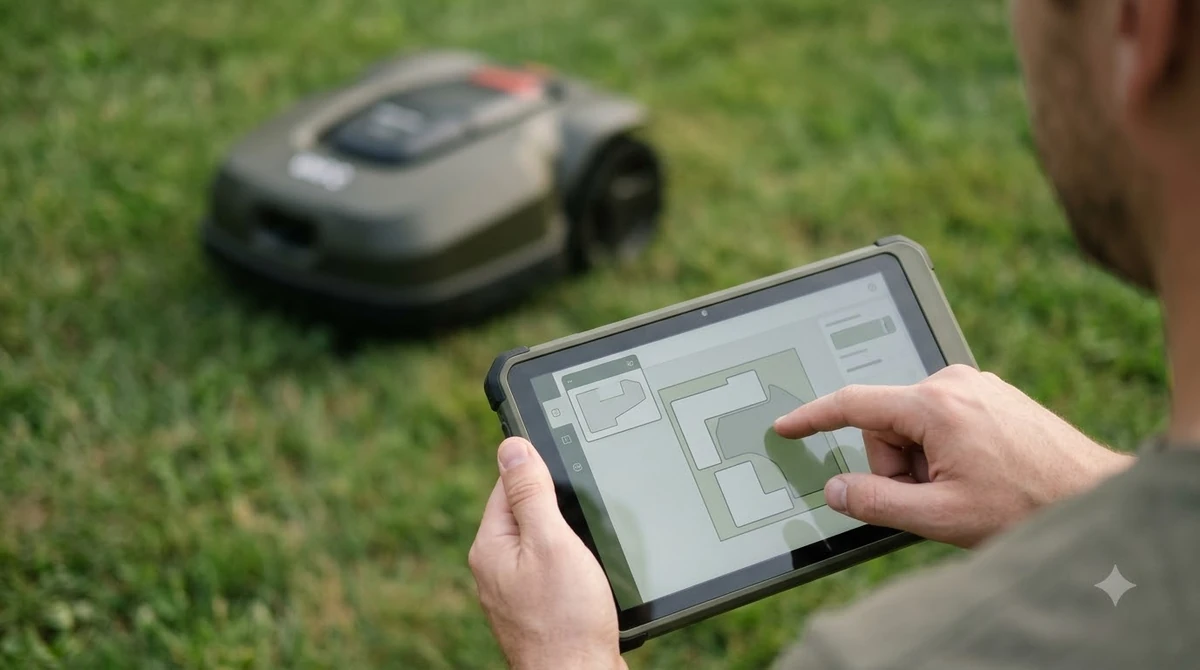
Changing the layout is also harder with a boundary wire. Robomow notes that changing the garden may require reinstalling the wire, which is laborious if it is buried. Wire-free maps change differently: you drive the new edge in the app and update the map, with no digging, as our explainer on virtual boundary mapping describes. Mammotion’s US guide adds that GPS-based models may need periodic recalibration, especially when the signal is weak.
Cost and maintenance
Cost is often the first comparison people make with wire free vs boundary wire robot mowers. Boundary wire mowers are usually the lower-cost option. Mammotion’s comparison labels wired mowers budget-friendly and wire-free mowers premium, and Sunseeker’s price table, as of 2026-11-09, lists EUR 700 to 1,600 for wired models against EUR 1,000 to 2,500 for wire-free models. Prices vary by brand, size and features, so check current listings before you buy.
| Factor | Boundary wire | Wire-free |
|---|---|---|
| Typical price band (Sunseeker, EUR, as of 2026-11-09) | 700 to 1,600 | 1,000 to 2,500 |
| Upkeep | Wire repairs, plus blade and deck care | Software updates, sensor cleaning, blade care |
| Navigation cost | None beyond the wire | Base station (RTK) or sensors |
Mammotion describes wire-free maintenance as minimal, covering deck cleaning, blade replacement and firmware updates. Wired maintenance is more complex because of wire repairs. Our reading is that the total cost depends on how often the wire needs fixing in your yard.
Which system fits your yard
When you weigh wire free vs boundary wire robot mowers for your own yard, start with the layout. Boundary wire suits a fixed, simple lawn where the layout will not change often. Wire-free suits a lawn that changes or has irregular edges, and Mammotion recommends wire-free models for lawns over 500 square meters. Sunseeker says the right choice depends on lawn size, terrain, budget and preferences, and gives no size thresholds for either type.
- Pick boundary wire if you want the lowest price and a fixed layout you do not plan to change.
- Pick wire-free if your lawn is large, has many trees, or changes often; our page on the best robot mower without a boundary wire lists models.
- Check the sky before buying an RTK model, since the base station needs an open view.
Frequently asked questions
Does a wire-free robot mower need a boundary wire at all?
Grass-sensor models do not use a perimeter cable, and RTK models map the lawn through an app and a base station instead. Check the model’s manual, because Robomow notes that some models use GPS alongside a wire, mainly to optimize mowing times and sometimes for theft protection.
How deep can a boundary wire be buried?
According to Robomow, the wire can be laid up to 20 cm deep. Burial protects the wire during scarifying, but it makes a break harder to find and repair.
Is a boundary wire cheaper than a wire-free mower?
Yes, in the price bands read for this guide. Sunseeker lists EUR 700 to 1,600 for wired models and EUR 1,000 to 2,500 for wire-free models, as of 2026-11-09. Check current listings in your region before buying.
What happens if the boundary wire breaks?
A single break can stop a wired mower completely, according to Mammotion. Finding the break can be hard, especially underground, and special tools may be needed.
Sources
- Boundary wire vs. grass sensors for robotic mowers (Robomow): wire layout, gap, burial depth, repairs, grass-sensor limits.
- Boundary wires vs. no-wire robot mowers (Mammotion, vendor): wire faults, mapping setup, lawn-size guidance.
- Wired vs. wireless robot mower (Mammotion, vendor): installation effort, recalibration, price and maintenance comparison.
- Wire-free robot lawn mowers explained (Sunseeker, vendor): app mapping time, RTK accuracy, vision and LiDAR limits, price bands.
 Up next8 min readBest Robot MowersDo Robot Lawn Mowers Need a Boundary Wire?Updated Nov 11, 2026
 8 min readBest Robot MowersWhat Is the Best Robot Mower Without a Boundary Wire?Updated Nov 11, 2026
 8 min readBest Robot MowersRTK vs LiDAR vs Vision: Which Robot Mower Navigation Fits Your YardUpdated Nov 11, 2026
 8 min readBest Robot MowersHow Do Robot Lawn Mowers Work? Wire, Sensors and Docking ExplainedUpdated Nov 11, 2026
 7 min readBest Robot MowersRobot Mower vs Riding Mower: Which Fits Your LawnUpdated Nov 11, 2026
 8 min readBest Robot MowersRobot Mower vs Push Mower: Which Fits Your Lawn?Updated Nov 11, 2026