
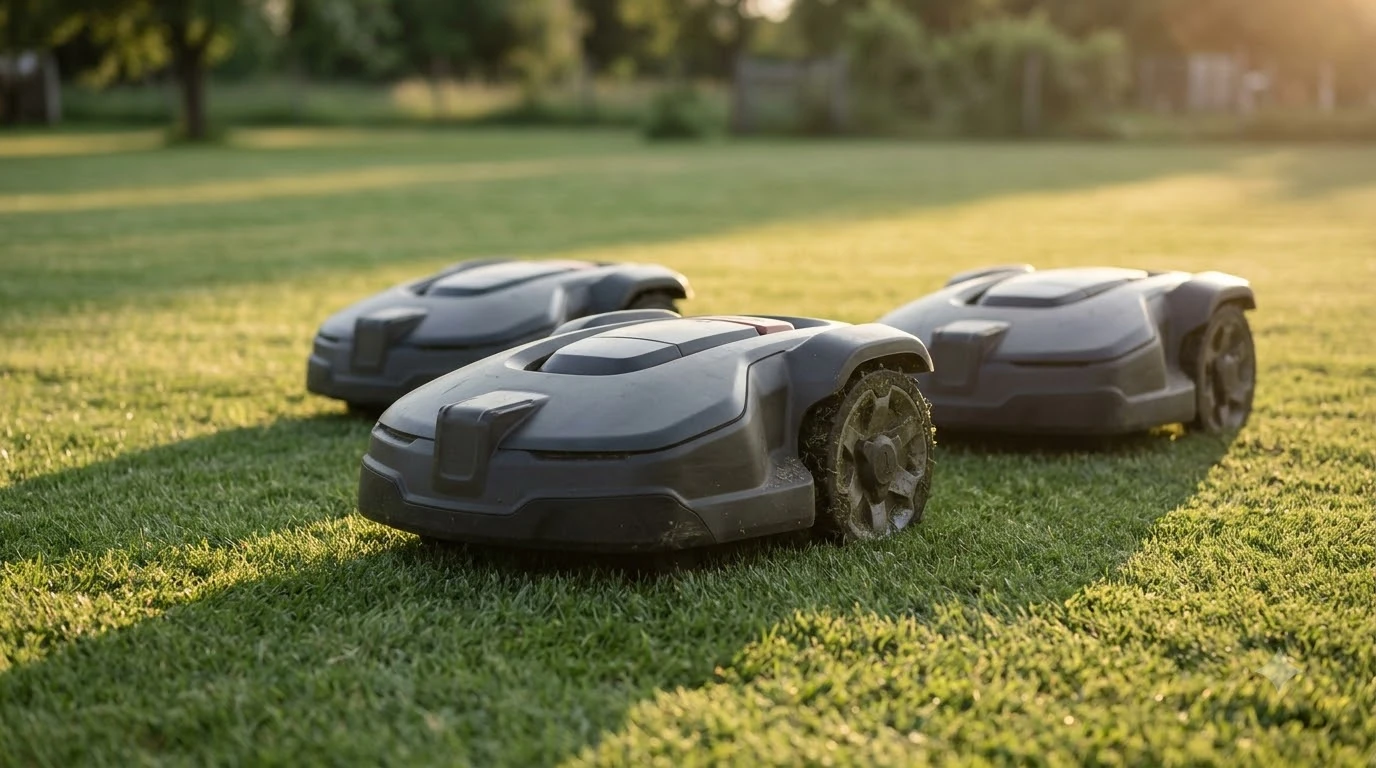

Robot mower vs push mower comes down to a trade-off: a robot costs more up front and needs a one-time setup, while a push mower costs less and takes your time for every session. The better pick depends on lawn size, slope, how loud you can tolerate, and how many hours a year you want back. The figures below come from manufacturer and reviewer pages we read, and several are undated, so check current prices.
The short answer
- Price: push mowers cost less to buy in every source we read.
- Time: the robot runs on its own after setup, while a push mower takes 30 to 60 minutes a session.
- Noise: robot mowers are rated near 55 to 65 dB, and gas push mowers near 85 to 95 dB.
- Lawn fit: robots suit small-to-medium lawns with moderate slopes; push mowers suit any size, if you will push it.
Upfront cost: robots cost several times more
On price, robots sit well above push mowers in every source we read. A US vendor blog gives robot mowers at $700 to $5,000 and traditional push mowers at $300 to $500, while a UK manufacturer lists robots at GBP 400 to GBP 2,000 and push mowers at GBP 50 to GBP 300. Mammotion’s own table gives a higher top figure of GBP 5,000 for robots, so treat the upper figures as a rough guide rather than a fixed price. Our robot lawn mower cost guide looks at the price tiers in more detail.
| Source | Robot mower | Push mower |
|---|---|---|
| TerraMow blog (US) | $700 to $5,000 | $300 to $500 |
| Mammotion UK blog | GBP 400 to GBP 2,000 | GBP 50 to GBP 300 |
The price gap is the first thing most buyers notice. The question that matters is whether the robot’s lower running cost and saved time close that gap over the life of the mower, which the next sections cover.
Weekly time: what each type asks from you
When you weigh a robot mower vs push mower, the push mower takes real time each session, while a robot mows on a schedule once it is set up. A UK manufacturer says mowing with a push mower can take 30 minutes to over an hour, depending on the garden. A US vendor estimates a typical push mowing session at 30 to 60 minutes and about 60 hours a year for a homeowner.
Both types still need upkeep, so the comparison should count it. Robot mowers need occasional blade sharpening and debris cleared from the body, according to eufy. Push mowers need the blades cleaned and moving parts oiled regularly, according to eufy, and TopTenReviews notes that the grass box must be emptied when full.
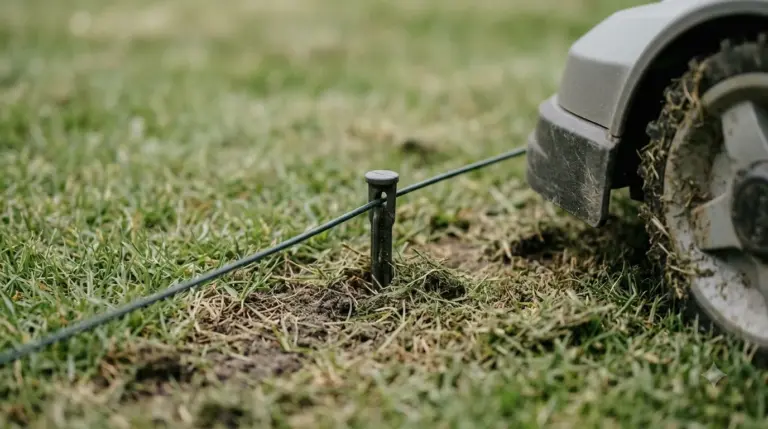
The robot’s setup is the main time cost. TopTenReviews notes that a wire boundary “takes a while to set up” on the Gardena model it reviewed, and Mammotion says the initial setup takes time. Our reading is that the one-time setup is what you trade for many hours of mowing you no longer do.
Noise: robot mowers run quieter
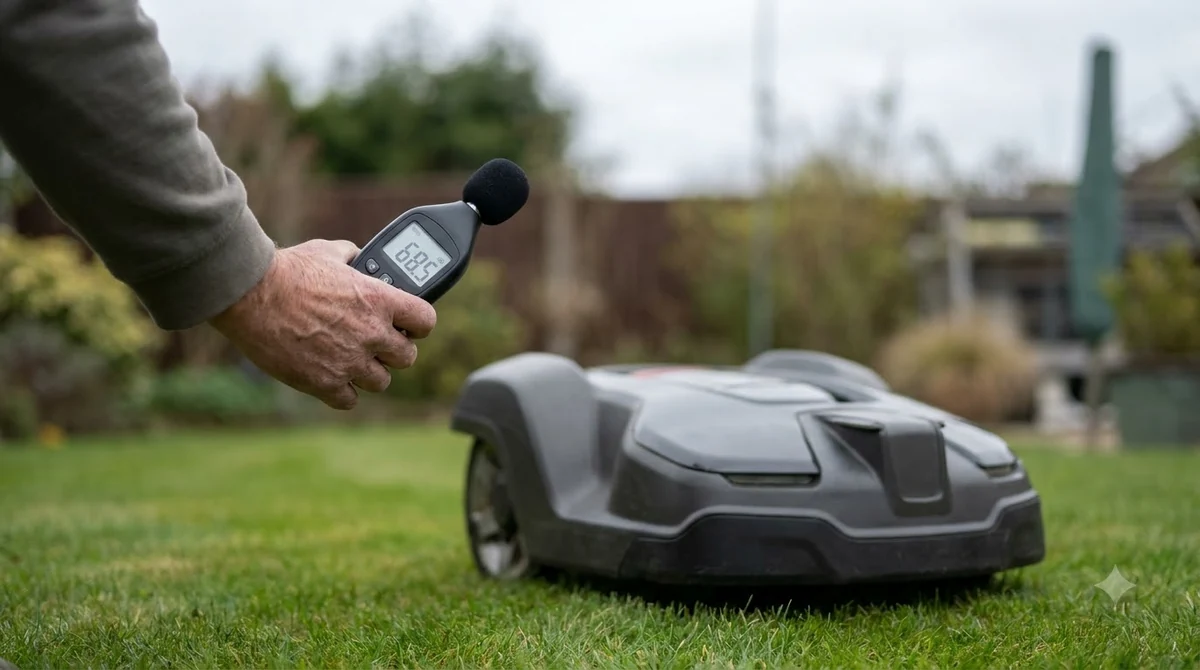
On noise, the robot mower vs push mower gap is wide: robots are rated quieter than gas push mowers in every source we read. Vendor figures put robots at 55 to 65 dB and say they stay under 60 dB, while gas mowers run at 85 to 95 dB. eufy gives 56 dB for its robot and an average of 90 dB for gas mowers. The guide to robot mower noise levels compares more models.
For context, OSHA sets its workplace permissible exposure limit at 90 dBA over an 8-hour day, and its hearing conservation program starts at an 85 dBA time-weighted average over a shift. Those rules cover workers, not homeowners, but they show why a mower near 90 dB is loud enough to matter over a long session.
Lawn size and slope limits
Size often decides the choice. Robot mowers handle lawns up to a size set by the model, and the limit is not the same across brands; our guide to sizing a robot mower to your lawn shows how to measure. One Gardena model is listed for lawns up to 2,700 square feet, eufy describes robots as best on small-to-medium plots with some models handling up to 0.4 acres, and a US vendor says some high-end home models reach 1.25 acres.
- Up to about 2,700 square feet: the listing for the Gardena model reviewed by TopTenReviews.
- Up to about 0.4 acres: the range eufy gives for its small-to-medium models.
- Up to 1.25 acres: high-end home models, according to the TerraMow vendor blog.
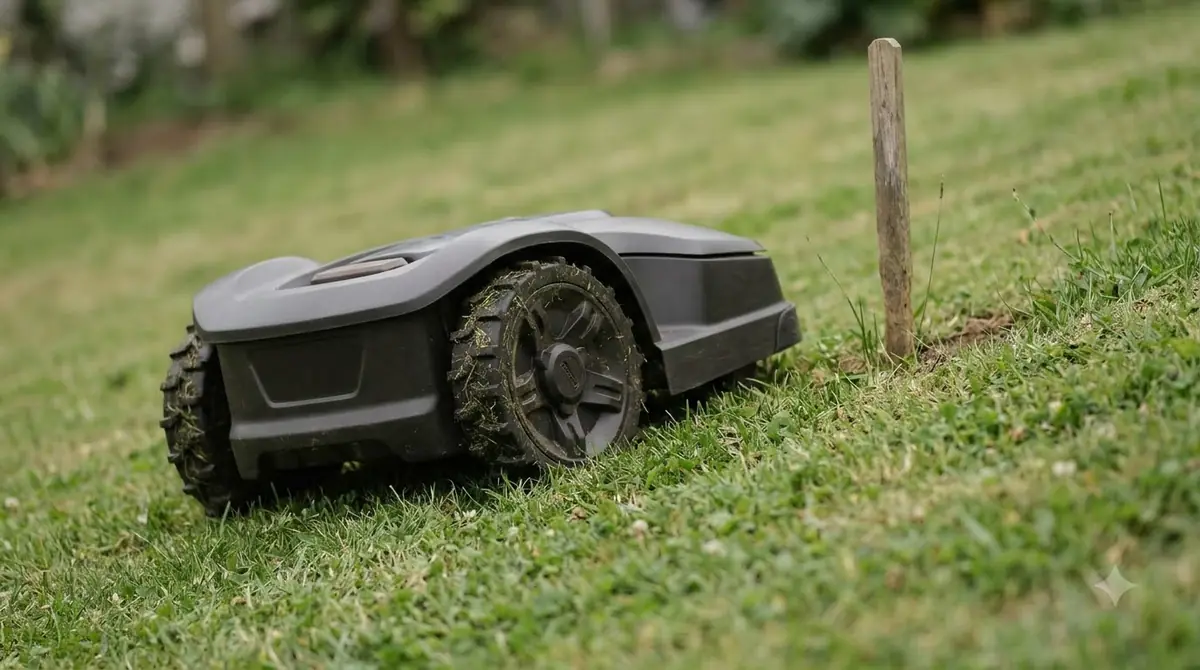
In a robot mower vs push mower decision, slope is the limit that needs the closest check. The sources do not agree: the Gardena model is listed for slopes up to 35 percent, a Mammotion model up to 45 percent (24 degrees), and TerraMow gives conflicting figures of 24, 35 and 45. Check the spec sheet of the exact model before you buy. None of the sources we read gave a slope limit for push mowers, so these sources cannot rank the two on hills. For how slope ratings are read, see robot mower slope ratings explained.
Robot mower vs push mower running cost
The running-cost gap is about energy: a robot mower uses electricity, and a gas push mower uses fuel plus oil and filters. A US vendor puts robot electricity at 0.5 to 2 kWh a week, which it estimates at about $15 to $20 a year at US rates. A gas mower on a 1-acre lawn uses about 15 gallons a year, which the same page puts at roughly $47 in fuel. The sources we read did not date these estimates, so use them as rough figures.
| Running cost item | Robot mower | Gas push mower |
|---|---|---|
| Energy use (vendor estimate) | 0.5 to 2 kWh a week | About 15 gallons a year on 1 acre |
| Yearly energy cost (vendor estimate) | About $15 to $20 | About $47 in fuel |
| Five-year cost (vendor estimate) | $250 to $740 (electricity, blades, battery) | $1,880 to $2,500 (fuel, oil, filters) |
The five-year figures add the parts that wear out. Robot blades and batteries are a recurring cost, and the vendor includes them in its robot total. For the power side, see robot mower power use and cost. The totals favor the robot in this vendor’s model, but the gap depends on the price you pay up front and the lawn you mow.
Robot mower vs push mower: which to choose
The choice favors the robot when quiet operation and saved time matter more than the purchase price, and your lawn falls inside the model’s listed area and slope. Choose a push mower when the budget is tight, the lawn is small and flat, or the yard has slopes beyond what the robot can climb.
- Pick a robot if you mow often, want to skip the weekly session, and have a lawn within the model’s limits.
- Pick a push mower if the upfront cost is the deciding factor, or if the slope is steeper than any robot listing you find.
- Check first the area, slope, and boundary-wire needs of the exact model, since the sources disagree on several limits.

Frequently asked questions
Is a robot mower worth the money?
It depends on your time and lawn, and a robot mower vs push mower decision turns on those two things. Vendor estimates put robot mowers at $700 to $5,000 up front against $300 to $500 for push mowers, but the robot takes over the 30 to 60 minute push mowing session. If you value that time and your lawn is within the model’s limits, the higher price can make sense. A push mower is the better value for a tight budget.
Are robot mowers quieter than push mowers?
Yes. Every source we read puts robots quieter. Vendor figures place robot mowers at about 55 to 65 dB and gas push mowers at 85 to 95 dB. OSHA’s workplace limit of 90 dBA over an 8-hour day is set for workers, but it gives a sense of how loud 90 dB is over a long session.
Can a robot mower handle a hill?
Some can, but the limits vary by model. One Gardena model is listed for slopes up to 35 percent, and a Mammotion model for 45 percent or 24 degrees. The sources conflict, so check the exact model’s spec sheet before you buy. None of the sources we read gave a slope limit for push mowers.
How much time does a push mower take each week?
A typical push mowing session takes 30 to 60 minutes, according to a US vendor blog. That vendor estimates about 60 hours a year for a homeowner. The time depends on lawn size, mowing frequency, and the grass height, so your own weekly total may be higher or lower.
Sources
- OSHA noise standards (U.S. Department of Labor): the 90 dBA permissible limit and the 85 dBA hearing conservation trigger.
- Robot vs push lawn mower (TopTenReviews): Gardena model specs for area, noise, and slope, and the wire boundary setup note.
- Is a robotic lawn mower worth it (TerraMow blog): purchase price ranges, mowing time, noise, and five-year running cost estimates.
- Robot lawn mower vs push mower (Mammotion UK blog): UK price ranges, push mowing time, and a slope figure for one model.
- Robot mowers vs traditional mowers (eufy blog): robot and gas noise figures and maintenance tasks.
 Up next8 min readBest Robot MowersRTK vs LiDAR vs Vision: Which Robot Mower Navigation Fits Your YardUpdated Nov 11, 2026
 7 min readBest Robot MowersRobot Mower vs Riding Mower: Which Fits Your LawnUpdated Nov 11, 2026
 8 min readBest Robot MowersWire-Free vs Boundary Wire Robot Mowers: Which Setup Fits Your YardUpdated Nov 11, 2026
 9 min readBest Robot MowersWhat Is the Best Cheap Robot Lawn Mower? How to Choose One That FitsUpdated Nov 11, 2026
 9 min readBest Robot MowersAre Robot Lawn Mowers Worth It? Who Benefits and Who Should SkipUpdated Nov 11, 2026
 9 min readBest Robot MowersHow Do LiDAR Robot Mowers Navigate?Updated Nov 11, 2026