
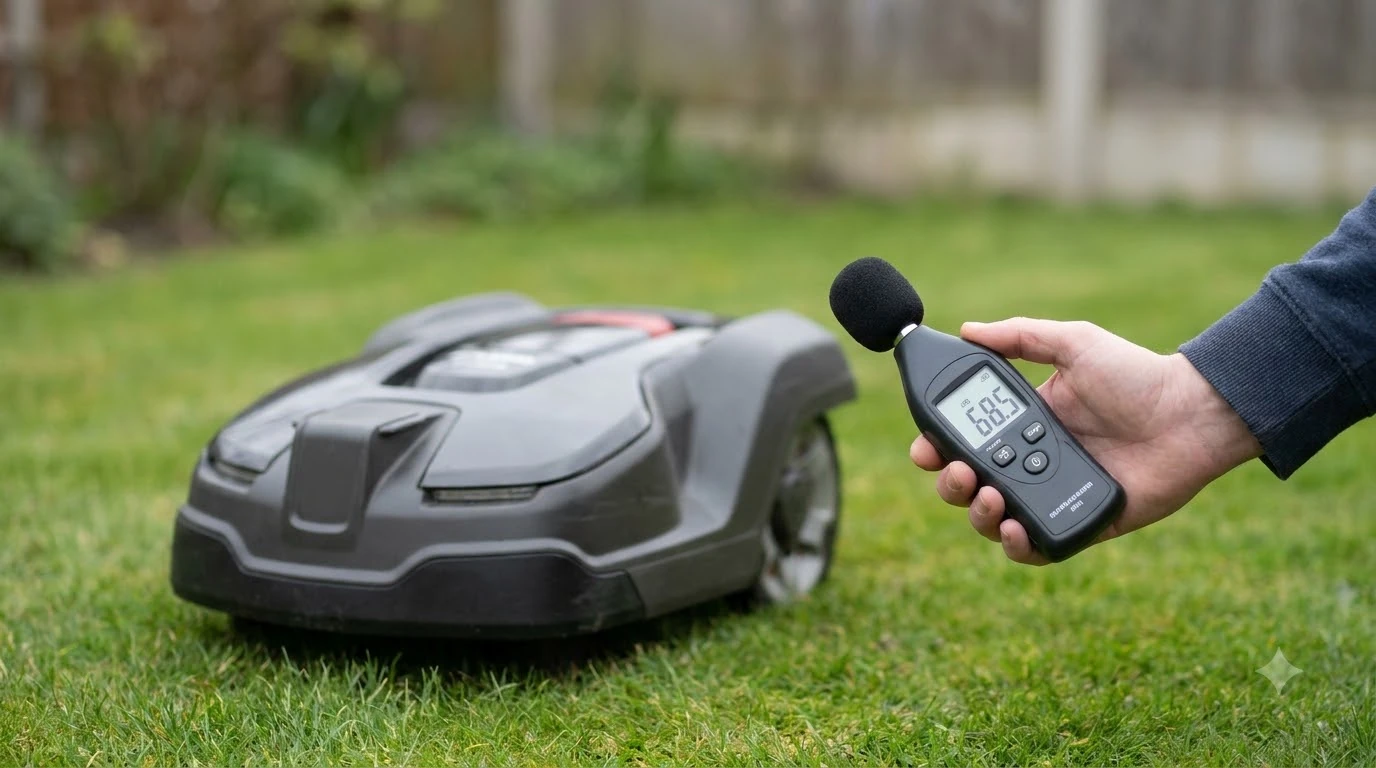

How loud are robot lawn mowers? They are marketed as quieter than gas or electric models, but a decibel figure only means something with a distance and a scale attached. Robomow says a unit rated at 60 dB or less usually does not cause quarrels in the neighborhood.
The short answer
- Rating: Robomow says robotic mowers at 60 dB or less usually do not cause neighborhood quarrels.
- Distance: the level drops by about 6 dB each time the distance doubles, according to Robomow.
- Hearing: NIDCD says sounds at or below 70 dBA are unlikely to cause hearing loss, even after long exposure.
- Scale: check whether a spec says dB or dBA, because health guidance is written in dBA.
- Gas comparison: the sources we read give no verified decibel figure for gas or electric mowers, so compare specs measured the same way.
How loud are robot lawn mowers compared with gas and electric models?
Robomow states that robotic mowers are substantially quieter than electric or gasoline mowers, but its page gives no decibel figure for those machines. That is a manufacturer’s comparison of its own category, not an independent test. The sources we read did not give a verified figure for gas or electric mowers, so this guide does not put a number on the difference.
Asking how loud are robot lawn mowers only gets you half an answer, because the distance and scale complete it. Before you compare two products, check that both figures use the same distance, the same scale and the same operating condition. Otherwise a gap of a few decibels may reflect how each number was measured rather than how the mower sounds. Robomow’s noise guide is one manufacturer’s view, so read its comparisons with that in mind.

What the decibel scale means in everyday terms
Normal conversation sits at 60 to 70 dBA, and motorcycles reach 80 to 110 dBA, according to the National Institute on Deafness and Other Communication Disorders. That page gives no decibel value for lawn mowers, though it names them as a home source of harmful noise. dBA is the A-weighted scale used in health guidance, which is why it matters when you read a spec sheet.
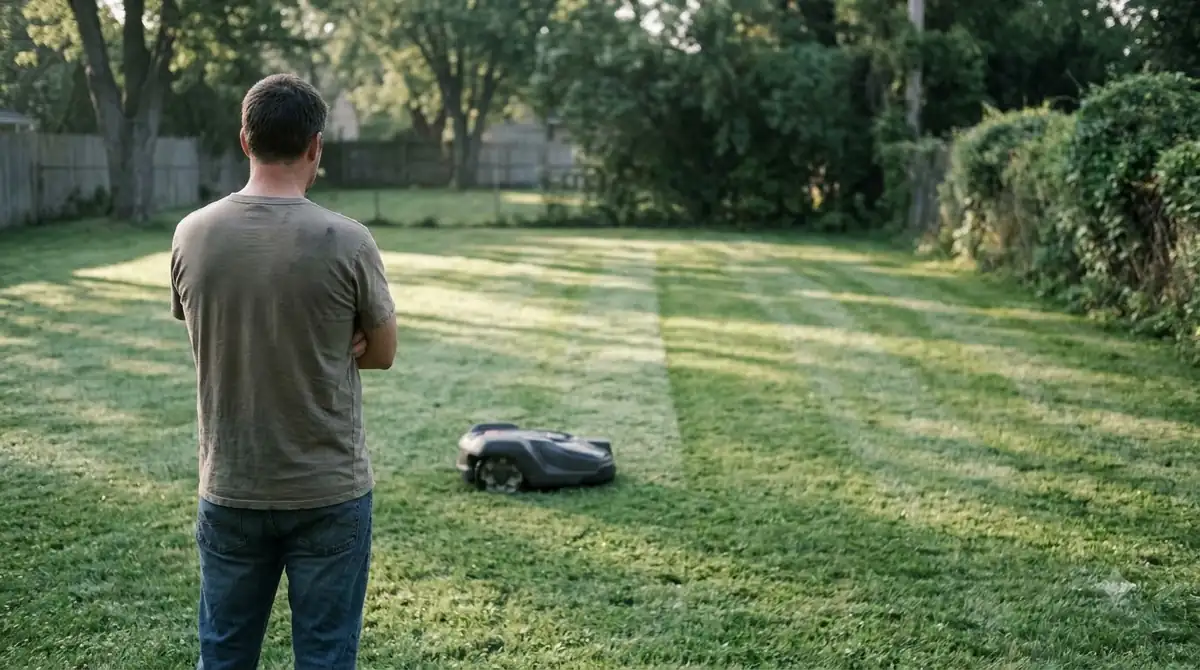
Robomow notes that a robotic mower at 70 dB seems much louder than one at 60 dB. A gap of 10 dB on a spec sheet is therefore worth checking, not dismissing as a small difference.
Why distance changes the number on the spec sheet
The level falls as you move away from the mower, by roughly 6 dB for each doubling of distance, according to Robomow. Its example starts with a robotic mower rated at 60 dB at 5 meters, which would read about 54 dB at 10 meters. That 54 dB value is an illustration on the page, not a measured result for a named model, but the rule behind it is the useful part.
| Distance from the mower | Estimated level for a 60 dB unit rated at 5 meters |
|---|---|
| 5 meters | 60 dB (the rating) |
| 10 meters | About 54 dB (Robomow example) |
| 20 meters | About 48 dB (our calculation using the same 6 dB rule) |
Because the level falls with distance, our reading is to judge the sound at the boundary rather than at the mower. Robomow also says manufacturers often leave the distance out of dB specs, and that legal limits apply at the property boundary rather than at the mower itself. Our reading is that the level at your neighbor’s fence line matters more than the number printed on the box, so keep that in mind when you choose where the mower will run. If a mower is too loud at the fence line, our tips on how to reduce robot mower noise cover what you can change.
When robot mower noise can affect hearing
Hearing loss is linked to long or repeated exposure to sounds at or above 85 dBA, according to NIDCD. The same page says sounds at or below 70 dBA are unlikely to cause hearing loss, even after long exposure. It also notes that the louder the sound, the shorter the time before hearing loss can develop, and its rule of thumb is to avoid sounds that are too loud, too close or last too long.
The Occupational Safety and Health Administration sets its workplace limit at 90 dBA over an eight-hour day and treats an 85 dBA time-weighted average as the trigger for a hearing conservation program. OSHA applies a 5 dBA exchange rate, while NIOSH recommends a 3 dBA rate, so allowable time shrinks faster under the NIOSH rule. These limits cover workers, but they show how quickly safe time drops as levels rise.
The EPA defines noise as unwanted or disturbing sound, lists hearing loss as the most common health effect of noise and says people can use hearing protection. If a robot mower is rated near 60 dBA, it sits below the 70 dBA level that NIDCD describes as unlikely to harm hearing. A manufacturer figure may not be stated in dBA, though, so treat it as a rough guide rather than a measurement at your ear.
How to read a robot mower noise spec
Compare two robot mowers only when their figures share the same unit, distance and operating condition. Use this checklist before you rely on any noise rating, and see how many hours a day a robot mower runs to judge how long the noise lasts.
- Confirm the unit. Check whether the spec says dB or dBA. Health guidance from NIDCD and OSHA uses dBA, so a dBA figure is easier to set against those thresholds.
- Find the distance. A number with no distance cannot be compared with another. Robomow notes that manufacturers often leave the distance out.
- Ask what was measured. The sources we read do not say which operating mode manufacturers use, so treat the test condition as unknown until the maker states it.
- Estimate at your boundary. Use the 6 dB rule to estimate the level at your nearest neighbor’s wall, because Robomow says legal limits apply at the property boundary.
- Check local rules. Noise ordinances and quiet hours vary by city and county, so look up your own rules before you set a mowing schedule. Homeowner associations may add their own limits, as covered in robot lawn mower HOA rules.
Put simply, how loud are robot lawn mowers depends on which figure you read and where you stand when you hear it. A rating near 60 dB is a useful starting point, not a guarantee. Our reading is that the cutting schedule and the mower’s route across your yard matter as much as the printed number. You can compare how mowers differ on other spec lines in how to read a robot mower spec sheet.
Frequently asked questions
Are robot lawn mowers quieter than gas mowers?
Robomow says robotic mowers are substantially quieter than electric or gasoline mowers. The sources we read do not give a verified decibel figure for gas or electric models, so the size of the difference is not quantified here. The question of how loud are robot lawn mowers relative to gas models has no verified number in our sources, so compare specs measured at the same distance and on the same scale.
Is 60 dB loud for a lawn mower?
Robomow says a robotic mower rated at 60 dB or less usually does not cause quarrels in the neighborhood. NIDCD lists normal conversation at 60 to 70 dBA, so 60 is close to everyday talk. Distance and the scale used still change what you hear at home.
Can a robot mower damage hearing?
NIDCD says long or repeated exposure to sounds at or above 85 dBA can cause hearing loss, and sounds at or below 70 dBA are unlikely to do so even after long exposure. A robot mower rated near 60 dBA sits below both levels at normal distance. A rating is still not a measurement at your ear.
Where should I check noise rules for a robot mower?
Robomow says legal limits apply at the property boundary, not at the mower itself. Check your city or county noise ordinance and quiet hours, since rules differ by place.
Sources
- How loud is a robotic mower? (Robomow): the 60 dB threshold, the 5 to 10 meter example, the 6 dB rule and the property boundary point.
- Noise-Induced Hearing Loss (NIDCD, NIH): everyday sound levels and the 70 and 85 dBA thresholds.
- Occupational Noise Exposure: Overview (OSHA): the 90 dBA limit, the 85 dBA trigger and the exchange rates.
- Clean Air Act Title IV: Noise Pollution (EPA): the definition of noise and its health effects.
 Up next8 min readBest Robot MowersRobot Mower Subscription Fees: Simple 2026 Price GuideUpdated Nov 11, 2026
 8 min readBest Robot MowersBest Quiet Robot Lawn Mower for Night Mowing: 60 dB GuideUpdated Nov 11, 2026
 9 min readBest Robot MowersAre Robot Mowers Safe for Kids and Pets?Updated Nov 11, 2026
 9 min readBest Robot MowersAre Robot Lawn Mowers Worth It? Who Benefits and Who Should SkipUpdated Nov 11, 2026
 8 min readBest Robot MowersDo Robot Mowers Work in the Rain? Sensors, Delays and LimitsUpdated Nov 11, 2026
 8 min readBest Robot MowersHow Long Do Robot Mower Batteries Last?Updated Nov 11, 2026