
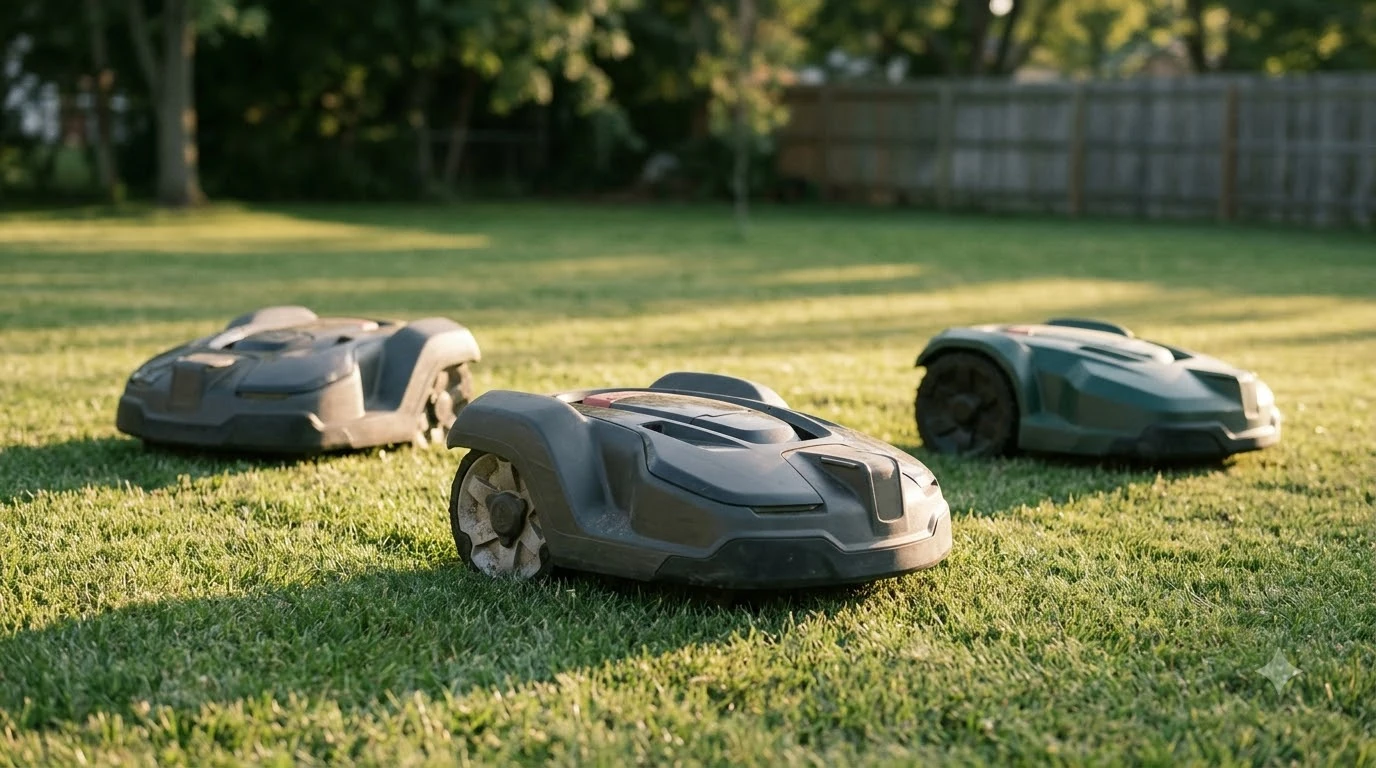

How to choose a robot mower for your lawn size starts with the grass you will actually cut, not the total property. Measure that mowable area, match it to a size tier, and then add headroom. Maker guides say rated coverage assumes a flat lawn with no obstacles, so real yards usually get less.
The short answer
- Measure only the grass the mower will cut, leaving out beds, patios and driveways.
- Match that area to a size tier, such as under 0.25 acre, up to 0.50 acre, or larger.
- Add headroom of at least 20 to 30 percent above your mowing area, per Dreame’s buying guide.
- Check slopes and trees before buying, since both reduce usable coverage.
Start with your mowable lawn area
Measuring only the grass the mower will cut is the first step, and our guide to how small a yard can be for a robot mower covers the low end. Clemson Extension calls measuring lawn area one of the most crucial steps any homeowner can take to manage a lawn, and the same measurement drives the size choice. Start with a rough sketch, mark the house, beds and patios, and divide the grass into simple shapes.
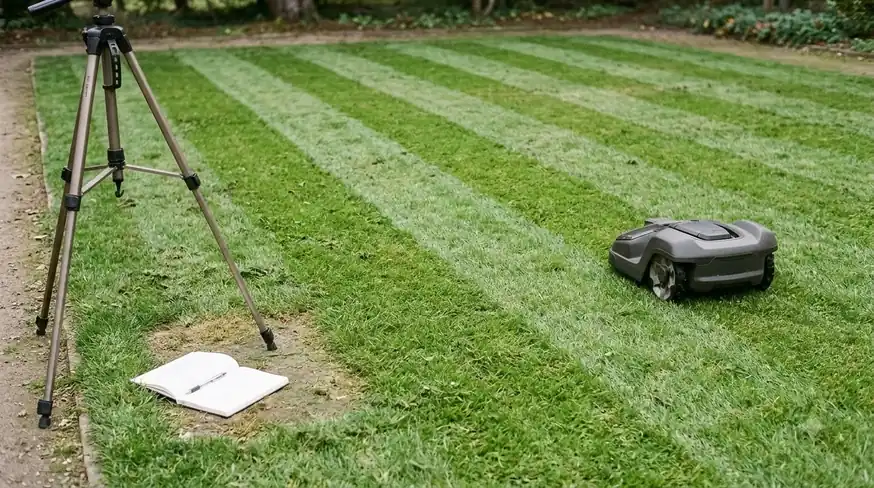
Iowa State Extension gives the shape formulas for lawns and beds. A rectangle is length times width, a triangle is base times height times 0.5, and a circle is 3.14 times the radius squared. A semicircle is half of that circle area. Add the areas of the grass shapes, then subtract anything that is not lawn.
Curved or irregular borders are harder to split into shapes. Clemson describes the offset method, which divides the lawn into many small rectangles:
- Mark the longest line across the lawn, with ends A and B.
- Draw offset lines at right angles to that line, evenly spaced.
- Measure the width across the lawn at each offset line.
- Add the widths and multiply by the spacing between the lines.
Clemson notes that the closer the offset lines are, the more accurate the estimate. Its example uses five widths of 26, 24, 18, 30 and 28 feet, spaced 10 feet apart. The page prints a total of 1,536 square feet, but adding the five widths gives 126 feet, and 126 times the 10-foot spacing is 1,260 square feet, so use the arithmetic rather than the printed total.
Match your lawn to a size tier
Dreame’s buying guide sorts robot mower lawns into three tiers. Entry-level mowers suit small, flat lawns under 1,000 square meters, which is 0.25 acre. Mid-range models suit typical suburban lawns up to 2,000 square meters, or 0.50 acre. Premium models are meant for lawns over 2,000 square meters.
| Tier | Lawn size (Dreame guide) | Typical fit |
|---|---|---|
| Entry | Under 1,000 m2 (0.25 acre) | Small, flat lawns |
| Mid-range | Up to 2,000 m2 (0.50 acre) | Typical suburban lawns |
| Premium | Over 2,000 m2 (0.50 acre) | Larger lawns |
Model listings give a second check on how to choose a robot mower for your lawn size. Husqvarna’s robotic mower page lists the Automower 410 iQ for up to 0.5 acre and the 420 iQ for up to 1 acre. Its other listed sizes include 1.3 acres for the 435 iQ AWD, 2 acres for the 440 iQ and 1.5 acres for the 560 EPOS. Each size carries a plus or minus 20 percent tolerance.
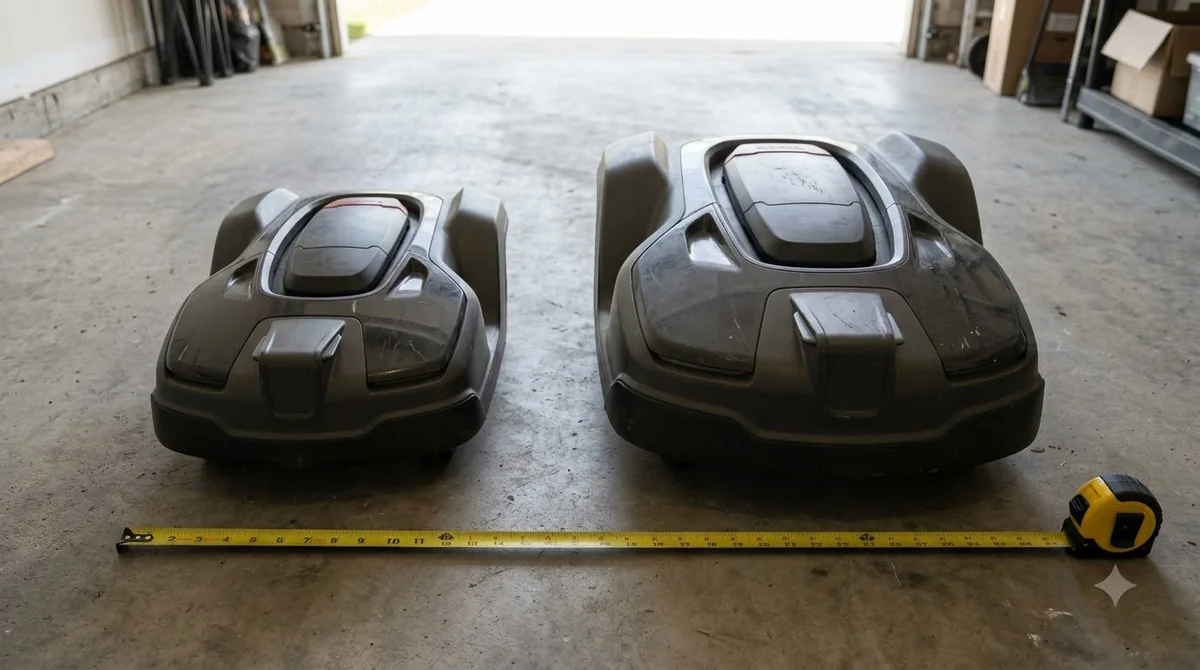
Husqvarna does not explain what the plus or minus 20 percent covers, so treat each listed size as a rough guide, not a hard limit. Its page describes the 410 iQ for small to medium yards and the 420 iQ for medium to large yards.

Why rated coverage is lower than the number on the box
Rated coverage is calculated under ideal conditions, which means a flat, rectangular lawn with no obstacles; the guide to how coverage ratings are calculated goes deeper. Dreame’s guide says a yard may lose 20 to 30 percent of its rated coverage to several common features:
- Trees and beds that take space out of the mowable area; see robot mowers under trees for how canopy affects the job.
- Slopes, which Dreame lists as a loss factor on their own.
- Complex boundaries in the shape of the lawn.
- Wet grass, which Dreame also lists as a loss factor.
Dreame gives a concrete example. A mower rated for 0.5 acre realistically covers 0.35 to 0.4 acre in a typical suburban setting. Our reading of that example is that real coverage can fall to about 70 to 80 percent of the box rating, so a rating equal to your lawn size is too tight.
How much headroom to add
How to choose a robot mower for your lawn size comes down to headroom. Dreame recommends a rated coverage at least 20 to 30 percent above your mowing area, and 30 to 50 percent above for a 2,000 square meter lawn when you want single-run coverage. Its checklist sets a separate rule for daily mowing.
- General rule: rated coverage at least 20 to 30 percent above the mowing area.
- Large lawn: size up by 30 to 50 percent for a 2,000 square meter lawn, aiming for single-run coverage.
- Daily mowing: rated coverage at least 20 percent above the mowing area.
Here is a worked example using these rules. A 0.4 acre mowing area multiplied by 1.2 to 1.3 gives a rating of about 0.48 to 0.52 acre. Our reading is that a 0.5 acre rating falls inside that band, near its bottom edge, so it is a tight fit for a 0.4 acre lawn.
Slopes and steep ground
Dreame says slopes steeper than about 35 percent call for all-wheel drive, and slopes also reduce usable coverage. The explainer on what AWD means on a robot mower shows why. Its guide lists slopes among the factors that can cut rated coverage, alongside trees and wet grass.
Husqvarna’s Automower 435 iQ AWD is listed as navigating slopes up to 70 percent. Maker slope figures are limits, not everyday targets, so keep a margin below them. Check the manual for the exact slope rating, because a percent grade and an angle in degrees are different scales. To check your own yard, see measuring the slope of your yard.
How to choose a robot mower for your lawn size: common mistakes
The most common sizing error is measuring the whole property instead of the mowable grass. The second is buying a mower rated exactly at your lawn size, which leaves no room for the coverage losses described above.
- Counting the whole property. Beds, patios and driveways are not mowed, so they should be left out of the total.
- Buying at the rated size. Dreame’s headroom rules exist because real coverage falls short of the rating.
- Treating the 20 percent tolerance as a limit. Husqvarna does not say what the plus or minus range covers.
- Ignoring slope and trees. Dreame’s 20 to 30 percent loss range includes both.
When you decide how to choose a robot mower for your lawn size, let the measured area set the tier. If your measured lawn sits near the top of a tier, or has steep sections and many trees, we recommend choosing the higher tier. Then confirm the slope rating and boundary setup in the maker’s manual before you buy.
Frequently asked questions
Is a 0.25 acre lawn small enough for an entry-level robot mower?
Dreame places small, flat lawns under 1,000 square meters, or 0.25 acre, in its entry tier. If your lawn is flat and open, that tier is a reasonable starting point. Slopes or many trees may call for more headroom than the entry tier gives.
Should I always buy 20 percent more coverage than my lawn size?
Dreame recommends at least 20 to 30 percent above your mowing area. For a 2,000 square meter lawn, it suggests 30 to 50 percent when you want single-run coverage. These are maker recommendations, so compare them with your yard’s obstacles and slopes.
What does plus or minus 20 percent mean on a lawn size spec?
Husqvarna lists each model’s lawn size with a plus or minus 20 percent tolerance but does not explain the range. Read it as a rough estimate, and check the manual or owner reviews for the mower’s stated limits.
Can I measure my lawn with an online map instead of a tape measure?
Iowa State Extension says websites and phone apps can estimate area from online maps. Treat the result as an estimate, and check it against a rough sketch with measured shape formulas before you choose a tier.
Sources
- Measuring the Area of a Home Lawn (Clemson HGIC): offset method and accuracy notes.
- How do I determine the size of my garden bed or lawn in square feet? (Iowa State Extension): shape area formulas.
- How to Choose a Robot Lawn Mower for Your Yard (Dreame): size tiers, headroom rules and ideal-case coverage.
- Robotic mowers (Husqvarna): listed lawn sizes by model and the 435 iQ AWD slope figure.
 Up next8 min readBest Robot MowersBest Robot Lawn Mower for 3/4 Acre: How to Choose the Right SizeUpdated Nov 11, 2026
 8 min readBest Robot MowersBest Robot Lawn Mower for 1/2 Acre: How to Choose by Lawn SizeUpdated Nov 11, 2026
 8 min readBest Robot MowersWhat Size Robot Mower Do I Need for 1.5 Acres?Updated Nov 11, 2026
 7 min readBest Robot MowersWhat Size Robot Mower Do You Need for 2 Acres?Updated Nov 11, 2026
 8 min readBest Robot MowersWhat Size Robot Mower Do I Need for 1/4 Acre?Updated Nov 11, 2026
 9 min readBest Robot MowersWhat Is the Best Cheap Robot Lawn Mower? How to Choose One That FitsUpdated Nov 11, 2026