
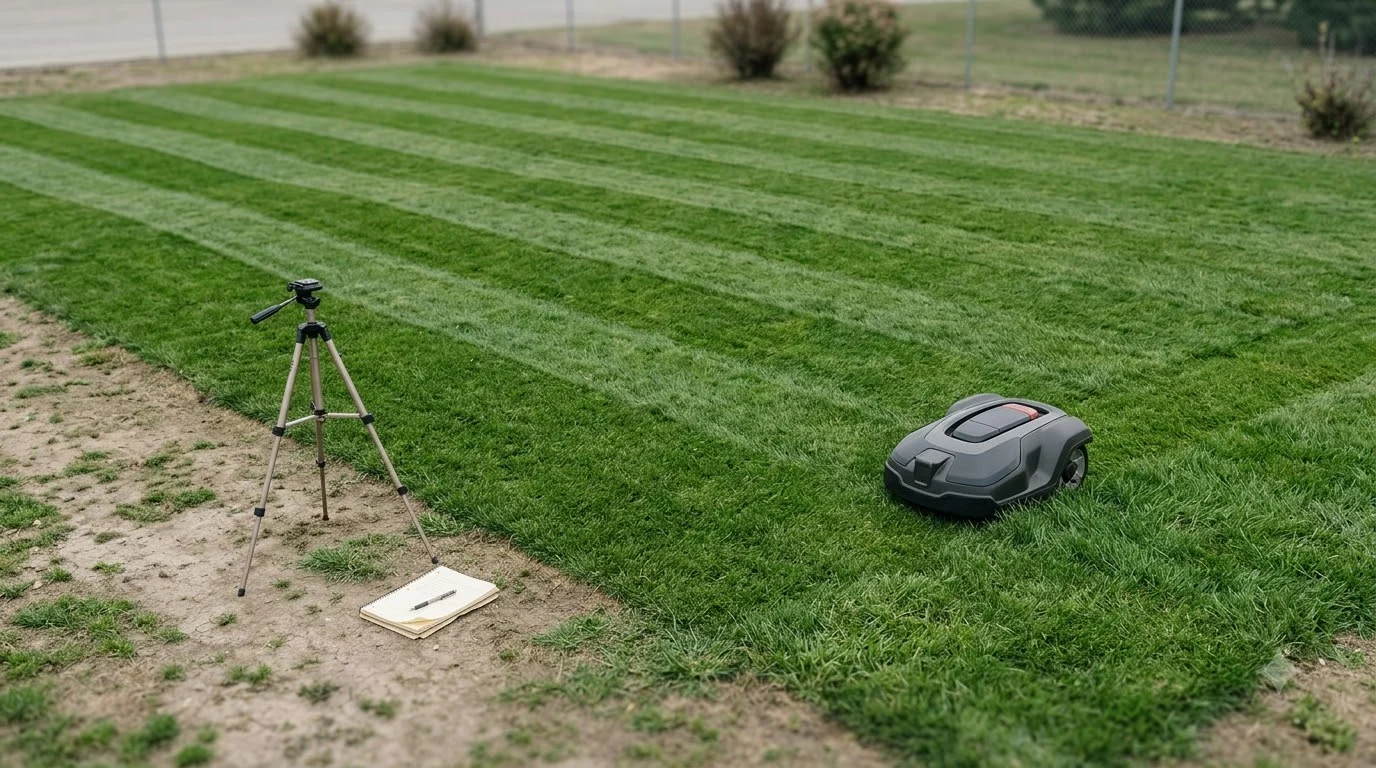

Robot mower coverage rating explained: the rating is the largest lawn area a manufacturer says the mower can keep trimmed, usually listed in square feet, square meters or acres. The figure is measured under ideal conditions, so it works as a ceiling rather than a promise for your yard.
The short answer
- The rating is a maximum. It describes how much grass the mower can keep short over a typical growth cycle.
- Daily coverage is smaller. It is what the mower finishes in one day, after recharge breaks.
- Real results drop with slopes, obstacles, fast grass growth and signal loss.
- Size from your mowable lawn, not the property, and leave a margin above it.
What a coverage rating actually measures
A coverage rating is the total area a mower can keep trimmed within a typical growth cycle, not the area it cuts in one pass. Eufy’s guide describes this “maximum capacity” as the total area the unit can keep trimmed within a typical growth cycle, and notes that capacity is usually measured in square meters. The rating therefore reflects how the mower handles a lawn over time, including the grass that regrows between sessions.
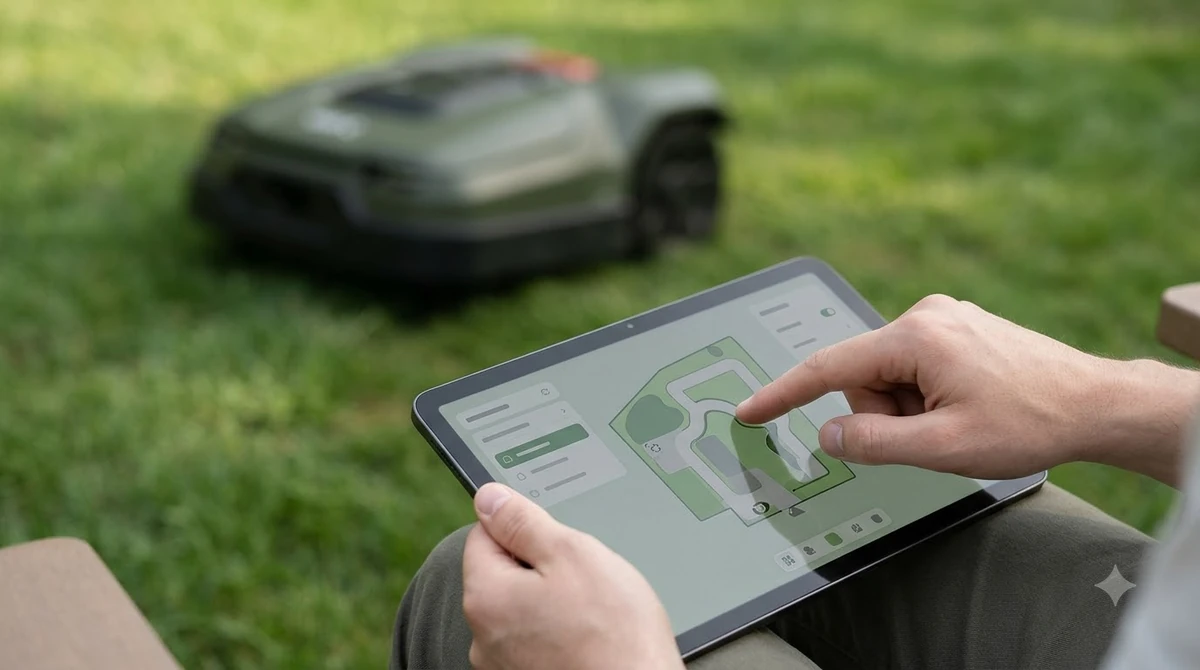
Manufacturers also state the rating under controlled conditions. Eufy says a mower’s rated capacity assumes a perfectly flat, rectangular lawn with soft grass. Most home lawns are not that simple, so the same rating can produce different results in two yards of the same size.
Some brands label their models with a lawn size and a tolerance instead of a single number. Husqvarna’s US product pages list the Automower 410 iQ at up to 0.5 acres and the 420 iQ at up to 1 acre, and show a “Lawn Size (±20%)” label for each model, such as 1.3 acres for the 435 iQ AWD. The page does not explain how that tolerance is calculated, so we read it as a rough band rather than a precise limit. When you compare Husqvarna’s models, read the label as a range and check it against your own measurement.
Why maximum area is not daily coverage
Robot mower coverage rating explained in one line: it is a ceiling, not a daily result. Daily coverage is the area a mower finishes in one day, and it is almost always smaller than the maximum rating. Dreame’s buying guide makes the point directly: for a large lawn, daily coverage matters more than maximum area, because the maximum only shows how big a yard the mower can handle across several sessions.
The gap comes from runtime. Dreame states that most robot mowers run for 2 to 3 hours on a single charge before returning to the dock, and that a maximum-area figure assumes continuous running, which no mower achieves once recharge cycles are counted. Gardenia’s spec comparison lists working times of 60 to 65 minutes for three popular models, so a single cutting window covers only part of a large lawn. The guide to robot mower daily run time covers schedules.
Ecovacs publishes hourly figures for its GOAT models, which show how the calculation works in practice. The GOAT A2500 RTK is listed at 4,305 square feet per hour, and up to 5,382 square feet in two hours with charging time included. The GOAT O1000 RTK is listed at 1,507 to 1,938 square feet per hour and is positioned for gardens up to a quarter acre. Ecovacs notes that these numbers come from laboratory tests in real lawn scenarios and may vary with actual use.
Eufy describes the same chain of limits from a different angle. The total area a mower can handle depends on how many square meters it covers per hour of active cutting, and if a garden is too large for the battery capacity, the far end of the lawn can fall behind. Wider cutting decks cover more ground per pass, which is why the cutting width is worth checking alongside the rating.
Robot mower coverage rating explained on the spec sheet
Spec sheets give the rated area in one unit, so the first step is to convert everything to the same unit. One square meter is about 10.76 square feet, and one acre is 43,560 square feet. The table below uses figures from Gardenia Organic’s comparison of manufacturer maximums, so you can see how the rating, slope limit and working time sit side by side.
| Model | Maximum lawn area | Maximum gradient | Working time |
|---|---|---|---|
| Husqvarna Automower 115H | 10,882 sq ft (1,011 m²) | 30° | 60 min |
| Bosch Indego S 500 | 5,832 sq ft (500 m²) | 27° | 60 min |
| GARDENA SILENO Minimo | 2,700 sq ft (250 m²) | Not listed | 65 min |
| Robomow RX20 | 180 sq ft (16.7 m²) | 8.5° | Not listed |
The spread in this table is wide, and it shows why a single number tells you little on its own. The RX20 is a small-lawn model, while the 115H is rated for a lawn about sixty times larger. Our reading is that the rating should be the first filter, and the working time and slope limit should be the second. For a walk through every line, see reading a robot mower spec sheet.
Gardenia’s guide adds a scheduling caution: a rating based on long daily operation may not suit a short daytime schedule that keeps pets and wildlife clear of the mower. The schedule you plan to run matters as much as the rating.
Eufy’s guide offers a useful reference for sizing: it describes typical suburban lawns as falling between 400 and 800 square meters, and it suggests that very large estates, where the lawn exceeds 1,500 square meters, may need a high-capacity unit or two medium-sized mowers rather than one machine.

What reduces real coverage
Slopes, obstacles, grass growth and signal loss all reduce the area a mower finishes, and the effect grows with the complexity of the yard. Eufy gives a simple example: a mower rated for 800 square meters can cover only about 600 square meters on a hilly lawn. The exact loss depends on the slope and the mower, so treat that figure as an illustration rather than a fixed rule. See what a slope rating means for coverage before you trust a gradient figure.
- Slope. Gradient limits tell you whether a mower can climb a hill, not how much area it finishes. Husqvarna lists its 435 iQ AWD at slopes up to 70 percent, Ecovacs lists the GOAT A2500 RTK at 27 degrees, and Gardenia lists the Robomow RX20 at 8.5 degrees.
- Obstacles. Dreame estimates that a one-acre yard with mature trees and complex landscaping can lose 20 to 30 percent of its rated coverage to obstacle navigation. That is a manufacturer estimate, not a measured result for every yard; our guide to mowing under tree cover looks at the canopy side.
- Grass growth. Gardenia’s guide advises allowing for peak grass growth rather than treating the area alone as a promise of completion time. Fast-growing grass in spring can push a lawn past what a mower finishes in a day.
- Signal loss. Eufy notes that losing the satellite signal can reduce daily coverage while the mower waits for the signal to return. The point applies to any satellite-navigated model, so check how the mower handles signal in your yard, especially RTK mowers near tall buildings.
Routing also changes how fast a lawn gets finished. Eufy reports that parallel mowing paths can cover the same area in nearly half the time of a random-path pattern, so the mower’s navigation method affects the result even when the rating stays the same.
How to size a mower for your lawn
With the robot mower coverage rating explained above, sizing comes down to four steps. Measure the mowable lawn rather than the whole property, then choose a mower whose daily coverage sits comfortably above that figure.
- Measure the property. Find the total area in square meters or square feet.
- Subtract non-lawn areas. Remove the house footprint, driveway, patios, garden beds and pools. Dreame gives an example of a 4,000 square meter property with about 2,800 square meters of actual lawn.
- Add a buffer for obstacles. Dreame suggests multiplying the lawn size by 1.3 to allow for trees, beds and edges. Applied to the 2,800 square meter example, that gives about 3,640 square meters, which is our reading of the method rather than a rule from the source.
- Check daily coverage, not the headline number. Compare the buffered figure with the mower’s daily coverage in its standard or efficient mode, and allow for rain days when the mower pauses. Ecovacs also lists coverage as the first feature to check when choosing a mower for a large garden.
Dreame’s advice to size up is worth keeping in mind. Its guide says a mower with extra capacity gets the lawn finished on time even after a few rainy days force the mower to pause. Dreame also warns against sizing down to save money.
Frequently asked questions
Is the coverage rating the same as the area a mower cuts in one day?
No. The rating is a maximum that assumes conditions the mower may not meet all day. Daily coverage is what the mower actually finishes in one day, after charging breaks, weather pauses and obstacles.
Why does my yard give different results from the spec sheet?
Manufacturers measure ratings under ideal conditions, which Eufy describes as a flat, rectangular lawn with soft grass. Slopes, trees, flower beds, narrow passages and fast grass growth all reduce the area a mower finishes, so the same rating can produce very different results.
Should I buy a mower rated above my lawn size?
In most cases, a margin makes sense. Dreame recommends a buffer above the measured lawn size and warns against undersizing. A larger rating gives the mower room to finish on time after rain days or fast growth.
How do square feet, square meters and acres compare?
One square meter is about 10.76 square feet, and one acre is 43,560 square feet. A half-acre lawn is about 21,780 square feet, or roughly 2,023 square meters. Convert every model to one unit before comparing spec sheets.
Sources
- Can a Robot Lawn Mower Handle a Large Garden? (Ecovacs): hourly coverage figures for GOAT models and the laboratory test footnotes.
- Robotic lawn mowers (Husqvarna US): capacity and lawn size labels with ±20% tolerance, and slope limits for Automower models.
- Best Robot Mowers for Large Lawns (Dreame): daily coverage versus maximum area, the 1.3 buffer method and runtime per charge.
- Robot lawn mower coverage and yard size (Eufy): definition of maximum capacity, flat-lawn rating conditions and the hilly-lawn example.
- Robotic Mower Buying Guide: Capacity, Safety and Costs (Gardenia Organic): manufacturer maximum areas, gradients and working times for four models.
 Up next8 min readBest Robot MowersRobot Mower IP Rating Explained: What IPX4, IPX5 and IPX6 MeanUpdated Nov 11, 2026
 8 min readBest Robot MowersRobot Mower Warranty Guide: Coverage, Exclusions and ClaimsUpdated Nov 11, 2026
 9 min readBest Robot MowersWhat Does AWD Mean on a Robot Mower?Updated Nov 11, 2026
 8 min readBest Robot MowersRobot Mower Slope Rating Explained: Percent vs DegreesUpdated Nov 11, 2026
 8 min readBest Robot MowersWhat to Look for in a Robot Mower With an IPX6 RatingUpdated Nov 11, 2026
 9 min readBest Robot MowersHighest Rated Robot Lawn Mower: What Ratings Can and Cannot Tell YouUpdated Nov 11, 2026