
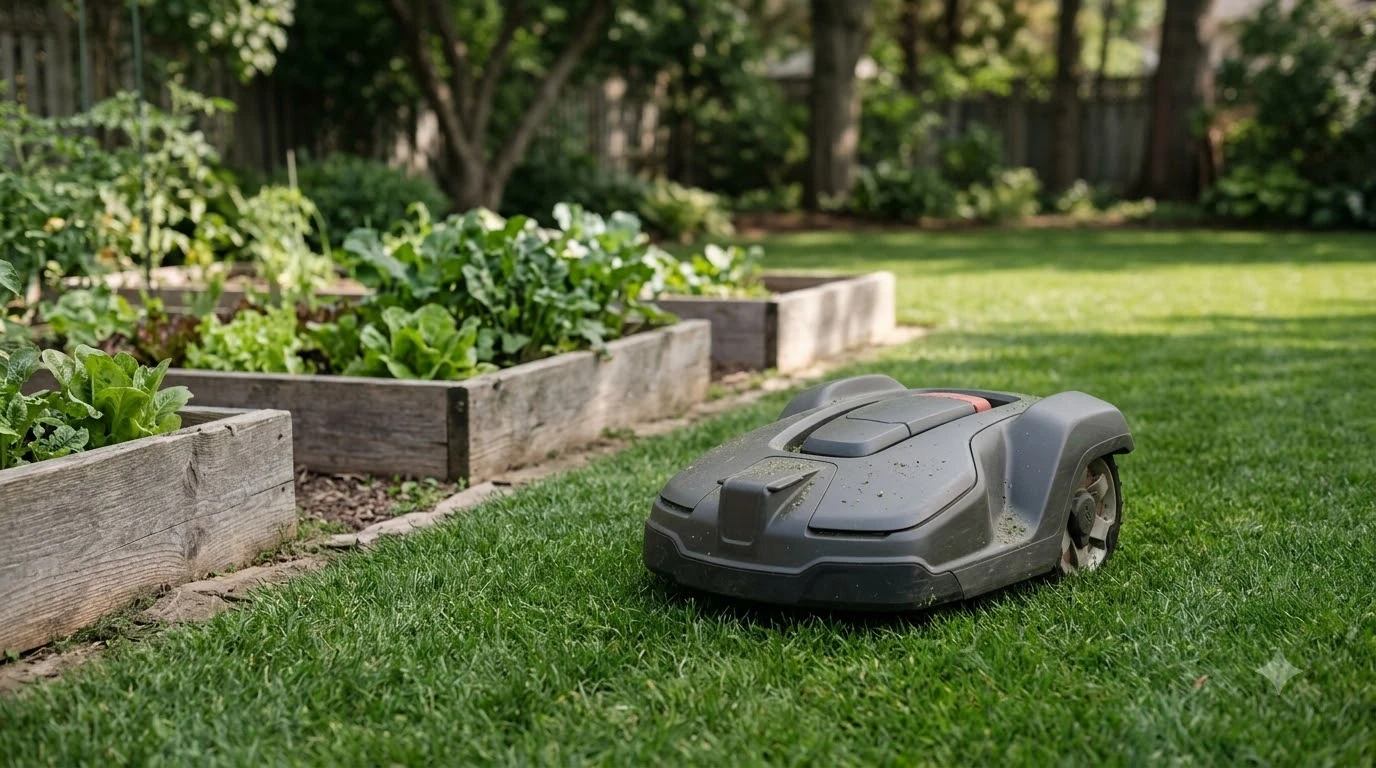

The highest rated robot lawn mower is not one model for every yard. Roundups name different top picks because each one weighs its own criteria, lawn size and price range. As of November 10, 2026, the manufacturer pages give the specs that decide whether a rated model fits your lawn, and those specs matter more than a headline score.
The short answer
- No universal winner: a highest rated robot lawn mower on one list can rank lower on another, so a score only means something for a lawn like the one it was measured on.
- Size first: Husqvarna lists 2 acres as the maximum for two US models, with a ±20% label on its size figures.
- Slope second: standard Husqvarna models are rated for 25 to 50% slopes, and AWD models for up to 70%.
- Navigation third: physical wire, virtual wire and network RTK each change how much installation work you do.
- Charging last: Navimow’s per-charge figures show how many cycles a large lawn needs.
Why the highest rated robot lawn mower changes from lawn to lawn
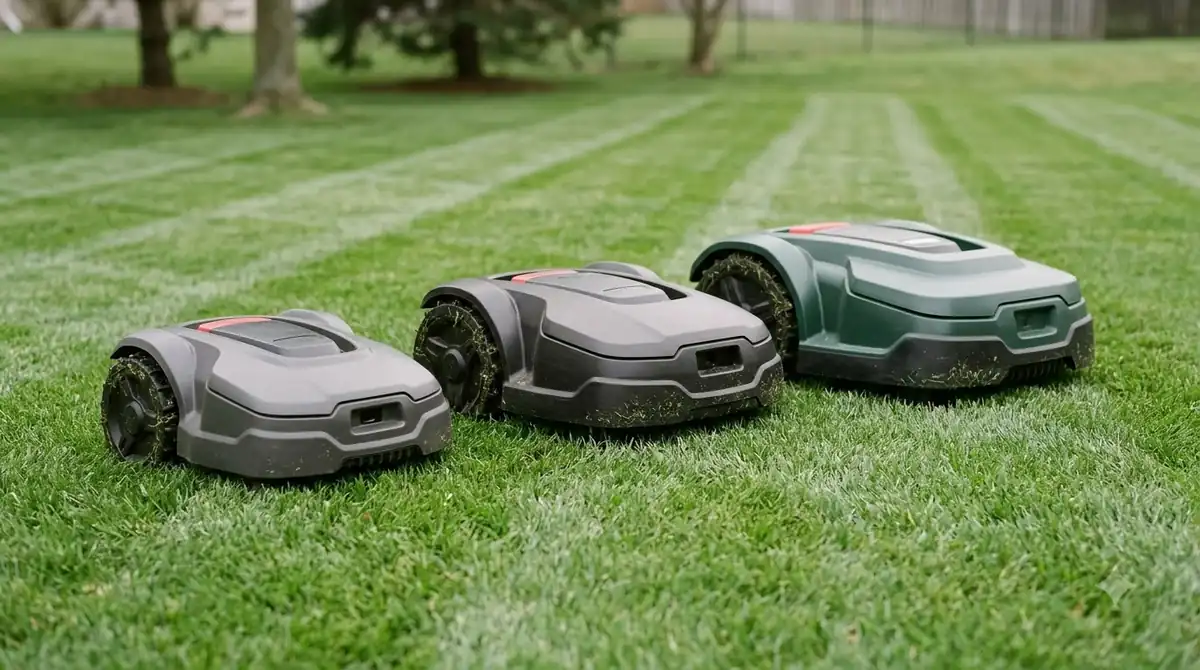
Rankings of the highest rated robot lawn mower usually name different top picks, and that is the first thing to understand. Each publication chooses its own test criteria, its own lawn size and its own price band, so the same model can be a top pick in one list and a middle pick in another. A rating tells you how a reviewer scored a set of features, not how the mower will handle your slope, your boundary or your grass.
Our reading of the current roundups is that the most useful question is not “which highest rated robot lawn mower scores best?” but “which model’s published limits clear my lawn?” That question can be answered from manufacturer pages, and it is the only comparison that stays fixed when the rankings change.
Read the rated lawn size with its tolerance
Start with the maximum lawn size, because the highest rated robot lawn mower on paper can still be too small. Husqvarna’s US product page lists the largest lawn each model is designed for, and it labels those figures “Lawn Size (±20%)”, so they are approximate. If a spec sheet’s wording is new to you, see how to read robot mower specs first. Two models are listed at 2 acres, the Automower 440 iQ and the 580 EPOS, while the 435X AWD is listed at 0.9 acres.
| Model (Husqvarna US) | Max lawn size (acres) | Boundary type listed |
|---|---|---|
| Automower 410 iQ | 0.5 | Physical wire, virtual wire |
| Automower 420 iQ | 1 | Physical wire, virtual wire |
| Automower 440 iQ | 2 | Virtual wire, physical wire |
| Automower 435 iQ AWD | 1.3 | Virtual wire, physical wire |
| Automower 435X AWD | 0.9 | Physical wire |
| Automower 560 EPOS | 1.5 | Virtual wire |
| Automower 580 EPOS | 2 | Virtual wire |
| Automower 535 AWD EPOS | 1 | Physical wire, virtual wire |
| CEORA | 6 | Virtual wire |
Two acres is 87,120 square feet, or about 8,094 square meters (our arithmetic from the standard conversion of 4,046.86 square meters per acre). Because the listed figure carries a ±20% tolerance, a 2-acre lawn is a tight fit for a model rated at exactly 2 acres. Measure your lawn from the map or a survey, not from the street frontage, and leave room for beds, trees and corners the mower will not reach.
Check slope against your hills, not the headline number
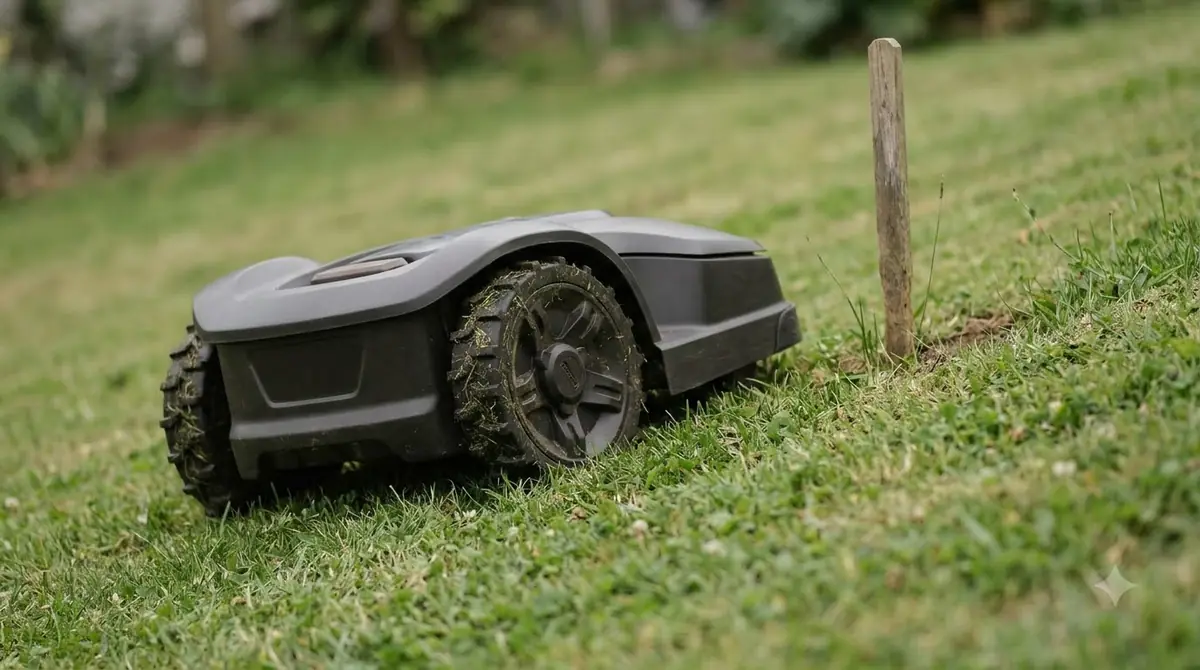
Slope is where a highest rated robot lawn mower often fails for buyers. According to Husqvarna’s steep-slope support article, standard models are rated at 25 to 50% slope depending on the model, which is 14 to 26 degrees, while AWD models reach up to 70%, which the article gives as 35 degrees. The limits are not the same for every part of the work area, so read the figures for the exact model. A separate explainer on robot mower slope ratings covers the basics.
Per-model figures are listed as a work-area limit and a boundary limit. For example, the 405X is rated at 40% for the work area and 15% for the boundary, the 320 NERA at 50% and 25%, and the 435X AWD at 70% and 50%. A slope can be fine inside the lawn and still fail at the edge, so check both numbers.
Heads up
Husqvarna’s formula is slope (%) = vertical height divided by horizontal distance, multiplied by 100. A rise of 15 cm over 100 cm is a 15% slope. Measure the slope with a level and a tape, because a hill that looks gentle can be steeper than it seems.
For AWD models on slopes between 50% and 70%, Husqvarna asks you to keep 1.5 m (5 ft) between the bottom of the slope and the boundary wire. For physical wire, the guide wire should run diagonally across the slope rather than straight up it. These are installation rules, so they change how much of your yard is usable even when the mower’s rating looks high.
Compare boundary wire, virtual wire and RTK navigation
Navigation decides how much work comes before the first cut on any highest rated robot lawn mower. Husqvarna’s US page lists physical wire and virtual wire as boundary types, and several of its EPOS models are listed with virtual wire. Physical wire means laying a guide wire around the lawn and across slopes, which takes time but gives a visible boundary; a comparison of wire-free and boundary wire mowers goes deeper. Virtual wire moves the boundary into the app, which cuts installation work but depends on the mower’s positioning.
Navimow’s large-lawn guide describes a different route. It says that with network RTK support there is no need to install a local antenna, and that network RTK access is included at no extra cost. The same page does not discuss a boundary wire, so do not assume a wire-free model needs no setup at all. Our reading is that the install cost for any highest rated robot lawn mower depends on the lawn shape, the number of obstacles and whether your address is covered by the network service, which you should confirm with the maker.
Look at per-charge area and charging
Per-charge area tells you how many cycles a highest rated robot lawn mower needs for your lawn. Navimow lists 675 square meters per charge for the X420 and 1,300 square meters for the X450, and it recommends the X420 and X450 for lawns of 2,000 to 5,000 square meters. The i210 LiDAR Pro and i220 LiDAR Pro are listed at 195 and 470 square meters per charge.
- X420: 675 square meters per charge, recommended for 2,000 to 5,000 square meters.
- X450: 1,300 square meters per charge, recommended for 2,000 to 5,000 square meters.
- i210 LiDAR Pro: 195 square meters per charge.
- i220 LiDAR Pro: 470 square meters per charge.
Using the 8,094 square meters for a 2-acre lawn, an X450 would need about 6.2 full charges, so at least seven cycles once you count the last partial pass (our arithmetic, before overlap and dock time). The fetched pages do not give charging time or runtime per session for these models, so check the manual for the exact figures before you plan around them. For the runtime side, see how robot mower battery life works. Read the Navimow large-lawn guide for the vendor’s own per-charge numbers.
When the highest-rated model may still be a poor fit
A highest rated robot lawn mower can still be the wrong tool if your lawn falls outside its published limits. The main cases are simple, and each one comes from a figure in the maker’s own specs rather than from a review score.
- The lawn is larger than the rated size: a model rated at 2 acres with a ±20% tolerance has little margin for a 2-acre lawn with beds and trees.
- The slope is above the work-area limit: a standard model rated to 50% may struggle on a steeper bank even if the boundary rating is met.
- The yard has many obstacles: our reading is that narrow passages and many beds add work for any boundary method.
What to check before you buy
Use the maker’s pages to shortlist any highest rated robot lawn mower, and use reviews only to check ease of use after you have confirmed the specs. The steps below follow the order that most often rules out a model.
- Measure the lawn. Get the area from a map or survey (the guide to robot mower coverage ratings explains the figures), then compare it with the rated size and its ±20% tolerance for the highest rated robot lawn mower on your list.
- Measure the slope. Use the formula in the support article and check both the work-area and boundary limits.
- Choose the boundary method. Decide between physical wire, virtual wire and RTK based on how much setup you will accept.
- Count the charges. Divide the lawn area by the per-charge figure and add margin for overlap.
- Read the warranty terms on the maker’s site. This guide did not confirm warranty lengths, so the current terms are the only reliable source.
Frequently asked questions
Is there one highest rated robot lawn mower for every yard?
No. Roundups name a different highest rated robot lawn mower because each uses its own criteria, lawn size and price band. The right model depends on lawn size, slope, boundary method and how much setup you will accept.
Can a robot lawn mower cut 2 acres?
Husqvarna lists 2 acres as the maximum for the Automower 440 iQ and 580 EPOS, with a ±20% label on its size figures. Measure your lawn and leave margin, because beds, trees and corners reduce usable area.
Does slope matter more than lawn size?
For many yards it does. A highest rated robot lawn mower above its work-area slope limit may not climb the hill, even on a lawn that is well under its rated size. Check the work-area and boundary percentages separately.
Should I buy a model rated for exactly my lawn size?
Leave margin. The stated size carries a tolerance, and slopes, obstacles and lawn shape change how much area the mower covers in practice. A highest rated robot lawn mower with a rated size somewhat above your lawn is the safer choice.
Sources
- Husqvarna US robotic lawn mowers (manufacturer): maximum lawn sizes, ±20% label and boundary types by model.
- Husqvarna steep-slope installation support (manufacturer): slope ranges, per-model limits, slope formula and AWD wire distance.
- Navimow large-lawn guide (manufacturer): per-charge mowing area, recommended lawn sizes and network RTK without a local antenna.
 Up next8 min readBest Robot MowersRobot Lawn Mower HOA Rules: What Your Association Can and Cannot EnforceUpdated Nov 11, 2026
 9 min readBest Robot MowersBest Robot Lawn Mower for 3 Acres: What the Ratings Really CoverUpdated Nov 11, 2026
 8 min readBest Robot MowersWhat to Look for in a Robot Mower With an IPX6 RatingUpdated Nov 11, 2026
 8 min readBest Robot MowersRobot Mower IP Rating Explained: What IPX4, IPX5 and IPX6 MeanUpdated Nov 11, 2026
 8 min readBest Robot MowersRobot Mower Slope Rating Explained: Percent vs DegreesUpdated Nov 11, 2026
 9 min readBest Robot MowersRobot Mower Coverage Rating Explained: What the Number MeansUpdated Nov 11, 2026