
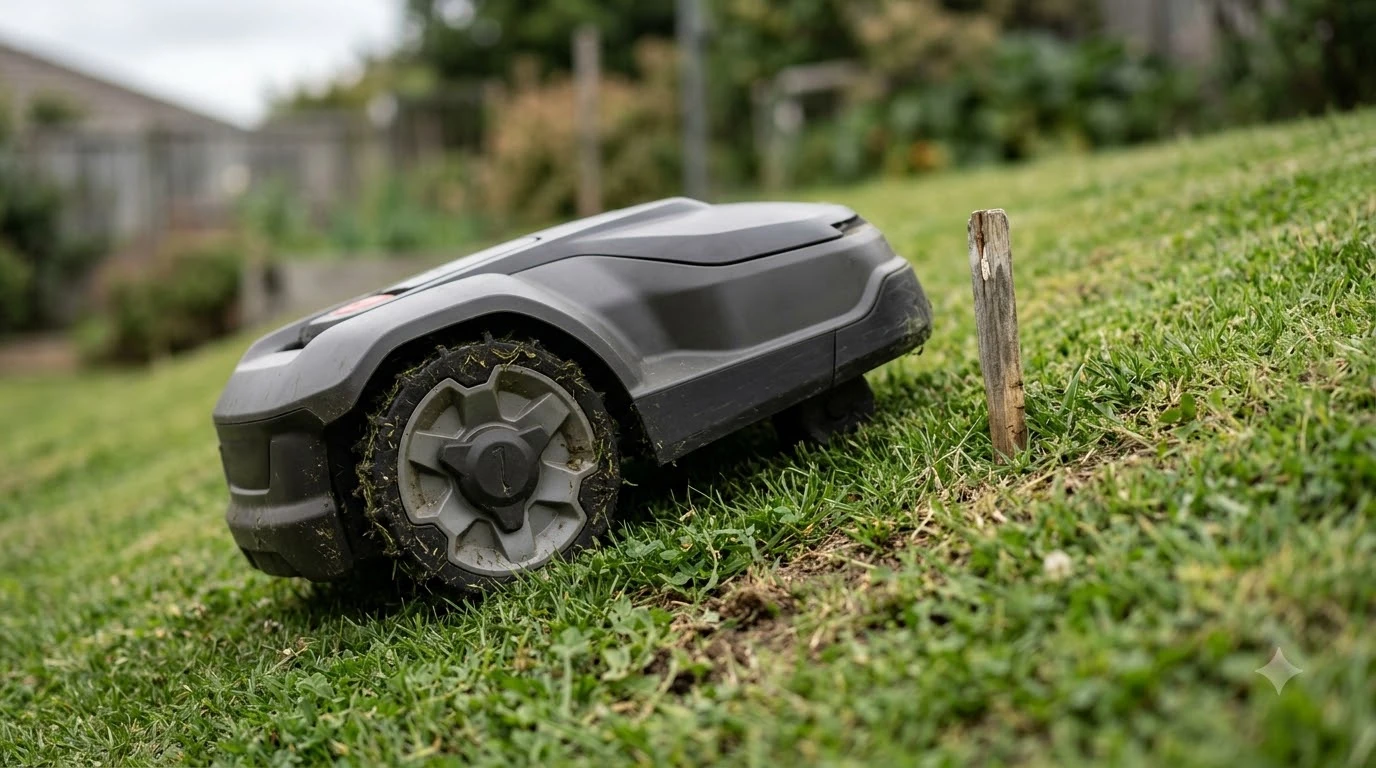

Robot mower slope rating explained: it is the steepest incline a mower is designed to handle, shown as a percent, in degrees, or both. The two units describe the same hill in different ways, so a rating of 45 percent and a rating of 45 degrees are very different machines. Treat the rating as a limit to stay under, not a target to aim for.
The short answer
- Percent is the rise divided by the flat distance, times 100.
- Degrees is the angle between the lawn and flat ground.
- Conversion: 45 degrees equals 100 percent, and 24 degrees is about 45 percent.
- Rule of thumb: keep your steepest section well under the rating, and expect less grip on wet grass.
Robot mower slope rating explained: the basics
A slope rating is the steepest incline a robot mower is designed to climb, and manufacturers print it as a percent, as an angle in degrees, or as both. The rating is a limit set by the maker for normal use, and the number in the manual is the one that counts. It is not a promise that the mower will climb every slope up to that number in every condition.
Both units come from the same geometry. Percent grade is 100 times the rise divided by the horizontal run, which equals 100 times the tangent of the angle. Wikipedia’s grade article gives this definition, and it is the formula used to check the conversions in this guide.
What a percent slope rating means
A percent slope is the rise divided by the flat distance, times 100. A 25 percent slope rises 25 feet for every 100 feet measured flat along the ground. The percentage is a ratio, so it can go past 100. A 100 percent slope is a 45 degree angle, where the rise equals the run.
Percent is the unit most lawn owners see on spec sheets for robot mowers, and it is the easier of the two to picture from a tape measure reading. Our reading is that the percent figure is the one to compare first, then convert the degree number if the manual uses it.
What a degree slope rating means
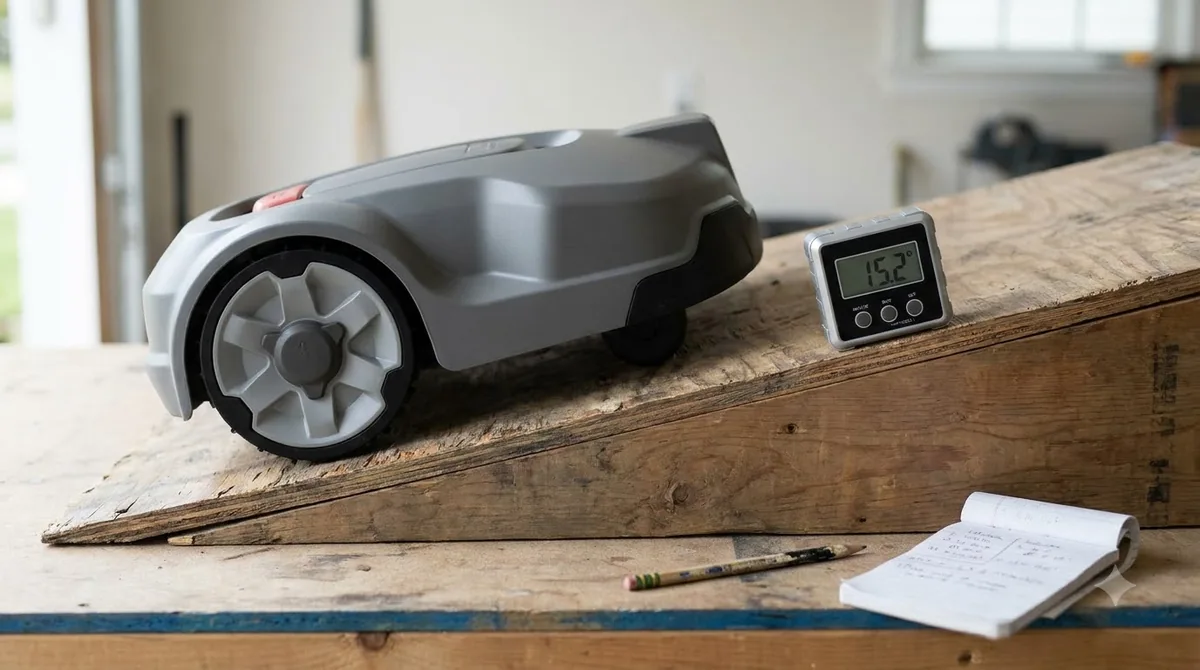
A degree rating is the angle itself, measured from flat ground. Zero degrees is level and 90 degrees is a vertical wall. Because percent is based on a tangent, the two scales spread apart near the top. Wikipedia notes that as the angle approaches 90 degrees, the percentage approaches infinity.
Many people measure with a phone’s level or inclinometer app. Mammotion’s guide notes that a phone’s measurement tool can show the value in either degrees or percent, so you can read the slope in whichever unit the spec sheet uses.
Percent and degrees side by side
Robot mower slope rating explained in numbers: the table below gives the pairs that appear in the sources read for this guide, with the origin of each pair. Use it to match a spec sheet in one unit to the other.
| Degrees | Percent | Where the pair appears |
|---|---|---|
| 5.7 | 10 | Eufy, basic mower range start |
| 14 | 25 | Eufy, top of basic range |
| 20 | 36 | Sunseeker conversion table |
| 24 | 45 | Mammotion guide |
| 35 | 70 | Sunseeker conversion table, Eufy and Husqvarna AWD top |
| 40 | 84 | Sunseeker conversion table |
| 45 | 100 | Wikipedia grade article |
Some retailer guides list 18 degrees as 40 percent. That pair does not match the formula, because the tangent of 18 degrees is about 32 percent. Our reading is that when a spec sheet and a conversion disagree, the tangent is the reference, and the manufacturer’s own number for the model is the one to use for planning.
Heads up
Conversion pairs in retailer blogs are not always consistent with each other. Check any pair against the formula before relying on it.
What manufacturers list as slope ratings
Listed ratings range from about 20 percent on entry-level models to 70 to 80 percent on all-wheel-drive models. Most of these figures are manufacturer claims, and the pages read for this guide did not give test conditions for them.
- Sunseeker says entry-level models may handle 20 percent grades, while advanced hillside models may handle 35 percent or more.
- Eufy lists basic mowers at 10 to 25 percent (5.7 to 14 degrees), mid-range models up to 35 percent (19.7 degrees), and all-wheel-drive models up to 70 percent (35 degrees).
- Husqvarna says its Automower 435X AWD handles slopes up to 70 percent (35 degrees) inside the cutting area and up to 50 percent at the boundary.
- Mammotion claims one mower can climb slopes of up to 80 percent (38.6 degrees). The page gives no test conditions.
Eufy also describes the rated maximum as an absolute limit rather than a target for daily mowing. Its guide adds that running a mower continuously at the top incline strains the motor, so a rating well above your steepest section leaves room for normal work.
Why wet grass and soil change the picture
A slope inside the rating can still cause wheel slip when the grass is wet, the soil is loose, or the turf is new. Sunseeker’s guide says wet grass, loose soil, and steep inclines can cause wheels to slip, and it adds that slippage is more likely on clay soil, new turf, or heavy shade where moisture lingers.
Eufy makes the same point from another angle. Even when an incline falls within the rated limit, wet grass reduces tire grip. Our guide to mowers slipping on wet slopes covers the yard side of the problem. Sunseeker also says all-wheel drive makes a difference on wet grass and steep inclines, but that is a manufacturer’s claim rather than a test result.
Heads up
The rating describes the mower in reasonable conditions. A wet, clay-heavy or freshly laid slope can slip well below the rated number.
How to measure your lawn slope
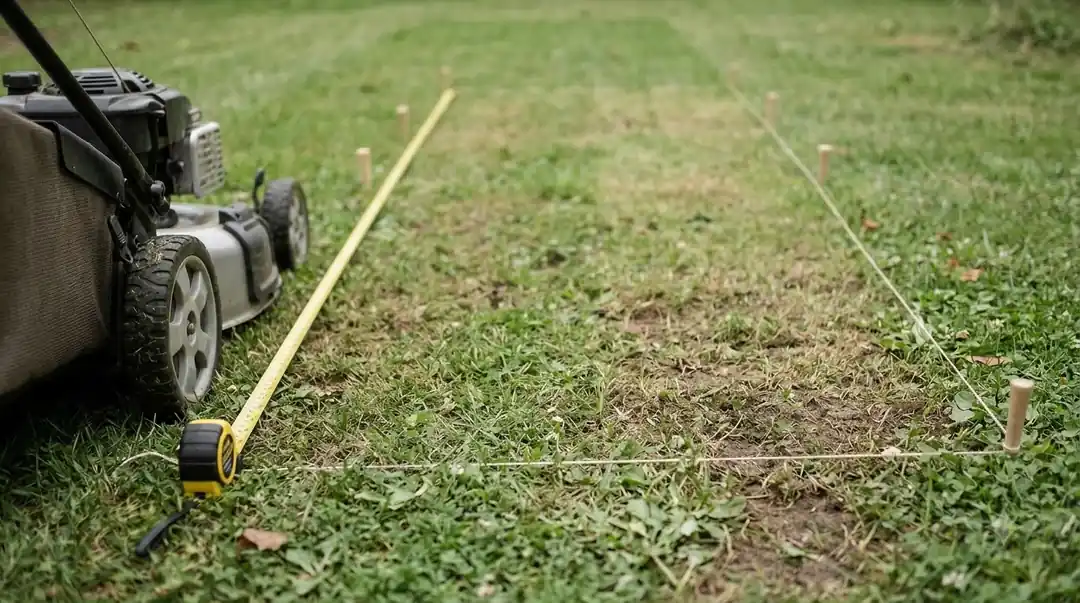
You can measure a slope with a level, a string, a tape, or a phone app, then convert the result. The rise-over-run method below needs only a tape measure and a spirit level. The sources read for this guide did not describe a measuring method in detail, so the steps are our reading of the standard approach.
- Pick the steepest section where the mower would actually drive, not the average of the yard.
- Stretch a string level across the slope between two points, using a spirit level to check it.
- Measure the run along the string and the vertical drop from the string to the ground at the lower end.
- Divide the drop by the run and multiply by 100 to get the percent. For a 3 foot drop over a 10 foot run, that is 30 percent.
Our arithmetic gives an angle of about 17 degrees for that 30 percent slope, since the arctangent of 0.30 is about 16.7 degrees. Compare the percent with the rating in the same unit before deciding.
Matching a slope rating to your yard
Here is the robot mower slope rating explained in practice: compare the rating against your steepest measured section, not the yard as a whole, and leave some headroom. A mower that is rated just above your steepest slope has little margin for wet grass or uneven ground.
- Check the steepest spot. One steep bank can decide the choice, even if the rest of the yard is flat.
- Leave headroom. Our reading is that a rating clearly above your steepest section is safer than one just at the limit.
- Plan for weather. Mow steep areas on dry days, since rated limits assume reasonable grip.
- Compare drive types. If the steep section is long, see how AWD and 2WD mowers differ on hills, and read choosing a robot mower for slopes before you shortlist models.
- Check the manual. Sunseeker advises checking the manufacturer’s specifications to confirm that steep sections fall within safe operating limits.

Frequently asked questions
Is a 45 percent slope the same as 45 degrees?
No. A 45 percent slope is about 24 degrees, while 45 degrees is a 100 percent slope. The two units grow at very different rates, so always convert before comparing a mower’s rating with your lawn.
Can a robot mower climb a 100 percent slope?
The highest manufacturer figure in the sources read for this guide was 80 percent, from Mammotion, and that figure was a manufacturer claim. Ratings of 70 percent appear for all-wheel-drive models from Eufy and Husqvarna. A 100 percent slope is the same as a 45 degree angle, so check the exact rating in the manual.
Is a higher slope rating always better?
A higher rating gives more margin, but it is still a limit. Eufy says a rated maximum is an absolute limit rather than a target for daily mowing, and that running continuously at the top incline strains the motor.
Should I measure my lawn in degrees or percent?
Measure in whichever unit the spec sheet uses, so the numbers match. A phone app is quick, but check its reading against a string and level on a steep spot. An app can show either unit, and the conversion table in this guide covers the common pairs. That is the robot mower slope rating explained at its simplest: one unit, the steepest spot, and some margin.
Sources
- Grade (slope) (Wikipedia): the percent grade formula and the 45 degree equals 100 percent relation.
- Robot lawn mower slope limits (Eufy): rating ranges by mower class, wet grass and rated limit guidance.
- Robot lawn mowers on uneven or sloped lawns (Sunseeker): conversion table and wheel slip on wet grass.
- Best robot lawn mower for steep slopes (Mammotion): 80 percent claim and the 45 percent to 24 degree pair.
- Automower 435X AWD (Husqvarna US): the 70 percent inside and 50 percent boundary slope figures.
 Up next9 min readBest Robot MowersWhat Is the Best Robot Lawn Mower for a 1/2 Acre With SlopesUpdated Nov 11, 2026
 9 min readBest Robot MowersRobot Mower Coverage Rating Explained: What the Number MeansUpdated Nov 11, 2026
 8 min readBest Robot MowersRobot Mower IP Rating Explained: What IPX4, IPX5 and IPX6 MeanUpdated Nov 11, 2026
 8 min readBest Robot MowersWhat to Look for in a Robot Mower With an IPX6 RatingUpdated Nov 11, 2026
 9 min readBest Robot MowersHighest Rated Robot Lawn Mower: What Ratings Can and Cannot Tell YouUpdated Nov 11, 2026
 9 min readBest Robot MowersBest Robot Lawn Mower for 3 Acres: What the Ratings Really CoverUpdated Nov 11, 2026