
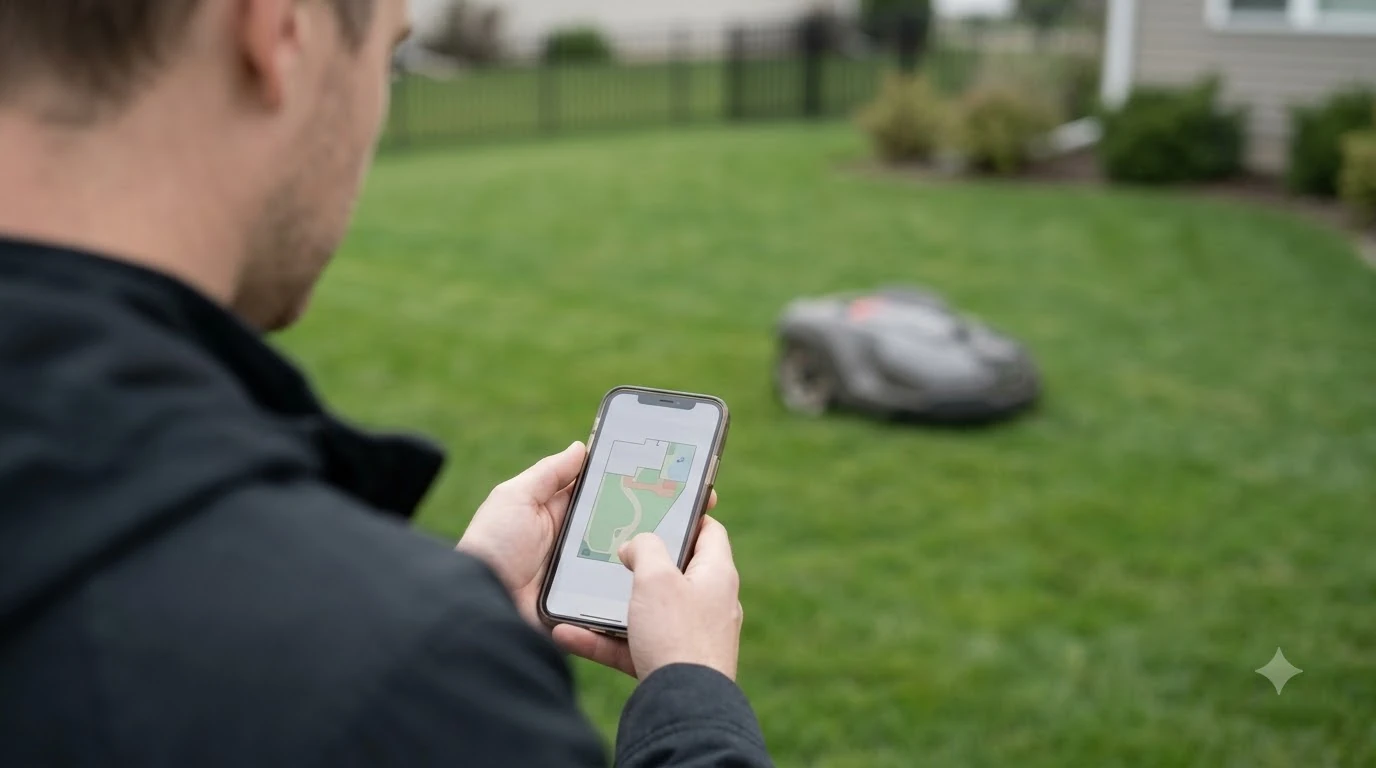

What is the best robot mower without a boundary wire? There is no single answer, because wire-free models find their way in different ways and each one depends on the conditions in your yard. Many use satellite RTK positioning with a virtual boundary drawn in an app, and some add LiDAR or cameras. The right model is the one whose method suits your sky view, slopes and setup.
The short answer
- No universal winner: the best option depends on how much open sky your lawn has.
- Positioning: RTK satellite positioning is the main method, and Husqvarna quotes 1 to 6 cm accuracy for its cloud option.
- Trees: dense canopy can stop an RTK mower from holding a precise fix, so a perimeter wire may still suit shaded lots.
- Check first: sky view, base or cellular needs, slope rating and mobile coverage at your address.
How wire-free robot mowers find their way
Wire-free mowers replace the buried perimeter cable with a map. The mower receives satellite signals and correction data, then tracks its position inside a boundary you draw in the manufacturer’s app. Husqvarna describes its EPOS system this way, using satellite-based RTK positioning to create virtual boundaries (how an RTK robot mower works), and it lists accuracy of 1 to 6 cm for its Husqvarna Cloud option and 1 to 2 cm for its EPOS reference stations (Husqvarna’s EPOS page).
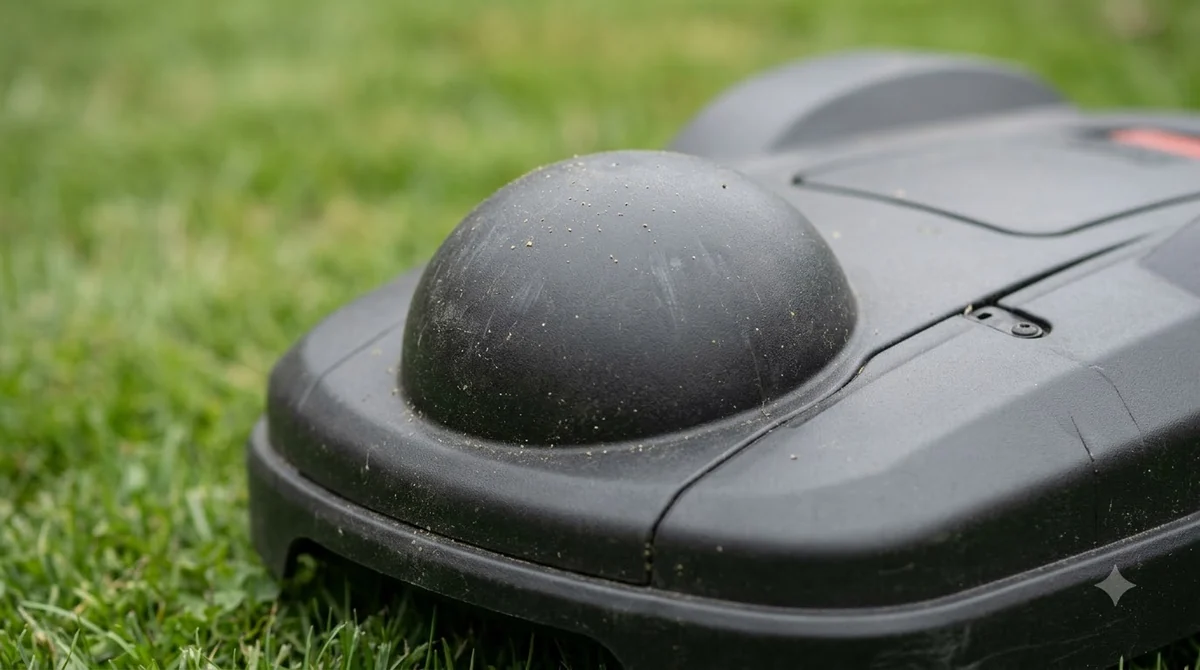
Husqvarna’s EPOS description also says the system needs at least two cooperating receivers, one on the mower and one at the reference station or cloud service. That is why a wire-free setup is never just the mower on its own. Some wire-free models also use LiDAR, and RTK vs LiDAR vs vision robot mowers compares the three approaches. Navimow’s product page says its mowers detect and avoid pets, children and garden decorations, but it does not explain how that works alongside RTK. Check the positioning section of the model’s manual before you compare sensor claims.
Why sky view decides how well RTK works
RTK accuracy depends on how much of the sky the antenna can see. RTKdata, a commercial RTK provider, says its troubleshooting guide calls for clear sky above roughly 15 degrees from the horizon, and it describes sky view as the main predictor of how well an RTK mower performs (RTKdata’s accuracy guide). That is a vendor view, so treat its figures as guidance rather than lab results.
- Open lawns usually hold a fix most of the time, according to the same guide.
- Suburban trees can cause occasional fix and float transitions, which show up as hesitation or wobbly paths.
- Dense canopy may prevent a fix altogether, and walls and reflective surfaces can also degrade accuracy.
- Side yards between a house and a fence often hide low satellites.
When you decide what is the best robot mower without a boundary wire for your yard, sky view matters more than the brand name. Our reading is that the simplest test is to stand at the spot where the base or antenna would go and look up. If trees or buildings block a large slice of the sky, a wire-free model is a riskier choice for that yard, and robot mowers under trees covers that case in more detail.
Base station, network RTK or cellular: what each option needs
Deciding what is the best robot mower without a boundary wire also means choosing how it gets its correction data. Wire-free systems do not all need the same hardware. Husqvarna offers three correction paths, and the cloud option needs no physical installation but does need mobile coverage on site. Segway Navimow’s network RTK needs no local antenna and is included at no extra cost, according to its product page (Navimow’s network RTK explainer).
| Option | What it needs | Stated range or accuracy |
|---|---|---|
| Husqvarna Cloud | No physical install; cellular coverage on site | Typically 1 to 6 cm |
| EPOS RS 4G reference station | One station; mobile coverage | Typically 1 to 2 cm (within 10 km); range up to 25 km |
| EPOS RS5 reference station | Local radio link to the station | Typically 1 to 2 cm; range up to 500 m per unit |
| Navimow network RTK | No local antenna; cellular data | Included at no extra cost |
RTKdata adds a timing point: it says latency under one second gives full RTK performance, while latency of one to three seconds causes more float readings. RTKdata says Navimow and Mammotion include their network RTK at no extra cost. Our reading is that network RTK depends on a cellular connection, so a weak signal at the lawn can matter as much as a base would (robot mower Wi-Fi, Bluetooth and 4G explains the connection types).
Two practical points apply to any base-based setup. RTKdata’s guide says a base should not sit near tree canopy, and it should stay within 30 m of structures taller than its antenna. It also warns that moving the reference point after mapping shifts every boundary, so the base should be placed once and left alone.
Slopes, obstacles and coverage limits
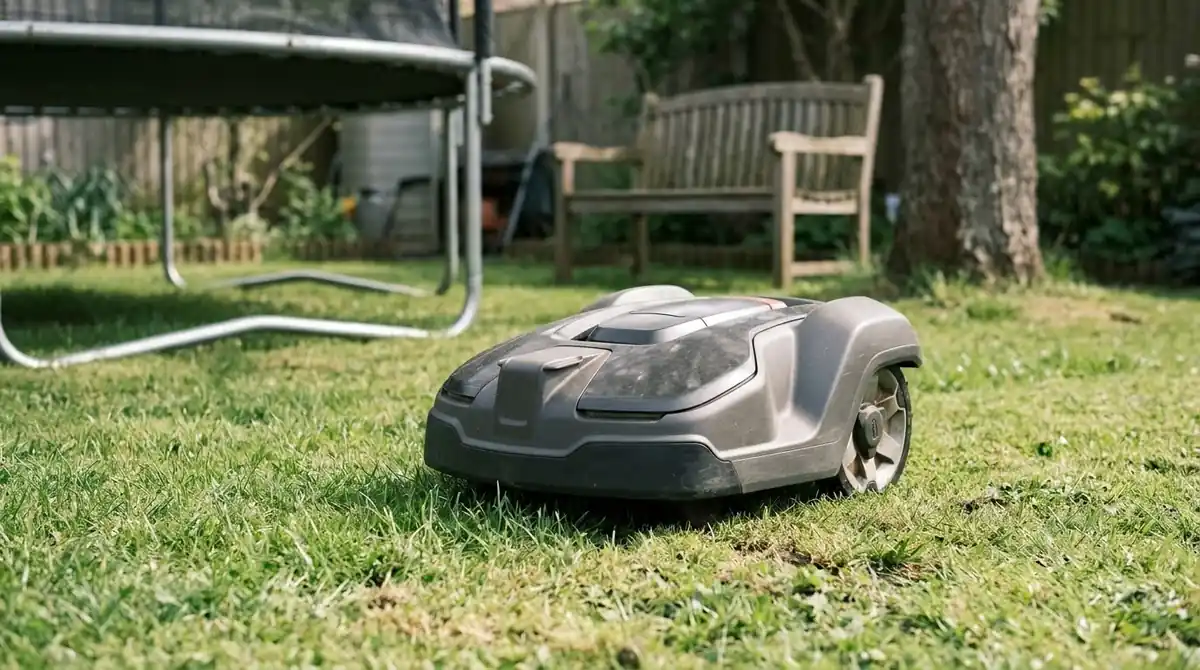
Slope capability is model-specific, so a rating for one mower does not transfer to another. Navimow’s product page lists maximum slopes of 45% (24 degrees) for the i2 AWD, 55% (29 degrees) for the i2 LiDAR Pro and 84% (40 degrees) for the X4.
- Measure your steepest section and compare it with the model’s listed slope, leaving a margin.
- Describe your garden honestly. Navimow’s product page separates “lightly landscaped” yards, with a few trees, flower beds or fences to avoid, from “fully landscaped” yards with multiple garden areas, narrow paths or shaded corners.
- Check coverage in your area. The same page offers a postcode checker to confirm that network RTK is available in your area, so check before you buy.
Navimow’s listed mowing area per charge is 125 square meters for the i205 AWD and 250 square meters for the i208 AWD. Its LiDAR Pro i220 is listed at 470 square meters per charge, and the X450 at 1,300. Those figures cover one charge, so the mower will need to recharge and resume on larger lawns.
Navimow lists recommended lawn sizes of 500 to 1,000 square meters for the i2 AWD and 800 to 2,000 square meters for the i2 LiDAR. Those bands are the manufacturer’s own guidance, and they show why size matters as much as sensor type when you compare models.
Listed coverage per charge is a best case. Slopes, obstacles and separate zones all reduce what a mower can cut in practice, so a model rated comfortably above your lawn size is the safer pick.
How you set the boundary
Setup is part of judging what is the best robot mower without a boundary wire for you, because the boundary is only as good as the map behind it. With a wire-free system, the boundary is drawn on a map instead of buried. Husqvarna’s Fleet Services interface lets you set area preferences, change boundaries and create temporary stay-out zones for events or work, from a phone or desktop. Setup steps differ between brands, so read the manual for the model you are considering.
What is the best robot mower without a boundary wire for your yard
Use this checklist to narrow the field before comparing individual models. Each step maps to a fact covered above.
- Sky view. Confirm the install spot has clear sky, not a canopy or walls on several sides.
- Positioning method. Know whether the model uses RTK alone, RTK with LiDAR, or another sensor set.
- Correction source. Decide between a local base, a cloud service or network RTK, and confirm mobile coverage.
- Slope rating. Compare the listed maximum with your steepest section.
- Coverage and fit. Match the rated area and passage width to your lawn, with headroom.
- Wire fallback. If your lawn is heavily shaded, ask whether a perimeter wire model is the more reliable choice.

Frequently asked questions
Does a wire-free robot mower work under trees?
It can, but accuracy usually drops under trees. RTKdata says dense canopy may not hold an RTK fix, and suburban trees can cause occasional fix and float changes. A perimeter wire may suit lawns with dense canopy better.
Can I move the base station after mapping?
Avoid it. RTKdata warns that shifting the reference point shifts every boundary, so the base should stay where it was when you mapped the lawn.
Do wire-free mowers always need a base station?
Not always. Husqvarna’s cloud option needs no physical installation but does need mobile coverage, and Navimow’s network RTK needs no local antenna. Husqvarna’s EPOS reference stations are the local option.
Is a wire-free mower always better than a boundary wire?
No single answer fits every yard. Wire-free models avoid buried cable, but their positioning depends on sky view. Our reading is that open lawns suit them well, while heavily shaded lawns may be better served by a wire. Wire-free versus boundary wire robot mowers compares the two in full.
Sources
- Husqvarna EPOS (Husqvarna): RTK positioning, accuracy figures, base and cloud options, boundary setup.
- How do robotic lawnmowers without boundary wires work (Segway Navimow): network RTK, slope limits, coverage availability.
- Wire-free Robot Mower RTK Accuracy Guide (RTKdata, dated 2026-01-20): sky view, tree canopy, base siting, boundary shifts.
 Up next8 min readBest Robot MowersDo Robot Lawn Mowers Need a Boundary Wire?Updated Nov 11, 2026
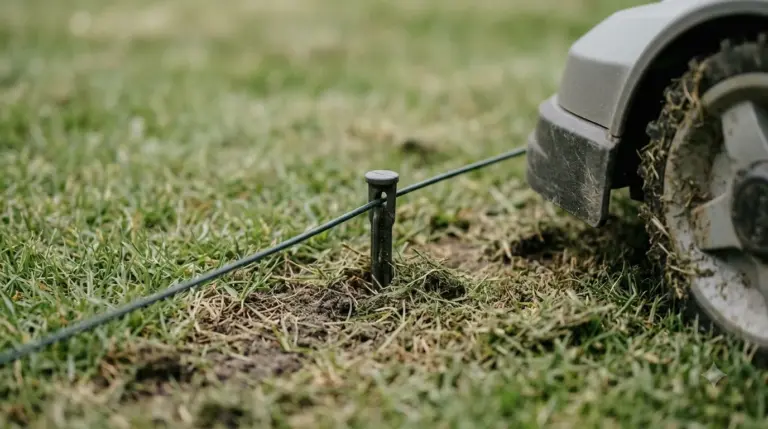 8 min readBest Robot MowersWire-Free vs Boundary Wire Robot Mowers: Which Setup Fits Your YardUpdated Nov 11, 2026
 8 min readBest Robot MowersHow Do Robot Lawn Mowers Work? Wire, Sensors and Docking ExplainedUpdated Nov 11, 2026
 8 min readBest Robot MowersWhich Wireless Robot Mower Is the Most Reliable? How to Judge ItUpdated Nov 11, 2026
 8 min readBest Robot MowersWhat Is the Best Robot Mower for a Corner Lot?Updated Nov 11, 2026
 9 min readBest Robot MowersWhat Is the Best Robot Lawn Mower for a Large Yard?Updated Nov 11, 2026