
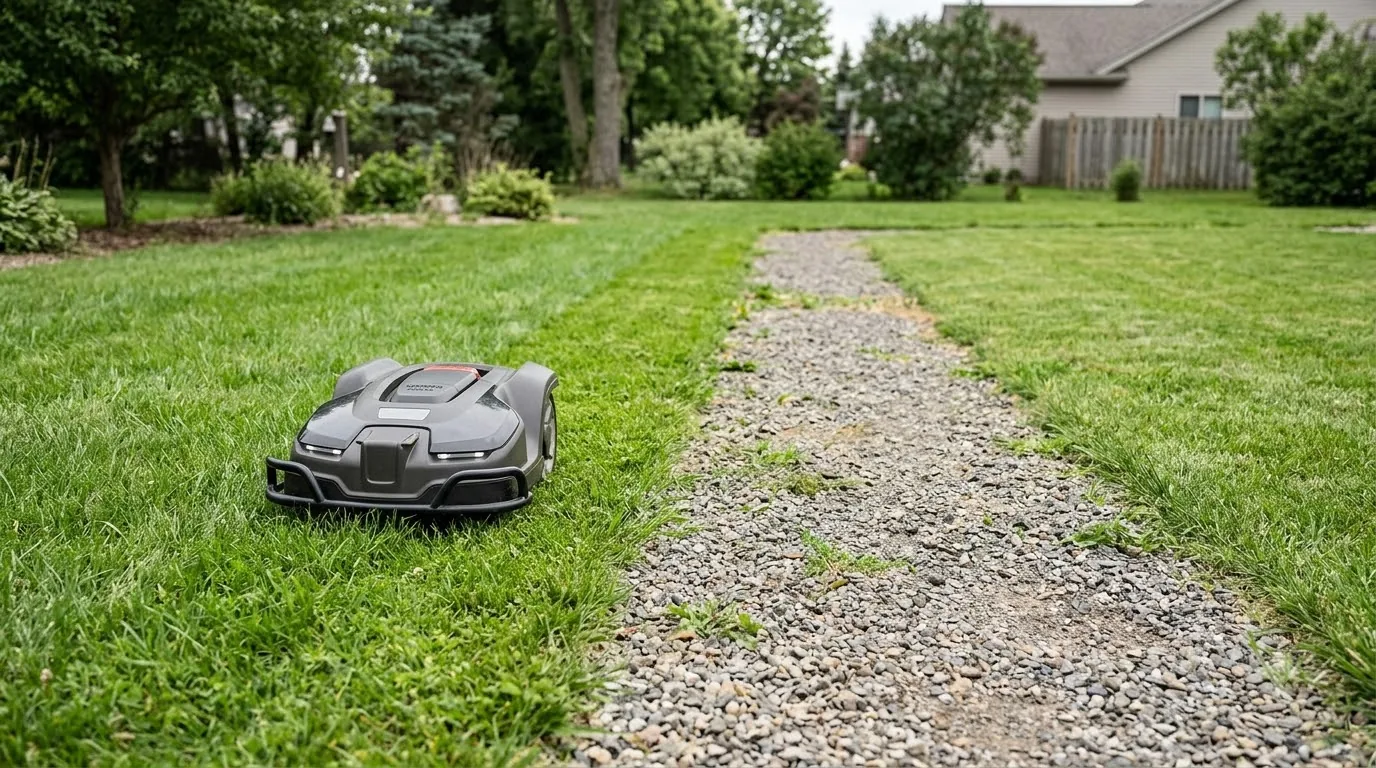

The answer to what is the best robot lawn mower for a large yard is the model whose rated area covers your mowable grass with room to spare, and whose slope rating and navigation suit your lot. No single model wins every property. Manufacturer guidance gives clear thresholds for lawn size, slope and cutting width, and this guide uses those numbers to show how to decide.
The short answer
- Size: Robomow treats a private lawn of 1,000 square meters as large, and its size guidance uses 2,000 square meters as the point where a powerful battery is needed.
- Margin: Robomow says slopes, obstacles, weather and layout can reduce the optimum by up to 30 percent, so our reading is to buy with about 30 percent headroom.
- Slope: Husqvarna says its mowers handle slopes of at least 25 percent, and steep lawns call for an all-wheel-drive model.
- Cutting width: Robomow reports that a 56 cm model covers twice the area of a 28 cm model in the same time.
- Boundary: wire-free and virtual-boundary models exist, but the manufacturer pages give no coverage figures for them.
How big is a large yard for a robot mower?
Robomow treats a private lawn of 1,000 square meters as large, a figure it calls “an absolute matter of opinion,” so treat it as a guide rather than a standard. Its lawn-size guide sorts lawns into classes: small lawns around 300 square meters, and large lawns of 2,000 square meters and more, which it says need a powerful battery.
Its large-area guide also covers lawns of 5,000 square meters and up, and mentions mowers for sports fields and parks that reach an area output of 10,000 square meters. Those classes are a useful starting point, but suitability also depends on slope and shape, not area alone.
To compare with acres, 1,000 square meters is about a quarter acre and 2,000 square meters is about half an acre. An acre is roughly 4,047 square meters. Husqvarna’s buying guide says to “always start with the size of your lawn,” and our reading is to measure only the grass the mower will cut, leaving out the house, driveway, patio and garden beds. For smaller yards, choosing a robot mower by lawn size covers the full range.
Rated area is not your lawn size
When you ask what is the best robot lawn mower for a large yard, the rated area is the first number to check. A mower’s rated area is the work it can cover under ideal conditions, so a model that matches your lawn size exactly leaves no margin for slopes, obstacles or weather. Husqvarna defines work area capacity as the area a mower can cover per hour and per day at full capacity, running 24 hours a day, 7 days a week. Robomow describes its recommended area output as a realistic value achieved in an average garden, not a maximum.
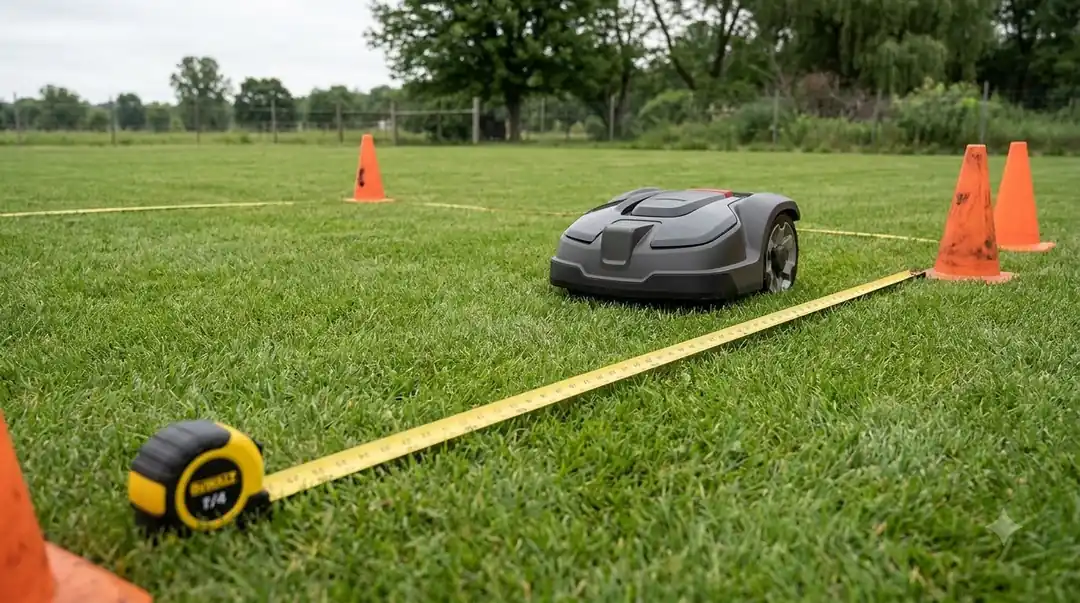
Robomow gives a formula for working out the rating you need: lawn size divided by the hours you want the mower to run each week, multiplied by the manufacturer’s operating hours. Its example is a 1,000 square meter garden mowed for at most 40 hours a week by a mower rated for 120 hours, which needs a unit with a maximum area output of 3,000 square meters.
- Measure the mowable grass. Use only the area the mower will cut.
- Set your weekly run hours. Robomow’s example assumes 40 hours a week.
- Apply the manufacturer’s hours. Robomow’s example uses 120 hours of operation to reach the 3,000 square meter rating.
Robomow says the factors it lists, including slopes, obstacles, weather, variable mowing times, lawn type and garden layout, can reduce the optimum by up to 30 percent. That is the basis for our reading that about 30 percent headroom is a sensible starting point. Treat any rating that assumes round-the-clock running as an upper bound, since some manufacturers estimate continuous use that a real lawn will not match.
Slope decides which large yard you can actually mow
Husqvarna says every mower in its range handles slopes of at least 25 percent, and its all-wheel-drive Automower 435X AWD handles a 70 percent incline, or 35 degrees. The same guide advises that if your lawn has steep slopes, you should look for an all-wheel-drive robotic mower.
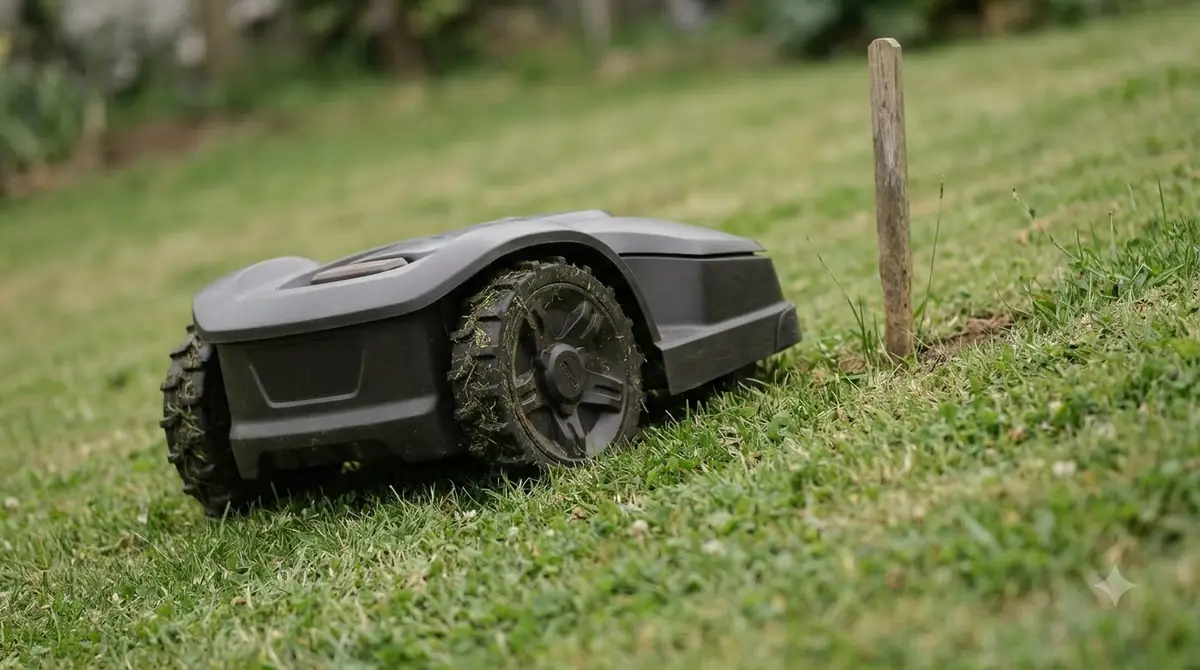
Robomow puts the range wider. It says many cheap models are designed for slopes of 20 to 25 percent, while high-quality robotic mowers can handle slopes of up to 45 percent and more. It also warns that not every robotic mower is designed for large inclines, and its large-area guide says an overwhelmed mower can come to a standstill or slide down the slope.
Check the slope rating for the exact model you are considering, not the brand’s general claim, and how steep a hill a robot mower can handle explains the limits in more detail. For a lawn that is both large and hilly, the best robot lawn mower for hills goes deeper on slope. Our reading is to find the steepest zone in your yard and compare it with that rating before looking at anything else.
Cutting width and speed on big lawns
Cutting width decides how much grass a mower removes on each pass. Robomow reports that a model with a cutting width of 56 cm can mow twice as much area in the same time as a 28 cm model, which makes the deck width one of the biggest time savers on a large lawn.
| Lawn class (Robomow) | Cutting width guidance |
|---|---|
| Small lawns, around 300 square meters | From 18 cm |
| Large lawns, 2,000 square meters and more | Up to 56 cm |
A wider deck also needs room to pass. Our reading is to check the narrowest gaps between beds, fences and trees against the model’s stated cutting width before you buy, because a wide deck that cannot get through a gate saves no time.
Wire, wire-free and two-mower setups
Husqvarna says wire-free models are available and allow flexible installation, and that its EPOS virtual boundary removes the risk of wire breakage. The page gives no coverage figures for either claim, so check the stated boundary method against your yard (see wire-free versus boundary wire robot mowers) when deciding what is the best robot lawn mower for a large yard.
Its X-Line range includes GPS-assisted navigation, and its mowers use built-in radar for obstacle avoidance. No range or distance figures are given for either system.
Robomow’s guidance on two mowers sharing one lawn is more specific. The perimeter wire has to limit each mower to its own area, and the induction loop frequency must be changed so the units do not interfere with each other.
- Wire-free: flexible installation, and no boundary wire to break, per Husqvarna.
- Perimeter wire: the way to split one lawn between two mowers, per Robomow.
- Our reading: on a large yard with trees, ask which navigation method the model uses and what the manufacturer says it needs to work well.
Battery and charging on a large lawn
Robomow says that a higher area output can mean the mower needs to return to its charging station less often. Its size guidance says lawns of 2,000 square meters and more require a powerful battery.
Battery size is part of the answer to what is the best robot lawn mower for a large yard, but neither source gives runtime or charge-time figures, so compare those numbers on each spec sheet before deciding (robot mower run time per day explains how to read them). Do not assume a model suits a large lawn just because it is labeled large.
What is the best robot lawn mower for a large yard? Five checks first
Before comparing brands, check the rated area against your measured mowable grass, the slope rating of the specific model, the cutting width, and the boundary method. Work through these five checks in order.
- Measure the mowable grass. Leave out the house, driveway, patio and beds, because that is the number you size against.
- Add about 30 percent headroom. Robomow’s up-to-30-percent reduction factors are the reason for this margin.
- Read what the rated area means. Ask whether the figure is a per-day capacity at full running time or a realistic average.
- Match slope and drive type. Use the model’s own slope rating, and look for all-wheel drive on steep zones, as Husqvarna advises.
- Decide the boundary and security. Choose wire, wire-free or virtual boundary, then check theft features. Husqvarna lists an alarm, GPS tracking and a PIN code, with no figures given.
When you work out what is the best robot lawn mower for a large yard on your own lot, shortlist models by their spec sheets, not by a top-ten list. Many ranking pages are published by brands or sellers, so put the rated area, slope rating and cutting width of each model side by side before you decide.

Frequently asked questions
How big a lawn counts as large for a robot mower?
Robomow treats a private lawn of 1,000 square meters as large, and its size guidance uses 2,000 square meters as the threshold for a powerful battery. Both figures are guidance, not industry standards. Measure your mowable grass and compare it with the model’s rated area.
Should I buy a robot mower rated for exactly my lawn size?
No. Robomow says slopes, obstacles, weather, layout and lawn type can reduce the optimum by up to 30 percent. Our reading is that about 30 percent headroom above your mowable grass is a sensible starting point.
Can a robot mower handle a steep large yard?
Whether a model is the best robot lawn mower for a large yard on a steep lot depends on its slope rating. Husqvarna says its mowers handle at least 25 percent, and its all-wheel-drive 435X AWD handles 70 percent. Robomow says many cheap models stop at 20 to 25 percent, so check the slope rating for the exact model you are considering.
Is a wire-free robot mower better for a large yard?
Husqvarna says wire-free models allow flexible installation and that its EPOS virtual boundary removes the risk of wire breakage. Its page gives no coverage figures, so compare the navigation method and the stated area on the spec sheet before choosing.
Sources
- Buying robotic lawn mowers for a large lawn (Husqvarna): starting from lawn size, work area capacity, slope ratings, all-wheel drive, wire-free and virtual boundary notes.
- Which robotic lawnmower is suitable for which lawn size (Robomow): lawn size classes, the up-to-30-percent reduction factors, the area formula with its worked example, and slope ranges.
- Mowing robots for large areas (Robomow): the realistic-average rating, the large-lawn threshold, the cutting-width comparison and the two-mower perimeter wire notes.
 Up next9 min readBest Robot MowersWhich Robot Lawn Mower Is Best for Complex Yards?Updated Nov 11, 2026
 8 min readBest Robot MowersWhich Robot Mower Has the Best Navigation? It Depends on Your YardUpdated Nov 11, 2026
 9 min readBest Robot MowersWhat Is the Best Robot Lawn Mower for a Narrow Yard?Updated Nov 11, 2026
 8 min readBest Robot MowersRTK vs LiDAR vs Vision: Which Robot Mower Navigation Fits Your YardUpdated Nov 11, 2026
 8 min readBest Robot MowersWire-Free vs Boundary Wire Robot Mowers: Which Setup Fits Your YardUpdated Nov 11, 2026
 8 min readBest Robot MowersMost Accurate Robot Lawn Mower Navigation for Your YardUpdated Nov 11, 2026