
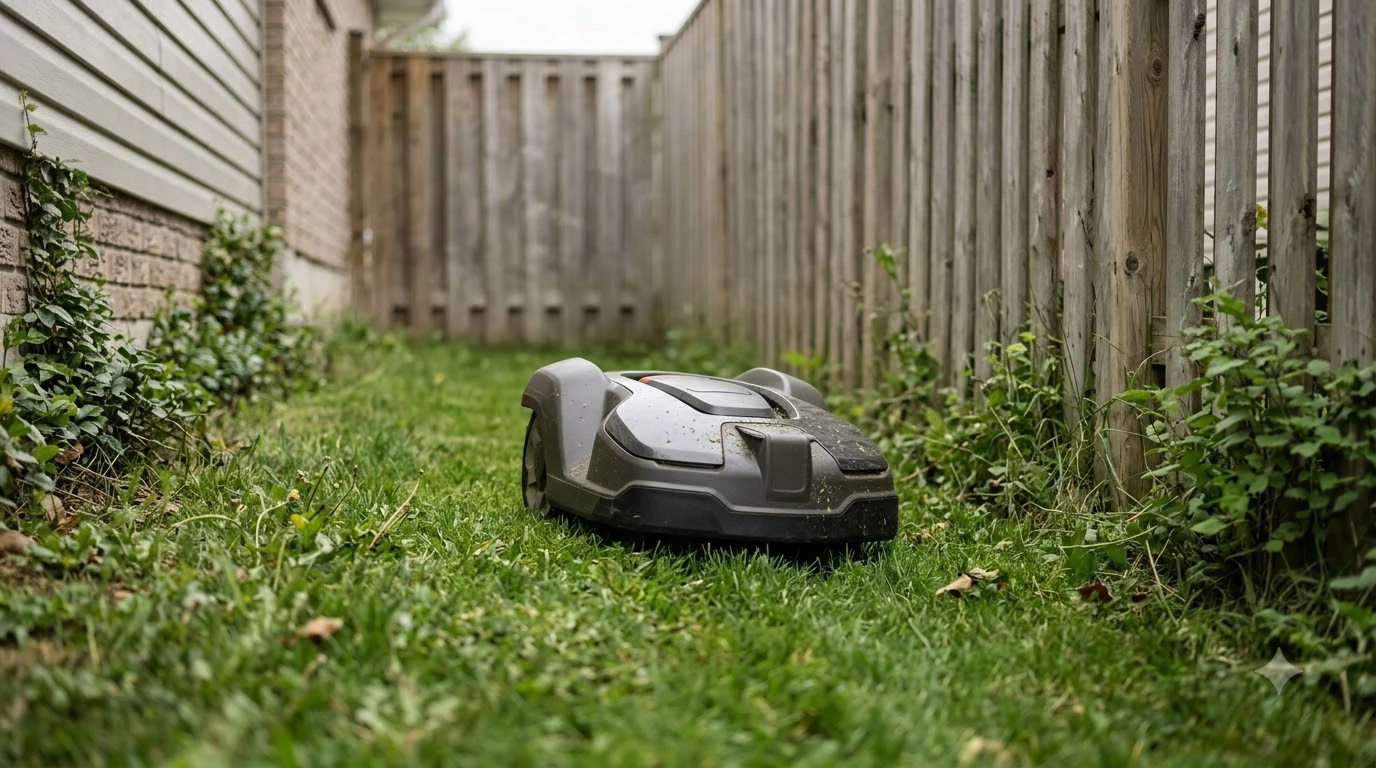

Answering what is the best robot lawn mower for a narrow yard starts with the narrowest passage you have. No single model fits every narrow lot, because passage rules come from each manufacturer’s installation guide, not from a ranking. Husqvarna sets the minimum at 60 cm (24 in) between boundary wires with a guide wire, and 2 m (6 ft 6 in) without one, as of 2026-11-10.
The short answer
- No single best pick: fit depends on the narrowest passage, guide wire support, and the lawn area and slope the model is rated for.
- With a guide wire: 60 cm (24 in) between boundary wires is the minimum in Husqvarna and Gardena guidance.
- Without a guide wire: plan for at least 1.5 m (Gardena) to 2 m (Husqvarna) between boundary wires.
- Before you buy: measure the narrowest point and check the owner’s manual for your model.
What is the best robot lawn mower for a narrow yard?
A narrow yard can fail in different ways. Some lots are a long, thin strip with a clear path. Others have one pinch point between a fence and a flower bed. A mower that suits a strip with a guide wire may still struggle at a gap with obstacles on both sides, so the answer depends on your own measurements.
Manufacturers publish installation distances rather than rankings. Husqvarna and Gardena both state how wide a passage must be for their mowers to pass through reliably. Those figures are the most useful starting point, because they come from the companies that build the machines and set the boundary wire rules.

Measure the narrowest passage first
A passage is measured wire to wire, not wall to wall, and 60 cm (24 in) is the minimum with a guide wire. Husqvarna’s passage guide gives 60 cm (24 in) between boundary wires when a guide wire leads the mower through, and at least 2 m (6 ft 6 in) between the boundary wires on each side when there is no guide wire. Read the steps in the Husqvarna passage guide, and use our guide to measuring yard square footage for the lawn area.
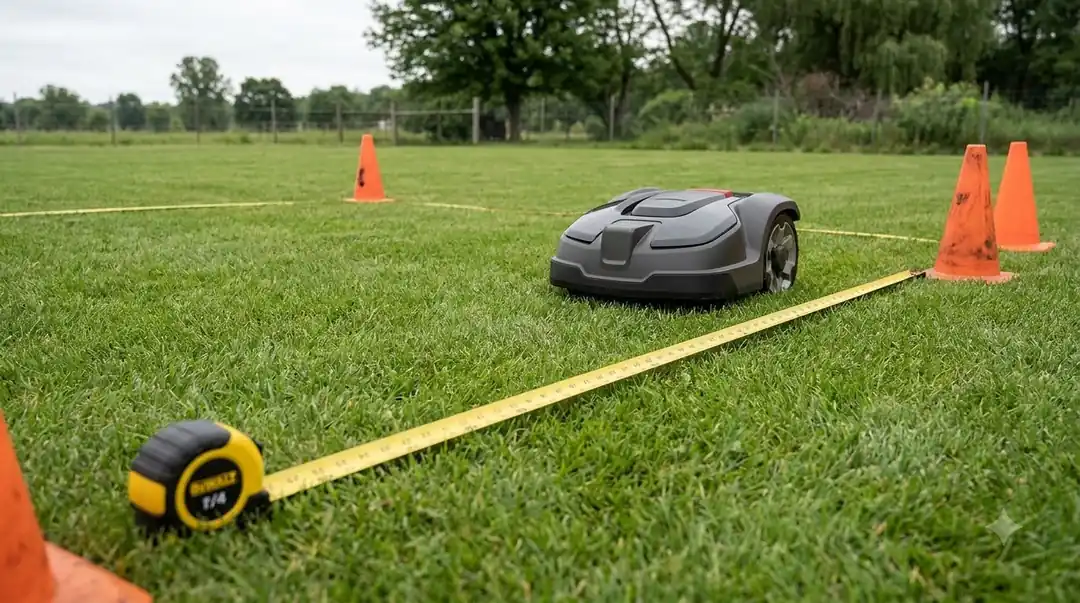
Gardena’s FAQ gives a different figure for the no-guide-wire case. It asks for at least 1.5 m on long narrow passages without a guide wire. For its CorridorCut function, a passage 60 cm wide, boundary wire to boundary wire, can be mowed easily when a guide wire is installed. Our reading is that 60 cm is the tightest width either company supports, so treat it as a floor, not a target.
Obstacles add to the width. Gardena’s FAQ adds the distance from each obstacle to the boundary wire on top of the 60 cm minimum. Its worked example for a SILENO City between two house walls uses 35 cm from each wall, so the total is 35 cm + 60 cm + 35 cm = 130 cm. The FAQ notes that exact model distances are listed in the operating manual.
- Measure the gap at its narrowest point. Use the distance between the two boundary wires, not the distance between walls.
- Add the clearance for each obstacle. Use the manual’s figure for fences, walls and beds, not a rule of thumb.
- Compare the total with the manufacturer figure. Use 60 cm with a guide wire, or 1.5 m to 2 m without one, depending on the brand.
Guide wire and corridor width: what they change
A guide wire is a separate wire that runs down the middle of the passage and connects to the boundary loop. The mower follows it through the gap instead of finding the path on its own. Husqvarna says the guide wire must stay at least 30 cm (12 in) from the boundary wire, and its installation illustration shows both distances. Our guide to laying boundary wire around obstacles covers the routing.
Corridor width is the setting that controls how closely the mower follows the wire. Husqvarna’s corridor width guide says you can set it between 1 and 9, with factory defaults of 6 for the boundary wire and 9 for the guide wire. If the mower gets stuck in a narrow passage, the page advises adjusting this width, and several models allow it to be set by hand.
The corridor setting is a Husqvarna feature described in its own documents. Gardena describes CorridorCut separately, so check each brand’s settings for the model you plan to buy.
Check lawn size and slope, not just width
A narrow yard is often a long lot, so the answer to what is the best robot lawn mower for a narrow yard must also fit the total area, which can exceed what a model is rated for even when the passage works. Our guide to choosing a robot mower by lawn size shows how to match the two. Gardena rates its SILENO Minimo 250 for lawns up to 250 m2, its SILENO Minimo 500 and City 500 for up to 500 m2, and its SILENO Life 750 for up to 750 m2. Each rating carries a tolerance of plus or minus 20 percent.
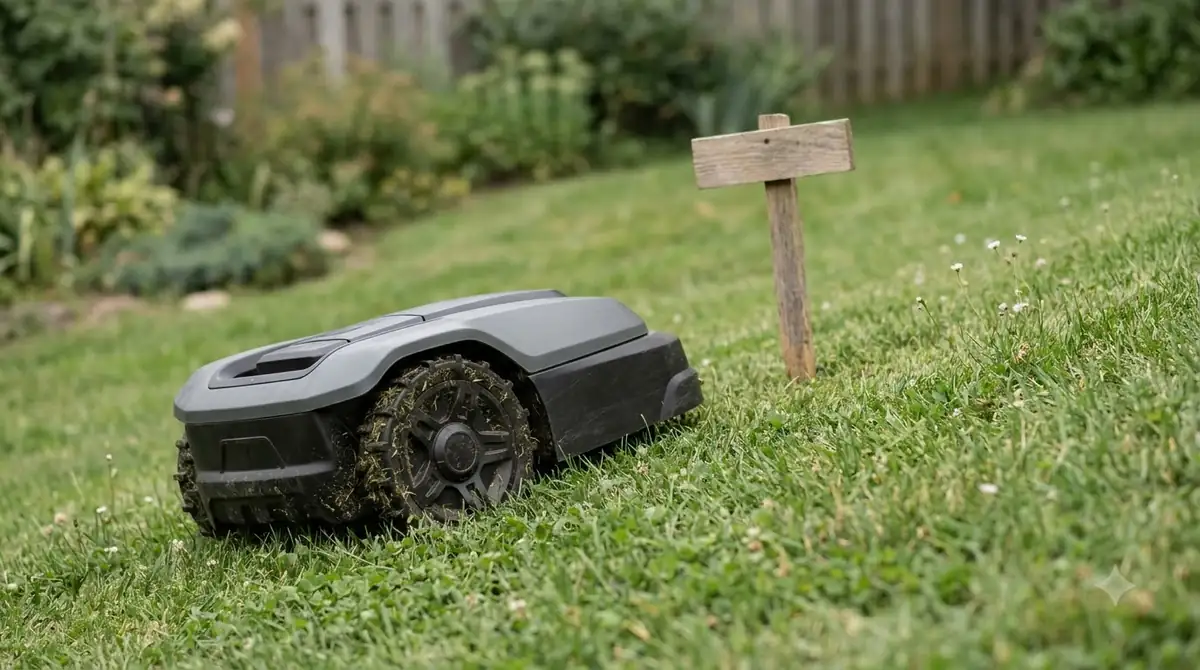
Slope matters on narrow lots that run toward a fence or a drop, and our explainer on robot mower slope ratings shows how to read the figure. Gardena lists a maximum slope of 25 percent (14 degrees) for its Minimo 250 and Minimo 500 models, and 35 percent (19 degrees) for its City 500 and Life 750. These are Gardena’s figures for its own models, so compare them with other brands’ published limits, not with a general rule. Gardena’s robotic mower FAQ lists the full ratings.
How to compare models on the specs that matter
Compare each model on five figures, using the manufacturer’s own number for each one. The table below is a checklist, not a scorecard.
| Spec to compare | What to look for | Our reading |
|---|---|---|
| Passage without a guide wire | Manufacturer minimum between boundary wires, such as 2 m (Husqvarna) or 1.5 m (Gardena) | Use this figure if you cannot run a guide wire |
| Passage with a guide wire | 60 cm (24 in) between boundary wires in Husqvarna and Gardena guidance | Your narrowest gap should clear this with room to spare |
| Corridor width setting | Adjustable range, such as 1 to 9 on Husqvarna models | Helps when the mower gets stuck in a tight passage |
| Rated lawn area | Square metres, with the manufacturer’s tolerance | Long, narrow lawns often run above a model’s rated area |
| Rated slope | Percent and degrees, such as 25 percent (14 degrees) on Gardena Minimo 250 | Check the steepest strip of the lawn, not the average |
Do not compare these figures across brands as if they used the same tests. Each company measures and rates differently, so a higher number from one brand does not prove it will fit your passage better.
Which setup suits which narrow yard
A gap of 60 cm or more between fixed edges is the range where a guide wire is most useful. A gap under 60 cm sits below the minimum both manufacturers give with a guide wire, so it needs a manual check before you buy. Our reading is that a long side strip with room for a guide wire suits a mower whose area rating covers the whole lot. So what is the best robot lawn mower for a narrow yard? It is the one that clears your measured gap and covers your lawn area.
A yard split into two lawn zones joined by a passage needs two checks, and a multi-zone robot mower may be worth a look. Measure the passage on its own, then measure each zone against the area and slope ratings, because the rules apply to each part separately.
What to check before you buy
Before you buy, confirm the narrowest passage, the manufacturer figure for your model, and whether a guide wire fits. Then check the area and slope ratings against your own numbers.
- Measure the narrowest point. Use the wire-to-wire distance and add the clearance for each obstacle.
- Read the model’s manual. A brand guide may differ from the figures for your exact model.
- Confirm the guide wire spacing. The guide wire must sit at least 30 cm (12 in) from each boundary wire, so the passage needs the 60 cm minimum.
- Compare the lawn area and slope. Check the total area and steepest slope against the model’s ratings.
- Check the corridor setting. If your passage is tight, confirm the model offers an adjustable corridor width.
Our reading on what is the best robot lawn mower for a narrow yard is that the best pick is the one whose published passage and rating figures fit your measurements with some margin. Choose after you measure, and confirm every figure in the manual for that exact model.
Frequently asked questions
What is the best robot lawn mower for a narrow yard?
No single model is best for every narrow yard. The right choice depends on your narrowest passage, whether a guide wire fits, and the lawn area and slope the model is rated for. Compare the manufacturer’s figures for each model you consider.
How narrow can a robot mower passage be?
With a guide wire, Husqvarna and Gardena both list 60 cm (24 in) between boundary wires as the minimum. Without a guide wire, Husqvarna recommends at least 2 m (6 ft 6 in), and Gardena asks for at least 1.5 m on long narrow passages. Check the owner’s manual for your model.
Does a guide wire help in a narrow passage?
Yes. A guide wire leads the mower through the passage, and Husqvarna says it must sit at least 30 cm (12 in) from the boundary wire. If the mower still gets stuck, Husqvarna suggests adjusting the corridor width, which runs from 1 to 9.
Can a robot mower handle a long, thin lawn?
It depends on total area and slope, not only width. Gardena rates its SILENO Minimo 250 for up to 250 m2 with a maximum slope of 25 percent (14 degrees), and it allows a plus or minus 20 percent tolerance on area. Measure the whole lawn and compare it with the rating.
Sources
- How to create a passage in an Automower boundary wire installation (Husqvarna): 60 cm with a guide wire, 2 m without one, and 30 cm guide wire spacing.
- How to adjust the corridor width in a boundary wire Automower installation (Husqvarna): corridor width range 1 to 9 and factory defaults.
- Robotic Lawnmower FAQs (Gardena): CorridorCut 60 cm, 1.5 m without a guide wire, obstacle distances, and area and slope ratings.
 Up next8 min readBest Robot MowersWhich Robot Mower Has the Best Navigation? It Depends on Your YardUpdated Nov 11, 2026
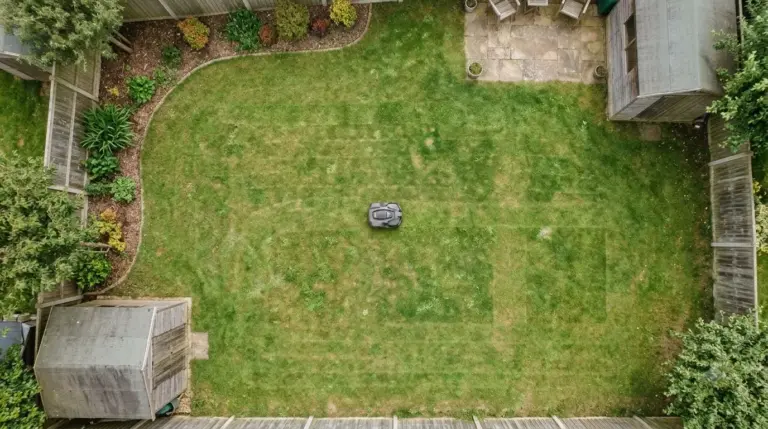 9 min readBest Robot MowersWhich Robot Lawn Mower Is Best for Complex Yards?Updated Nov 11, 2026
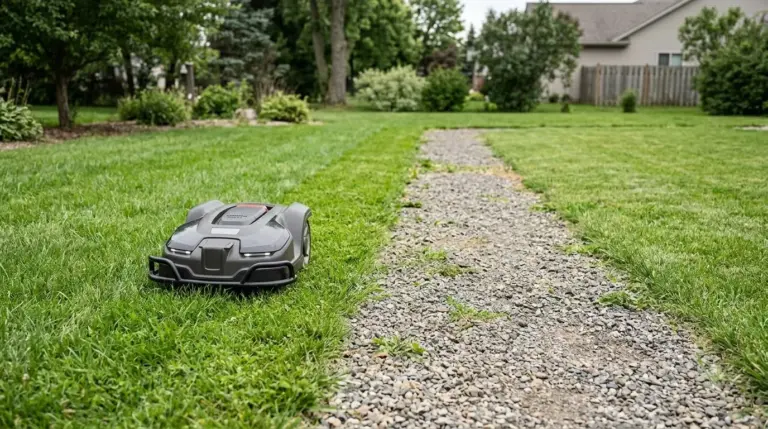 9 min readBest Robot MowersWhat Is the Best Robot Lawn Mower for a Large Yard?Updated Nov 11, 2026
 8 min readBest Robot MowersRTK vs LiDAR vs Vision: Which Robot Mower Navigation Fits Your YardUpdated Nov 11, 2026
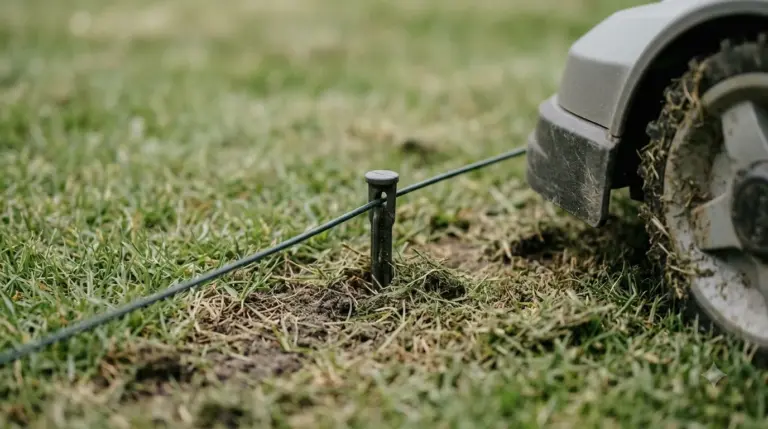 8 min readBest Robot MowersWire-Free vs Boundary Wire Robot Mowers: Which Setup Fits Your YardUpdated Nov 11, 2026
 8 min readBest Robot MowersMost Accurate Robot Lawn Mower Navigation for Your YardUpdated Nov 11, 2026