
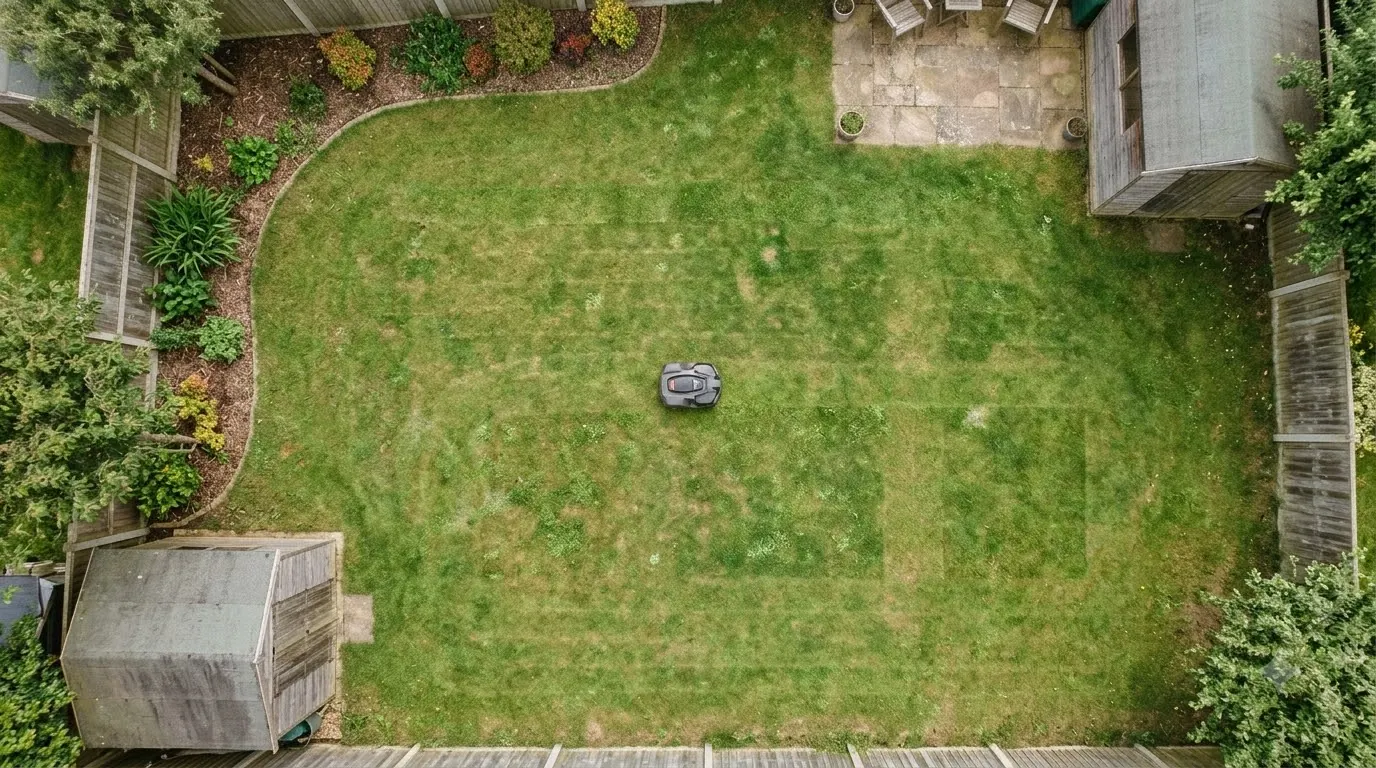

Which robot lawn mower is best for complex yards depends on the yard’s layout, not on one brand. A complex yard usually combines slopes, narrow passages, obstacles and several separate lawn sections. The right mower is the one whose published slope limits, passage handling and navigation method fit those features, and that you can install according to the manufacturer’s instructions.
The short answer
- Check slope twice. Manufacturers often publish one limit for the work area and a lower one for the boundary. Husqvarna’s 300-series models are listed at 40% in the work area and 15% at the boundary, while its 435X AWD is listed at 70% and 50%.
- Check passage width. Honda notes that passages narrower than roughly 60 to 75 cm may be a limiting factor, depending on the model.
- Check how the mower finds its way. Boundary-wire and wire-free systems install differently, and the difference matters most where the lawn has narrow sections or zones separated by paths.
- Check lawn size and zone features against your total area, not only the largest section.
What makes a yard “complex” for a robot mower
A complex yard is one where the mower has to handle more than one difficult condition at the same time. A single open lawn is the easy case. The harder layouts combine a slope beside a flower bed, a side passage between a fence and a shed, or two lawn sections joined by a narrow gap. Separate sections have rules of their own, covered in mowing several separate lawn areas.
Honda’s guidance for complex layouts names three features: narrow sections, multiple levels, and zones separated by paths. Those features are the ones to measure first. Our reading is that a sketch of the yard, with each slope, passage and separate section marked, makes model comparison far easier than comparing brochure features. So which robot lawn mower is best for complex yards depends on how many of these conditions your lawn combines.
Slope limits: read the work area and boundary figures separately
Most manufacturers publish a slope limit for the lawn and a lower one for the boundary, so both need checking. Husqvarna’s support page defines slope as vertical height divided by horizontal distance, multiplied by 100. A 15 cm rise over 100 cm of run is 15%. Its standard Automower models are rated from 25% to 50% depending on the model, and the 435X AWD is rated up to 70% in the work area and up to 50% at the boundary, according to the Husqvarna steep-slope installation guide.
Honda rates its HRM 1000, 1500, 2500 and 4000 models for slopes up to 47%, equal to a 25-degree incline. Its Miimo 40 and 70 models are rated up to 27%. Worx lists 35% as the maximum slope for its Landroid M700 Plus.
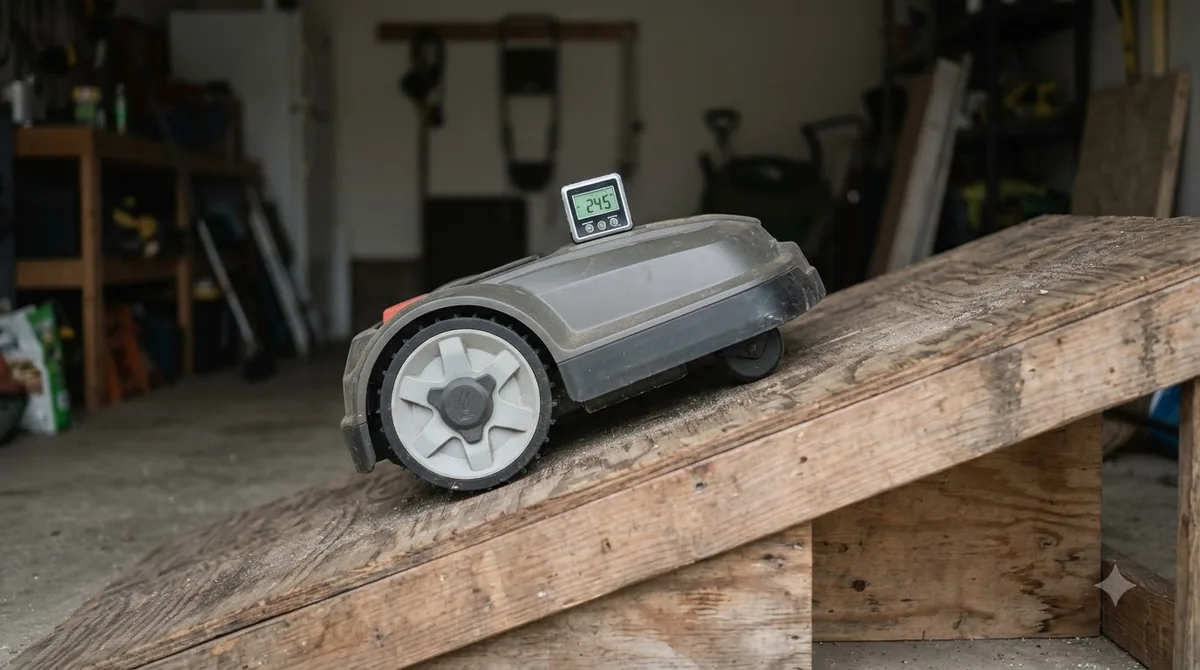
A published maximum is a ceiling rather than a daily target. If you have not measured yet, start with measuring your yard’s slope, then read how slope ratings work on robot mowers. Honda states that wet grass reduces grip for any mower, regardless of its rating, and advises avoiding wet conditions where possible, especially early in the morning when dew is present. Our reading is that if a steep section runs along the lawn’s edge, the boundary figure matters more than the work area figure. For anyone asking which robot lawn mower is best for complex yards with slopes, that boundary number is the first one to compare.
Heads up
The numbers above come from specific models and, in some cases, from older manuals. Limits can differ within one brand’s range, so confirm the figure in the manual for the exact model you are considering.
Narrow passages and obstacles
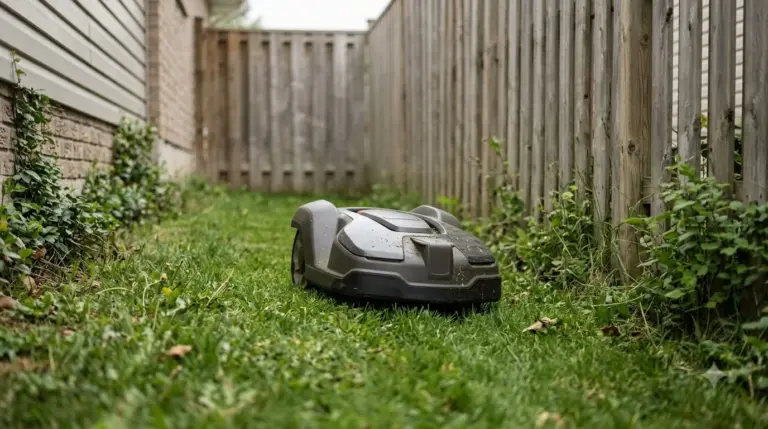
A passage that is narrow enough to slow a mower is often a layout problem before it is a model problem. Honda’s guidance says passages narrower than roughly 60 to 75 cm may be a limiting factor, depending on the model. Its advice also covers zones separated by paths, which are common in complex yards. For a closer look at tight gaps, see narrow passage limits for robot mowers.

Husqvarna’s guidance for its AWD models asks for at least 1.5 m (5 ft) between the boundary wire and obstacles, and between obstacles, when the work area slope is up to 50%. Between 50% and 70%, the same guide advises avoiding obstacles on the slope and keeping 1.5 m between the bottom of the slope and the boundary wire.
Worx’s product page for the Landroid M700 Plus says the mower goes through narrow passages “with ease, without any guiding wire,” and lists its product width as 403 mm. The page does not give a minimum passage width, so the claim should be tested against the actual gap. Our reading is that you should measure each passage at its narrowest point after edging, fences and boundary wire are in place, because those items reduce the usable width.
Navigation: boundary wire, wire-free and satellite systems
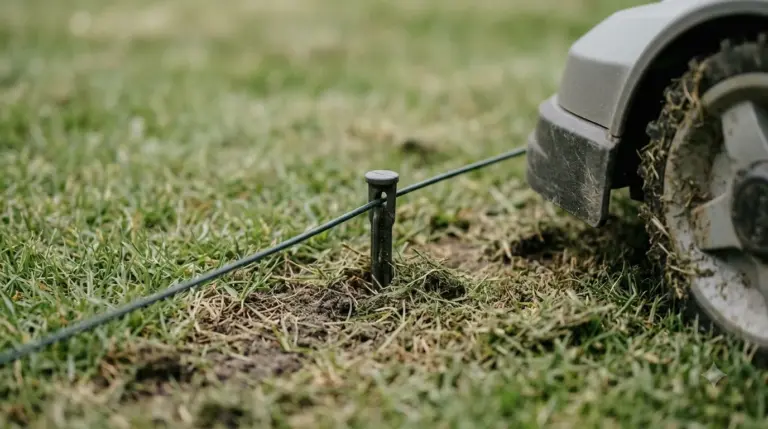
The navigation method affects how easily a mower handles separated areas and how much installation work a complex layout needs. Husqvarna’s wire-free (EPOS) installations use stay-out zones around slopes that exceed the mower’s limit. Its physical-wire installations isolate too-steep areas with boundary wire islands, and the guide wire is laid diagonally across the slope.
Honda advises running the boundary wire over flat ground before a slope, not at the top or bottom of a bank, and placing the docking station on stable, flat ground that the mower can reach from every part of the lawn. Honda also lists layouts with narrow sections, multiple levels or zones separated by paths as the ones where extra navigation help is most useful.
Our reading is that a wire-free system reduces the wire work in tight corners (the wire-free versus boundary-wire robot mowers comparison goes deeper), but it does not remove the need to follow the manufacturer’s installation rules. Compare the setup effort honestly before you settle which robot lawn mower is best for complex yards like yours.
Comparing published specifications
The table below lists figures from manufacturer pages only. It is not a ranking of which robot lawn mower is best for complex yards, and a model that suits one yard may not suit another.
| Model (as published) | Slope, work area | Slope, boundary | Other published limit |
|---|---|---|---|
| Husqvarna 435X AWD | Up to 70% | Up to 50% | 1.5 m between obstacles and boundary on slopes up to 50% |
| Husqvarna 305 to 315 Mark II | 40% | 15% | Listed in the Husqvarna model table |
| Honda HRM 1000 to 4000 | Up to 47% rated | Not stated on the page | Passages under roughly 60 to 75 cm may limit use |
| Honda Miimo 40 and 70 | Up to 27% rated | Not stated on the page | Not stated on the page |
| Worx Landroid M700 Plus | 35% maximum | Not stated on the page | Maximum lawn 700 m², multi-area management |
Which robot lawn mower is best for complex yards: how to choose
Match each feature of your yard to a published figure, then check the total area and the navigation method. The steps below keep the comparison to measurable items.
- Measure the steepest section. Convert rise over run into a percentage and note whether it sits in the work area or along the boundary.
- Measure the narrowest passage. Take the width at its tightest point after fences and edging are in place.
- Count the separate lawn sections. If there are several, check whether the model supports zones or multi-area management.
- Check the total lawn size. Worx lists a 700 m² maximum for the M700 Plus, and Honda lists its HRM range for lawns from 1,000 to 4,000 m².
- Decide on the wire you can accept. Boundary-wire installs need the wire laid on flat ground before slopes, while wire-free installs need stay-out zones around steep areas.

What to check before you buy
Before you decide which robot lawn mower is best for complex yards, get the exact model’s manual and compare its numbers with your yard. The points below come from the manufacturer material cited in this guide.
- The work area slope and the boundary slope, both in percent.
- Any passage width the manual recommends, including the 60 to 75 cm range Honda describes for some models.
- Whether the model supports zones, and how it handles separate lawn sections.
- The stay-out zone or boundary wire island steps needed for steep areas.
- The maximum lawn area, measured against your total lawn area rather than one section.
Frequently asked questions
Which robot lawn mower is best for complex yards overall?
No single model fits every layout. Match the published slope limits, passage requirements and navigation method to the features of your yard, and compare the figures in each model’s manual.
What slope can a robot lawn mower handle?
It depends on the model. Husqvarna lists its standard Automower models at 25% to 50% depending on the model, and the 435X AWD at up to 70% in the work area. Check the boundary figure too, because it is often lower.
Do I need a wire-free mower for a complex yard?
Not always. Wire-free systems reduce wire work in tight corners, but boundary-wire models can handle complex yards when the wire is placed as the manufacturer advises, such as on flat ground before a slope.
How wide should a passage be for a robot mower?
Honda says passages narrower than roughly 60 to 75 cm may be a limiting factor, depending on the model. Husqvarna’s AWD guidance asks for 1.5 m between obstacles and the boundary wire on slopes up to 50%. Check the manual for the exact model you are considering.
Sources
- Optimising an Automower installation for steep slopes (Husqvarna): slope definition, limits by model, stay-out zones, AWD spacing guidance.
- Can robotic lawn mowers handle slopes and uneven gardens? (Honda): HRM and Miimo slope ratings, wet-grass traction, boundary wire placement, passage width, complex layout guidance.
- Landroid M700 Plus product page (Worx): listed maximum slope, narrow passage wording, product width, maximum lawn size, multi-area management.
 Up next9 min readBest Robot MowersWhat Is the Best Robot Lawn Mower for a Large Yard?Updated Nov 11, 2026
 8 min readBest Robot MowersWhich Robot Mower Has the Best Navigation? It Depends on Your YardUpdated Nov 11, 2026
 9 min readBest Robot MowersWhat Is the Best Robot Lawn Mower for a Narrow Yard?Updated Nov 11, 2026
 8 min readBest Robot MowersRTK vs LiDAR vs Vision: Which Robot Mower Navigation Fits Your YardUpdated Nov 11, 2026
 8 min readBest Robot MowersWire-Free vs Boundary Wire Robot Mowers: Which Setup Fits Your YardUpdated Nov 11, 2026
 8 min readBest Robot MowersMost Accurate Robot Lawn Mower Navigation for Your YardUpdated Nov 11, 2026