
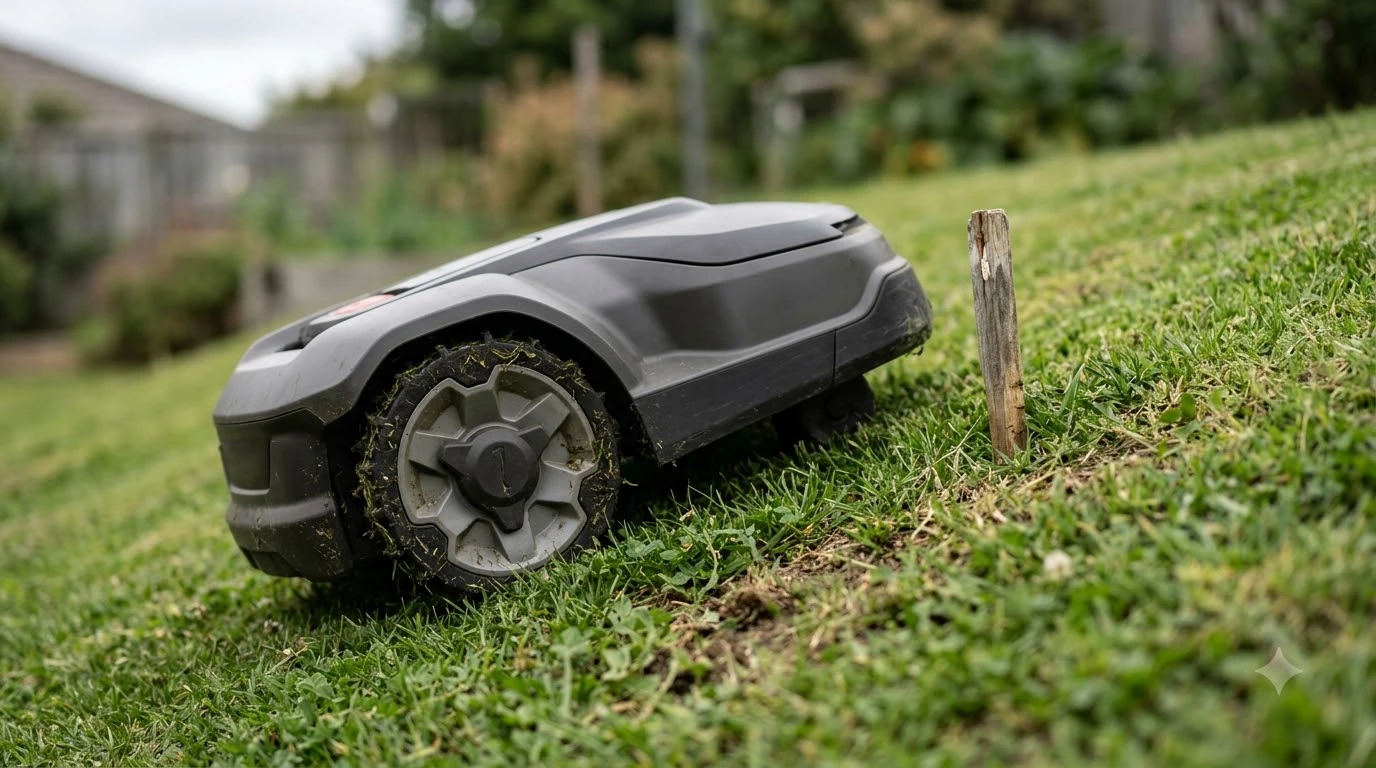

What is the best robot lawn mower for hills? It is the one whose rated slope clears your steepest measured point with room to spare. No single model wins every yard. Husqvarna’s support guidance lists limits from 25% to 70%, and the right number depends on how steep your lawn really is.
The short answer
- Measure first: find the steepest strip of your lawn and convert it to a percent.
- Read two limits: the work-area rating and the lower boundary rating.
- Choose AWD for the steepest ground: Husqvarna’s 435X AWD is rated at 70% in the work area.
- Leave margin: our reading is to keep your steepest slope under the rating, not right at it.
What is the best robot lawn mower for hills? It depends on your slope
No single model is the best robot lawn mower for hills in every yard, because the right pick depends on your steepest measured slope, the drive type, and where the boundary wire has to go. Vendor roundups often name one top pick. Those lists help you build a shortlist, but they do not know your lawn.
Ratings are also model-specific. A number printed for one series does not carry over to another, so check the rating for the exact model you plan to buy.

Measure your steepest point before you shop
Measure the steepest part of your lawn first, because a rating only helps when you have a real number to compare it with. Once you have that number, the best robot lawn mower for hills on your list is the one whose limit sits above it. Husqvarna’s installation guide uses one simple formula for this, and you can do it with a level and a tape measure. How to measure yard slope covers other methods.
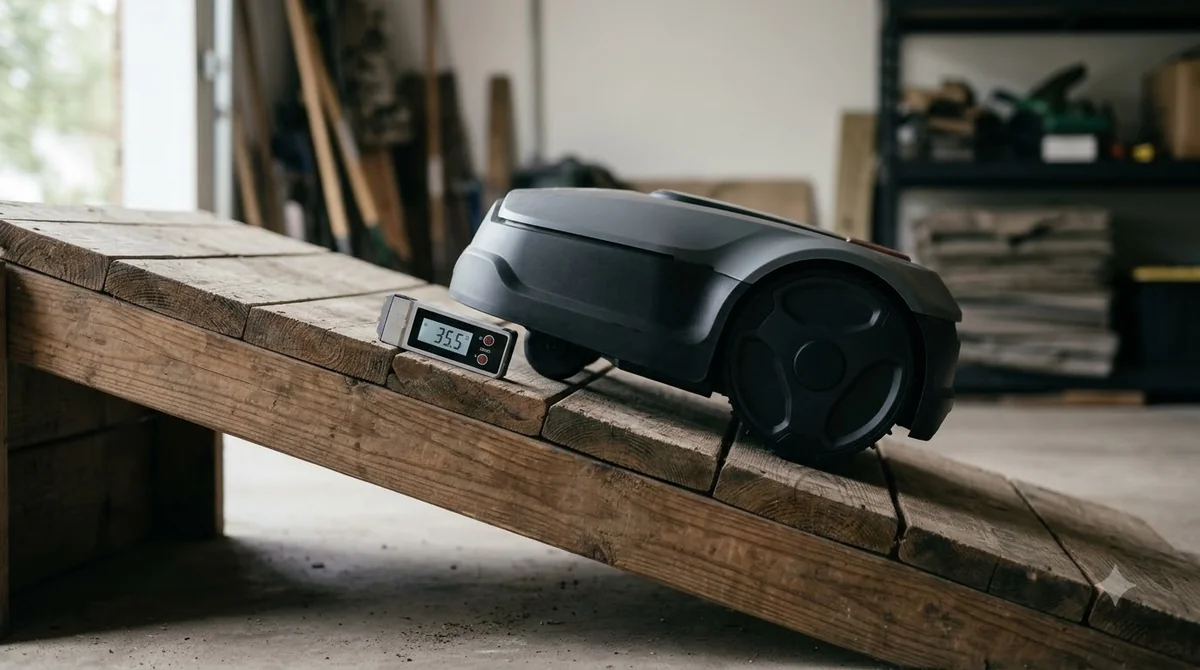
- Pick a straight line. Run it from the flat ground up the steepest part you want to check.
- Lay a long level. Set it along the line with the low end on the grass, and center the bubble.
- Measure the run. The length of the level is the horizontal distance.
- Measure the rise. Measure the vertical gap under the far end of the level.
- Divide and multiply. Divide the rise by the run, then multiply by 100 to get the percent.
Husqvarna gives the formula as vertical height divided by horizontal distance, times 100. Its example is a 15 cm rise over 100 cm, which gives a 15% slope. Keep both measurements in the same unit, so the result is the same whether you use centimeters or inches.
Once you have the number, use it to filter the shortlist. Our reading is to measure in more than one spot. The steepest strip is the one that matters for the mower, not the average slope of the whole yard.
Convert percent to degrees before you compare
A 50% slope is about 26.6 degrees, not 50 degrees, so confirm the unit before you compare two models. Percent is rise over run, as robot mower slope rating explained also shows. Degrees is the angle of the ground. Mixing the two is an easy mistake, and it changes the answer a lot.
| Slope (percent) | Angle (degrees) |
|---|---|
| 25% | 14.0 |
| 40% | 21.8 |
| 50% | 26.6 |
| 70% | 35.0 |
| 100% | 45.0 |
The angles above are our calculation from the percent values. Husqvarna describes its standard models as handling slopes of 25% to 50%, which it also gives as 14 to 26 degrees.
Work-area and boundary limits
Husqvarna lists two slope limits for most models, one for the work area and a lower one at the boundary wire. The boundary number often decides where the wire can go, so read both before you choose. The figures below come from Husqvarna’s steep slope installation guide, which is a UK support page, so check the spec sheet for the model sold in the US.
| Husqvarna model | Work area | By boundary |
|---|---|---|
| Aspire R4 | 25% | 10% |
| 105 | 25% | 15% |
| 310 | 40% | 15% |
| 430X NERA | 50% | 25% |
| 435X AWD | 70% | 50% |
Knowing this pattern helps you narrow the field before you compare features. In every row, the boundary limit is lower than the work-area limit. If the outer edge of the work area is steeper than the mower’s limit, Husqvarna advises positioning the boundary further in, on flat ground, before the slope begins. That keeps the wire clear of ground the mower cannot safely hold.
Choose AWD when the hill is steep
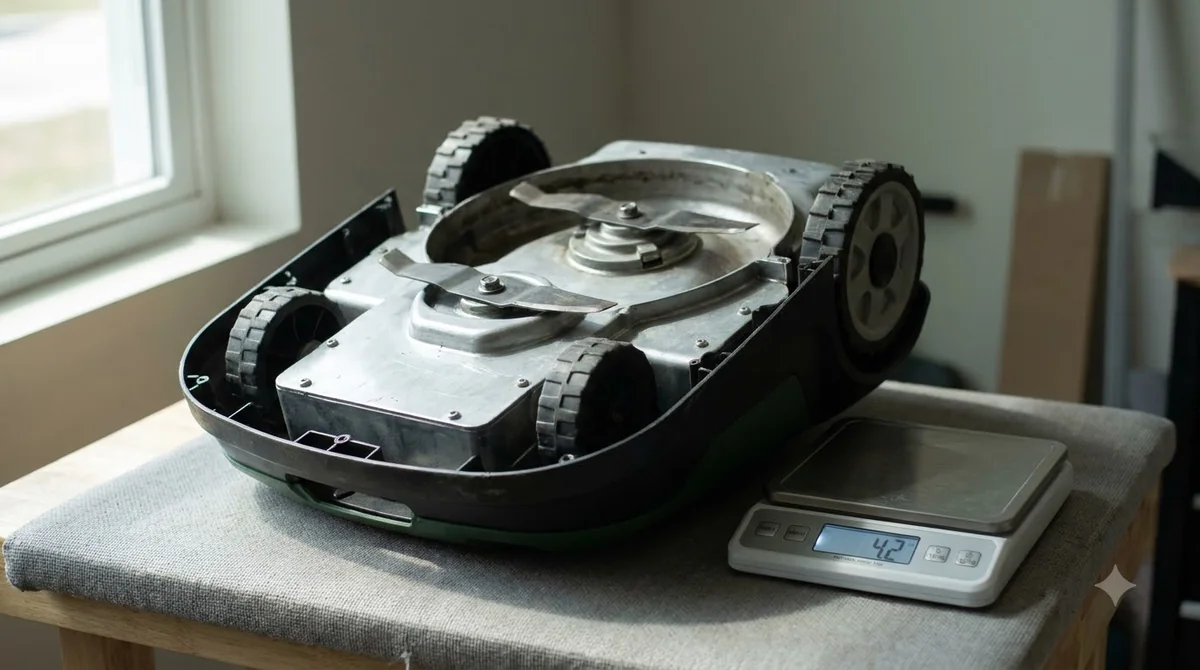
All-wheel drive in robot mowers is the option for the steepest ground, and Husqvarna’s 435X AWD and 435X AWD NERA are rated at 70% in the work area and 50% at the boundary. Husqvarna describes its standard models as handling 25% to 50%, depending on the model, so the drive type is a real difference on steep yards.
- Above 50%: keep 1.5 m (5 ft) from the bottom of the slope to the boundary wire, according to Husqvarna’s AWD guidance.
- Transition: leave at least 50 cm (1.6 ft) of level ground between flat areas and steep slopes.
- Guide wire: lay it diagonally across the slope for traction and less grass wear.
When you ask what is the best robot lawn mower for hills on very steep ground, AWD is a useful filter. Our reading is that AWD is a reason to read the rating closely, not a replacement for measuring your lawn. A steep yard still needs a rated limit that clears your measured slope.
Wet grass and wheel grip
Wet grass and clogged wheels cut grip on a slope, and Husqvarna warns that the slipping risk rises especially in wet conditions. The same guidance notes that slopes become harder to manage when the wheels are clogged with grass. For more on damp lawns, see how robot mowers handle wet grass.
Rain changes the picture for every model, not only for budget ones, so it belongs in any answer to what is the best robot lawn mower for hills. Husqvarna does not publish a number for grip loss on wet grass, so do not assume a dry-day rating holds after rain. Our reading is to plan for less grip after rain, and to clean the wheels when the grass is wet.
What to check when you look for the best robot lawn mower for hills
Before you buy, confirm the work-area and boundary ratings for your exact model, the drive type, and that your steepest measured slope sits below both limits with some room to spare. A mower that is the best robot lawn mower for hills on paper can still fail a yard with a steep strip near the boundary.
- Work-area rating: check it for the exact model, not just the series name.
- Boundary rating: it is usually lower, so your wire layout depends on it.
- Drive type: standard or AWD, since the steepest models in Husqvarna’s table are AWD.
- Your steepest slope: the percent value from your own measurement.
- Margin: our reading is to keep your steepest slope well below both limits.
If you are still asking what is the best robot lawn mower for hills for your own yard, the answer starts with your measurement. If your steepest strip sits near the top of a model’s range, choose a higher-rated model or reshape the slope before you install. If the ground is bumpy as well as steep, see which robot lawn mower is best for uneven ground. A mower working at its limit on dry grass will have less room once the grass is wet.
Frequently asked questions
What is the best robot lawn mower for hills in general?
There is no universal pick. The best robot lawn mower for hills is the model whose work-area and boundary ratings clear your measured steepest slope. Husqvarna’s AWD models carry its highest published ratings, but the right model depends on your lawn.
How steep a hill can a robot mower climb?
It depends on the model. Husqvarna says its standard models handle slopes of 25% to 50%, which is 14 to 26 degrees. Its 435X AWD models go up to 70% in the work area. Check the rating for your exact model before you buy.
Do I need an AWD robot mower for hills?
Not always. A gentle slope may suit a standard model. For the steepest ground, Husqvarna’s highest published rating belongs to its AWD models, so that is the drive type to check first.
Why is the boundary slope limit lower?
Husqvarna lists a lower limit at the boundary wire for each model in its table. The boundary decides where the mower is allowed to cut, so check it alongside the work-area rating.
Does rain change the answer?
Husqvarna warns that the slipping risk on steep slopes rises, especially in wet conditions. It does not publish a wet-grass number, so plan for less grip after rain and do not assume the dry-day rating holds.
Sources
- Optimising an Automower installation for steep slopes (Husqvarna support): slope formula, model work-area and boundary limits, AWD boundary placement, wet-slope warning.
- Optimising an Automower installation for steep slopes, Irish edition (Husqvarna support): cross-check of the same model table and figures.
 Up next8 min readBest Robot MowersWhat Is the Best Robot Mower for a Lawn With Trees?Updated Nov 11, 2026
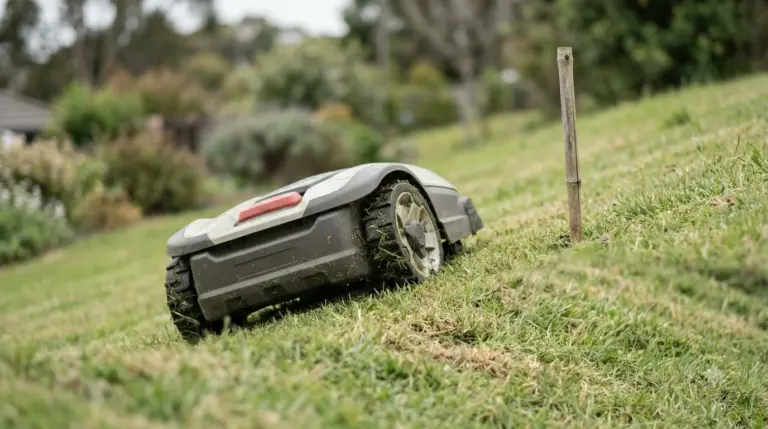 9 min readBest Robot MowersWhat Is the Best Robot Lawn Mower for a 1/2 Acre With SlopesUpdated Nov 11, 2026
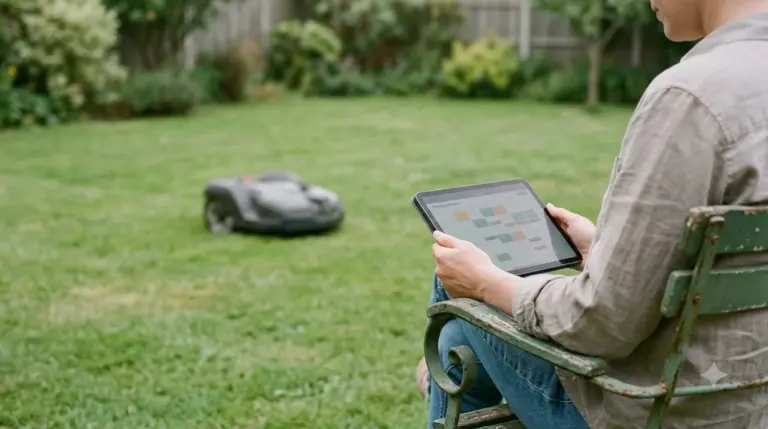 8 min readBest Robot MowersWhich Robot Mower Works Best With Poor Wifi?Updated Nov 11, 2026
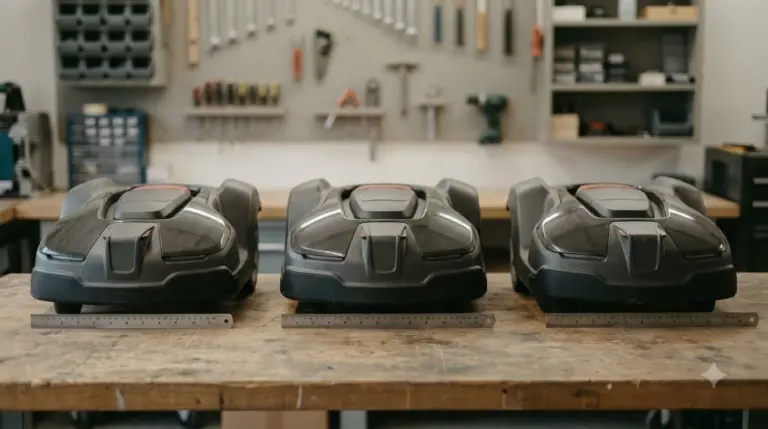 8 min readBest Robot MowersWhat Size Robot Mower Do I Need for 1.5 Acres?Updated Nov 11, 2026
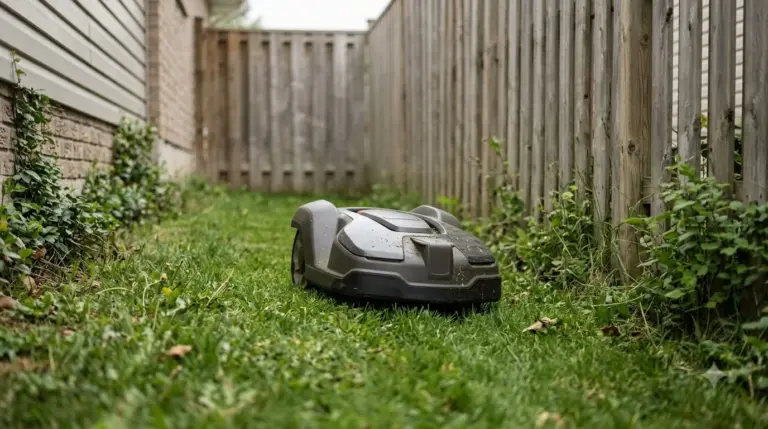 9 min readBest Robot MowersWhat Is the Best Robot Lawn Mower for a Narrow Yard?Updated Nov 11, 2026
 8 min readBest Robot MowersWhich Robot Mower Do Lawn Care Experts Recommend?Updated Nov 11, 2026