

Which robot lawn mower is best for uneven ground depends on three specs: drive type, slope rating and obstacle clearance. No single model suits every yard, so match the mower to your lawn’s steepest slope and its largest dips and bumps. This guide explains what each spec means and what to check before you buy.
The short answer
- Drive type: vendors describe all-wheel drive (AWD) and track designs as suited to steeper or rougher ground than standard two-wheel-drive (2WD) models.
- Slope rating: Honda lists some models at up to 47 percent (25 degrees), while Lymow describes standard 2WD models as suited to gentle inclines of 20 to 25 degrees.
- Obstacle clearance: Lymow gives one model a vertical obstacle clearance of 7 cm, a figure to compare with your largest bump.
- The first step: measure your steepest slope and biggest bump, then compare them with the rating and clearance in your model’s manual.
Which robot lawn mower is best for uneven ground: the key specs
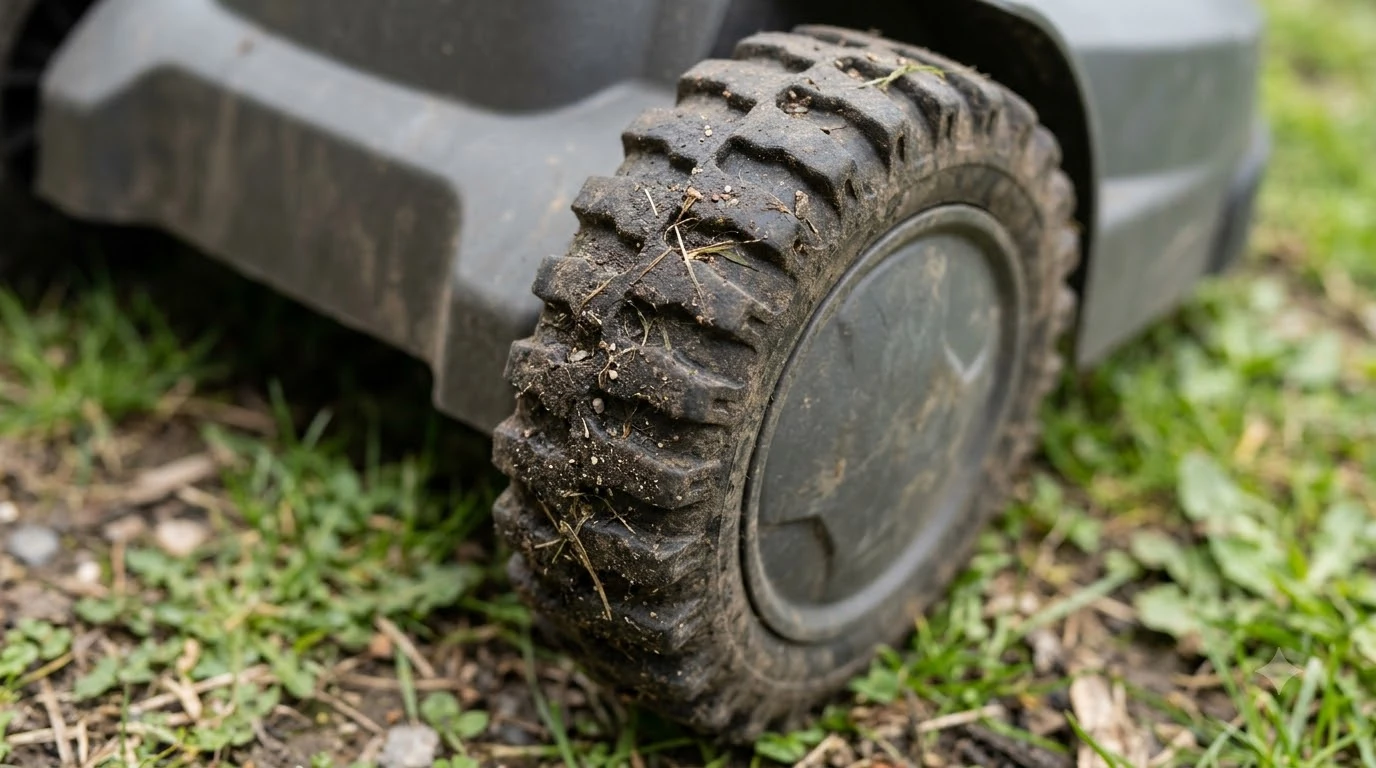
A mower suits uneven ground when all its wheels stay in contact with the lawn, its slope rating is above your steepest incline, and its clearance is above your largest bump. Honda’s guidance on robot mowers notes that good weight distribution across all four wheels helps maintain contact on uneven surfaces. Lost contact means lost traction, so wheel layout matters as much as the headline rating.
Our reading is that uneven ground creates three separate problems: climbing a slope, crossing a dip where a front caster drops in, and keeping grip on damp grass. Each problem maps to a different spec, so a single “best” label hides the trade-offs. Check all three before you decide.
Drive type: 2WD, AWD and tracks
Two-wheel drive suits gentle inclines, while all-wheel drive and track designs are marketed for steeper or rougher ground (how AWD robot mowers work). Lymow’s guide describes standard 2WD models as managing gentle inclines of 20 to 25 degrees, which is 36 to 47 percent. It cites an AWD system reaching 35 degrees (70 percent) and a track-based premium design at 40 to 45 degrees. These are vendor descriptions, not independent test results, and the page does not explain how the ratings were measured.
| Drive type | Figure cited | Where it comes from |
|---|---|---|
| Standard 2WD | Gentle inclines of 20 to 25 degrees (36 to 47 percent) | Lymow, general guidance |
| AWD | 35 degrees (70 percent), example model Husqvarna 535 AWD | Lymow, competitor spec as cited |
| Track-based premium | 40 to 45 degrees (84 to 100 percent) | Lymow, general guidance |
Use this table as a starting point only. Compare the drive type named in your own model’s manual with the slope you measured on your lawn.
How to convert and compare slope ratings
Percent and degrees describe the same slope in different units, so convert before you compare two models (reading robot mower slope ratings). Slope percent is rise over run multiplied by 100, and the angle in degrees is the arctangent of that ratio. Anker’s UK guidance lists its E15 and E18 mowers with slope handling up to 18 degrees, which is about 32 percent.
Ratings also disagree across sources. Anker’s article gives a general FAQ range of 14 to 22 degrees (25 to 40 percent) for standard mowers, while its body text gives 17 to 19 degrees (30 to 35 percent) for the same category. Lymow does not state a measurement method either. That is why we recommend reading the rating’s unit and the test conditions in the manual, then comparing models on the same scale.
| Degrees | Percent (our conversion) |
|---|---|
| 14 degrees | 25 percent |
| 18 degrees | 32 percent |
| 22 degrees | 40 percent |
| 25 degrees | 47 percent |
| 35 degrees | 70 percent |
| 45 degrees | 100 percent |
Honda’s figures show the same pattern: its HRM 1000, 1500, 2500 and 4000 models are rated to slopes of up to 47 percent, equivalent to 25 degrees, while its Miimo 40 and Miimo 70 models are rated up to 27 percent.
Obstacle clearance and cutting height on bumpy lawns
Obstacle clearance decides whether a mower rolls over a bump, and cutting height decides whether its blades scalp the high points. Lymow lists a vertical obstacle clearance of up to 7 cm for one of its models, a manufacturer specification. Measure your largest bump or exposed root and compare it with that number, then check the figure for the exact model you plan to buy.
Anker’s UK guidance gives an adjustable cutting height of 25 to 75 mm for its E15 and E18 mowers and links a higher setting to less scalping on bumps, without giving test figures. Our reading is that a higher setting is the simpler way to protect bumpy patches while you fill or level the ground.
Passage width is a separate limit. Honda notes that very narrow passages, below around 60 to 75 cm, can be a limiting factor depending on the model, so measure any gap the mower must pass through, not just the open lawn.
Boundary wire and docking on slopes
Lymow recommends keeping the boundary wire 30 to 50 cm from the base of a slope and placing the charging dock on ground under 15 degrees. For placement beyond slopes, see where to put a robot mower charging station. These are general guidance rather than manufacturer specifications, so confirm them against your model’s installation manual before you dig.
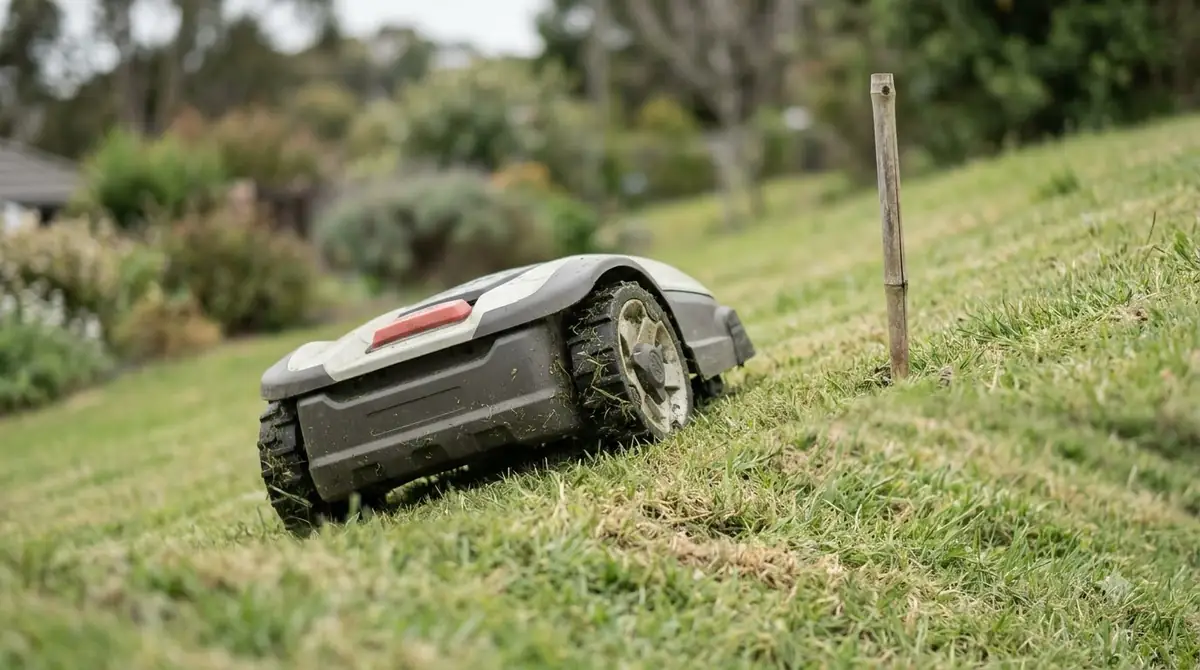
Our reading is that a dock on a steep slope is harder to reach and more likely to be missed, so a flatter spot near the lawn edge usually works better. Lymow’s page also says wet conditions reduce capability, though it gives no measured figure. Treat slope ratings as the best-case number for dry ground.
Heads up
Most of the slope and clearance figures in this guide come from robot mower makers’ own pages or from a competitor’s spec as quoted by a vendor. None of the figures here come from independent lab tests. The Honda and Anker pages are UK editions, so confirm the numbers for the model sold in the US in its manual.
What to check before you buy
Start with your lawn, not the product page. To decide which robot lawn mower is best for uneven ground in your yard, measure the steepest slope and the largest bump, then compare them with the rating, drive type and clearance for each model you are considering.
- Measure the steepest slope. Use a level or a phone inclinometer app (measuring the slope of your yard), then convert the result to percent so it matches the rating.
- Compare with the stated maximum. Check whether the manual gives percent or degrees, and whether the figure is a maximum or a recommended limit.
- Choose the drive type for the terrain. Standard 2WD suits gentle inclines, while AWD and track designs are marketed for steeper or rougher ground.
- Measure the largest bump. Compare it with the stated vertical obstacle clearance for the exact model.
- Measure the narrowest passage. Passages below about 60 to 75 cm can limit some models.
- Read the boundary and dock instructions. Check the wire distance from slope bases and the dock’s maximum ground angle.
For most yards, the answer to which robot lawn mower is best for uneven ground is the model whose manual rating clears your worst slope with a margin. Our reading is that a rating with a margin above your worst slope is more useful than the highest rating on the market. Choose the model whose manual supports your real lawn, then keep the grass short and the low spots filled so the mower keeps its traction. Robot mower wheel ruts and brown patches shows what lawn damage to watch for.
Frequently asked questions
Which robot lawn mower is best for uneven ground on a 25 percent slope?
Many models can, but check the rating. Anker’s general guidance puts basic models at 15 to 25 percent, so a 25 percent slope sits at the upper edge of that range. Honda lists some models up to 47 percent, which is more margin.
Is all-wheel drive always better on uneven ground?
Not always. Lymow describes AWD and track models as suited to steeper ground, but its figures are vendor descriptions and not independent tests. Compare the rating against your own measured slope before assuming AWD is necessary.
What does 7 cm of obstacle clearance mean?
It is the vertical height that one Lymow model can roll over, according to the manufacturer. Measure your largest bump or root and compare it with the figure for the exact model, since clearance varies between models.
Does wet grass change the rating?
Lymow says wet conditions reduce a mower’s capability but gives no measured figure. Treat the rating as a dry-ground number, and expect less margin on damp slopes, where grip is lower.
Sources
- Can robotic lawn mowers handle slopes and uneven gardens? (Honda UK): slope ratings for HRM and Miimo models, passage width, four-wheel contact.
- Do robot mowers work on uneven lawns? (Anker, Eufy brand, UK): E15 and E18 slope handling, cutting height range, general slope ranges by category.
- Robot Mowers on Hills: Slope Ratings and Stuck Prevention (Lymow, UK): drive-type slope ranges, obstacle clearance, boundary and dock distances.
 Up next9 min readBest Robot MowersHow to Read a Robot Mower Spec SheetUpdated Nov 11, 2026
 8 min readBest Robot MowersMost Powerful Robot Lawn Mower: What the Specs Really MeasureUpdated Nov 11, 2026
 8 min readBest Robot MowersBest Robot Lawn Mower for Texas Lawns: 4 Specs to CheckUpdated Nov 11, 2026
 8 min readBest Robot MowersBest Robot Lawn Mower for 3/4 Acre: How to Choose the Right SizeUpdated Nov 11, 2026
 8 min readBest Robot MowersBest Hookii Robot Mower Model to Buy: 3 Models ComparedUpdated Nov 11, 2026
 9 min readBest Robot MowersBest Robot Lawn Mower for 3 Acres: What the Ratings Really CoverUpdated Nov 11, 2026