
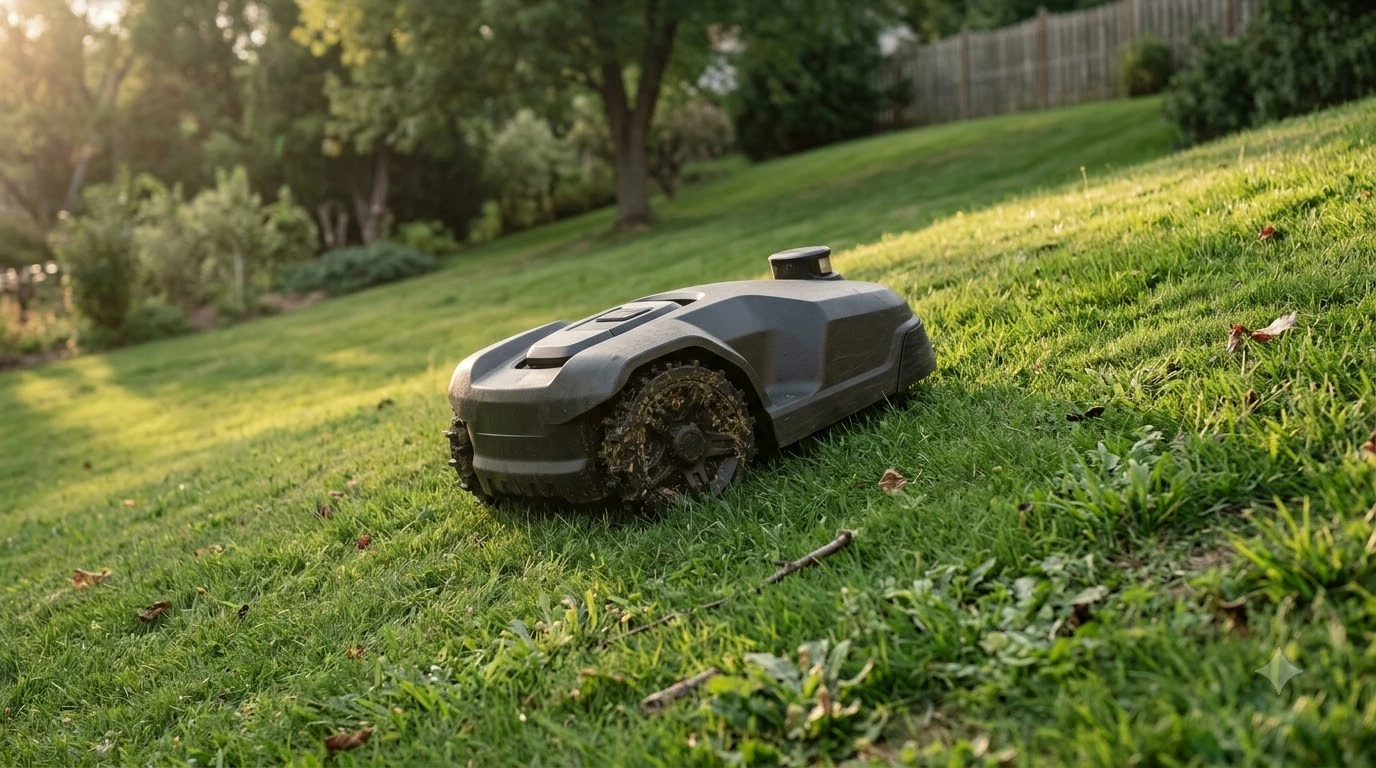

How steep a hill can a robot mower handle? Most models are rated for slopes of about 25 to 50 percent, or 14 to 26 degrees, and some all-wheel-drive models reach 70 percent. Treat the top number on the spec sheet as a ceiling, not a daily target, and see robot mower slope ratings explained for how the spec is written.
The short answer
- Standard models: roughly 25 to 50 percent (14 to 26 degrees), depending on the model, according to Husqvarna.
- AWD models: up to 70 percent (35 degrees) on the Husqvarna 435X AWD.
- Boundary limit: the edge of the work area is often rated lower, and on some models it is 15 percent or less.
- Check first: measure the steepest spot in your yard and keep a margin below the rating.
Percent and degrees are not the same unit
Robot mower makers use two units for slope, and they are easy to mix up. Percent is the vertical rise divided by the horizontal run, multiplied by 100. Degrees measure the angle itself. A 100 percent slope is 45 degrees, but 40 percent is only about 22 degrees, so the same number on two spec sheets can describe very different ground.
Husqvarna gives the formula as slope (%) = vertical height divided by horizontal distance, multiplied by 100. Its worked example is a 15 cm (6 in) rise over a 100 cm (40 in) run, which is 15 percent. Iowa State University Extension writes slope as a ratio as well: 1:12 means one foot of rise for every 12 feet, which equals 8.33 percent.
One Eufy guide pairs 40 percent with 18 degrees. Standard trigonometry does not support that pairing, because 18 degrees is about 32 percent. Our reading is that you should check the unit on the spec sheet before comparing two models. The table below is our calculation, not a manufacturer figure.
| Percent | Degrees (our calculation) |
|---|---|
| 10% | 5.7 |
| 25% | 14.0 |
| 40% | 21.8 |
| 50% | 26.6 |
| 70% | 35.0 |
| 100% | 45.0 |
How steep a hill can a robot mower handle by model tier
The answer to how steep a hill can a robot mower handle varies by brand and tier. Eufy’s guide places basic mowers at 10 to 25 percent (5.7 to 14 degrees), mid-range models at up to 35 percent (19.7 degrees), and advanced residential models at up to 40 percent. Its all-wheel-drive models go to 70 percent (35 degrees). These are manufacturer statements, and the page does not describe the test conditions behind them.
| Source | Tier | Stated slope |
|---|---|---|
| Husqvarna support | Standard Automower models | 25 to 50% (14 to 26 degrees), by model |
| Husqvarna support | 435X AWD | Up to 70% (35 degrees) |
| Eufy blog | Basic models | 10 to 25% (5.7 to 14 degrees) |
| Eufy blog | Advanced all-wheel-drive | Up to 70% (35 degrees) |
| Yarbo blog | Hill-capable units (vendor claim) | Up to 70%, described as about 35 degrees |
Yarbo’s own article gives 70 percent as “nearly 34 degrees” in its FAQ and 35 degrees elsewhere, so treat vendor figures as maximums to confirm on the model’s manual. Is 40 percent steep? For a standard model it sits inside the range many brands claim, but it is not a comfortable working slope. Our reading is that AWD traction matters most on wet or loose ground, where a two-wheel-drive mower can slip even inside its rating; see what AWD means on a robot mower.
Read the rated work-area limit, not just the top number
When you check how steep a hill can a robot mower handle, the top number on a spec sheet usually describes the work area, the open lawn where the mower runs. Near the boundary wire, many models have a lower limit, so a steep bank at the edge can be out of bounds even when the middle of the yard is fine. Husqvarna lists both values for each model. Four examples from its installation guide are shown below.
| Model | Work-area limit | Boundary limit |
|---|---|---|
| Automower 105 | 25% | 15% |
| Automower 305, 310, 315 | 40% | 15% |
| Automower 320 NERA, 430X NERA, 450X NERA | 50% | 25% |
| Automower 435X AWD | 70% | 50% |
Husqvarna’s rule is that slopes in the work area and near boundaries must not exceed the model’s limits, and any area that is too steep “must be excluded from the installation.” If the outer edge of the work area is steeper than the limit, the fix is to move the boundary inward on flat ground before the slope begins.
Why the rated limit is not a daily target
Eufy says a maximum rated slope is “an absolute limit rather than a target for daily mowing.” Running at the top of the range strains the motor, drains the battery faster and increases tire slip, according to the same guide.
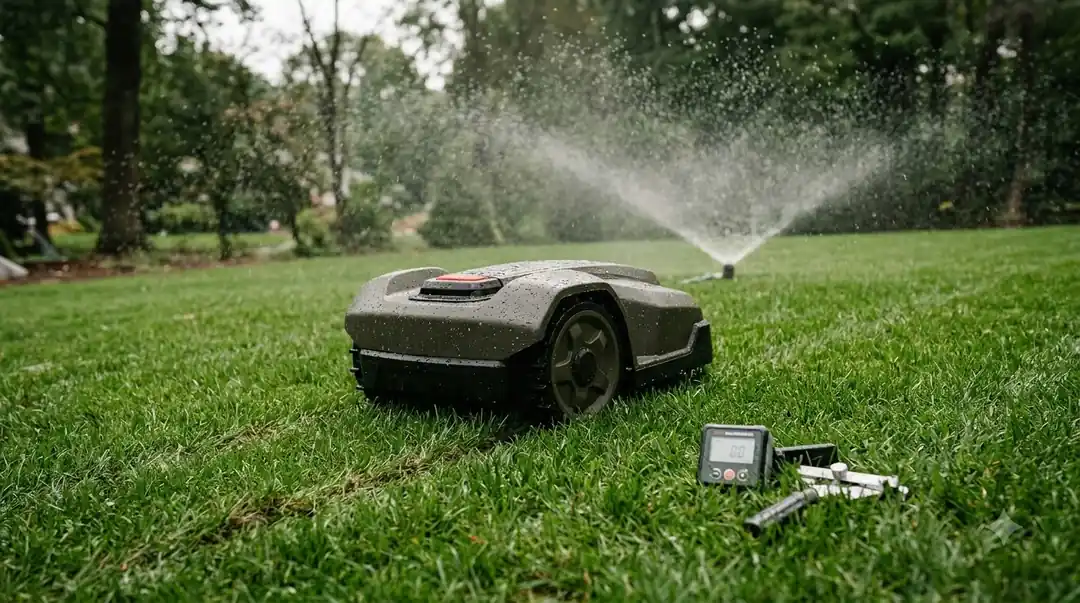
Three conditions make the answer to how steep a hill can a robot mower handle less reliable in practice:
- Wet grass. Damp turf reduces tire grip, so a mower can slide sideways or downhill even on a slope within its rating (see do robot mowers work in the rain).
- Battery. Steeper inclines shorten runtime per charge, so the mower returns to its dock more often.
- Debris and wheels. Clippings, rocks, branches and divots reduce traction, so Yarbo’s guide advises removing clippings and debris to maintain traction.
Our reading is that a yard with a lot of wet or shaded grass should be judged against a lower number than the spec sheet gives.
How to measure your yard’s steepest slope
Measure the steepest section of the lawn, not the average, because the mower will attempt the hardest spot it reaches. Three simple methods work well, and each gives you the number you need to judge how steep a hill can a robot mower handle in your yard.
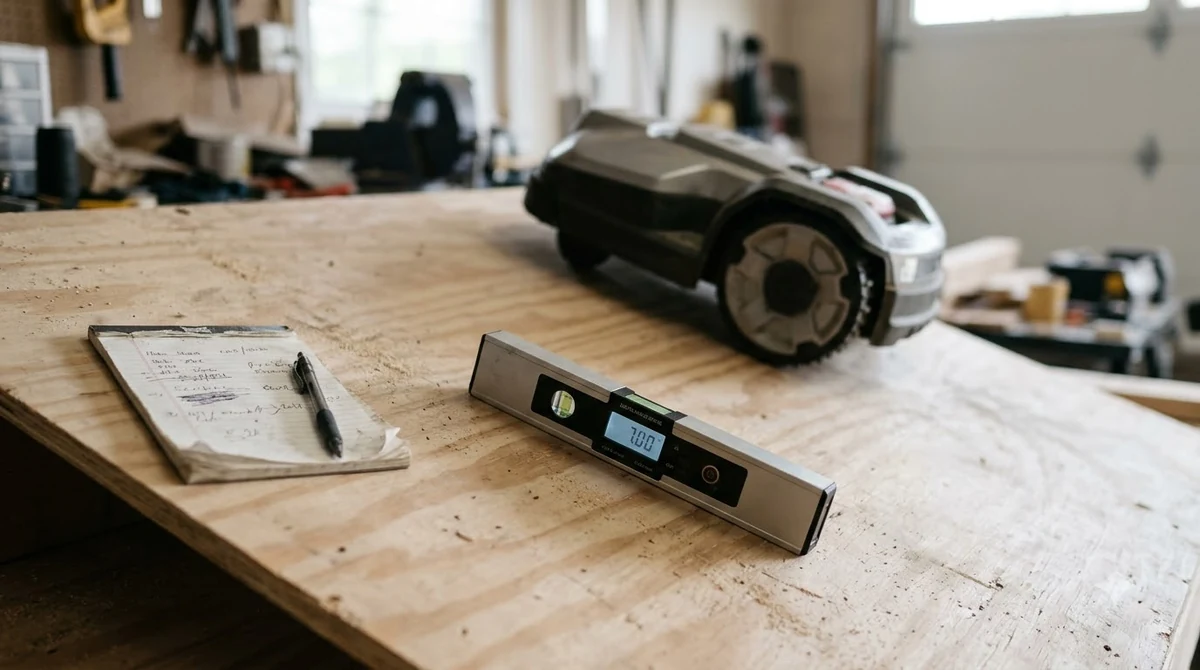
- Rise over run. Lay a straight board across the slope, measure the drop at one end with a level and tape, and divide that drop by the horizontal length. Multiply by 100 for percent.
- Angle app or spirit level. Eufy recommends a smartphone incline app or a spirit level with a tape measure, and warns that visual checks are unreliable because sloping yards look flatter than they really are.
- Compare the units. Convert your result to degrees if the spec sheet uses degrees, then compare it with the work-area and boundary values for the model.
Boundary wire and steep ground
Husqvarna’s guidance for steep areas is to exclude them rather than hope the mower copes. Where a slope is too steep, you can isolate it with a boundary wire island or, on systems that support it, a stay-out zone.
- Direction: lay the guide wire diagonally across the slope, which Husqvarna says gives better traction and less grass wear.
- Clearance: on AWD models working slopes up to 50 percent, keep 1.5 m (5 ft) between the boundary wire and obstacles.
- Transition: leave at least 50 cm (1.6 ft) of level ground between flat areas and steep slopes.
Husqvarna also advises a barrier of at least 15 cm (6 in) along the outer edge where a slope borders a public road. These are Husqvarna figures for its own range, so check your model’s manual before you lay wire. The company’s full installation guide is available on its support site.
Where steep ground stops being a mowing job
Robot mower specs are not the only guide. Iowa State University Extension, writing about landscape slopes rather than robots, treats slopes of 20 percent or more as steep, and says those around 30 percent or more are too steep to mow, so non-turf plantings are needed. That is a hand-mowing rule of thumb, not a robot specification, but it shows how quickly a slope stops being practical for lawn care.
Extension guidance on sod is also useful. On slopes steeper than 10 percent, secure each strip with two or three wooden stakes or sod staples. Our reading is that a bank needing stakes or new planting should be handled before the mower goes in, and wire around steep banks is covered in how to lay boundary wire around obstacles.
How to pick a mower with margin
We recommend choosing a model whose work-area limit sits clearly above your steepest measured slope, then checking the boundary limit separately. That margin is the practical answer to how steep a hill can a robot mower handle on your lawn, and it matters more on wet grass, where traction falls.
- Measure the steepest section and convert it to percent so you compare like with like.
- Compare it with the work-area limit, and keep headroom rather than buying the exact maximum.
- Check the boundary limit, since your lawn edge may be rated lower than the middle.
- Choose AWD only if the hills are wet or loose, and be realistic about battery life on long climbs. Our guide to the best robot lawn mower for hills compares models.
Frequently asked questions
Is 40 percent too steep for a robot mower?
Not by itself. Many standard models list 25 to 50 percent for the work area, so check whether the boundary limit of your model is also above your slope. Measure the steepest spot before deciding.
Can a robot mower climb a 70 percent slope?
Only models rated that high, such as the Husqvarna 435X AWD. Its boundary limit is 50 percent, so the edge of a steep yard still needs wire clearance and may need an island.
How do I convert percent slope to degrees?
Divide the percent by 100 and take the arctangent. Twenty-five percent is about 14 degrees, and 50 percent is about 26.6 degrees (our calculation).
Does wet grass change how steep a robot mower can go?
Yes. Damp turf reduces grip, and Eufy notes a mower can slide even on a slope within its rating. Use a lower number for wet weather.
Sources
- How to optimise an Automower robotic lawn mower installation for steep slopes (Husqvarna support): standard and AWD slope figures, per-model limits, boundary and wire guidance.
- Gardening on Slopes and Hillsides (Iowa State University Extension): ratio and percent conversion, steep-slope thresholds, sod staking.
- Robot lawn mower slope limits (Eufy, manufacturer blog): tier ranges, limit as a daily target, wet grass and battery effects.
- Can a robot lawn mower go uphill? (Yarbo, manufacturer blog): vendor slope claims and traction factors.
 Up next7 min readBy YardDo Robot Mowers Tip Over on Hills?Updated Nov 11, 2026
 7 min readBy YardWill a Robot Mower Get Stuck on a Lawn with Mole Hills?Updated Nov 11, 2026
 8 min readBy YardHow Does a Robot Mower Handle Trees?Updated Nov 11, 2026
 8 min readBy YardCan a Robot Mower Handle a Lawn Full of Weeds?Updated Nov 11, 2026
 9 min readBy YardHow Does a Robot Mower Handle a Playset?Updated Nov 11, 2026
 9 min readBy YardHow Does a Robot Mower Handle Sprinkler Heads?Updated Nov 11, 2026