
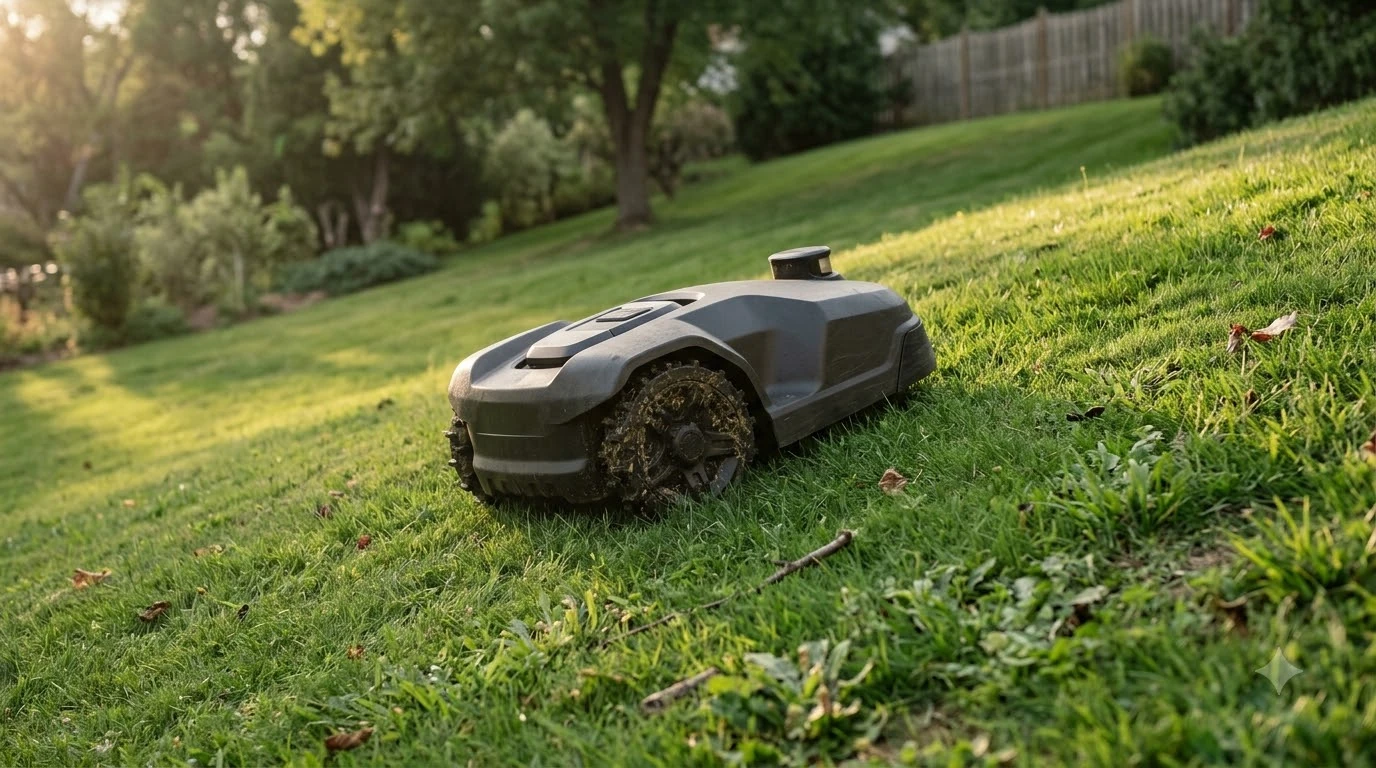

Do robot mowers tip over on hills? They are designed to react to lean before a dangerous angle, but the exact cutoff depends on the model. A rated slope is the steepest ground the mower is built to work on, and a tilt sensor is the part that reacts to lean. Check both figures in your model’s manual before you buy or set up a sloped yard, since whether robot mowers tip over on hills in your yard depends on those numbers.
The short answer
- Tip-over is a design limit. The Husqvarna Automower 450XH spec page lists a tilt sensor, and the cutoff angle is set per model.
- The rated slope is not a tipping angle. The same page lists 45 percent maximum slope inside the installation and 15 percent at the boundary.
- Riding mower rules do not transfer. Extension guidance on overturns is written for riding mowers with a person steering.
Do robot mowers tip over on hills? What the tilt sensor does
A tilt sensor detects lean. The Husqvarna 450XH spec page lists one as standard, along with a lift sensor. The page does not state the angle at which the sensor acts, so the owner’s manual is the place to find the number for your model.
The same spec page lists a lift sensor, a weight of 34.6 lbs and a body about 24.8 in wide, 29.5 in long and 13.8 in high. It does not say how the weight or body shape affects stability on a slope, so we do not draw a conclusion from those figures.
Our reading: a tilt sensor lowers the risk on a hill, but it does not replace checking the yard for slope before installation. So when you ask “do robot mowers tip over on hills”, the honest answer is that the spec sheet tells you the rating and the sensors, and the manual tells you what the mower does at the limit.
A rated slope is a ceiling, not a tipping angle
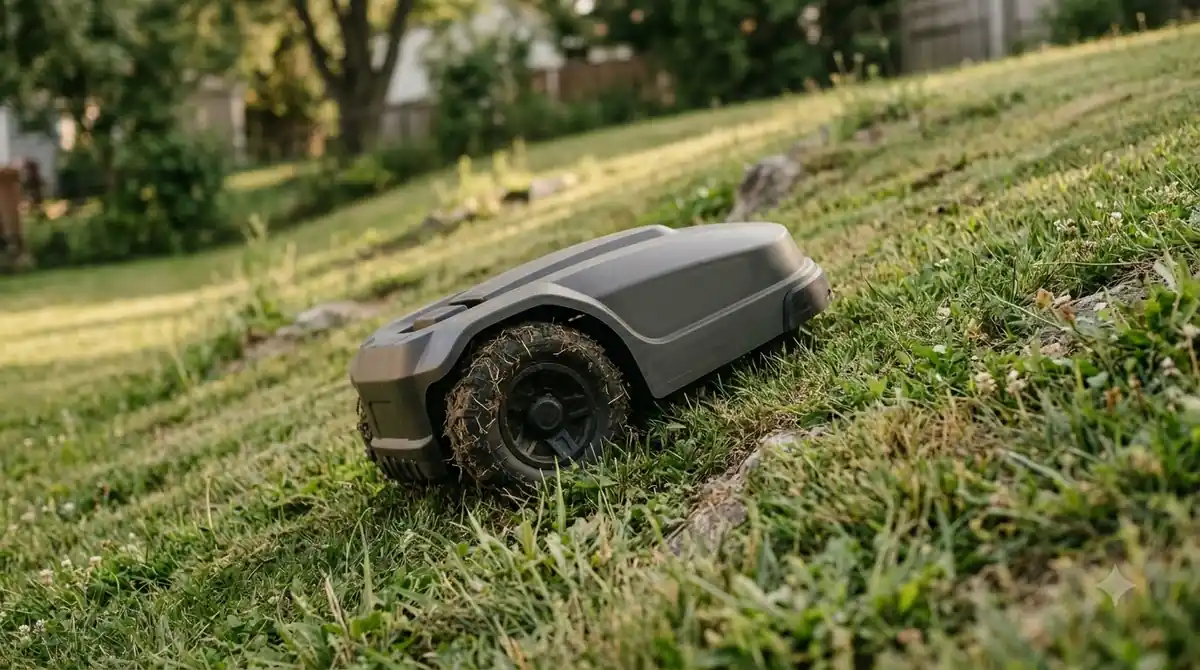
Husqvarna lists the 450XH at 45 percent maximum slope inside the installation. The same spec page gives 15 percent along the boundary. Fifteen percent is about 8.5 degrees, so the edge of a yard can be rated far below the middle of a hill.
The page does not say what limits the 45 percent figure or what the mower does above it. We read the rating as the steepest ground the mower is designed to cover, not the angle where it would roll, and we recommend treating it as a ceiling.
Ratings also differ between brands. This article uses only the figures on the 450XH spec page, so compare numbers from each brand’s own spec page rather than from a summary table.
How to read a slope rating
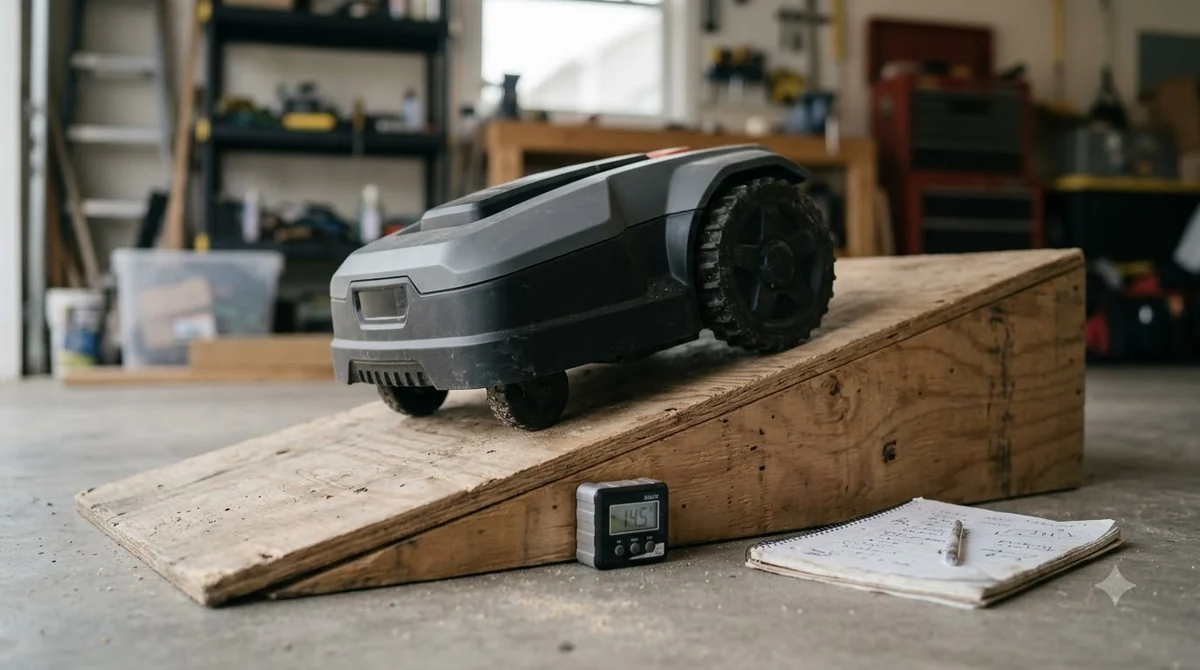
A slope rating is a percent, and a percent is a ratio: 45 percent means 45 centimeters of rise for every 100 centimeters of run. That is a different number from degrees, so a 45 percent rating and a 45 degree rating describe very different hills.
The table below converts the figures used in this article. The degree values are our arithmetic from the percent, not numbers taken from a manufacturer or extension page.
| Slope rating | Approximate angle | Rise per 100 cm of run |
|---|---|---|
| 15 percent | 8.5 degrees | 15 cm |
| 25 percent | 14 degrees | 25 cm |
| 35 percent | 19 degrees | 35 cm |
| 45 percent | 24 degrees | 45 cm |
Our reading: when a spec sheet gives only a percent, convert it before comparing it with a riding mower guide that uses degrees, and never mix the two units in one comparison.
Why the boundary rating matters on a slope
Robot mowers that carry two slope figures are a good test of where the risk sits. The boundary limit is lower than the limit inside the lawn. On a yard where the edge runs up a bank, the boundary rating can decide how much of the slope the mower can cover, even when the middle of the lawn is rated higher.
The risk to the mower on a bank is not only a tip-over. If you want to know do robot mowers tip over on hills in your own yard, look at where the steepest ground sits, not at the average slope of the lawn.
Our reading: if the steepest part of your yard sits along the boundary, plan the wire layout around the 15 percent figure rather than the 45 percent figure. If a slope is a real concern, AWD versus 2WD robot mowers for hills compares drive layouts, and traction spikes for slopes covers an accessory some owners add.
What riding mower guidance says
Penn State Extension advises that on a riding mower, if the slope is greater than 15 degrees, the operator should mow up and down the slope, and side-to-side mowing is for slopes below 15 degrees. The same guide tells operators to check the operator’s manual for slope-specific instructions. Penn State Extension’s riding lawnmower safety guide sets out that rule.
Ohio State University Extension says riding mowers should mow up or down slopes to avoid the potential for overturns. The Ohio State power lawn mower factsheet gives the same direction and does not state a degree limit.
Neither source answers “do robot mowers tip over on hills” directly, because both cover riding mowers.
Our reading: these rules explain why a steep slope is risky for a machine that can roll. They were written for a person steering, so do not treat the 15-degree figure as a robot mower’s cutoff.
What to check before you buy or set up
To settle “do robot mowers tip over on hills” for your own mower, use the spec page and the manual for your model, not a general rule, and work through these checks in order.
- Find the rated slope inside the yard. Use the maximum figure from the brand’s spec page, and note whether it applies inside the installation or at the boundary.
- Compare the boundary rating with your steepest edge. A bank along the lawn edge needs the lower figure.
- Shortlist models for the slope. Our list of the best robot lawn mower for hills is a starting point.
- Confirm the tilt sensor. Check the spec sheet for it, then read the cutoff behavior in the manual.
- Measure the slope before setup. We recommend a slope gauge or a level rather than judging by eye, and a guide to measuring your yard slope shows how.
Frequently asked questions
Do robot mowers tip over on hills in real yards?
It can in principle, which is why manufacturers list a tilt sensor and a slope rating. The exact cutoff angle is set per model, so check the manual for the mower you plan to buy.
Is the rated slope the angle where the mower tips?
Not according to the Husqvarna 450XH spec page, which lists a 45 percent maximum slope inside the installation and a tilt sensor, but no tipping angle.
Why is the boundary rating lower than the inside rating?
The 450XH spec page gives 15 percent at the boundary and 45 percent inside the installation. The page does not explain the difference, so we do not guess at a reason.
Do the riding mower rules apply to a robot mower?
Not directly. Extension guidance on riding mowers assumes an operator on board, so use it as background on slope risk, not as a robot mower’s limit.
Sources
- Automower 450XH EPOS support page (Husqvarna): maximum slope 45 percent inside the installation, 15 percent at the boundary, tilt sensor listed.
- Riding Lawnmower Safety Practices (Penn State Extension, updated August 5, 2025): 15-degree rule for up-and-down mowing on riding mowers.
- Power Lawn Mowers, AEX-79030 (Ohio State University Extension, 2015): mow up or down slopes on riding mowers to avoid overturns.
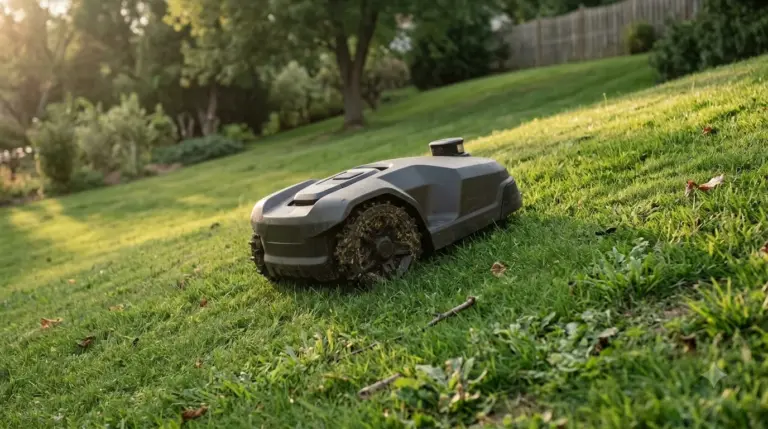
 Up next9 min readBy YardRobot Mower and Dog Poop: Should You Let It Mow Over Waste?Updated Nov 11, 2026
 8 min readBy YardHow Steep a Hill Can a Robot Mower Handle?Updated Nov 11, 2026
 7 min readBy YardWill a Robot Mower Get Stuck on a Lawn with Mole Hills?Updated Nov 11, 2026
 9 min readBy YardCan a Robot Mower Work in a Yard With a Gate Between Zones?Updated Nov 11, 2026
 8 min readBy YardHow to Prepare Your Yard for a Robot MowerUpdated Nov 11, 2026
 9 min readBy YardCan a Robot Mower Mow Around a Pool Safely?Updated Nov 11, 2026