
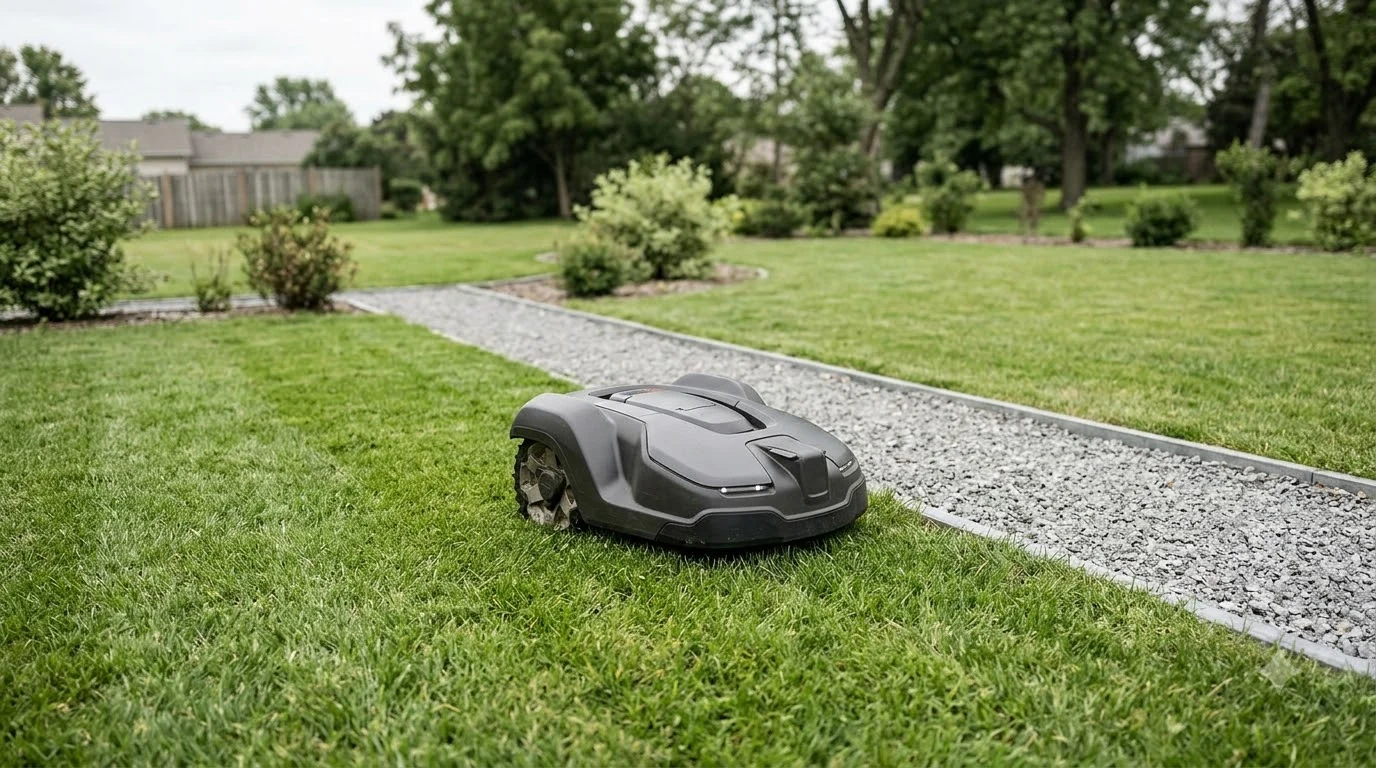

In short, can a robot mower work in a yard with a gate between zones? Yes, if the gate opening is a route the mower can drive through, set up by wire or by a mapped transport path. If it is not, the zones need a gate opener or manual moving. Rules vary by model, so check the manual.
The short answer
- Yes, if the gap is drivable. Husqvarna’s support article lists 60 cm (24 in) between boundary wires when a guide wire leads the mower through.
- Mapped paths work too. Wire-free mowers can follow a transport path through a gate without cutting on the way.
- Closed barriers need help. A gate opener such as Navimow’s MowGate, or moving the mower by hand, covers what the mower cannot pass.
Most of the problem is the gap, not the gate itself. Check the passage width, where the charging station goes, and whether your model supports transport paths before you decide on a layout. Those three checks settle the layout before any wire goes in the ground.
Can a robot mower work in a yard with a gate between zones?
A robot mower crosses a gate only when the opening is a route it can actually drive through. Two things decide that: whether the gap is wide enough, and whether the mower has been told the route. The charging station location matters too, because a zone far from the dock needs a safe way back to charge. For a robot lawn mower with two zones, the gate is simply a narrow passage that has to be planned.
When you ask can a robot mower work in a yard with a gate between zones, start with the layout. Wired systems use boundary wires to define a passage. Wire-free systems use points set in the app to define a transport path. In both cases the passage has to be planned during setup, not added after the mower gets stuck at the gate.
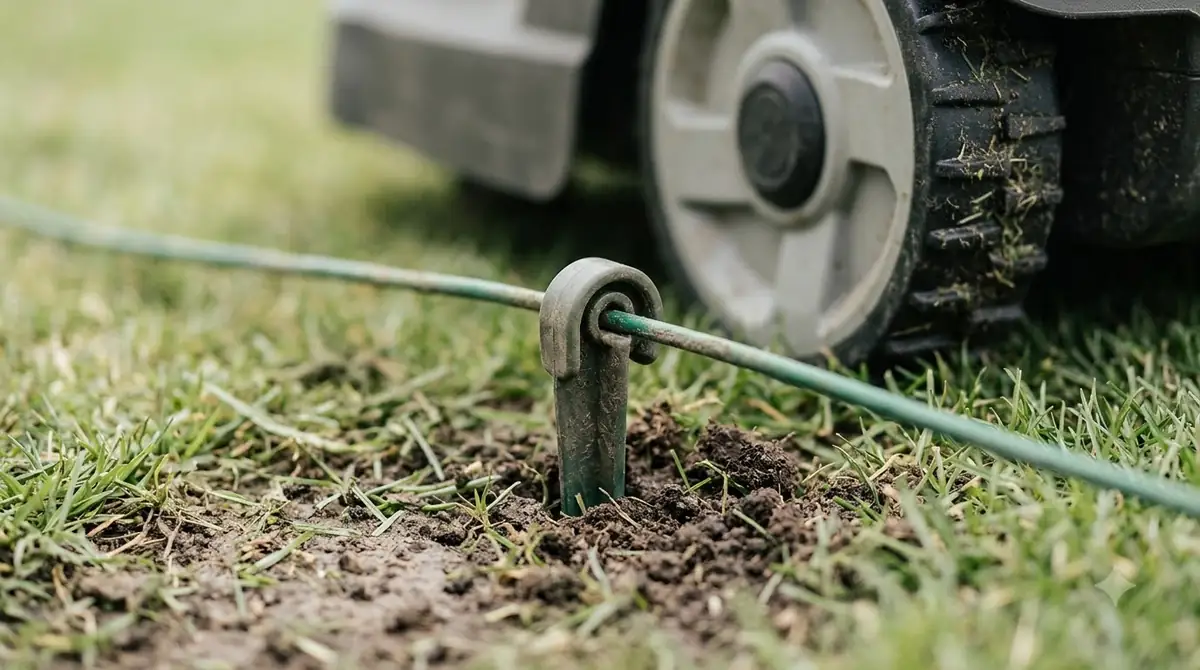
Stay-out zones, which you can learn to set up as no-go zones on a robot mower, are the other factor. Husqvarna’s wire-free guidance says a mower on a transport path ignores work areas but will not pass through stay-out zones. A flowerbed, a gravel patch or a garden bed beside the gate must stay clear of the route. Our reading: plan the gate route before you draw the zones, so the path does not run into a no-go area.
How wide does a gate passage need to be?
Husqvarna’s support article gives 60 cm (24 in) as the minimum distance between boundary wires when a guide wire leads the mower through a passage. Without a guide wire, the same article recommends at least 2 m (6 ft 6 in) on each side of the passage. If you are checking whether a gate can work in your yard, these are the first numbers to compare against.
| Passage setup (Husqvarna boundary wire) | Minimum distance |
|---|---|
| Passage with a guide wire | 60 cm (24 in) between boundary wires |
| Passage without a guide wire | 2 m (6 ft 6 in) between boundary wires |
| Guide wire to boundary wire | at least 30 cm (12 in) |
The figure is the distance between the boundary wires, not the width of the gate itself. A gate that measures 90 cm between its posts does not give 90 cm of usable passage if fence panels or posts sit closer to the wire. Our reading: measure the clear gap at the wire line, then leave some margin, because the mower needs room to line up with the entry. If the wire is not laid yet, read how to install a robot mower boundary wire first.
The same article says that Husqvarna’s 435X AWD and 535 AWD models should have a passage at least 2 m (6 ft 6 in) wide for a good cutting result. If the mower sticks while following the wire through a passage, Husqvarna suggests adjusting the corridor width setting, which is covered in a separate guide. Model differences matter here, so the numbers in this table are a starting point, not a final answer for every mower.
How a wire-free mower maps a path through the gate
A wire-free mower can cross between zones on a transport path that you set up in the app. Husqvarna’s EPOS guide says the mower does not mow while it follows a transport path, so the path is a route between areas, not a place to cut.
- Check the docking point. A transport path is needed when the charging station sits outside a work area.
- Set the start point. Keep the start of the path at least 1 m (3.3 ft) inside the work area it leaves from.
- Add a point in each area. The path needs at least one point inside each work area it enters, so the app knows where the route passes. This step is the core of any wire-free gate setup.
- Confirm the return. The mower goes back to the charging station after each area before it starts the next one.
The guide also says that once a work area is created, it cannot be split into smaller areas later. Points can be moved, but only up to 5 m (16 ft 4 in) in each direction at the time of editing. That limit matters for a gate, because a boundary that sits badly near the entry is hard to fix without redrawing it.
The Husqvarna page tells you to increase the path width in the app, but it does not give a numeric width for the path itself. The passage rules above are the closest published figures, and they are the best reference when you test a wire-free gate route. Our reading: treat a wire-free path as a route that needs the same clear space as a wired passage, and watch the first run at a slow pace before you rely on it.
Can a gate open for the mower?
Yes, with an accessory. For a closed gate, can a robot mower work in a yard with a gate between zones? It can, if the gate opens for it. Navimow sells MowGate, a gate unit designed to let its mowers move between lawn zones without manual help, including when the charging station is in another area. If you are weighing a gate unit against moving the mower by hand, this is the main option that removes the manual step.
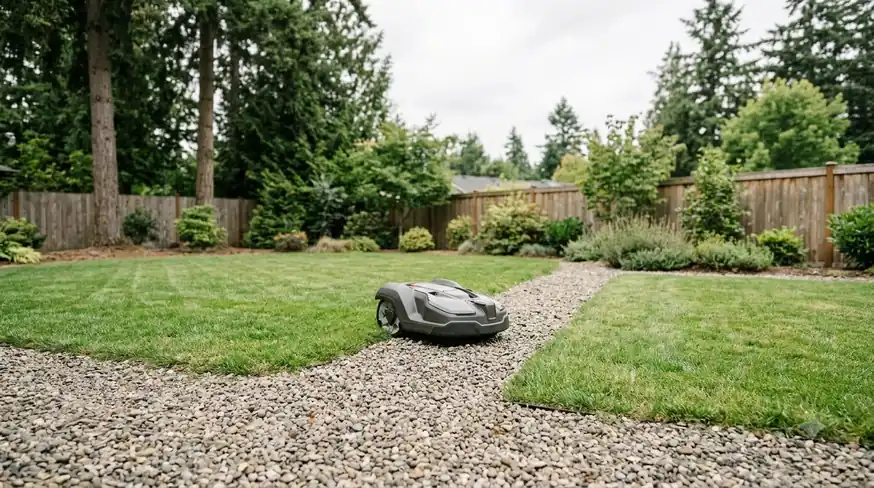
According to Navimow’s support page, MowGate detects changes in magnetic field voltage to recognize when the mower is approaching. The gate then unlocks and opens on its own. The unit runs on four D-cell batteries (6V in total), so it needs no wired power. The page also says the gate is designed to keep pets from escaping the yard during automatic opening, which matters when a gate is used often and a dog or cat shares the lawn.
The page does not list supported mower models or other compatibility limits, so the supported model list is the deciding document. Before you buy a gate unit, check the supported model list with the manufacturer and confirm that your gate hardware will take the unit.
What to do when the mower cannot pass the gate
If the gap is narrower than the passage rules allow and no gate opener fits, the mower cannot cross on its own. The safe approach is to treat each side of the gate as a separate zone and plan the mowing schedule around that limit. So can a robot mower work in a yard with a gate between zones when the gap is too narrow? Only as two separate jobs, and the plan decides how often the lawn on the far side gets cut.
- Give each side its own map or boundary, as in a robot mower setup for a front and back yard, so the mower never tries to cross the gap.
- Place the charging station on the side where most of the mowing happens.
- Move the mower by hand for the other side, and add that job to your calendar.
- Ask the manufacturer whether a narrower gap works for your exact model before you accept a shorter passage.
Heads up
Some retailer guides say a lawn across a closed gate may need a second stored map and manual relocation. A manufacturer page we read did not confirm that rule, so treat it as a common setup, not a guarantee for your mower.
Frequently asked questions
Can a robot mower go through a gate by itself?
Yes, if the gate opening is a route the mower can drive through, set up by wire or by a mapped transport path. A closed gate that the mower cannot open needs a gate opener, such as Navimow’s MowGate, or manual moving. Check your model’s manual for the exact rules, because they differ by brand.
How wide should the gap be for a robot mower?
Husqvarna’s support article lists 60 cm (24 in) between boundary wires with a guide wire and 2 m (6 ft 6 in) without one. These are Husqvarna figures, so confirm the numbers for your brand and model before you install a passage. For your own yard, the manual figure beats any general number.
Does the mower cut grass while it crosses the gate?
On Husqvarna’s wire-free system, the mower does not mow while it follows a transport path. The path is a route between work areas, so cutting happens only inside the areas you have set up. That is the trade-off to weigh: crossing between zones costs mowing time.
Is a gate opener safe for pets?
Navimow says MowGate is designed to keep pets from escaping the yard during automatic opening. The page does not describe other safety tests, so check how the gate behaves with your own hardware and keep pets supervised during the first runs.
Sources
- Husqvarna: how to create a passage in an Automower boundary wire installation (manufacturer): passage widths with and without a guide wire, guide wire spacing, corridor width.
- Husqvarna: set up work areas, stay-out zones and transport paths with EPOS (manufacturer): transport path rules, start offset, stay-out zone handling, point adjustment limit.
- Navimow support: What is MowGate and what does it do (manufacturer): gate detection, power source, pet safety, zone travel.
 Up next8 min readBy YardCan a Robot Mower Work in a Yard With Gravel Path Crossings?Updated Nov 11, 2026
 8 min readBy YardCan a Robot Mower Work in a Yard With a Detached Garage?Updated Nov 11, 2026
 9 min readBy YardCan a Robot Mower Work in an L-Shaped Yard?Updated Nov 11, 2026
 8 min readBy YardRobot Mower for Narrow Side Yard Passages: What Widths Work?Updated Nov 11, 2026
 9 min readBy YardHow Do I Know If a Robot Mower Will Work in My Yard?Updated Nov 11, 2026
 7 min readBy YardCan a Robot Mower Work in a Long Narrow Yard?Updated Nov 11, 2026