
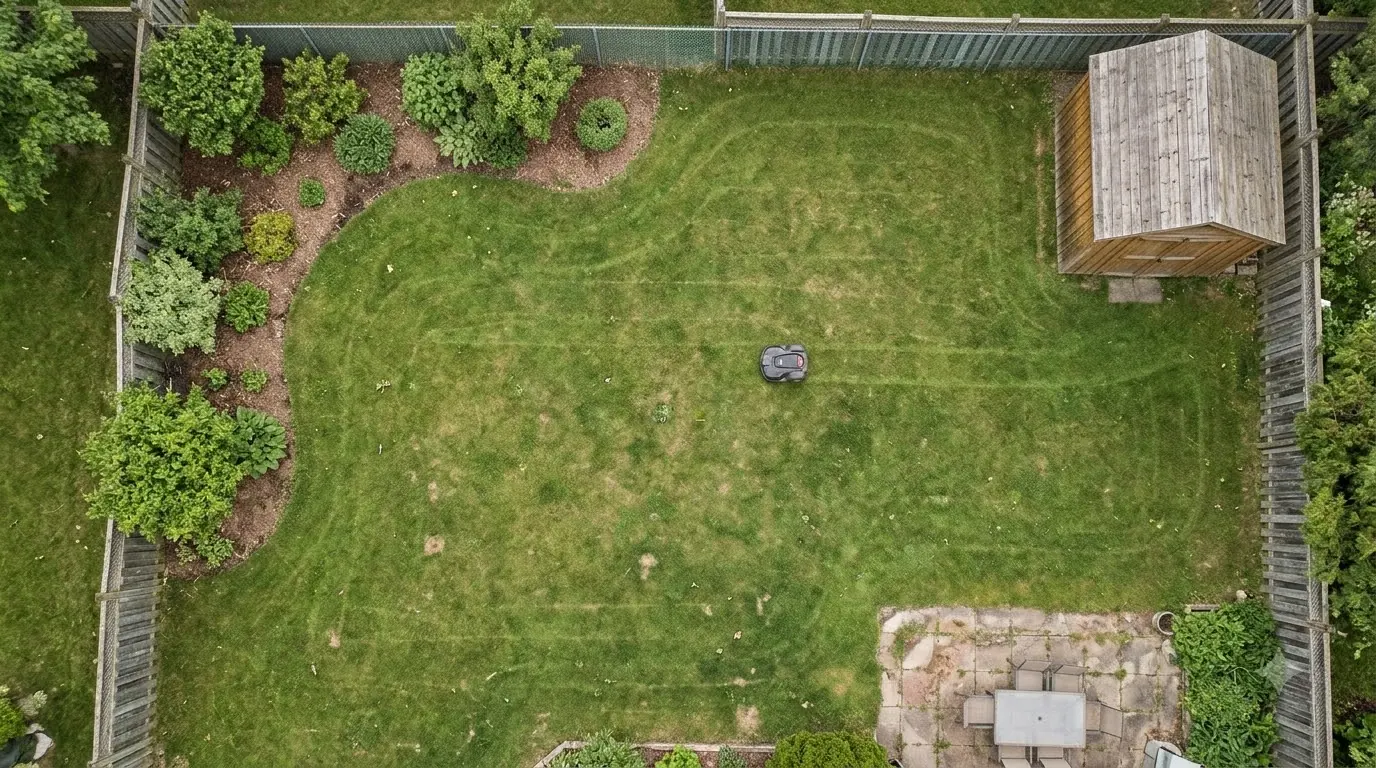

Can a robot mower work in an L-shaped yard? Yes, as long as the boundary wire can run as one unbroken loop around the whole lawn and the narrow neck between the two arms is wide enough for the model. Manufacturers usually set that width at about 2 m (6 ft 6 in) when no guide wire is used, and about 60 cm (24 in) between boundary wires when a guide wire runs through the passage. The rest of this guide explains those limits, how to lay wire around the corners of an L, and when a wire-free model may be a better fit.
The short answer
- Works in an L shape: a robot mower can work in an L-shaped yard because the boundary wire is a closed loop, so it can follow any outline, including two arms joined at a corner.
- Narrow neck: Husqvarna recommends at least 2 m (6 ft 6 in) between boundary wires without a guide wire, and at least 60 cm (24 in) with one.
- Corners: lay the wire in a gentle curve and never let it cross itself, per Robomow.
- Irregular lawns: Mammotion says small, irregular or obstacle-filled lawns may suit wired models, while wire-free models depend on a clear view of the sky.
Can a robot mower work in an L-shaped yard with a narrow neck?
An L-shaped lawn is usually two rectangles joined at a corner, with a neck where the arms meet. The neck is the part that decides whether a robot mower can work in an L-shaped yard. A robot mower does not need a straight line to cover a lawn. It needs a continuous path between every part of the grass, and the boundary wire defines that path. Gardena describes the wire as the thing that tells the mower where to mow, and says larger areas are handled by adding wire to the same loop.
Husqvarna’s passage guide treats a narrow link between two parts of the work area as a passage, and gives different minimum widths depending on the setup. Without a guide wire, the boundary wires on each side of the passage should be at least 2 m (6 ft 6 in) apart. With a guide wire running through the passage, the boundary wires can be as close as 60 cm (24 in). Those are minimums from one manufacturer, not universal rules, so the exact figure depends on the model you buy.
Husqvarna adds that for the Automower 435X AWD and 535 AWD, 2 m (6 ft 6 in) is advised for a good cutting result even with a guide wire. For similar tight lots, see our guide to a robot mower for narrow side yard passages.
Robomow’s wire guide gives a different threshold for a passage that leads to a separate zone. Its guide says the passage should be wider than 70 cm, because two boundary wires that sit too close can interfere with each other. Taken together, the figures suggest a simple rule: the narrower the neck, the more likely you need a guide wire and a model that handles passages well.
Our reading: measure the narrowest part of the neck before you buy, from the inside edge of one bed or wall to the inside edge of the other. If that distance is under 2 m, plan on a guide wire and confirm the minimum in the model’s manual.
Lay the boundary wire around the corners of the L
The wire has to go around the outside of the lawn and along every edge that the mower could reach. In an L shape, the inside corner is where the wire changes direction most sharply, and that is where installers tend to make mistakes. Robomow advises laying the cable in a curve at corners, so the mower does not need to make complicated maneuvers to follow it. If you have not laid wire before, read how to install a robot mower boundary wire first.

- Curve, do not turn sharply: a rounded line gives the mower a smoother path through the corner.
- Never cross the wire: Robomow says the wire must not cross at any point, because crossing wires cause signal interference.
- Keep a safe gap from obstacles: Robomow lists about 35 cm (14 in) from walls and tall stones, and about 10 cm (4 in) from beds, hedges, slabs and paths.
- Join with the right parts: Gardena says only its original coupler should join two pieces of boundary wire, and our guide to waterproof wire connectors for robot mowers covers the joint itself.
Use a guide wire for a narrow neck
A guide wire is an extra wire that runs through a passage, centered between the boundary wires. It helps the mower find its way through a neck that is too narrow to rely on the boundary alone. Husqvarna says the guide wire should sit at least 30 cm (12 in) from the boundary wire, and that the mower always runs to the left of the guide wire when facing the charging station.
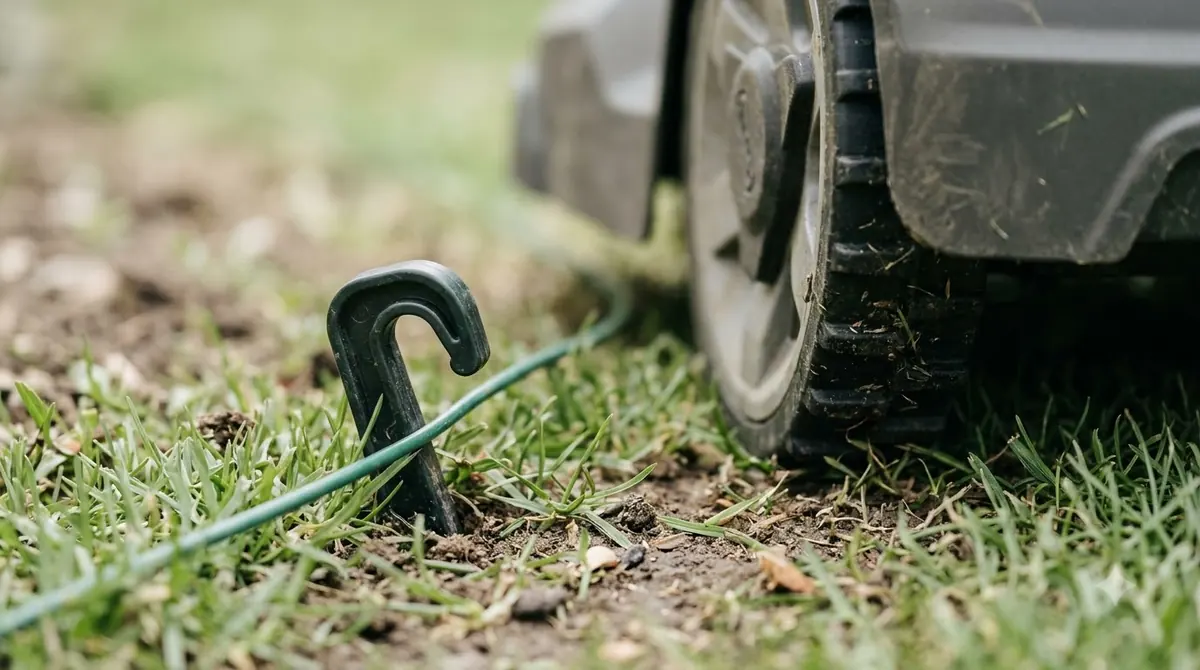
Two features matter for a narrow neck. First, Husqvarna notes that systematic mowing, where the mower switches from a random pattern to straight lines inside narrow passages, needs a guide wire. Second, if the mower gets stuck in a passage, Husqvarna suggests adjusting the corridor width setting rather than moving the wire first.
Husqvarna also recommends a low frequency of passage use, because the mower can wear the grass in a passage if it travels there too often.
Heads up
Husqvarna’s figures apply to its own boundary-wire installations. Other brands may set different passage widths, so the manual for your model overrides any general number in this guide.
Handle a flower bed or island inside the L
Many L-shaped lawns have a bed, tree or patio in the inside corner. Each obstacle needs its own wire path, and the rules differ depending on whether the obstacle is inside the lawn or cuts off part of it.
Robomow describes an island method for obstacles that are hard to reach. The wire runs from the edge of the lawn to the obstacle, encircles it once, and returns parallel to the outward run. The two runs must not cross. Robomow notes that islands and flower beds can be “quite a challenge” to include, and recommends checking your model’s installation instructions for the required distances, because it gives no island dimensions of its own.
If a bed fully separates the two arms, the mower may not be able to travel between them, so check that the wire can reach both arms through a passage before you buy. A mower that has to cross between separate grass areas is covered in our guide on whether a robot mower can mow multiple separate lawns.
Wired or wire-free for an L-shaped lawn
The wire is not the only way to define a yard, and the choice affects whether a robot mower can work in an L-shaped yard like yours. Wire-free models use satellite positioning, cameras or sensors to learn the boundary. That matters for an L shape, because a wire can be laid around any outline, while a wire-free model needs a clear path to the satellites.
Mammotion, a maker of wire-free mowers, says small, irregularly shaped or obstacle-filled lawns may benefit from wired models for precise navigation. The same company’s FAQ says RTK accuracy degrades under heavy tree canopy or near tall buildings. Those are vendor claims, not independent test results, so treat them as a reason to check the site rather than a verdict.
Our reading: an L-shaped yard with a tall house on one side, big trees over the neck or a narrow corner is a case where a wired model is often the safer choice. An open L with clear sky over both arms can suit a wire-free model, as long as the neck is still wide enough for its path planning. For another awkward shape, see whether a robot mower can work in a long, narrow yard.
| Question | Wired boundary | Wire-free (GPS-based) |
|---|---|---|
| Shape flexibility | Wire follows any outline | Virtual zones drawn in an app |
| Narrow neck | Passage rules and guide wire | Depends on model and sky view |
| Trees and buildings | Not affected by satellite signal | Accuracy can drop under heavy canopy |
| Setup effort | Wire must be laid and joined | Mapping in the app |
Can a robot mower work in an L-shaped yard? What to check before you buy
Before you decide whether a robot mower can work in an L-shaped yard, measure the neck, photograph the corners and note any trees or tall walls that could affect a satellite signal. Those three measurements decide most of the questions that come up later.
- Measure the neck. Record the width between the inside edges of the two boundaries at the narrowest point.
- Check the passage rules. Find the minimum passage width and guide wire guidance in the manual of the model you are considering.
- Plan the wire path. Sketch one closed loop, with curves at the corners and no crossings.
- Confirm the sky view. If you are considering wire-free, look for trees and tall buildings over the neck.
Frequently asked questions
What if the neck of my L-shaped yard is narrower than 2 m?
Husqvarna’s figure is 60 cm (24 in) between boundary wires when a guide wire runs through the passage, and at least 30 cm (12 in) between the guide wire and each boundary wire. Check the manual for your model before you commit to a passage plan.
Does the wire have to follow the corners of an L exactly?
No. Robomow advises laying the wire in a curve at corners rather than sharp turns, and it must not cross itself. A smooth curve that stays inside the lawn edge is enough for the mower to follow.
Can a robot mower work in an L-shaped yard that a bed splits in two?
Yes, if the boundary is one continuous loop that includes the neck and the mower can reach both arms through it. If a bed or wall fully cuts the two arms apart, the mower may need a separate area or manual help for one part.
Will the mower get stuck in the narrow part of the yard?
It can, which is why Husqvarna recommends adjusting the corridor width setting when that happens. Using a guide wire and keeping the passage mowed on a regular schedule also reduces the chance of repeated stops.
Sources
- How to create a passage in an Automower boundary wire installation (Husqvarna): passage widths with and without a guide wire, guide wire distance, systematic passage mowing and corridor width.
- Laying the lawn boundary wire (Robomow): curved corners, the 70 cm passage guidance, island method and obstacle distances.
- Boundary wire for robotic mowers (GARDENA): the wire defines the mowing area, larger areas use added wire, and joins use the original coupler.
- Do robot lawn mowers need a boundary wire (Mammotion): vendor view on wired models for irregular lawns and RTK accuracy under tree canopy.
 Up next8 min readBy YardCan a Robot Mower Work in an Irregular Shaped Lawn?Updated Nov 11, 2026
 8 min readBy YardRobot Mower for Narrow Side Yard Passages: What Widths Work?Updated Nov 11, 2026
 9 min readBy YardHow Do I Know If a Robot Mower Will Work in My Yard?Updated Nov 11, 2026
 7 min readBy YardCan a Robot Mower Work in a Long Narrow Yard?Updated Nov 11, 2026
 8 min readBy YardRobot Mower for Front and Back Yard: What WorksUpdated Nov 11, 2026
 9 min readBy YardCan a Robot Mower Work in a Yard With a Gate Between Zones?Updated Nov 11, 2026