
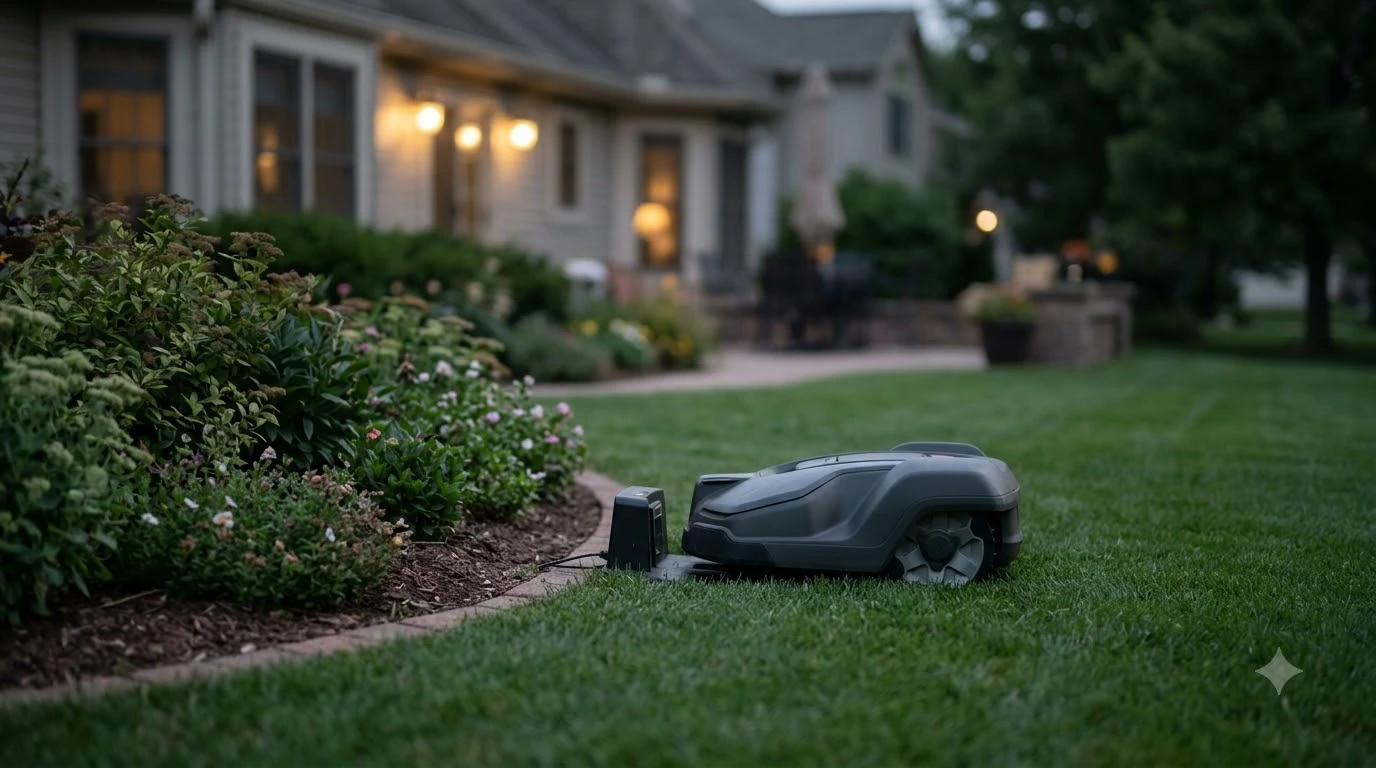

Learning how to prepare your yard for a robot mower comes down to four jobs: clear debris and small objects, cut long grass before the first run, fill holes and deep low spots, and set the charging station on flat ground. Manufacturer guides agree on these steps, though they give different first-cut heights.
Most of the work happens before the first run. Once the yard is clear and the layout is mapped, the mower can learn its boundaries and return to its station without repeated stops. Use the steps below as a checklist, then compare the numbers with your own model’s manual. If you are not sure the lawn suits a mower at all, start with checking whether your yard is suitable for a robot mower.
The short answer
- Clear the yard: pick up sticks, stones, toys, hoses, and garden tools.
- Cut long grass first: brand guides put the first cut between about 2 and 3.9 inches, depending on the model.
- Fill holes: level deep pits, large depressions, and exposed roots, or block them.
- Place the charging station on flat turf with a clear approach and a steady signal.
- Sketch the layout with obstacles, boundaries, paths, and no-go zones before setup.
How to prepare your yard for a robot mower: clear debris first
Clearing the lawn is the first step in learning how to prepare your yard for a robot mower, because loose objects cause most early problems. Toro’s manual asks owners to clear any obstructions and debris from the lawn before use. Ecovacs lists garden tools, toys, and sharp stones as items that can block the path, damage the blades, or cause navigation errors.
Husqvarna adds that leaves, sticks, pine cones, and scattered mulch should be raked up. Its guidance says debris can encourage grass mould and wear the blades faster. Wires also need attention: Ecovacs warns that loose wires can tangle in the wheels, so check the yard for hoses and extension cords before the first run.
Cut long grass before the first run
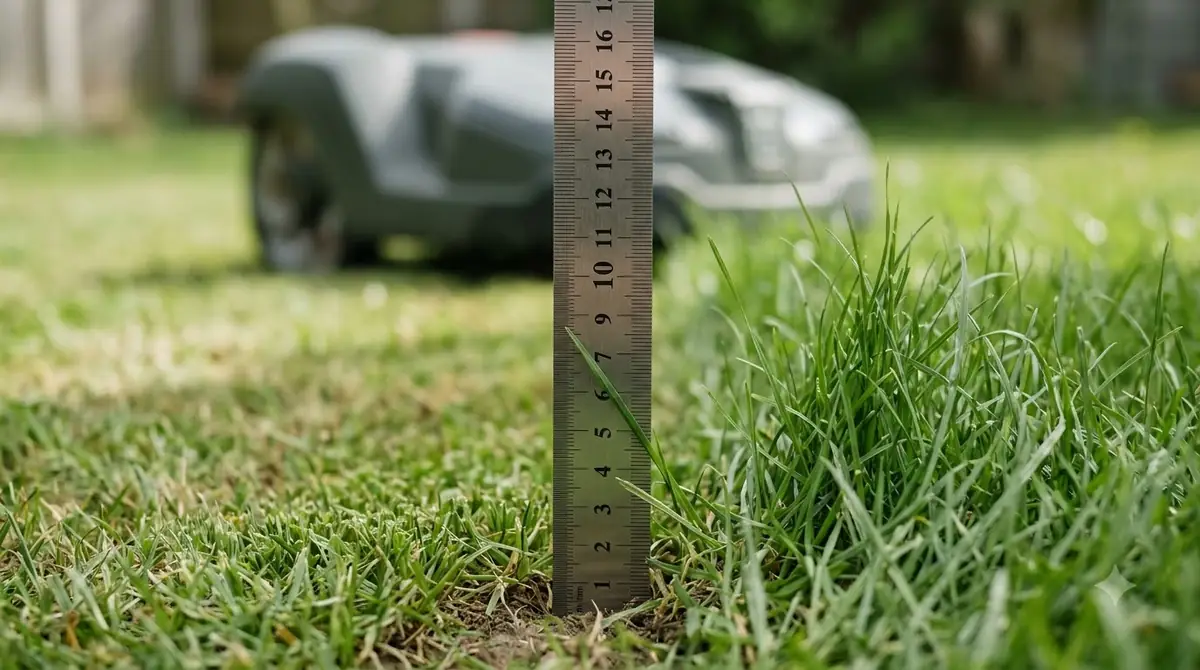
Robot mowers work best when the grass is already within their cutting range, so long grass should be cut by hand first. If the lawn is badly overgrown, cutting an overgrown lawn before the first run goes through the process in more detail. The three brands name different numbers, and the table below shows what each one says.
| Source | Height guidance before the first run | Note |
|---|---|---|
| Husqvarna support | Wait until grass is 5 to 7 cm (2 to 2.8 inches) tall | Before the season’s first cut |
| Toro operator manual | Mow to 83 mm (3.25 inches) before training the mower | Done before the mapping run |
| Ecovacs blog | Cut under 3.9 inches before the robot runs | Also keep grass around the station under 3.9 inches |
The gap between these numbers is mostly about timing and model. Husqvarna describes waiting for the grass to reach a certain height, while Toro and Ecovacs describe a cut before training. Our reading is that the safest approach is a high first cut, then a gradual drop. Husqvarna recommends starting with a high cutting height and lowering it over time, and it advises against mowing too short after winter because that stresses the grass.
Heads up
Do not cut the first pass down to your final height. Start high, run the mower for a few weeks, and lower the setting one step at a time.
Fill holes and deep low spots
Holes matter more than bumps. Filling holes is a core part of how to prepare your yard for a robot mower, because a hole deep enough to trap a wheel can stop it. Toro advises filling any hole that could stop the mower. Ecovacs goes further and says to fill deep pits, large depressions, and exposed roots, or to block the mower from entering those areas.
Ecovacs also gives a safety distance. It says to keep the mower at least 9.8 inches away from hazards such as ponds or cliffs. Our reading is that the same caution suits any drop-off, including a low corner near a retaining wall.
Check slope and flat ground at the charging station
The charging station should sit on flat ground, not a slope, and Ecovacs says so directly. Slope limits differ by model. Ecovacs lists an incline of up to 27 degrees for one LiDAR model, but that figure applies only to that model. Check the rating in your own manual before deciding whether a steep bank can stay in the mowing zone. Measuring your yard slope gives you the number to compare.
Ecovacs gives clearance figures for its GOAT O1000 RTK station: at least 15.75 inches on each side and 6.56 feet in front. Keep the grass around the station trimmed under 3.9 inches so the mower can dock, and see where to put a robot mower charging station for the placement basics. The station also needs a power source and a strong, stable Wi-Fi signal. Other models use different spacing, so treat these numbers as one example rather than a universal rule.
If you use an RTK model, the reference station has its own placement rule. Ecovacs says to install it vertically and keep it at least 6.56 feet from buildings and trees. Trees and walls can block the satellite signal, which is why this distance matters.
Sketch the layout and no-go zones
A simple sketch saves time in the app when you learn how to prepare your yard for a robot mower. Toro recommends drawing the mowing zone with all obstacles, boundaries, transit paths, and exclusion zones before setup.
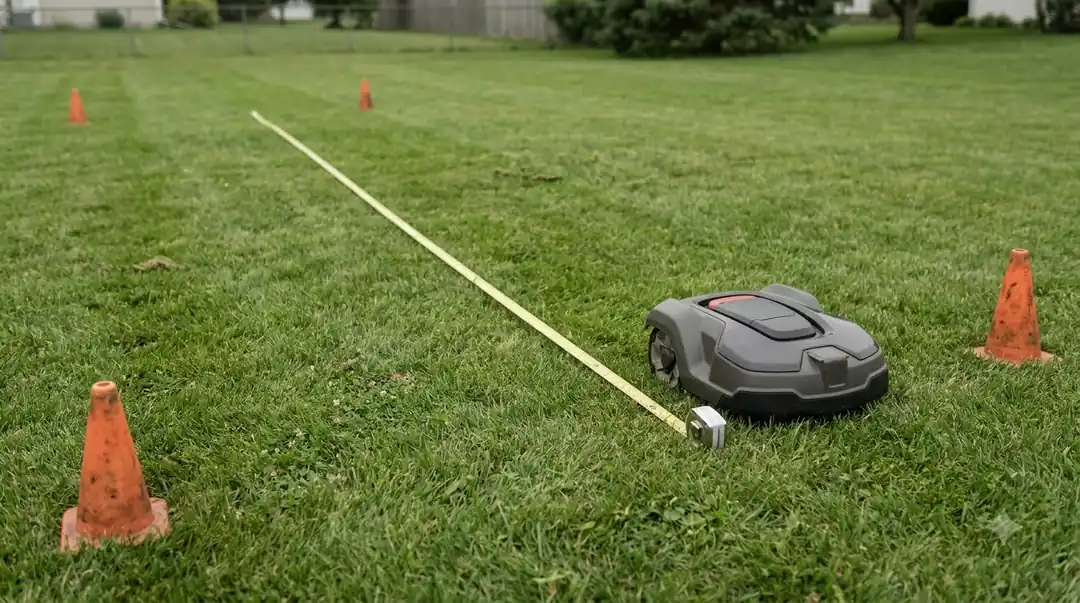
- Mowing zone: the lawn edge and the areas you want cut.
- Obstacles: trees, benches, sheds, and garden beds.
- Transit paths: the route between the station and the lawn, including any gate.
- No-go zones: flowerbeds and trampolines, which Ecovacs lists as typical examples.
During mapping, Ecovacs says to follow the mower within 19.7 feet until it completes the full loop. Keep children and pets off the lawn while it maps, and wait for wet grass to dry before the first run.
Check the boundary wire or Wi-Fi coverage
Boundary-wire models need a careful check as part of how to prepare your yard for a robot mower. Husqvarna advises walking the perimeter, confirming that no stakes have come loose, and looking for damaged wire. If the mower covers only half the lawn, its boundary or guide wire may be on the wrong charging station pin. For the routing itself, see laying boundary wire around trees and obstacles.
Wire-free models rely on a different setup, so how to prepare your yard for a robot mower differs a little from wired models. Husqvarna says Wi-Fi-only mowers need stable Wi-Fi across the whole work area, and Bluetooth models must stay within 5 meters of the mower. For these models, review the work areas, stay-out zones, and transport paths in the app before each season, and adjust them if the layout has changed.
Frequently asked questions
How long should the grass be before a robot mower first runs?
Brand guides give different numbers. Husqvarna says to wait until the grass is 5 to 7 cm (2 to 2.8 inches) tall, Toro says to mow to 83 mm (3.25 inches) before training, and Ecovacs says to cut under 3.9 inches. Check your model’s manual, and start with a high setting.
Do I need to fill every bump in the lawn?
No. Toro and Ecovacs focus on holes, deep pits, large depressions, and exposed roots. Fill those, or block the mower from them. Small bumps usually matter less, though a rough patch that repeatedly trips the mower may need attention.
Where should the charging station go?
Ecovacs says the station should sit on flat turf with no slope, with a power source, a steady Wi-Fi signal, and clear space on each side and in front. Keep the grass around it trimmed under 3.9 inches so the mower can dock.
Can a robot mower handle a steep yard?
The answer depends on the model. Ecovacs lists a 27-degree incline for one LiDAR model, so slope ratings differ widely. If a steep area is beyond your mower’s rating, block it with barriers or mark it as a no-entry zone in the app.
Sources
- Preparing your lawn and Husqvarna Automower for the mowing season (Husqvarna): first-cut height, debris, charging station, boundary wire, and Wi-Fi coverage.
- Preparing the Lawn Before Using the Robotic Mower (Toro operator manual): clearing debris, 83 mm first cut, filling holes, and the layout sketch.
- How Do You Install a Robot Lawn Mower? (Ecovacs): grass height limits, hazard distance, slope, station clearance, and mapping distance.
 Up next9 min readBy YardCan a Robot Mower Work in a Yard With a Gate Between Zones?Updated Nov 11, 2026
 8 min readBy YardCan a Robot Mower Work in a Yard With Gravel Path Crossings?Updated Nov 11, 2026
 8 min readBy YardWhere to Place RTK Antenna in a Yard With TreesUpdated Nov 11, 2026
 8 min readBy YardCan a Robot Mower Work in a Yard With a Detached Garage?Updated Nov 11, 2026
 8 min readBy YardRobot Mower for Yard With Heavy Tree Canopy: What to CheckUpdated Nov 11, 2026
 8 min readBy YardWhat Yards Are Not Good for Robot Mowers?Updated Nov 11, 2026