
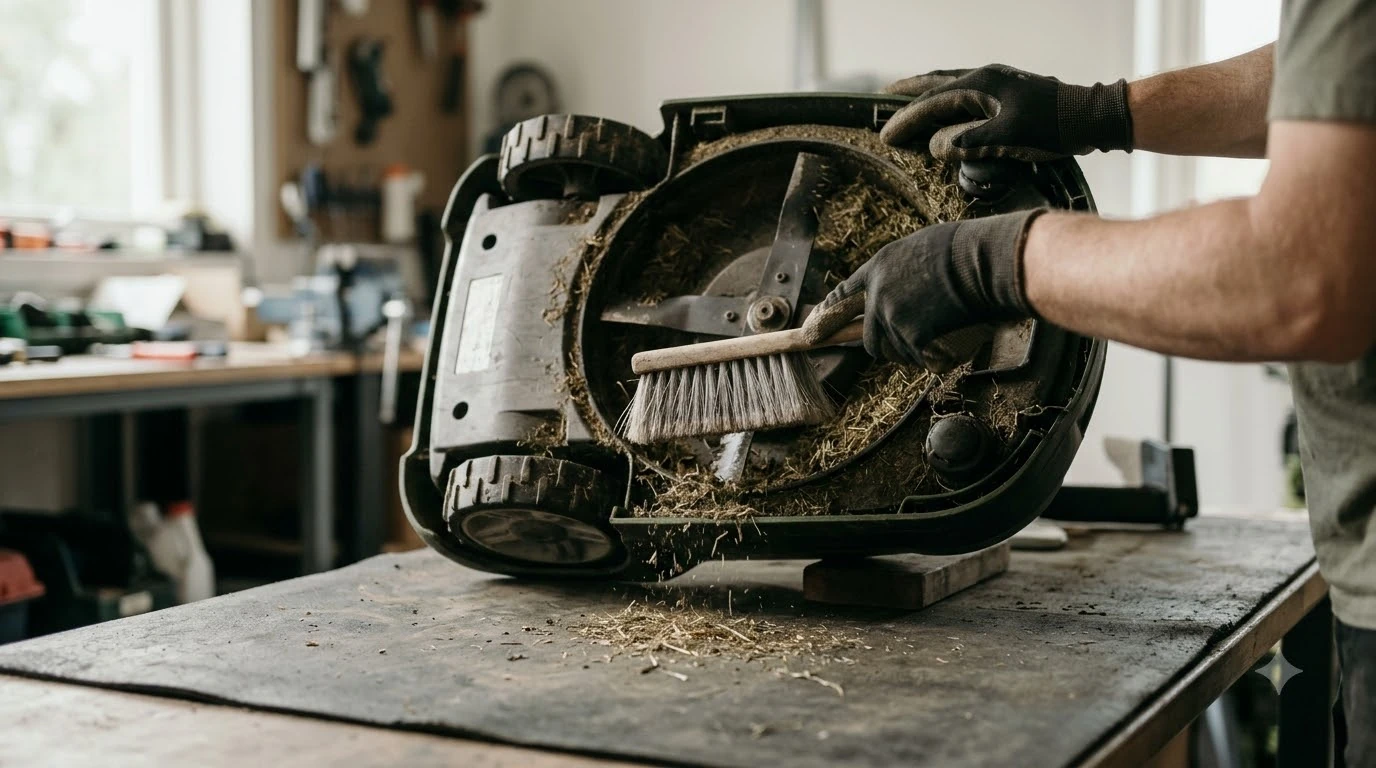

A robot mower maintenance checklist covers regular cleaning, monthly inspection, blade changes, and seasonal storage. Manufacturers give different intervals, so the schedule below shows the common ranges and where the guidance disagrees.
Use this robot mower maintenance checklist as a baseline, and treat your owner’s manual as the final word for your model, since intervals depend on the brand and the size of your lawn. The app’s error messages also give an early warning when a part needs attention.
The short answer
- Every 1 to 2 weeks: clean the deck, wheels, and sensors during the growing season.
- Once a month: check the battery, wheels, and sensors.
- Blades: Husqvarna gives 3 to 6 weeks for main disc blades, while Mammotion gives 1 to 2 months. Replace sooner if the blades are damaged.
- Before winter: replace blades, clean the mower, fully charge the battery, and store it indoors above 0°C.
How often should you clean and inspect a robot mower?
Clean the mower every 1 to 2 weeks in the growing season, and check the battery, wheels, and sensors once a month, according to Mammotion’s maintenance schedule. The routine should also include firmware, which Mammotion says to update whenever an update is available, and winter preparation before the first frost.
| Task | Frequency |
|---|---|
| Clean the mower | Every 1 to 2 weeks during the growing season |
| Check battery health | Once a month |
| Inspect wheels and sensors | Once a month |
| Update firmware | Whenever an update is available |
| Prepare for winter storage | Before the first frost |
Those intervals assume a typical schedule, so add each item as a recurring reminder. Our reading is that a mower that runs most days collects more clippings and debris, so it needs cleaning sooner than the minimum interval.
Cleaning the mower step by step
Power the mower off and wear gloves before you touch the blades or deck. Mammotion’s maintenance guide lists the cleaning steps in a clear order, and the steps below follow it.
- Power off. Switch the mower off completely before any cleaning. Never clean it while it is powered on.
- Clear the underside. Use a soft brush or a plastic scraper on the blades and deck. Avoid metal tools.
- Clean the wheels. Brush off mud and grass while turning the wheels by hand, so you can reach the debris caught between the treads.
- Wipe the sensors. Use a clean microfiber cloth on the sensors and the exterior. On models with an AI vision camera, keep the lens clean as well, according to Husqvarna.
- Dry and check. Avoid pressure washers, and let the mower dry fully before it returns to the charger.
Mammotion also advises wiping the charging contacts with a dry microfiber cloth as part of the same routine. Clean sensors support accurate navigation and obstacle detection, so the wipe-down is worth doing every time.
When should you replace robot mower blades?
Replace main disc blades every 3 to 6 weeks and EdgeCut disc blades every 9 to 12 weeks, according to Husqvarna’s seasonal support guide, and replace them earlier if they are damaged. Mammotion gives a broader rule of every 1 to 2 months, adjusted for lawn size, mowing frequency, grass type, and impacts with stones or branches.

Because the two brands give different numbers, the blade’s condition is a better guide than the calendar. Record the install date on your robot mower maintenance checklist so the reminder matches the blade’s age, and replace the blades when you spot one of these signs. Our guide to how often to replace robot mower blades covers the intervals in more detail.
- Grass tips look torn, frayed, or whitened after mowing.
- The cut is uneven, or the lawn shows streaks that were not there before.
- A blade is chipped or bent.
- The mower is louder than usual during a normal run.
When you fit new blades, follow a few rules that both guides share:
- Switch the mower off and wear gloves before you start.
- Install a new screw each time instead of reusing the old one.
- Do not mix blade types, or old and new blades, on one disc.
- On Husqvarna models, reset the blade counter in the app under More, then Statistics, then Blade Usage, then Reset.
Keeping the charging station and contacts clean
The charging station and its contacts belong in the routine too. Disconnect the power, remove debris, and wipe the charging station with a damp cloth. Husqvarna also says to clean the contacts and to avoid high-pressure washers on the station.
Husqvarna names only the NERA and the Aspire R6V, 308V, and 312V as models that can be rinsed with a garden hose. Check your manual before using water on any other model, and see what an IP rating means for a robot mower for how to read the rating.
- Keep the charging station out of direct sunlight, or use a shaded spot or a mower garage, according to Mammotion.
- Wipe the charging contacts with a dry microfiber cloth on the mower and the station.
- Let the mower return to the charger on its own when the battery runs low.
Battery care between mowing seasons
Husqvarna puts typical robot mower battery life at 2 to 5 years, and keeping the charging contacts clean and the station in shade helps the pack last. Battery life depends on how many hours the mower runs, so the schedule matters as much as the cleaning. For the full picture, see how long robot mower batteries last.
Husqvarna suggests its Scheduler Tool to avoid unnecessary mowing. Our reading is that fewer unnecessary runs also means fewer charge cycles over the season.
- Avoid prolonged heat exposure, and store the mower in a dry, ventilated place off-season.
- Before long-term storage, charge the battery to the level the manufacturer recommends.
- Check the battery health once a month, as Mammotion recommends, and log each check.
Seasonal robot mower maintenance checklist for spring, summer, and autumn
The first spring mow comes when the grass is 5 to 7 cm (2 to 2.8 in) tall, and autumn ends with grass left at 6 to 8 cm (2.4 to 3.1 in) before frost, according to Husqvarna’s seasonal support guide. The table below turns that guide into a seasonal robot mower maintenance checklist, with heights in centimeters.
| Season | Task | Detail |
|---|---|---|
| Spring | First mow | Wait until the grass is 5 to 7 cm (2 to 2.8 in) tall, start high, then lower the height gradually |
| Spring | Setup | Reinstall the charging station, update firmware and the app, then confirm a steady green LED |
| Spring | Boundary wire | Walk the lawn to check for breaks, loose stakes, or damage |
| Summer | Blades | Replace on schedule, then reset the blade usage counter in the app |
| Summer | Cutting height | The minimum is 2 cm (0.8 in), and the setting method depends on your model |
| Summer | Cleaning | Every few weeks, or as needed |
| Autumn | Final grass length | Keep the grass at 6 to 8 cm (2.4 to 3.1 in) before winter |
| Autumn | Frost protection | Set up Frost Guard before the first frost |
Heads up
Husqvarna gives a minimum cutting height of 2 cm (0.8 in). If your lawn needs a lower height, check the model’s spec sheet before you buy.
Winter storage and frost protection
Before winter, work through the last part of your robot mower maintenance checklist: replace the blades, clean the chassis and charging contacts, and fully charge the battery before switching off, according to Husqvarna. Then store the mower indoors in a dry, frost-free place above 0°C, resting it on all wheels on a flat surface or on a wall hanger. Our guide on how to store a robot mower for winter compares charge levels and storage temperatures across brands.
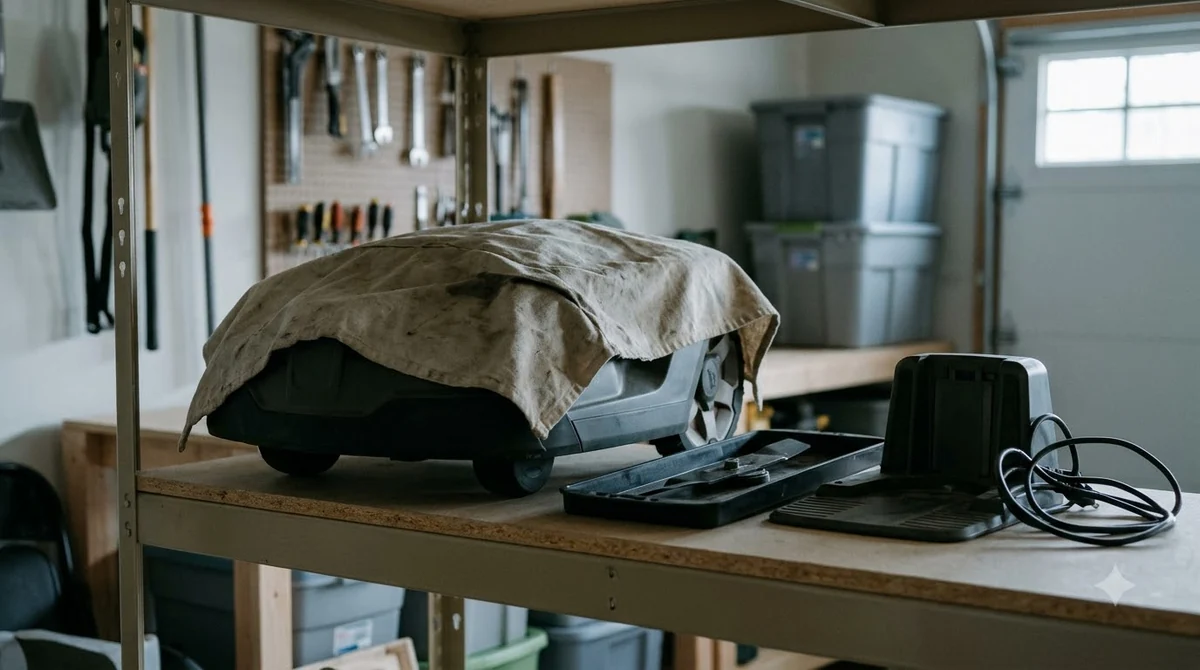
Husqvarna also recommends a professional cleaning at a dealer after each season. Frost Guard helps by parking the mower automatically before cold weather arrives.
- Smart Routine: on Wi-Fi or cellular models, the mower parks when the forecast predicts temperatures below 5°C.
- Sensor setting: on models with a temperature sensor, the mower parks when the sensor reads 5°C or below at the scheduled start time.
- Boundary and guide wires: these can stay in the ground, so label them before you disconnect anything.
- Charging station and power supply: store them indoors and dry. NERA baseplates can stay outdoors.

Frequently asked questions
How often should you clean a robot mower?
Mammotion advises cleaning the mower every 1 to 2 weeks during the growing season, so schedule that step in advance. Check the battery, wheels, and sensors once a month. Clean the sensors with a microfiber cloth, and keep the mower powered off while you work on it.
How often should you replace robot mower blades?
The answer depends on the brand, so look up your model’s interval. Husqvarna gives 3 to 6 weeks for main disc blades and 9 to 12 weeks for EdgeCut blades, while Mammotion suggests every 1 to 2 months. Replace them earlier if the grass tips look torn or a blade is chipped or bent.
Can you hose off a robot mower?
Not without checking your manual first. Husqvarna says to avoid high-pressure washers and names only certain models as safe to rinse with a garden hose. Let the mower dry fully before it returns to the charger.
What should you do before winter storage?
Start winter prep by fully charging the battery, replacing the blades, and cleaning the chassis and charging contacts. Then store the mower indoors in a dry, frost-free place above 0°C. Husqvarna also recommends a professional cleaning at a dealer after each season.
Sources
- Automower support guide by season (Husqvarna): blade intervals, cutting heights, Frost Guard, winter storage, and battery life.
- Robot lawn mower maintenance (Mammotion): cleaning frequency, monthly checks, cleaning steps, and blade replacement signs.
 Up next9 min readBest Robot MowersWhat Makes a Robot Lawn Mower Low Maintenance in 2026Updated Nov 11, 2026
 8 min readBest Robot MowersHow Often to Replace Robot Mower BladesUpdated Nov 11, 2026
 8 min readBest Robot MowersBest Robot Mower with Mulching Blades: What to Check Before You BuyUpdated Nov 11, 2026
 8 min readBest Robot MowersBest Robot Lawn Mower with Dual Blades: What the Evidence ShowsUpdated Nov 11, 2026
 9 min readBest Robot MowersHow Do Multi Zone Robot Mowers Work?Updated Nov 11, 2026
 8 min readBest Robot MowersDo Solar Powered Robot Lawn Mowers Exist?Updated Nov 11, 2026