
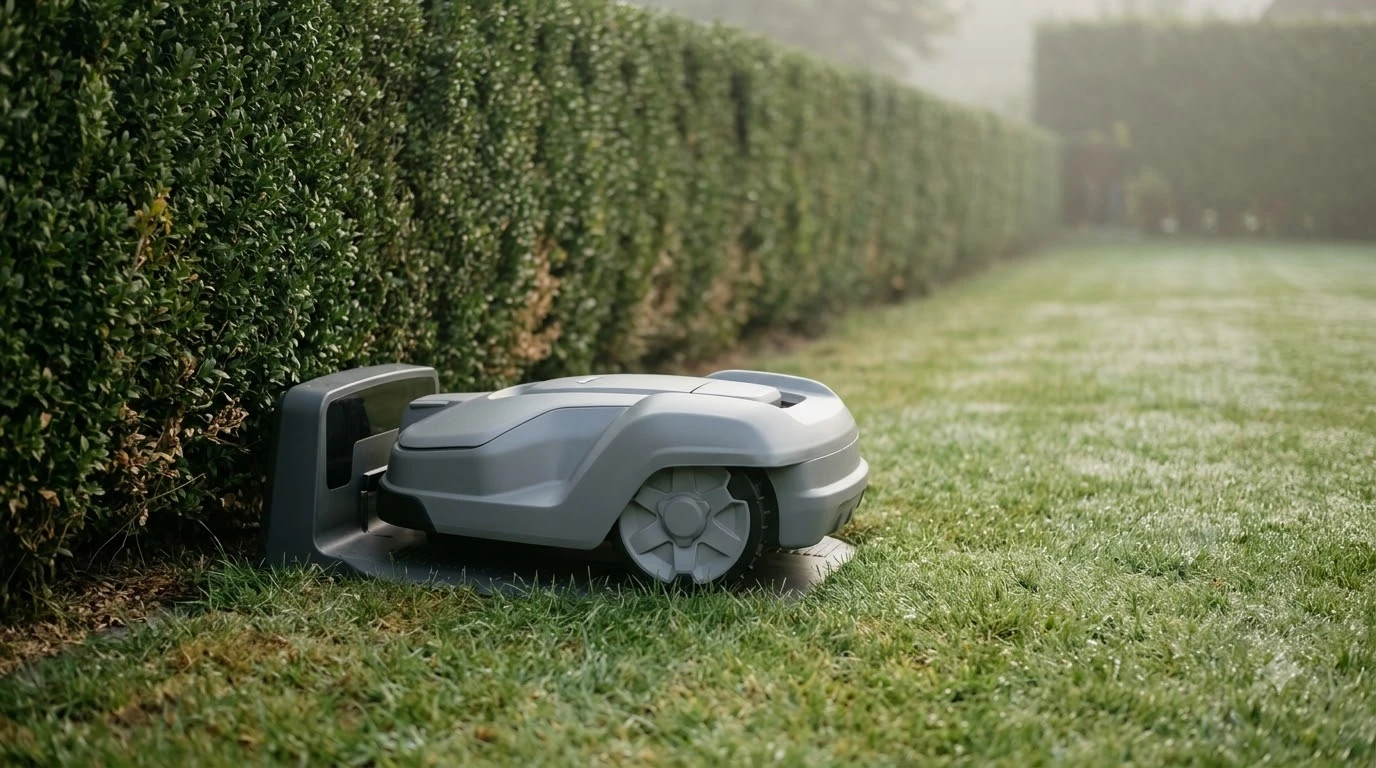

Do solar powered robot lawn mowers exist? Yes, but they are a niche. As of 2026-11-09, the solar options we could confirm are add-on charger systems for some Husqvarna Automower models and a university prototype with panels on its body. Most robot mowers still charge from a mains-powered station, so solar usually adds power rather than replacing it.
The short answer
- Yes, in limited form: Husqvarna sells solar charger systems for some Automower models.
- Body-mounted solar: the Massey SunScout prototype carries three 50 W panels, but we could not confirm current availability.
- Solar alone: the sources we read do not show a solar-only setup that handles cloudy weeks.
- Before you buy: confirm the mains fallback, the winter plan and the battery warranty.
Do solar powered robot lawn mowers exist as products today?
Yes, in limited form. Husqvarna sells solar charger systems for some Automower models, while the best-known solar-body mower we read, the Massey SunScout, was a 2023 crowdfunding project.
Husqvarna’s solar charger page describes its systems as a grid-independent power supply for robotic mowers. It is a product page, so it describes what the systems are meant to do rather than independent test results.
The Massey SunScout is a different kind of product. A team at Massey University in New Zealand developed it, and it was reported in April 2023 as a mower with solar panels on its own body. At that time the team was trying to gather customer support through a Kickstarter campaign. We did not confirm whether it reached production or is available today, so treat it as a development project until you find a current listing.
A solar robot mower from Massey University
Among solar powered robot lawn mowers, the Massey SunScout is the clearest example of panels mounted on the body. It carries three 50 W panels, one fixed on top and two on a sliding frame that extend to track the sun when its battery runs low. Its published specifications, as reported by pv magazine’s 2023 article, include:
- Battery: 20 Ah lithium iron phosphate (LiFePO4), rated 38.4 V and 768 Wh.
- Cutting width: 40 cm.
- Cutting height: 25 mm to 75 mm, programmable.
- Charging: an average of about 4 hours at 70% discharge, according to the developers.
The article does not say whether the mower also needs a mains charger. That is the first question to put to any manufacturer, because the answer decides whether the machine can run on sun alone. The figures above are developer claims for a prototype, not independent test results.
Solar charger systems sold for Automower models
Husqvarna’s solar charger systems come in four versions, with one, two or four panels, and the EPOS models are tied to a single system each.
| System | Panels | Voltage | Fits |
|---|---|---|---|
| 1-18 | 1 | 18 V | Other Automower models |
| 2-18 | 2 | 18 V | Other Automower models |
| 2-230 | 2 | 230 V | Automower 560 EPOS (its only system) and other models |
| 4-230 | 4 | 230 V | Automower 580 EPOS and 580L EPOS (their only system) and other models |
Each system supports one robotic mower. Husqvarna says the right panel count depends on the uptime you need, your daily runtime, the length of your season and your location. The 1-18 and 2-18 systems need an optional wire assembly to power a reference station alongside the mower, while the 230 V systems need no extra parts for that.
Check the model number on your mower before ordering, because the 560 EPOS, 580 EPOS and 580L EPOS each fit only one system.
What solar can and cannot do
Solar can cut grid use, but the Husqvarna page does not say how its systems handle cloud cover, grid backup or low-sun runtime, so whether a solar powered robot lawn mower can run alone remains unproven on the evidence we read.
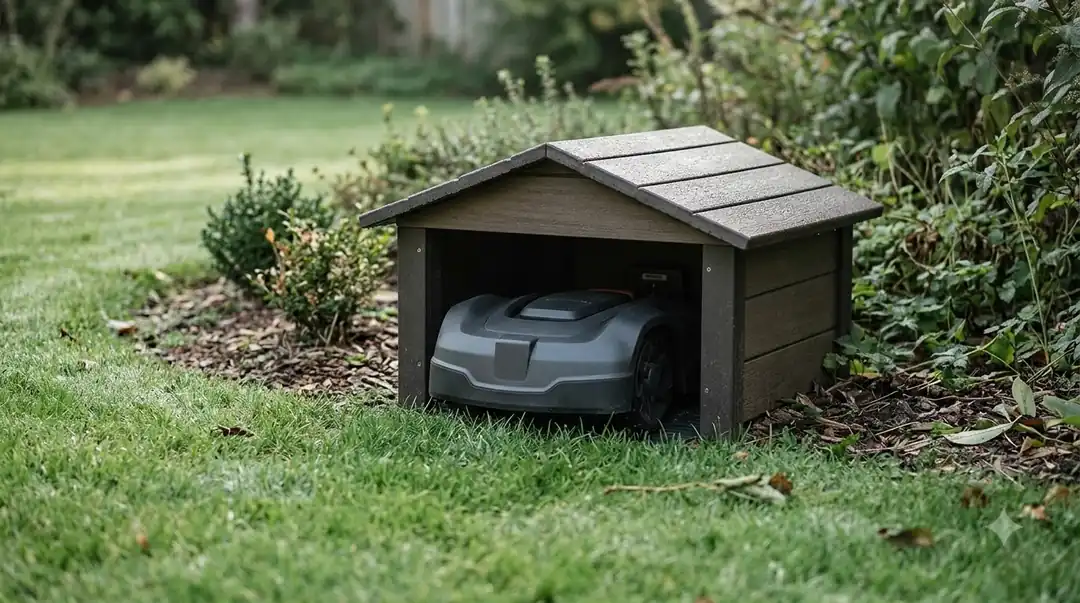
Husqvarna says its systems enable 24/7 battery-powered robotic mowing where power infrastructure is impractical or unavailable, and it lists continuous 24-hour operation. Those are manufacturer claims, and the page does not give the conditions behind them. The points below mark where the sources are silent or pull in different directions.
- Cloud cover: not addressed on the Husqvarna page.
- Grid backup: the page does not say whether a mains connection is still needed.
- Sun tracking: the Massey design slides its extra panels out to track the sun when the battery is low, which helps recharge speed rather than total energy.
- Heat and shade: Robomow advises avoiding mowing in the blazing midday sun of summer and placing the charging station in a shady spot (see our notes on where to put a robot mower charging station).
Heads up
Panels need sun, while Robomow’s advice points toward shade and moderate heat for the battery. Our reading is that this trade-off is real, but we did not test it, and none of the sources we read measures it.
Battery life and what solar changes
Robomow lists 1,000 to 2,000 charge cycles for LiFePO4 batteries, about five years of life, and says reducing the number of charging cycles can extend service life.
| Battery type | Charge cycles | Typical life (Robomow) |
|---|---|---|
| Li-ion | 500 to 800 | About 4 years |
| LiFePO4 | 1,000 to 2,000 | About 5 years |
| NiMH | 350 to 500 | About 6 years |
For a solar powered robot lawn mower, Robomow’s battery guidance still applies, because sunlight and cold both affect how long a battery lasts. Our reading is that extra daytime top-ups from solar panels count as charging cycles, so a solar setup uses part of the cycle budget even when it cuts grid use. The cycle count matters more than where the energy came from. For the other side of the ledger, see how much electricity a robot mower uses and how long robot mower batteries last.
Who should consider a solar robot mower
For solar powered robot lawn mowers, the case is strongest where grid power is impractical or unavailable, as Husqvarna puts it, and it adds least where a charging station already sits on a reliable outlet.
- Good fit: a remote lawn with no outlet nearby, and a sunny site where the charger can sit in an open spot.
- Skip it: a shaded yard, a region with frequent cloud, or a yard where a standard charging station already runs from a reliable outlet.
Our reading is that a standard robot mower with a mains charging station is the simpler choice for most homes, since its charging behavior is easier to check against the manufacturer’s documentation.
What to check before you buy a solar robot mower
Before you buy any solar powered robot lawn mower, confirm the panel count, whether mains charging is still required, and how the system handles winter and cloudy weeks.
- Confirm the model fit. Match your mower model against Husqvarna’s compatibility list before you order a charger system.
- Ask about the mains fallback. Find out whether the mower still needs a mains charging station, since the Husqvarna page does not say, and compare it with typical charging station power requirements.
- Ask how cloudy weeks are handled. Get the expected runtime without sun in writing, along with the battery warranty terms, instead of relying on the 24-hour claim alone.
- Plan winter storage. Husqvarna advises storing the battery fully charged indoors in winter, and Robomow says to move the robot to its winter home once temperatures are permanently below 10°C (50°F). Our guide to storing a robot mower for winter covers the rest.
Confirm every figure on the seller’s current spec sheet, because product details and availability change. Our reading is that the answer to whether solar powered robot lawn mowers exist for your yard depends less on the product category than on your sun, your grid access and your winter plan.
Frequently asked questions
Can a solar powered robot lawn mower run only on sun?
The sources we read do not show that. Husqvarna claims 24/7 battery-powered mowing where power is impractical, but its page does not say how cloudy weather is handled. Check the spec sheet before relying on solar alone.
How should a solar robot mower be stored for winter?
For solar powered robot lawn mowers, Husqvarna advises storing the battery fully charged indoors during winter to protect it from cold. Robomow says to move the robot to its winter home when temperatures are permanently below 10°C. Follow the manufacturer’s manual for the exact steps.
What battery does a solar robot mower use?
The Massey SunScout prototype uses a 20 Ah LiFePO4 battery rated 38.4 V, which stores 768 Wh. Robomow lists LiFePO4 batteries at 1,000 to 2,000 charge cycles, about five years of life.
Is a solar charger the same as a solar robot mower?
No. The Massey design puts panels on the mower body, while Husqvarna’s systems are separate charger systems for specific Automower models. Both are solar powered, but they differ in setup and in which models they fit. So when readers ask do solar powered robot lawn mowers exist, the answer depends on which of the two they mean.
Sources
- Solar charger for robotic mowers (Husqvarna): system names, panel counts, voltages, compatibility and winter storage.
- PV-powered robotic lawn mower from New Zealand (pv magazine, April 2023): Massey SunScout panels, battery, cutting specifications and sun tracking.
- How long does the battery of a robotic lawnmower last? (Robomow): sunlight and cold effects, charge cycles and winter advice.
 Up next8 min readBest Robot MowersHow Often to Replace Robot Mower BladesUpdated Nov 11, 2026
 8 min readBest Robot MowersRobot Mower Maintenance Checklist: Cleaning, Blades, and StorageUpdated Nov 11, 2026
 8 min readBest Robot MowersDo You Need a Grass Collector on a Robot Mower?Updated Nov 11, 2026
 9 min readBest Robot MowersHow Do Multi Zone Robot Mowers Work?Updated Nov 11, 2026
 9 min readBest Robot MowersHow to Store a Robot Mower for WinterUpdated Nov 11, 2026
 7 min readBest Robot MowersMulching Robot Mower Explained: How It Works and When It FailsUpdated Nov 11, 2026