
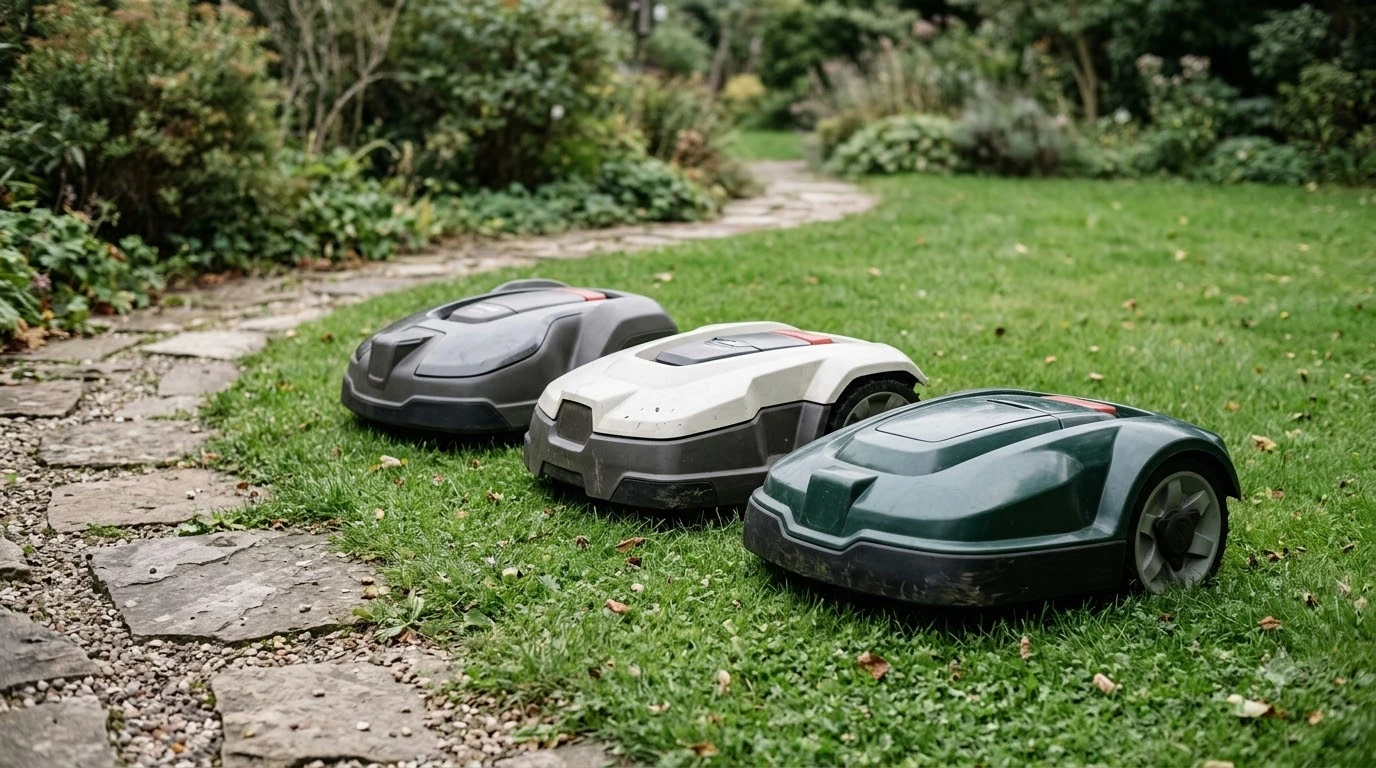

For most yards, how much of my lawn will a robot mower miss depends on one narrow strip along the borders. That strip is usually about 5 to 20 cm (2 to 8 inches) wide, depending on whether the blade sits in the middle of the deck or on an offset edge disc. The boundary wire setup can widen it further, so the answer is not the same for every lawn.
The short answer
- Centre-blade models leave a strip of about 10 to 20 cm (4 to 8 inches) along borders, according to Robomow.
- Edge-cut models reduce that strip to about 5 to 6 cm (2 to 2.5 inches) in Robomow’s figures.
- Boundary wire placement can add uncut grass if the wire sits too far from obstacles or the mower does not reach it.
- Your own estimate: multiply the border length by the strip width to get the area left for a trimmer.
How much of my lawn will a robot mower miss along the edges
A standard robot mower with a centre-blade deck usually leaves a strip of about 10 to 20 cm along the edge of the work area. Robomow describes this strip as “quite large at 10-20 centimeters.” The strip forms where the deck cannot reach, next to fences, walls, and flower beds. Ecovacs calls the same gap “greens creep” and says it leaves an uncut band that often needs hand trimming.
Edge-cut designs narrow that gap. Robomow says its edge-cut function reduces the uncut width to about 5 to 6 cm, and it recommends keeping a margin of about 6 cm from the outermost edges if you want to avoid retouching by hand. The company gives both figures in the same article, so treat the exact number as approximate. Ecovacs makes a similar point: offset blades cut nearer to the lawn edge than centre-blade designs do.
Even the best edge cut is not a full trim. Robomow notes that edge-cut models reach their limits where vegetation grows right up to walls and fences. Grass that touches a fence or wall is still a job for a string trimmer or shears.
Why the boundary wire sets the result
The boundary wire tells the mower where the lawn stops, so its placement shapes how much of my lawn will a robot mower miss as much as the blade does. Husqvarna recommends setting the work area border at least 1.5 m (5 ft) outside the lawn, so the mower can reach the boundary wire and cut right up to it. Husqvarna also gives the accuracy of its AIM technology as approximately 1 m (3.3 ft). When the mower cannot reach the wire, grass next to the wire can stay uncut.
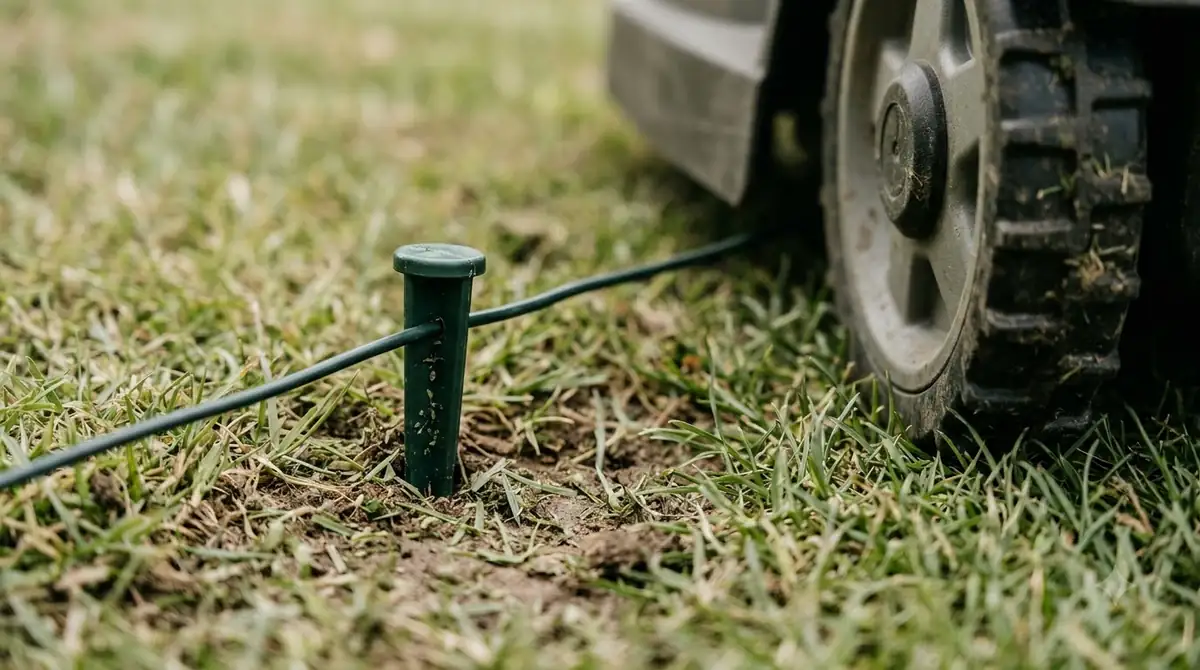
Husqvarna’s EdgeCut feature shows the other side of the problem. Its edge disc sits at the back of the mower in a fixed position of 45 mm (1.77 inches). The mower performs a sweeping turn when it reaches a boundary, so the disc cuts along the edge. The setup still matters. Husqvarna says that when the wire is placed too far from obstacles, more grass remains uncut. When it is placed too close, the mower bounces off the obstacle and triggers an EdgeCut instead.
Pattern matters too. Husqvarna notes that “parallel patterns may leave edges uncut,” and that the mowing pattern can change how well the borders are covered. If you see uncut grass in the same spots every time, check the pattern and the wire before you blame the blade.
How much of my lawn will a robot mower miss in my yard
You can estimate the uncut area with simple multiplication. This is the quickest way to see how much of my lawn will a robot mower miss before you buy. Walk the border that the mower reaches, meaning the fences, beds, and paths the mower mows up to, and add up the length in metres. Then multiply by the strip width. This is our arithmetic, not a measured result, but it gives a realistic size for the job.
For example, a yard with 80 m of border along fences, beds, and paths leaves the following areas, depending on the strip width:
| Strip width | Area left uncut (80 m of border) | Typical source |
|---|---|---|
| 10 cm (4 in) | 8 m² (about 86 sq ft) | Centre-blade mower, Robomow range low end |
| 6 cm (2.4 in) | 4.8 m² (about 52 sq ft) | Edge-cut mower, Robomow margin |
| 5 cm (2 in) | 4 m² (about 43 sq ft) | Edge-cut mower, Robomow lower figure |
The number looks small, but it adds up across a season. A patch of grass that you must trim by hand every week is a recurring chore, not a one-time one. The table also shows why a few centimetres of blade design make a visible difference on a long fence line.
Lawn shape changes the total. A long, narrow yard with many corners has more border per square metre than a round lawn, so the uncut area can be larger even when the lawn itself is small. Measure the border you actually plan to mow, not just the total lawn size, because that border decides how much of my lawn will a robot mower miss.
What a robot mower cannot finish alone
Some edges will need manual work, whatever the blade design, so ask how much of my lawn will a robot mower miss before you choose a model. Robomow says that pesky lawn edges may require manual reworking with a lawn trimmer or shears. Its grass-sensor models, which do not use a perimeter wire, are the clearest case: for those, manual trimming with a lawn trimmer is the only option at the edges.
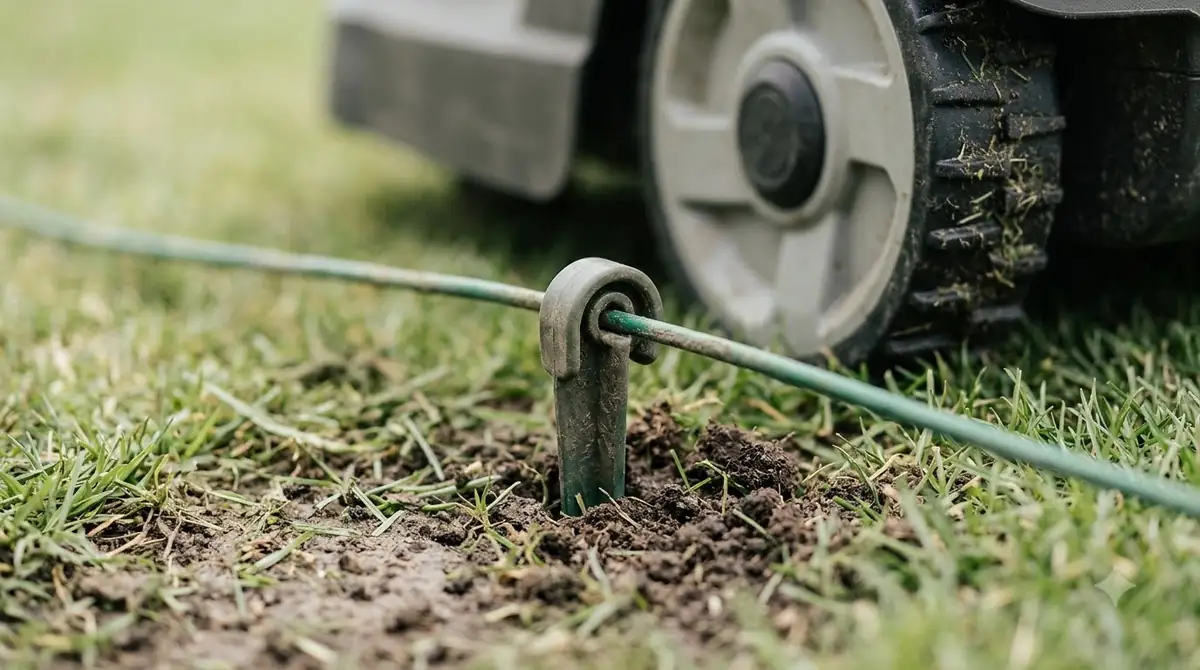
Obstacles inside the lawn also leave grass behind when the mower must go around them. The wire placement described above applies here too. Clean, straight placement around a bed or tree leaves less grass to trim later than a wire that curves tightly around every corner.
Plan for a trimmer and a short edging pass for the first few weeks. Once the wire and border are set, the remaining work is usually the same strip along each fence and bed, and you can schedule it with the rest of your yard care.
Coverage ratings do not show the edge
Coverage ratings describe the area a mower can keep trimmed, so they do not answer how much of my lawn will a robot mower miss at the edges. Eufy defines maximum capacity as the total area kept trimmed within a typical growth cycle. That number says nothing about the strip along a fence. In our reading, a mower with a high rating can still leave a 10 to 20 cm band along every border if it has a centre blade.
Dreame makes a related point for large lawns: daily coverage matters more than the maximum area a mower can cover. In our reading, a daily schedule that covers the whole lawn matters more to the finished look than a large rating that covers only part of the yard in each run. Look at the border handling and the schedule together.
How to check the result after setup
Checking how much of my lawn will a robot mower miss takes only a few minutes, so do it during the first few mowing cycles, not after a month. Look at the grass along the wire and the fences after each run. If the same spot stays uncut, the wire is probably too far from the obstacle or the mower is not reaching the wire.
- Set the border outside the lawn. Leave at least 1.5 m (5 ft) between the work area border and the lawn edge, as Husqvarna recommends for AIM setups.
- Adjust the wire at obstacles. Keep it far enough that the mower does not bounce, but close enough that the edge disc or blade reaches the grass.
- Change the pattern if edges repeat. Parallel patterns can leave edges uncut, so test another path if the same strip stays long.
- Trim the strip by hand on a schedule. A quick pass with a string trimmer along fences and beds keeps the strip from growing taller than the rest of the lawn.
Frequently asked questions
How much of the lawn does a robot mower usually miss?
The main miss is a strip along the borders, usually about 10 to 20 cm for centre-blade mowers and about 5 to 6 cm for edge-cut models, according to Robomow. The total area depends on how much border your yard has.
Can a robot mower cut right up to the fence?
Not completely with most designs. Edge-cut models get closer, but Robomow says vegetation touching walls and fences still needs a trimmer or shears. Plan for a short hand pass along fences.
Does the boundary wire affect how much grass is left?
Yes. Husqvarna says the mower may not reach the boundary wire when the border is set too close, and more grass remains uncut when the wire is placed too far from obstacles. Placement matters as much as the blade design.
Do I need to trim the edges after a robot mower runs?
Most owners do, at least occasionally. Robomow notes that grass-sensor models without a perimeter wire need manual trimming at the edges. Even with a wire, check the strip after the first few cycles and trim it when it grows taller than the lawn.
Sources
- AIM technology and uncut grass along the boundary wire (Husqvarna): used for the 1.5 m border distance and the 1 m accuracy figure.
- What is EdgeCut and how to use it (Husqvarna): used for the 45 mm disc position and the wire placement effects.
- How cleanly does a robotic mower cut the lawn edge (Robomow): used for the centre-blade and edge-cut strip widths and manual trimming notes.
- Robot lawn mower for edge cutting (Ecovacs): used for the greens creep description and offset blade point.
 Up next9 min readBy YardHow Do I Know If a Robot Mower Will Work in My Yard?Updated Nov 11, 2026
 8 min readBy YardHow Much Boundary Wire Do You Need for a Robot Mower?Updated Nov 11, 2026
 8 min readBy YardShould I Level My Lawn Before Getting a Robot Mower?Updated Nov 10, 2026
 8 min readBy YardIs My Yard Suitable for a Robot Mower?Updated Nov 11, 2026
 8 min readBy YardWhy Does My Robot Mower Stop on a Slope? Causes and FixesUpdated Nov 14, 2026
 9 min readBy YardWill a Robot Mower Get Stuck on a Lawn With Holes and Dips?Updated Nov 11, 2026