
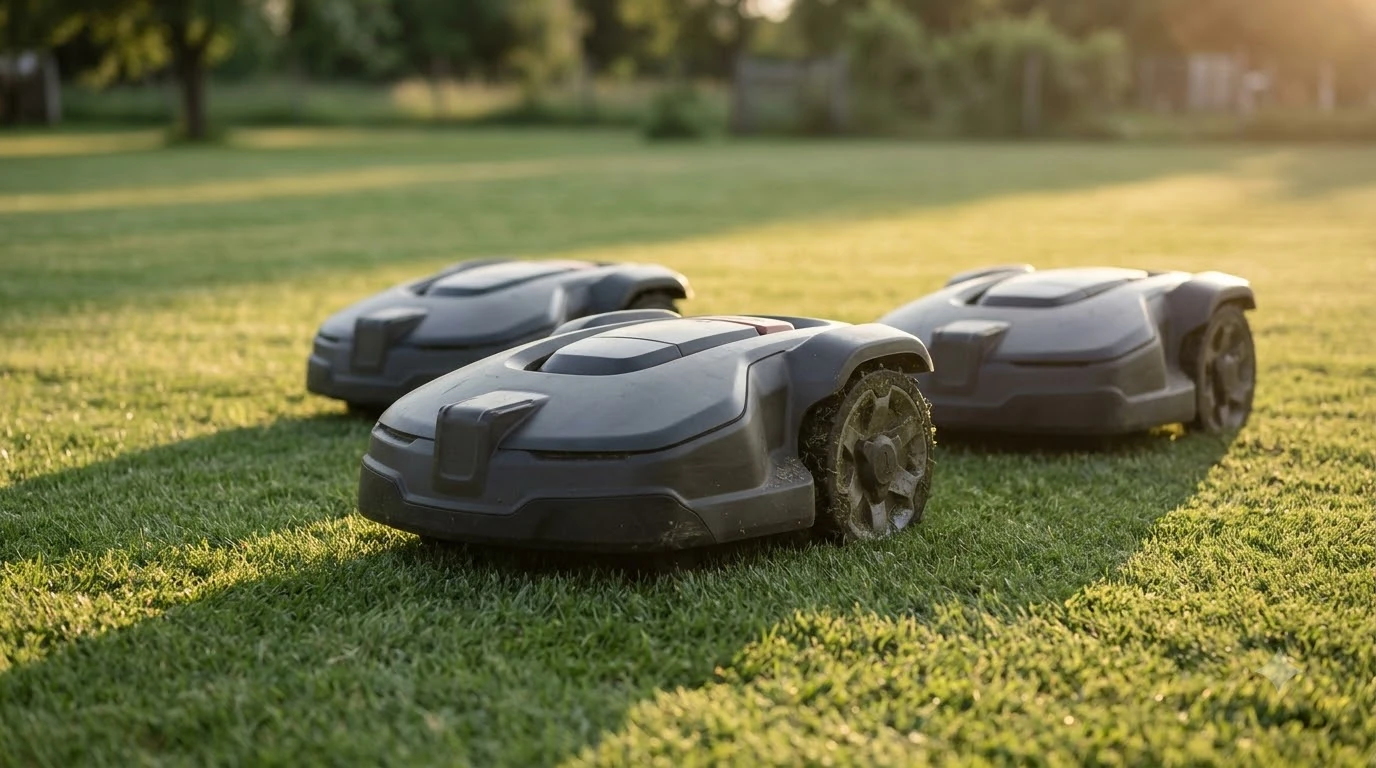

The best robot lawn mower for first-time homeowners is the one that matches your lawn size, setup type and upkeep time, not the one with the longest feature list. Start with the rated mowing capacity, decide between a boundary wire and wire-free setup, then check slope, battery life and the cost of blades and replacement parts before you compare brands.
The short answer
- Size first. Husqvarna rates its Automower 410 iQ for up to 0.5 acre and its 420 iQ for up to 1 acre.
- Setup second. Wired models need a buried or pegged perimeter wire, while wire-free models depend on satellite signal.
- Check slope and trees. Steep ground and heavy canopy can rule out a model that looks right on paper.
- Budget for upkeep. Plan for blades every 1 to 2 years and a battery that may need replacing after about 2 to 5 years.
What makes the best robot lawn mower for first-time homeowners
A robot mower is simple to run once it works, but finding the best robot lawn mower for first-time homeowners happens before the first mow. Four criteria cover most of the choice: lawn size, setup type, slope and the upkeep you are willing to do. Brand reputation matters less than these four, because two mowers from different makers can suit the same yard while only one suits your slope.
- Lawn size: the rated area must cover your lawn with margin.
- Setup type: wired or wire-free, and whether you want to do the installation yourself.
- Slope and obstacles: hills, tree cover, narrow gaps and steps.
- Upkeep: blades, battery and the time you will spend checking the machine.
This guide does not rank models, because no single pick is the best robot lawn mower for first-time homeowners in every yard. It explains how to read the specs that manufacturers and independent sources publish, so you can shortlist mowers that fit your yard.
Match the best robot lawn mower to your lawn size
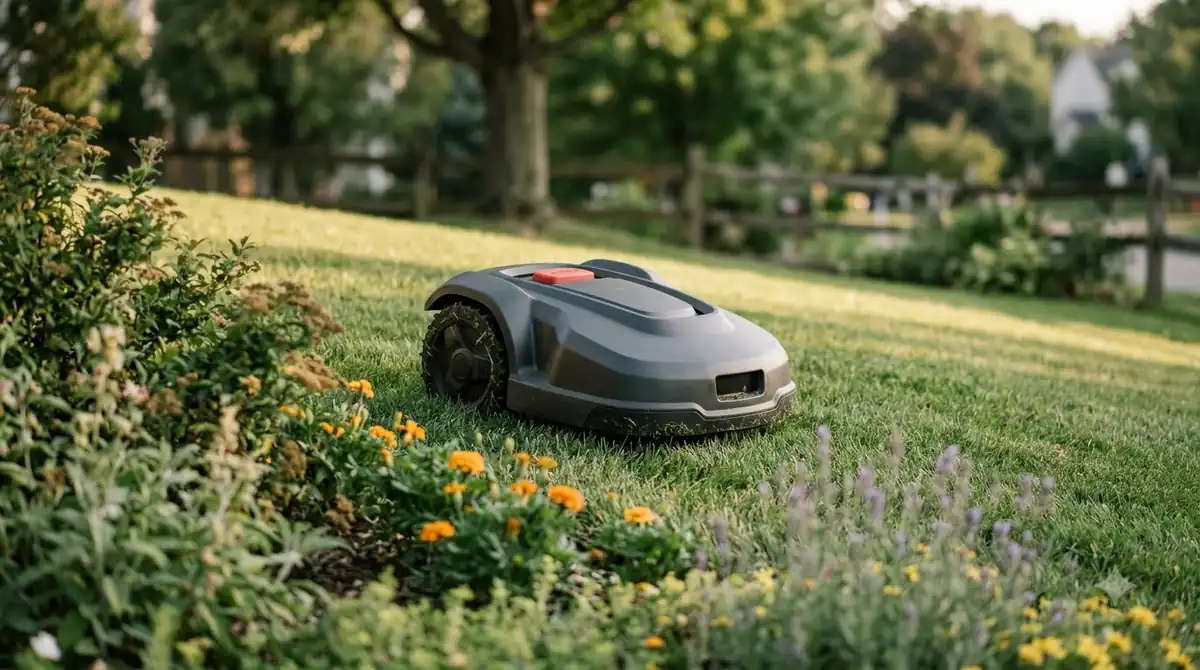
Lawn size is the first filter for the best robot lawn mower for first-time homeowners, because a mower rated for a smaller area will run for longer and wear faster on a large lawn. Husqvarna lists its Automower 410 iQ at up to 0.5 acre and its 420 iQ at up to 1 acre on its US robotic mower page, and labels them for small to medium and medium to large yards. Mammotion uses a simpler scale: small is under 0.25 acre (about 1,000 square meters), medium is 0.25 to 0.75 acre, and large runs up to 2.5 acres.
| Lawn size | Mammotion tier | Example rating from Husqvarna US |
|---|---|---|
| Under 0.25 acre | Small | 410 iQ class, up to 0.5 acre |
| 0.25 to 0.5 acre | Medium | 410 iQ, up to 0.5 acre |
| 0.5 to 1 acre | Medium (upper end) | 420 iQ, up to 1 acre |
| Over 1 acre | Large | Larger models; check each rating |
Treat the rated capacity as a ceiling, not a target. Our reading is that a mower rated for exactly your lawn size will work hardest at the edge of its range, so leaving some margin usually makes the machine more comfortable to live with.
Wire or wire-free: which setup is easier to install
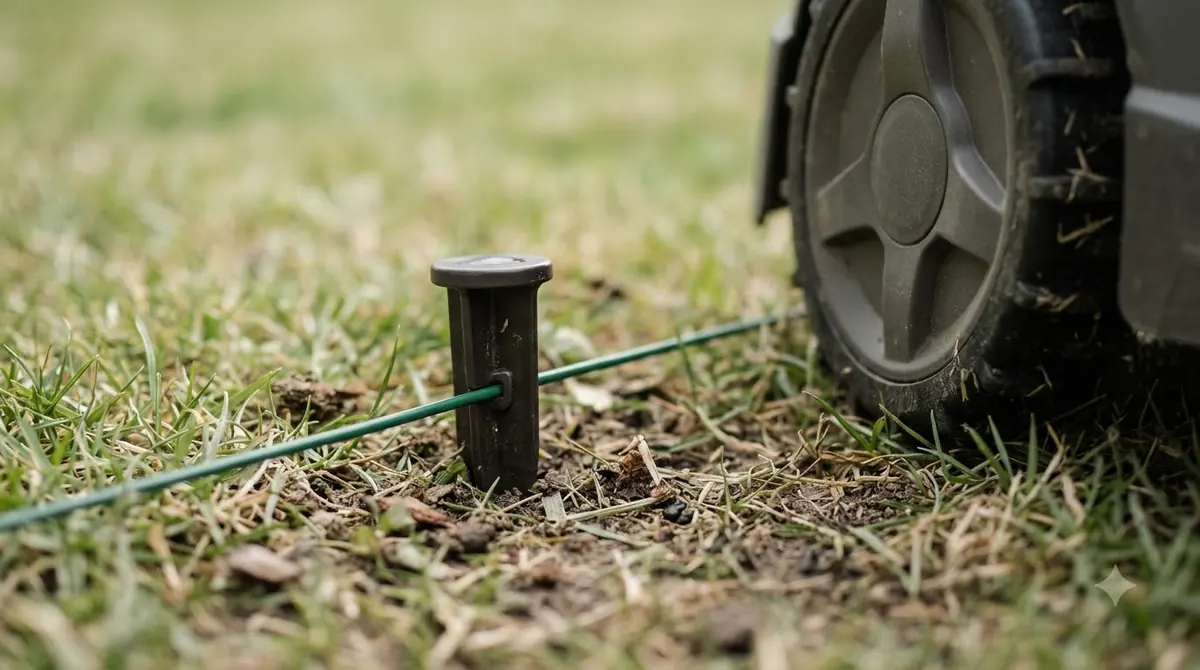
Setup type is the second filter for the best robot lawn mower for first-time homeowners. A boundary-wire mower needs a perimeter wire laid around the lawn and fixed with pegs, plus a charging station that must be close to a power outlet. Wire-free models use satellite positioning or other sensing to build a virtual boundary, which removes the trench work but needs a clear view of the sky. Which? notes that wire-free models are usually more expensive, and that a UK installation kit for wired models often adds GBP 70 to 100.
| Setup | Install time quoted by a source | Main trade-off |
|---|---|---|
| Boundary wire | 2 to 5 hours (Eufy, Australia); 4 to 8 hours of digging (Lymow, UK, vendor estimate) | Physical work, pegs and wire breaks to watch |
| Wire-free (RTK) | Mapping usually 30 to 60 minutes (Eufy); 30 to 60 minutes for simple yards (Lymow, vendor estimate) | Needs open sky and a steady base station |
Robomow describes a DIY wired install as “rather easy to do with minimal technical skills”. Its guide puts the charging station no further than 15 meters from the outlet, with about 3 meters of clear space in front, and pegs about every 50 centimeters. A first-time homeowner who is comfortable with basic hand tools can usually do this, but a long perimeter or a tricky layout is the point where a dealer install starts to make sense.
Slope and tree cover can decide the model
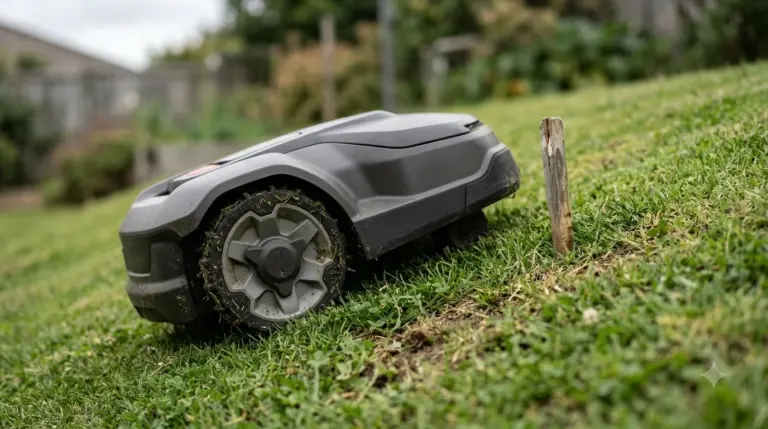
For the best robot lawn mower for first-time homeowners, slope is often the deciding spec. Slope decides which drive system you need. Mammotion’s guide says flat lawns suit any mower, that slopes up to 35 percent need a mid-range model with traction control, and that slopes up to 80 percent need all-wheel drive. Husqvarna’s own card for the 435 iQ AWD states a 70 percent limit, but its slope filter ranges do not map cleanly onto each model, so check the spec sheet of the exact model you are considering.
Tree cover is the other common surprise. Which? warns that RTK and GPS can lose signal under heavy canopy, deep shadow or tall walls. Eufy says tree cover and buildings “can severely degrade GPS and RTK satellite signals”. Husqvarna’s UK FAQ adds that narrow passages under 4 meters with tall hedges or walls can block satellite signals. If your lawn sits under mature trees, a wired model may be more predictable, which matters when you narrow down the best robot lawn mower for first-time homeowners.
Battery, blades and the upkeep you will own
Battery life is the cost most first-time homeowners underestimate when they search for the best robot lawn mower for first-time homeowners. Mammotion says a lithium-ion battery loses capacity over time and usually lasts 2 to 5 years, with warranties typically running 2 to 3 years. Bosch’s guide gives a similar picture, with a battery that may need replacing after about 3 years, and Which? reports UK replacement batteries that can cost more than GBP 100.
- Blades are the routine item. Bosch says they are replaced every 1 to 2 years, and Mammotion advises inspecting them every 4 to 6 weeks in the mowing season.
- Undercarriage and sensors need cleaning, so budget a few minutes a month.
- Battery is the big one. Ask whether it is user-replaceable before you buy.
Bosch also says a robot mower is not completely maintenance-free, so the best robot lawn mower for first-time homeowners still needs regular attention. The main task is blade sharpening or replacement, not repair.
What it costs to own, beyond the sticker price
For the best robot lawn mower for first-time homeowners, the total cost of ownership is the price plus the install kit, electricity, blades and a battery reserve. Which? lists UK Best Buy robot mowers from GBP 889 in an article dated 2024, and expects prices to drop as the market grows. Those figures are dated and UK-only, so use them only as a rough guide and check current US prices yourself.
| Cost item | Figure from a source | Source |
|---|---|---|
| Entry price, UK | From GBP 889 (Best Buy list, 2024) | Which? |
| Install kit, UK | Usually GBP 70 to 100 extra for wire and pegs | Which? |
| Electricity, one example | About 7 kWh a month, just over GBP 15 for an eight-month season | Expert Reviews (April 2025 tariff) |
| Blades | Replaced every 1 to 2 years, about GBP 18 a set | Bosch |
Our reading is that a simple annual calculation works best for comparing any robot lawn mower for first-time homeowners: divide the price by the years you expect it to last, add electricity, blades and a battery reserve, then compare the result with the hours you expect to save. Expert Reviews calls the time saved “a definite and measurable time saver”, and says the gain grows with lawn size.
Safety, theft and wildlife basics
Most models sold as the best robot lawn mower for first-time homeowners use a PIN code, and many sound an alarm if the mower leaves the wire area. Which? notes that some models can also be tracked through an app. These features matter for a first home, and they matter more for anyone shopping for the best robot lawn mower for first-time homeowners, because a mower left outside all day is an easy target.
Wildlife is the other basic check for the best robot lawn mower for first-time homeowners. Which? and Bosch both report hedgehogs and other animals injured by mowers running at night, so schedule mowing in daylight. Expert Reviews also notes that robot mowers struggle with long grass, so the first cut of the season is usually done by hand.
What to check before you buy
Use this checklist before you shortlist any model for the best robot lawn mower for first-time homeowners, so each claim on a product page can be tested against your own yard.
- Measure the lawn. Confirm the area, then compare it with the rated capacity and leave some margin.
- Decide the setup. Choose wired or wire-free based on trees, time and how much digging you want to do.
- Check the slope. Use Mammotion’s bands as a starting point and read the exact model’s spec sheet.
- Price the upkeep. Add the blade cost, the battery life and the warranty length to the upfront price.
- Confirm the charging spot. You need a power outlet and room to approach the dock.
- Read the theft and wildlife options. PIN, alarm, app tracking and a daytime schedule.
Start with lawn size and setup type, then compare upkeep and warranty length. Once those match your yard, the best robot lawn mower for first-time homeowners is the one you can maintain without stress.
Frequently asked questions
Is a robot lawn mower worth it for first-time homeowners?
It can be, if your lawn is big enough for the time saved to matter, so the best robot lawn mower for first-time homeowners is also the one that fits your acreage. Expert Reviews calls the time saving measurable and says it grows with lawn size, but it also says fussy gardeners who want regimented stripes may not be happy with the result.
Can a first-time owner install the best robot lawn mower for first-time homeowners alone?
Often yes. For the best robot lawn mower for first-time homeowners, Robomow describes a DIY install as possible with minimal technical skills and a few basic tools. Eufy estimates 2 to 5 hours for a boundary wire, and wire-free mapping usually takes 30 to 60 minutes.
How big a lawn can the best robot lawn mower for first-time homeowners handle?
Husqvarna rates its Automower 410 iQ for up to 0.5 acre and its 420 iQ for up to 1 acre. Mammotion groups lawns under 0.25 acre as small and up to 2.5 acres as large, so check the rating against your own measurement.
How long does the battery last?
For the best robot lawn mower for first-time homeowners, Mammotion says a lithium-ion battery usually lasts 2 to 5 years, and Bosch says a replacement may be needed after about 3 years. Check whether the battery is user-replaceable and what the warranty covers before you buy.
Sources
- Husqvarna US robotic mowers (manufacturer): capacity ratings for the 410 iQ and 420 iQ.
- Which? robot lawn mower guide (consumer testing body, UK): wire vs wire-free, canopy signal loss.
- Mammotion US buyer guide (manufacturer): lawn size and slope tiers, battery life and warranty.
- Robomow DIY installation guide (manufacturer): charging station distance, peg spacing.
- Bosch DIY robotic lawnmowers article (manufacturer): battery, blade and maintenance guidance.
- Expert Reviews on robot mower value (publisher, UK): time saving, long grass, electricity example.
 Up next8 min readBest Robot MowersRobot Mower Buying Checklist for First-Time OwnersUpdated Nov 17, 2026
 7 min readBest Robot MowersWhen Is the Best Time to Buy a Robot Lawn Mower?Updated Nov 11, 2026
 9 min readBest Robot MowersBest Robot Lawn Mower for Homeowners With Limited Mobility: What to CheckUpdated Nov 10, 2026
 10 min readBest Robot MowersBest Robot Mower Christmas Gift for Homeowners: 5 Key ChecksUpdated Nov 11, 2026
 8 min readBest Robot MowersWhich Gardena Robot Mower Should I Buy? Limits to Check FirstUpdated Nov 13, 2026
 7 min readBest Robot MowersWhich Dreame Robot Mower Should I Buy? Limits to Check FirstUpdated Nov 13, 2026