


The best robot lawn mower for homeowners with limited mobility is the one you can set up, control and handle without strain, and that fits your yard. No single model is best for everyone. The sources we read point to three checks: how much the mower weighs, how much setup needs kneeling or lifting, and whether it can be run from a phone or tablet instead of by hand.
The short answer
- Weight: a compact mower is easier to lift. Family Handyman lists the WORX WR165 at 21 pounds for yards of one-eighth acre or less, and warns that a wide cutting base makes a mower heavier to lift.
- Setup: wire-free models avoid the trenching step. Wired models usually need a buried or pinned boundary wire, which lawnmowers.com describes as an afternoon of work.
- Control: Husqvarna’s Automower Connect app lets you run the mower from a smartphone. Some sources say a phone makes control easier for people with disabilities, but the manufacturer does not say the app is required.
- Slopes: the Husqvarna Automower 435 iQ AWD is rated for slopes up to 70 percent. Standard models in the same support guide are rated 25 to 50 percent.
What makes a robot mower easier with limited mobility
A robot mower removes the walking, pushing and turning that a walk-behind needs. Once it is set up, it runs on a schedule and returns to its dock by itself. Family Handyman’s accessible-mower list was built for people with severe mobility issues or people who want to keep doing their own yard work as they age in place. That is the lens for this guide.
The trade-off is that the robot still has to be installed, lifted for service, and checked from time to time. Our reading is that the best fit depends less on the brand name and more on those three tasks.
Lift weight and handling
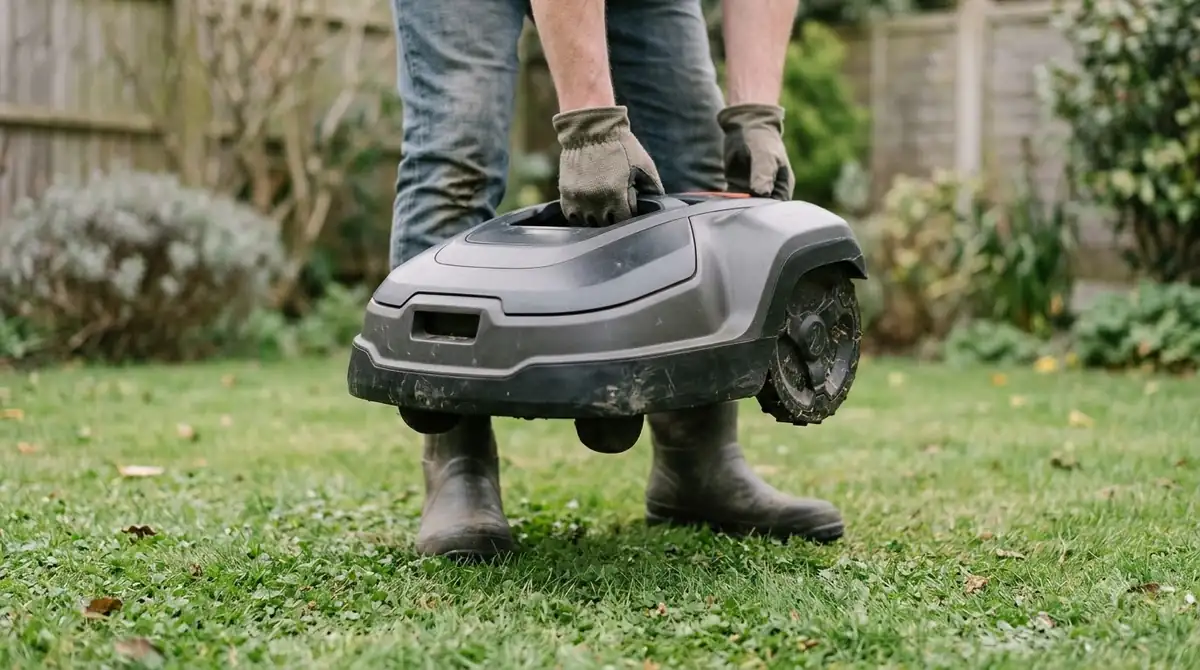
The mower body is the part you may have to lift, for example to clean the underside, swap a blade, or move it off the lawn. Family Handyman makes the point that a wide cutting base adds weight, and that a lighter body is easier to handle. In its list, the WORX WR165 is the example it gives, at 21 pounds, for a small yard.
| Check | Why it matters for limited mobility | Where to look |
|---|---|---|
| Body weight | Lighter bodies are easier to lift for cleaning and blade work | Spec sheet, weight line |
| Cutting base width | Wider bases add weight, per Family Handyman | Dimensions on the spec sheet |
| Lawn size | Matching the rated acreage to your yard is our reading of the size tables below | Rated acreage on the spec sheet |
Husqvarna’s own lawn-size table lists the Automower 410 iQ at 0.5 acre, the 420 iQ at 1 acre, the 435 iQ AWD at about 1.3 acres, and the 440 iQ at 2 acres, each with a plus or minus 20 percent margin. Our reading is that a mower rated for your lawn size is the safer starting point, because it does not have to run past its rated area.
Lift-stop behaviour also matters for safety when you pick up the mower. Anker/eufy says many models stop the blades when lifted or tipped, but not all of them, so check the manual for each model you consider. Husqvarna’s safety Q&A page does not describe blade behaviour when lifted.
Setup effort: wired versus wire-free
Setup is the step most likely to need kneeling, digging or long periods of standing. A wired mower needs a boundary wire around the lawn. lawnmowers.com says burying the wire takes an afternoon with a lawn edger or a wire-laying machine, at a depth of two to five centimeters. Surface-laid wire can be pinned down with plastic stakes placed every 50 to 80 centimeters, and the grass grows over it within three to four weeks.
Wire-free models use satellite positioning, cameras or sensors to set a virtual boundary, which removes the trench. lawnmowers.com says they eliminate the installation afternoon, but notes that the premium models cost 30 to 50 percent more than wired ones. They also need a clear view of the sky at the base station, and they can struggle under heavy tree cover.
Mammotion, a wire-free maker, rates wired installation as labor-intensive and wire-free setup as low to moderate. Read that as the vendor’s view. Its page also describes a hybrid option, with short sections of wire for flower beds, ponds and steep slopes.
For a homeowner who cannot easily kneel or dig, a wire-free model usually means fewer hours of setup. Ask whether a dealer will install the mower, because some dealers do the wire-laying for you.
Control: app, buttons and voice
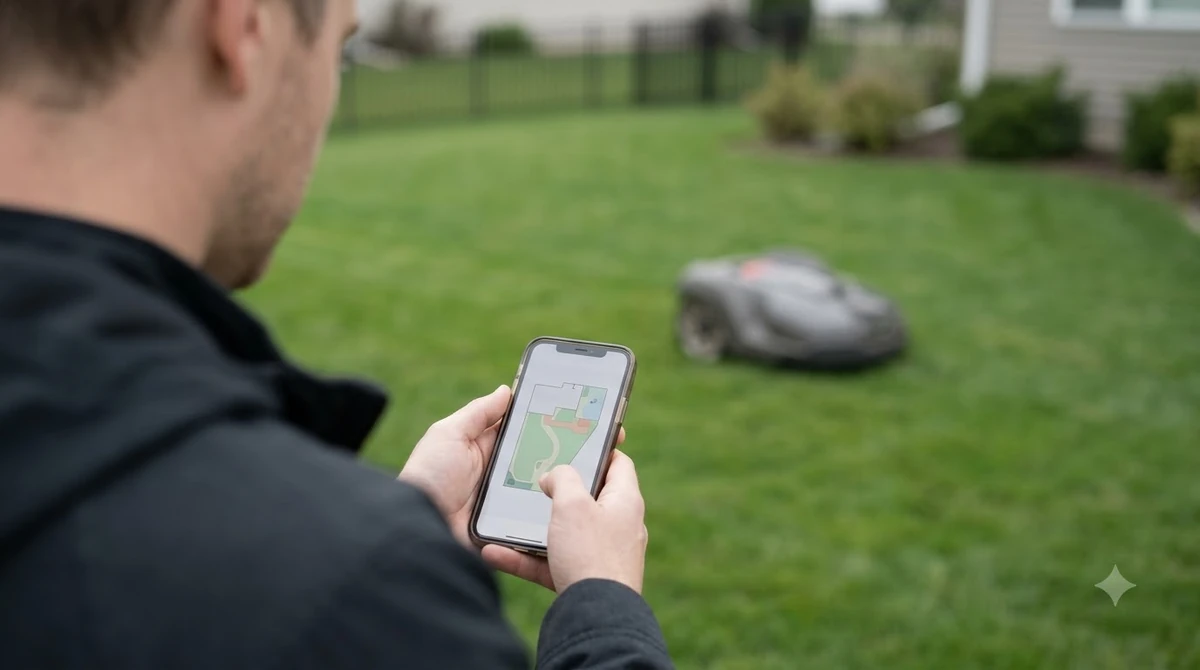
Most robot mowers can be run from a phone. Husqvarna’s Automower Connect app connects the mower to a smartphone, and the company says voice control is available. Its product page does not say whether the app is required, so ask the dealer whether the mower can be started and stopped from its own control panel without a phone.
Family Handyman’s accessible list notes that an app lets you control the mower without pushing or driving it. That is the main gain for a homeowner who cannot walk the lawn. Check the stop button and the app’s reach across the yard before you buy.
Slopes and uneven ground
Slopes are a limit in two ways: the mower has to climb them, and you may need to avoid them yourself. Husqvarna rates the 435 iQ AWD for slopes up to 70 percent, while its standard models are rated 25 to 50 percent. In the AWD guidance, the 50 to 70 percent zone is marked as one where the mower avoids obstacles.
The rating is a ceiling, not a daily target. Eufy’s retailer blog says the maximum slope is an absolute limit, and that running near it strains the motor and drains the battery. It also warns that wet grass reduces tyre grip, so a slope inside the rating can still cause slides. Our reading is that a lawn with gentle slopes is a much better match for a homeowner with limited mobility than a steep one, because you will not want to walk or climb to rescue the mower.
Lawn size and model match
Choose the mower by lawn size first. A mower that is too small runs for long periods, and a mower that is too large costs more without giving you more help. Check the acreage rating and the boundary type in the spec sheet. Husqvarna’s product page lists some models, such as the 435X AWD, with only one boundary type, so the boundary type you need may narrow the choice.
When a riding or zero-turn mower may fit better
A robot is not the only option. Family Handyman says riding mowers make mowing much easier for someone with mobility issues, because no walking or pushing is involved. It notes that zero-turn mowers with joystick steering need only one hand, and that some have no foot controls. Those machines are larger and more expensive, and they need storage and a way to get on and off, so the trade-off is space and cost rather than handling.
If you have a small yard and mainly struggle with pushing a mower, a robot is likely the better fit. If you have a large yard, steep slopes or a hard time getting on and off a seat, look at a riding model instead.
Checklist: the best robot lawn mower for homeowners with limited mobility
Use this short list when you compare models:
- Weight and base width. Find the body weight on the spec sheet and ask how often the blades need changing.
- Boundary type. Choose wire-free if you cannot kneel or dig; check whether a dealer will install it.
- Lift and tilt stop. Confirm in the manual that the blades stop when the mower is lifted or tipped.
- Phone-free operation. Confirm the stop button and basic start function work without the app.
- Slope rating and lawn size. Match both to your yard, and keep a margin below the maximum slope.
Frequently asked questions
Is a robot lawn mower easy to lift for someone with limited strength?
It depends on the model. Family Handyman lists the WORX WR165 at 21 pounds and warns that wider cutting bases are harder to lift. Check the body weight on the spec sheet before you buy.
Do I need a smartphone to run a robot mower?
Husqvarna’s Automower Connect app connects the mower to a smartphone, but the company does not say the app is required. Confirm with the dealer that the stop button and basic start function work without a phone.
Can someone else install the boundary wire for me?
Often yes. lawnmowers.com says dealers often rent wire-laying machines, and that a wire-free model removes the trenching step. Ask the seller whether installation is included before you buy.
Do robot mowers stop when they are lifted?
Many do, according to Anker/eufy, but not all models do. Check the manual for the model you are considering, because the safety information from manufacturers varies.
Sources
- Husqvarna robotic mowers (manufacturer): slope rating for the 435 iQ AWD, lawn-size table, Automower Connect app.
- Husqvarna support: steep-slope installation (manufacturer): standard and AWD slope ratings.
- Robotic Lawn Mower Boundary Wires: Setup Guide for 2026 (lawnmowers.com, no named author): wire depth, stake spacing, installation time.
- Family Handyman: best accessible lawn mowers (Dan Stout, updated June 4, 2025): WORX WR165 weight, riding and zero-turn mowers.
- Mammotion: do robot lawn mowers need a boundary wire (vendor, favors wire-free): installation effort and hybrid setups.
- Anker/eufy: are robot lawn mowers safe (manufacturer): lift and tilt stop, varies by model.
- Eufy: robot lawn mower slope limits (retailer blog): slope rating is an absolute limit; wet grass reduces grip.
- Husqvarna: robotic mower safety Q&A (manufacturer): blade behaviour when lifted not described.
 Up next10 min readBest Robot MowersBest Robot Lawn Mower for First-Time Homeowners: What to Check Before You BuyUpdated Nov 10, 2026
 10 min readBest Robot MowersBest Robot Mower Christmas Gift for Homeowners: 5 Key ChecksUpdated Nov 11, 2026
 6 min readBest Robot MowersBest Budget Robot Lawn Mower That Actually Works: What to CheckUpdated Nov 11, 2026
 7 min readBest Robot MowersBest Robot Lawn Mower for Pets and Kids: What to Check on SafetyUpdated Nov 10, 2026
 8 min readBest Robot MowersBest RTK Robot Lawn Mower for Suburban Yards: What to Check Before You BuyUpdated Nov 11, 2026
 8 min readBest Robot MowersBest LiDAR Robot Lawn Mower With No RTK Antenna: What to CheckUpdated Nov 11, 2026