

Looking for the best lidar robot lawn mower no rtk antenna means checking how the mower finds its position, not only whether it has a laser sensor. Some LiDAR models use no satellite antenna at all, while others add a cellular correction service instead of a base station. The spec sheet tells you which one you are buying.
The short answer
- LiDAR maps the lawn with laser pulses, so positioning does not rely only on satellites.
- No antenna does not always mean no correction signal. Some models use a network service called NetRTK.
- Weak spot: fog, heavy rain and water on the sensor can scatter laser pulses, and many models return to the charger in poor weather.
- Before you buy: check the positioning method, any service fee, the slope rating and the coverage figure against your own yard.
Best lidar robot lawn mower no rtk antenna: what the label means
Mowers without an external antenna fall into two groups. The first uses LiDAR and vision cameras without any satellite correction hardware. The second uses LiDAR together with a cellular correction service that replaces the base station. Both are sold as antenna-free, so the label alone does not tell you which system you get.
The ANTHBOT M5 is an example of the first group. An independent review describes it as using 360-degree LiDAR and a dual vision camera, with no RTK station and no perimeter wire. The reviewer calls it a “drop and mow” design. The Mammotion LUBA mini AWD is an example of the second group. Its vendor page describes a tri-fusion system that combines LiDAR, NetRTK and AI vision, and says no base station or antenna is needed because corrections come from the iNavi service.
Our reading is that the correction service is the detail most buyers miss when they search for a lidar robot lawn mower no rtk antenna. The vendor says that service is free for the life of the mower, but a free service is a claim you should confirm in writing before you buy. Some brands also keep an antenna on higher-end models, so check each model rather than the brand.
How a LiDAR mower finds its way without satellites
A LiDAR mower builds a map by scanning its surroundings with laser pulses, so it does not need satellites to know where it is. The sensor sits on top of the unit and rotates through 360 degrees. Setup usually starts with a guided mapping pass, in which the mower follows the lawn edge or is pushed around the perimeter in manual mode.
The Mammotion LUBA mini AWD lists a 144-beam LiDAR with a 70-meter detection range and up to 200,000 points per second. The vendor says you can map boundaries by guiding the mower by hand or by letting it follow the edges, store up to 10 maps in the cloud, and manage up to 20 zones, including no-go areas. It also states that there are no buried wires.
Research on LiDAR accuracy is mostly vendor-led. The RESIDENT article describes LiDAR mapping as accurate to the centimeter, a figure the article presents as its own claim rather than a test result. Treat it as a direction, not a measured error.
Where LiDAR is weaker than you might expect
Weather is the best-documented weak spot for any best lidar robot lawn mower no rtk antenna. Fog, heavy rain and water on the sensor can scatter the laser pulses, and Anker’s guide to LiDAR mowers says navigation may become less accurate in poor weather. It adds that many models return to the charging station until conditions improve. Ecovacs makes the same point about fog and heavy rain in its comparison of RTK and LiDAR.
Maintenance is the other practical issue. The Anker guide notes that sensors may need cleaning after rain, mud or dust. Very open lawns with few fixed reference points can also give the mower less to map, which is the opposite of the tree-covered yards where LiDAR is usually recommended.
Heads up
The sources we read do not say how LiDAR handles dark or non-reflective surfaces. Ask the maker directly before assuming it works on black mulch, dark pavers or similar areas.
Slope, coverage and drive layout
For a lidar robot lawn mower no rtk antenna, slope rating and drive layout decide whether the mower can finish a hilly yard, and a listed coverage area is only an upper limit. Anker’s guide says common robot mowers handle about 25 to 35 percent, while AWD models handle about 45 to 80 percent. Those are general ranges, not the rating of any one model.
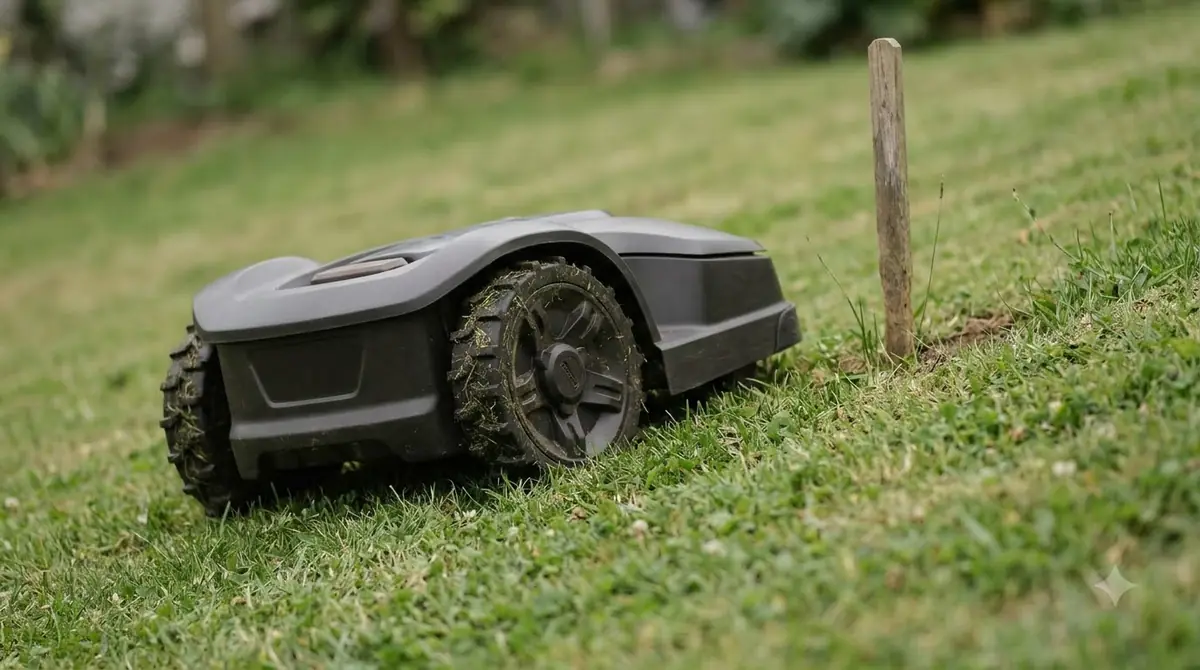
The ANTHBOT M5 review lists a 45 percent incline, about 24 degrees, and a coverage figure of 500 square meters, or one-eighth of an acre. The reviewer also notes that the M5 has no four-wheel drive, which may matter on bumpy ground or around tree roots. The Mammotion LUBA mini AWD vendor page lists an 80 percent (38.6 degree) slope rating, coverage of 1,500 square meters and up to 250 square meters per charge.
Our reading is that the per-charge figure matters more than the listed coverage for a large lawn, because a mower that stops to recharge takes longer to finish. Convert your lawn size to square meters before you compare any two listings.
LiDAR without an antenna compared with RTK
Both approaches trade setup effort against what your yard blocks, so the right pick depends on your trees, fences and open sky. The table below sums up the main differences found in the sources we read.
| Factor | LiDAR with no external antenna | RTK with a base station |
|---|---|---|
| Satellite dependence | Laser-based positioning, described as self-contained | Depends on satellite signal and loses accuracy when signal weakens |
| Under trees | Ecovacs says LiDAR is unaffected by shade or structures | Multipath error under canopy, per the RESIDENT article |
| Setup | No base station and no placement rules, per Ecovacs | Base station in an open, unobstructed area, plus calibration |
| Weather | Fog and heavy rain scatter laser pulses | Not covered by the sources we read |
| Typical price | Generally more expensive, per Anker | Generally less expensive, per Anker |
The table shows a trade rather than a winner. A best lidar robot lawn mower no rtk antenna buys you independence from satellites, not immunity to weather. LiDAR asks you to accept weather limits and more maintenance in exchange for skipping a base station and satellite placement. RTK asks you to find open sky for the base and accept signal loss under cover.
What to check before you buy a lidar robot lawn mower no rtk antenna
Confirm the positioning method on the spec sheet, then check service fees, slope and area before you compare prices. The steps below cover what the sources we read say to look for.
- Positioning method. Find whether the model lists an antenna, NetRTK, vision or LiDAR alone. The word “antenna-free” on a box is not enough.
- Correction service. Ask whether network corrections cost anything after the first period. The vendor for LUBA mini AWD says its service is free for the life of the mower, while the ANTHBOT M5 reviewer notes that 4G remote access costs extra after a limited period.
- Slope in your units. Convert a percent rating to degrees, since a 45 percent grade is about 24 degrees, and compare it with the steepest part of your yard.
- Coverage with margin. Measure your lawn in square meters, then leave room for beds and paths. Check the per-charge figure as well as the total area.
- Weather rating. The ANTHBOT M5 review lists an IPX6 rating and advises against pressure washers. Ask the maker how the mower behaves in rain.
Frequently asked questions
Does a LiDAR robot mower need an RTK antenna?
Not always. LiDAR positioning uses laser scanning, and some models add a network correction service instead of an external antenna and base station. Check the spec sheet for the exact positioning method, because the word “antenna” can be missing from a model that still uses satellite corrections.
Does LiDAR work under trees?
Ecovacs says LiDAR is unaffected by shade or structures, while the RESIDENT article says satellite navigation suffers multipath errors under tree canopy. Dense canopy still affects how much the map captures, so ask the maker for real-world results under the same kind of trees you have.
Does rain affect a LiDAR mower?
Yes, heavy rain, fog and water on the sensor can scatter laser pulses. Anker says many models return to the charging station until conditions improve, and sensors may need cleaning after rain, mud or dust.
Do I need a boundary wire with a LiDAR mower?
Usually not. The Mammotion LUBA mini AWD vendor page says it has no buried wires and maps the boundary by guiding the mower or letting it follow the lawn edge. Some other models still use wire, so check the setup method before you buy.
Sources
- Mammotion LUBA mini AWD LiDAR page (manufacturer): LiDAR specs, NetRTK positioning, slope and coverage claims.
- Anker, LiDAR Robot Lawn Mower: Benefits, Limits, and Alternatives (manufacturer guide): weather effects, maintenance, typical slope ranges, price comparison.
- Ecovacs, RTK vs. LiDAR Robot Lawn Mowers (manufacturer blog): base station placement, RTK signal loss, LiDAR weather limits.
- RESIDENT, LiDAR in Robot Lawn Mowers: What It Is and Why It Matters (magazine contributor article): LiDAR mapping process and RTK multipath under canopy.
- Easy Lawn Mowing, ANTHBOT M5 LiDAR review (independent review site): ANTHBOT M5 navigation, slope, area, IPX6 rating and drawbacks.
 Up next10 min readBest Robot MowersRobot Mower No RTK Antenna: How Navigation Works Without OneUpdated Nov 16, 2026
 8 min readBest Robot MowersRTK vs LiDAR vs Vision: Which Robot Mower Navigation Fits Your YardUpdated Nov 11, 2026
 8 min readBest Robot MowersBest Robot Mower With No Subscription Fee: What to Check Before You BuyUpdated Nov 11, 2026
 10 min readBest Robot MowersBest No Base Station Robot Lawn Mower 2026: What to Check Before You BuyUpdated Nov 13, 2026
 8 min readBest Robot MowersBest LiDAR Robot Lawn Mower 2026: What to Check Before You BuyUpdated Nov 13, 2026
 8 min readBest Robot MowersBest RTK Robot Lawn Mower for Suburban Yards: What to Check Before You BuyUpdated Nov 11, 2026