
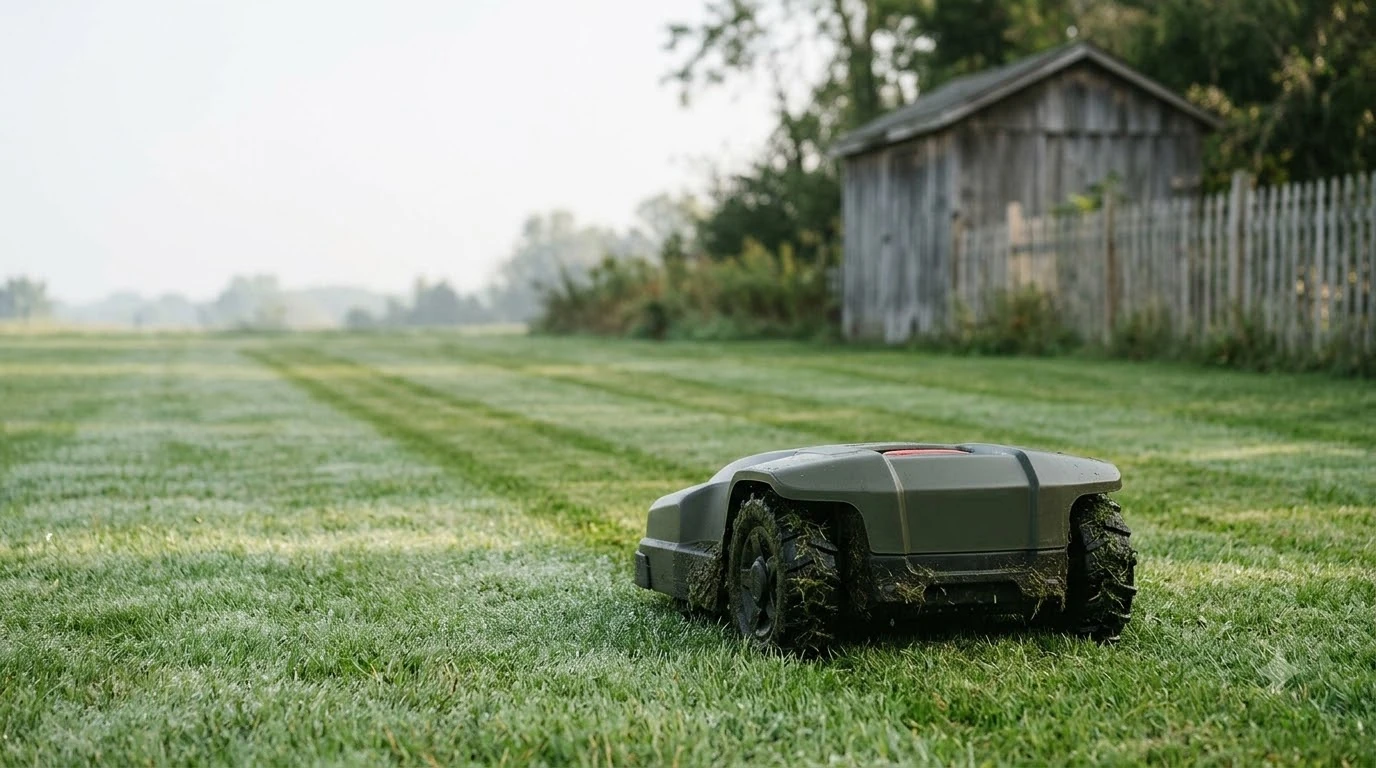

A robot mower no RTK antenna still has to know where it is, and it does this in one of three ways: network correction (NetRTK), cameras, or LiDAR. Each route replaces the base station and open-sky antenna that classic RTK needs, and each one trades setup effort for a different weak spot, such as cellular coverage, lighting, or open lawns with few landmarks.
The short answer
- NetRTK: the mower gets correction data over 4G or Wi-Fi, so no base station is needed, but accuracy depends on cellular coverage.
- Vision: cameras read fences, walls and trees to cover gaps in satellite signal, and most of the claims for this route come from vendors.
- LiDAR: laser scanning works without satellites and in darkness, but fog, heavy rain and featureless open lawns are the weak spots.
- Most current models combine two or three of these, so the spec sheet matters more than the word “antenna.”
What a robot mower no RTK antenna usually means
A robot mower no RTK antenna is one with no external satellite antenna and no on-site base station. Classic RTK places a reference station in an open area to correct GPS errors (see what an RTK base station is). Ecovacs describes that setup as needing a base station “in an open, unobstructed area,” and warns that “incorrect setup reduces positioning precision.” (Ecovacs’s RTK vs LiDAR comparison)
Removing the station removes the installation step, but it does not remove the need for position data. The mower still needs a correction source or a map built from its own sensors. Those two options are the basis of every route below, and the next sections explain how each one behaves when conditions get hard.
Route 1: NetRTK over 4G or Wi-Fi
For a robot mower no RTK antenna, NetRTK replaces the local base station with correction data from a network of reference stations, delivered over the internet. Mammotion describes its version as a network of reference stations with cloud-based error modelling, and its own comparison table lists accuracy of 1 to 3 cm. Treat that figure as the vendor’s claim, since it comes from marketing material. For the buying checklist, see RTK network service for a robot mower without a base station.
Mammotion’s product page for the LUBA mini AWD LiDAR says its service runs through iNavi with “No Antenna Required” and “No RTK Base,” and lists the cost as “Free for the Entire Product Lifetime.” (Mammotion’s LUBA mini AWD LiDAR page) Navimow makes a similar claim, calling its Network RTK “completely free for consumer users” on its own blog.
Independent testing is more cautious. Notebookcheck’s comparison of a local-RTK model with a LiDAR model says the NetRTK route is “not quite as precise” as a local base station. Pages we read also disagree on whether 4G correction will carry a charge after 2026, so confirm current terms with the seller before you count on a free service.
The main limit is the connection itself. Mammotion’s own guide says, “NetRTK stability is tied to cellular coverage. In areas with weak 4G/5G signal, performance can be intermittent.” Its FAQ adds that mowers “often automatically switch” to other positioning when cellular drops, “maintaining positional stability for several minutes until the signal is regained.” Our reading is that a far corner with weak signal needs a fallback that works for longer than a few minutes, so check coverage where the mower will actually sit. If the signal keeps dropping, why a robot mower keeps losing RTK signal lists the usual causes.
Route 2: vision as the backup sensor
Camera-based systems on a robot mower no RTK antenna read landmarks such as fences, walls and trees, and vendors use them as a backup when satellite signal weakens. Navimow says its X4 uses a “three-camera 360° panoramic vision system” for spots such as “a dense oak tree or alongside a tall stone wall,” and claims that “vision has a longer effective range than LiDAR.” Both statements come from the vendor, and the article we read gave no test figures for them.
Mammotion describes its LUBA 3 AWD as combining LiDAR, NetRTK and dual-camera vision, and says that “when the RTK signal weakens, Vision and LiDAR seamlessly take over positioning stability.” The page gives no time limit for that handover, so ask how long the fallback lasts before you rely on it under heavy canopy.
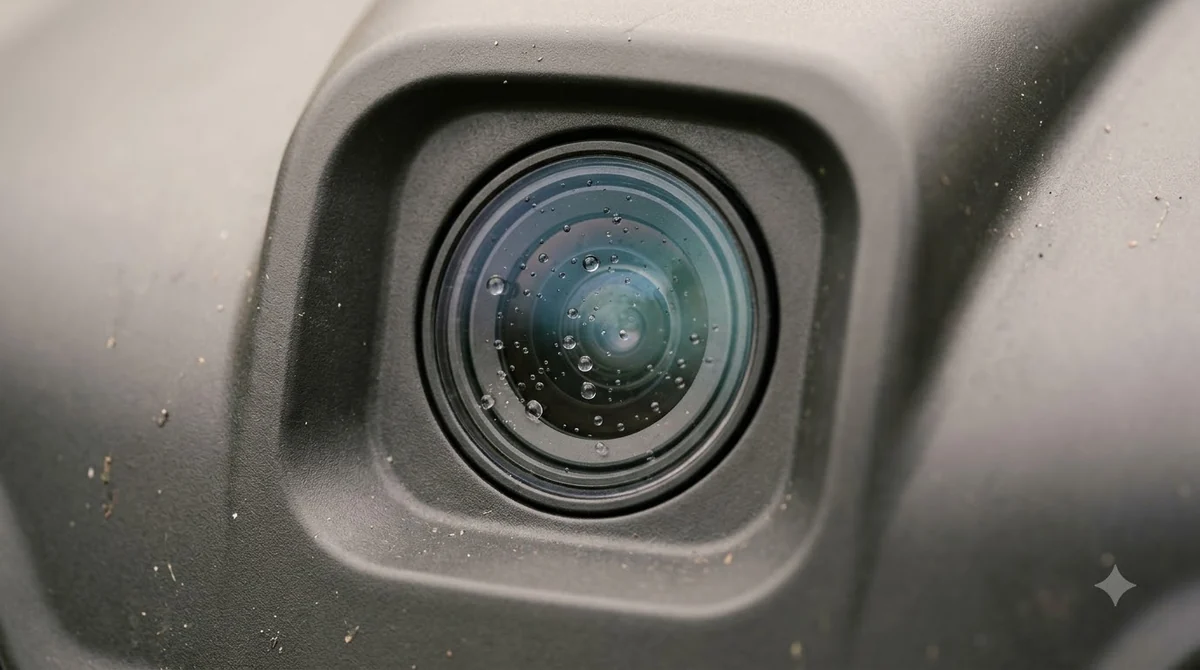
Lighting is the open question for cameras. Navimow says its AI handles shadows, glare and low sun angles “more robustly than standard vision systems,” which is again a vendor claim. Our reading is that a camera backup on a robot mower no RTK antenna model works best where the yard has fixed features to read. On a bare open lawn it has fewer reference points, and that limit applies to LiDAR too.

Route 3: LiDAR without satellites
LiDAR lets a robot mower no RTK antenna build a map from laser returns, so it does not need satellite signal to know where the mower is (more in how LiDAR robot mowers navigate). Mammotion lists the LUBA mini AWD LiDAR with a 144-beam solid-state sensor, a 70 m detection range and up to 200,000 points per second, along with an 80% (38.6 degree) slope claim. Those specs are the manufacturer’s.
For a robot mower no RTK antenna built on LiDAR, Ecovacs describes it as “unaffected by shade or structures” and says it “performs reliably even in complete darkness.” It also lists a drawback: fog and heavy rain “may scatter and absorb laser beams, impacting laser performance.” That is the main weather limit to ask about before you buy.
One independent review of a robot mower no RTK antenna gives a fuller picture. Notebookcheck says the LUBA mini AWD LiDAR “is completely independent of external factors” and “scored full marks” on obstacle detection. In the same test it climbed “up to a remarkable 65 percent incline,” below the 80% rating, and it used more energy than the RTK model. The review also notes that only a 1,500 m2 version exists and that it is not currently sold in the USA.
Side-by-side: how the three routes compare
No single route suits every robot mower no RTK antenna buyer. Each one fails in a different part of the yard, which is why the table below is organized by what each route depends on rather than by brand.
| Route | Depends on | Where it struggles (as reported) | Setup |
|---|---|---|---|
| NetRTK (4G or Wi-Fi) | Cellular or Wi-Fi coverage at the mower | Weak signal makes accuracy intermittent (Mammotion guide) | App and account; check fees |
| Vision (cameras) | Lighting and fixed landmarks | Bare open lawns with few features (Navimow); lighting claims are vendor-stated | App setup and mapping pass |
| LiDAR | Clear laser returns | Fog and heavy rain (Ecovacs); featureless open lawns (Navimow) | Mapping pass, no base station |
| Local RTK (for comparison) | Open sky over the base station | Trees, buildings and tall structures (Ecovacs) | Base station placement and calibration |
The table shows why the word “antenna” can mislead. A robot mower no RTK antenna still depends on something outside its own sensors, whether that is a cellular link, the light, or the landmarks in the yard. Our reading is that the real question is what the mower does when its main signal drops.
Why the base station is the part you avoid
The base station is the piece that a robot mower no RTK antenna design removes, and it is also the piece that most often needs careful placement. Ecovacs says RTK mowers “need to set up a base station in an open, unobstructed area,” and that RTK “may lose precision near tall structures.” In a yard with large trees or a house close to the lawn, that placement can be hard to get right.
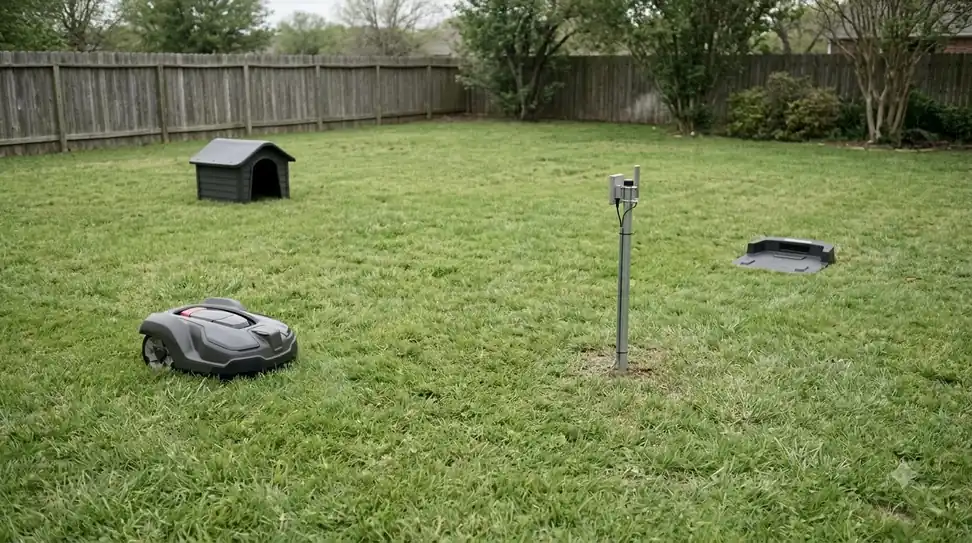
Dropping the base station trades placement work for dependence on the network or on onboard sensors. Mammotion’s guide says RTK satellite signals “can be blocked by trees, clouds, or tall structures,” which is the same limit that pushes vendors to add the other routes. Whether that trade suits you depends on your own trees, buildings and cellular signal.
What to check before you buy
Confirm which routes a robot mower no RTK antenna model uses, what its correction service costs, and whether your yard has the signal and sky view those routes need.
- Read the positioning line. Look for NetRTK, vision or LiDAR by name, not only the marketing phrase “robot mower no RTK antenna.”
- Check cellular or Wi-Fi coverage at the far corners of the lawn, since NetRTK performance depends on it.
- Ask about the correction fee and its term. Confirm current terms in writing, because the pages we read disagree on charges after 2026.
- Ask how long the fallback lasts when correction drops. Mammotion’s FAQ says “several minutes,” and the vision handover time is not published.
- Treat slope and area claims as vendor figures. The 80% and 1,500 m2 numbers are claims, and the one independent test we read recorded a lower incline.
- Ask for a weather rating. The Mammotion page we read gives “Any Weather” with no IP code, so ask a robot mower no RTK antenna seller for a formal rating before you buy.
Frequently asked questions
Does a robot mower no RTK antenna need internet?
Not always. A robot mower no RTK antenna that uses NetRTK needs a 4G or Wi-Fi connection to receive correction data, according to Mammotion’s guide. Notebookcheck described the LUBA mini AWD LiDAR as independent of external factors in its test, so a LiDAR-only model does not depend on the network for positioning.
Does a robot mower no RTK antenna work under trees?
Vendors say yes. Mammotion claims its LUBA 3 AWD can operate beneath tree canopies using LiDAR, NetRTK and vision together. That is a vendor claim. Ecovacs says RTK accuracy can drop under dense trees and buildings, so ask which routes the model uses in heavy canopy. For yards with heavy canopy, see robot mowers that work under trees without RTK.
Does rain affect a robot mower no RTK antenna with LiDAR?
Ecovacs says fog and heavy rain “may scatter and absorb laser beams, impacting laser performance.” The pages we read do not give a measured rain limit for any specific model, so ask the seller how the model handles wet weather.
Is a boundary wire needed with a no-antenna mower?
Often not, but it depends on the model. Mammotion’s LUBA mini AWD LiDAR page lists “No buried wires. No base stations.” among its selling points, which is a vendor claim for that one model. For any other robot mower no RTK antenna model, confirm in the manual whether a perimeter wire is needed before you assume the lawn can go without one.
Sources
- Mammotion LUBA mini AWD LiDAR page (manufacturer): NetRTK via iNavi, service cost, LiDAR and slope claims.
- Mammotion NetRTK guide (manufacturer): cellular dependence, fallback claims, accuracy table.
- Navimow blog on NRTK and 360 vision (manufacturer): NRTK fee claim, vision backup, LiDAR limits in featureless areas.
- Notebookcheck RTK vs LiDAR review (independent): NetRTK precision, LiDAR test results, availability.
- Ecovacs RTK vs LiDAR article (manufacturer): base station placement, RTK and LiDAR limits.
 Up next8 min readBest Robot MowersBest LiDAR Robot Lawn Mower With No RTK Antenna: What to CheckUpdated Nov 11, 2026
 10 min readBest Robot MowersHow to Choose the Best Robot Lawn Mower with Dual-Band RTK and SLAM NavigationUpdated Nov 19, 2026
 8 min readBest Robot MowersRTK vs LiDAR vs Vision: Which Robot Mower Navigation Fits Your YardUpdated Nov 11, 2026
 8 min readBest Robot MowersHow Does RTK Work on a Robot Lawn Mower?Updated Nov 11, 2026
 9 min readBest Robot MowersBest Robot Lawn Mower Without Perimeter Wire: How to Choose in 2026Updated Nov 16, 2026
 8 min readBest Robot MowersBest Robot Lawn Mower Without Perimeter Wire: How to Choose in 2026Updated Nov 16, 2026