
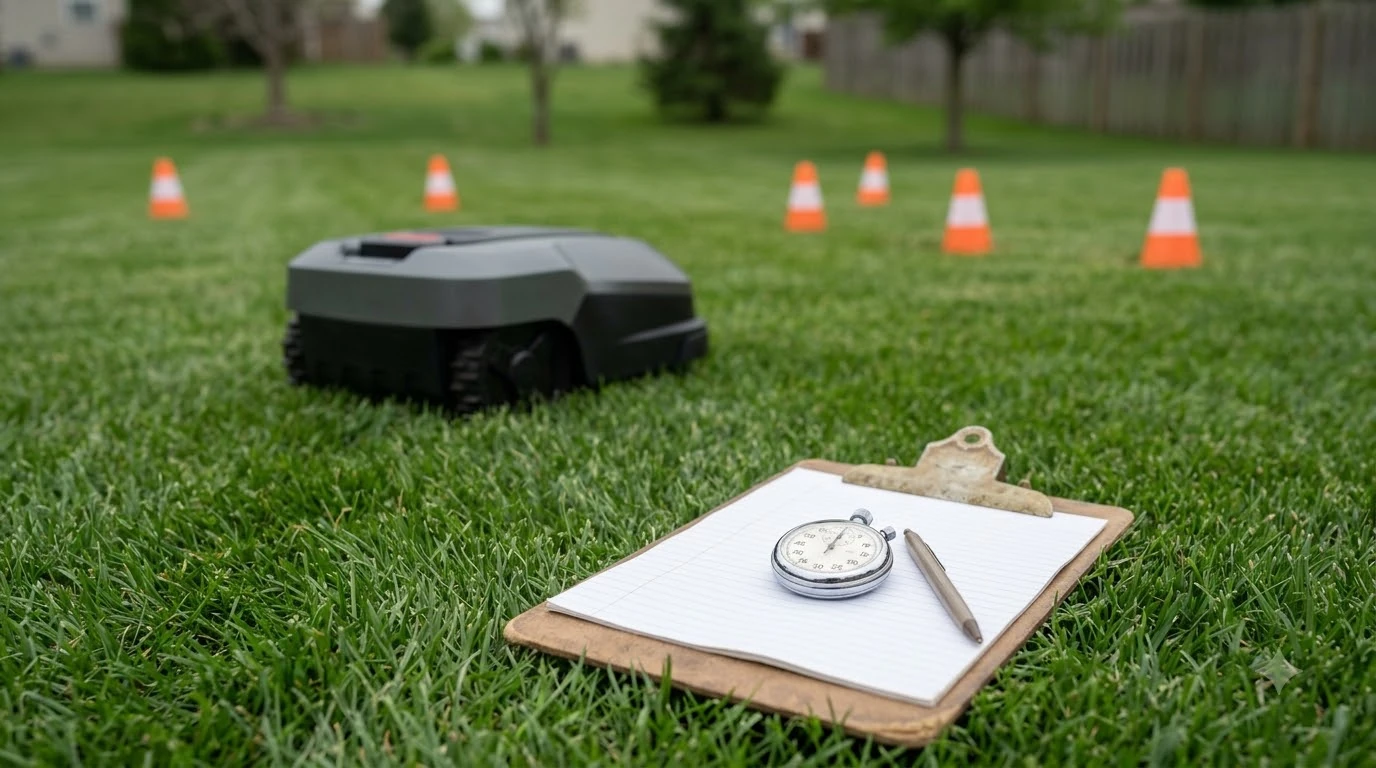

Choosing the best robot lawn mower with dual-band rtk and slam navigation means matching multi-frequency satellite receivers and onboard spatial sensors to the exact tree cover, corridor width, and terrain of your yard. Rather than burying hundreds of feet of perimeter cable, these wire-free machines fuse centimeter-level satellite corrections with camera or laser mapping to cut in straight, repeatable stripes. Understanding how dual-band frequency tracking, sensor fallback, and correction delivery work together ensures you pick a system that holds its boundary without stalling under shade.
The short answer
- Dual-band GNSS hardware: Look for receivers tracking L1 plus L2 or L5 frequencies across multiple constellations (GPS, Galileo, GLONASS, and BeiDou) to resolve satellite fixes faster and reject signal reflections near walls.
- SLAM sensor pairing: Visual SLAM (stereo or mono cameras) excels at identifying grass borders and soft objects, while 3D LiDAR SLAM maintains spatial positioning in low light and under dense tree canopies.
- Correction delivery method: Decide between a local reference antenna (no ongoing data fees, requires clear sky mounting) or cloud-based Network RTK (no yard antenna, requires reliable 4G or Wi-Fi coverage).
- Inertial fallback: Verify that the fusion stack includes an IMU and wheel odometry to bridge brief satellite and visual dropouts without drifting across flower beds.
- Terrain and deck specs: Match drivetrain type (2WD vs. AWD), slope rating, and motorized cutting-height range to your property’s steepest grade and turf species.
How dual-band RTK and SLAM work together
Combining dual-band Real-Time Kinematic positioning with Simultaneous Localization and Mapping creates a redundant localization architecture that pairs global coordinates with local environmental awareness.
Standard single-frequency GPS receivers suffer from atmospheric delays and multipath reflections when signals bounce off house siding or metal fences, which can push positioning errors to several feet. Dual-band receivers track two distinct satellite carrier frequencies simultaneously—typically L1 paired with L2 or L5—across global constellations including GPS, Galileo, GLONASS, and BeiDou. According to RTKdata’s wire-free mower accuracy guidance, an active RTK fix in open sky achieves roughly 1 to 2 centimeters of horizontal accuracy, giving the mower a fixed global coordinate frame for parallel row mowing.
Satellite signals alone cannot detect a garden hose, a low-hanging branch, or an unmapped patio chair, and satellite visibility drops whenever the chassis passes beneath heavy foliage or through narrow side yards. That is where SLAM takes over. As the mower moves, onboard cameras (Visual SLAM) or laser scanners (LiDAR SLAM) build a local spatial map of stationary landmarks such as tree trunks, fences, and curbing while continuously estimating the robot’s orientation. When satellite reception shifts from a locked RTK fix to a lower-precision float state, the sensor-fusion software weights SLAM and inertial measurement unit (IMU) data more heavily until clear sky returns.
Key navigation specifications to compare
Evaluating the underlying sensor stack helps separate true multi-sensor fusion platforms from basic satellite-only mowers that stall near buildings.
Start by checking how the system handles weak-signal transitions. Industry engineering guides, including Altverse’s navigation technology breakdown, emphasize that mature fusion architectures combine four distinct layers: global positioning (dual-band RTK), local perception (AI vision or LiDAR), short-term motion estimation (IMU plus wheel encoders), and dynamic confidence weighting. If a spec sheet lists RTK without an IMU or optical/laser odometry, the robot may pause immediately whenever tree cover blocks overhead satellites.
| Navigation Subsystem | Primary Role | Strengths in Residential Yards | Key Limitation to Check |
|---|---|---|---|
| Dual-band RTK (L1 + L2/L5) | Global coordinate lock and straight-line tracking | 1–2 cm open-sky accuracy; repeatable stripes across multi-acre plots | Degrades under dense tree canopy and tight eaves |
| Visual SLAM (Mono/Stereo AI) | Feature tracking, grass-edge detection, and object classification | Distinguishes turf from mulch beds; recognizes pets, toys, and hoses | Affected by harsh glare, deep shadows, lens dirt, and dusk lighting |
| 3D LiDAR SLAM | Laser distance mapping and 3D obstacle geometry | Unaffected by darkness or shadows; wide field of view up to 360 degrees | Does not provide absolute global coordinates on its own |
| IMU + Wheel Odometry | Continuous dead reckoning between sensor updates | Bridges brief signal drops around corners and shrubs | Accumulates positional drift if external fixes stay offline too long |
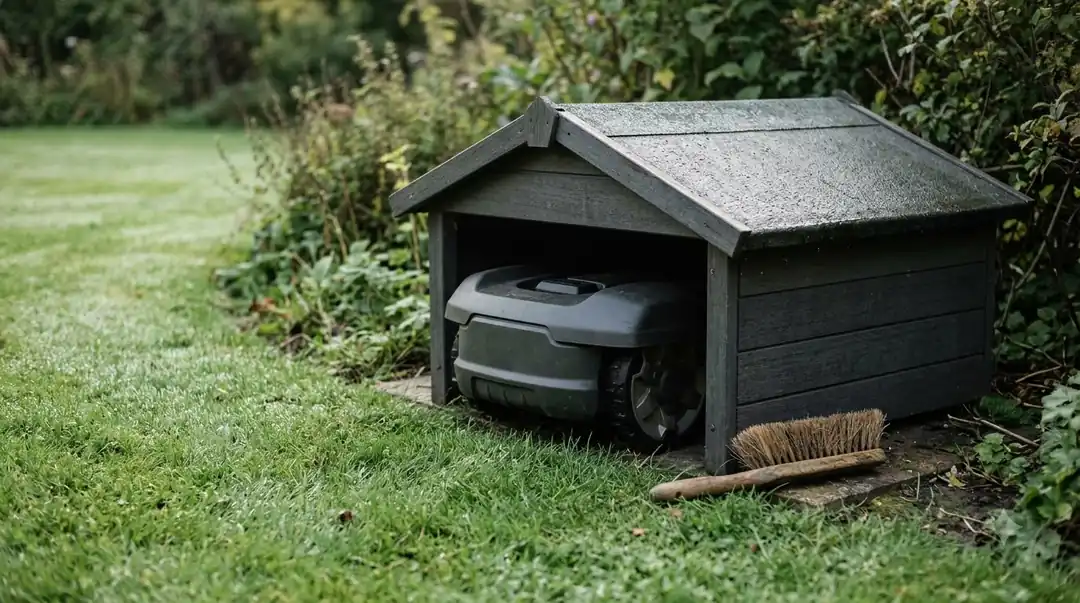
You should also verify the mower’s ingress protection rating and optical maintenance needs. Outdoor sensors endure wet grass clippings, morning dew, dust, and hose washdowns. Look for an IPX6 or IP67 waterproof rating alongside recessed or hydrophobic camera lenses and LiDAR windows that resist grass buildup.
Local base station vs. cloud Network RTK
Every RTK mower requires differential correction data from a known reference point, and manufacturers deliver those corrections through two distinct hardware architectures.
- Local RTK reference station: You mount a compact tripod or wall-bracket antenna on your property with an unobstructed view of the sky. The station broadcasts radio corrections directly to the mower without needing home Wi-Fi or cellular data across the lawn. However, if wind or maintenance shifts the antenna after mapping, every virtual boundary shifts with it, requiring a remap.
- Network RTK (NRTK / Cloud RTK): Platforms such as Kress EyePilot RTKⁿ and Worx Landroid Vision Cloud pull differential corrections over the internet from regional reference networks via 4G cellular or Wi-Fi. You never install a rooftop or yard antenna, and charging docks can sometimes sit under covered eaves. Before choosing an NRTK model, confirm regional reference-station coverage for your ZIP code and check whether cellular connectivity requires a paid subscription after an initial trial period.
Heads up
In yards bordered by pools, retaining walls, or public streets, never set a virtual RTK boundary flush with the drop-off. Even dual-band receivers can briefly enter an RTK float state near reflective walls or dense foliage, so leave a safety buffer of at least 8 to 12 inches along hard hazards and trim that strip manually.

Evaluating mowing hardware, slopes, and turf health
Precision guidance only pays off when the chassis and cutting deck can physically handle your yard’s grade, grass density, and layout.
According to the University of Florida IFAS Extension guide on autonomous mowers, robotic units maintain turf density through frequent micro-mulching with small, sharp pivoting razor blades rather than heavy rotary blades, reducing leaf tearing and soil compaction. To get that finish consistently across a real residential property, compare four mechanical specs:
- Drivetrain and slope rating: Standard two-wheel-drive models typically handle inclines up to 30% to 40% (roughly 17 to 22 degrees). Steep embankments, ditch banks, or wet clay slopes call for all-wheel-drive (AWD) chassis with articulating front axles or independent wheel motors rated for 70% to 84% grades (35 to 40 degrees).
- Cutting height range and adjustment: Warm-season grasses like Bermuda and Zoysia thrive between 0.8 and 2 inches, while cool-season tall fescue and Kentucky bluegrass often require 2.5 to 4 inches in summer. Check whether height adjustment is motorized through the app—allowing zone-by-zone height profiles—or adjusted manually via a physical dial on the deck.
- Corridor width and edge offset: If your front and back yards connect via a narrow gate or side path, verify the minimum passage width, which commonly starts around 24 inches (60 cm) for compact chassis. Offset cutting discs or side-mounted edge trimmers also minimize the uncut grass strip left beside fences and garden curbing.
- Safety certifications and anti-theft: Confirm compliance with the U.S. robotic mower safety standard ANSI/OPEI 60335-2-107, which governs blade-stop response times and obstacle detection. Look for lift and tilt sensors, PIN locks, 4G GPS tracking, and geofence alarms.
What to check before you buy
Walking your property with a tape measure and smartphone before ordering prevents the most common setup headaches with wire-free mowers.
- Measure total turf area and narrowest bottlenecks. Calculate square footage excluding driveways, patios, and mulch beds, then check that the mower’s 24-hour area rating exceeds your lawn size by at least 20% so it does not run continuously. Measure every gate and side yard to confirm it clears the manufacturer’s minimum corridor width.
- Audit overhead canopy and charging dock placement. Identify areas where mature trees overhang the lawn or where two-story walls flank a narrow alley. If your model relies on a local RTK antenna, locate a rigid mounting spot with an open sky view away from metal roofs and tall trees.
- Verify cellular, Wi-Fi, and NRTK coverage. Test cellular signal strength at the far corners of your yard if the mower uses 4G Network RTK, and check strong Wi-Fi availability near the charging dock for firmware and map updates.
- Check firmware policy, replacement blades, and warranty terms. Confirm whether the brand provides over-the-air software updates, keeps replacement razor blades and battery packs in stock in the United States, and covers both the chassis and battery under a clear multi-year warranty.
Frequently asked questions
How does dual-band RTK improve on single-band RTK for robot lawn mowers?
Dual-band RTK receivers track two satellite frequencies at once—such as L1 and L5 or L1 and L2—rather than relying solely on L1. Monitoring two bands allows the receiver to cancel out ionospheric signal distortion, lock onto an integer centimeter fix much faster after passing a house wall, and reject reflected multipath signals that cause single-band mowers to wander off line.
What happens when a dual-band RTK and SLAM mower goes under thick trees?
When foliage blocks satellite signals and pushes the receiver from a high-precision RTK fix into a float state, the sensor-fusion software shifts reliance to Visual SLAM or LiDAR SLAM alongside the internal IMU and wheel encoders. The mower tracks nearby tree trunks, fences, and turf edges to stay on its mapped path until it emerges into open sky and reacquires a full satellite lock.
Is Visual SLAM or LiDAR SLAM better alongside dual-band RTK?
Each pairing excels in different yard conditions. Visual SLAM uses cameras and AI recognition to distinguish grass borders from mulch beds and identify small objects like pet toys or hoses, though performance drops at dusk or in harsh glare. LiDAR SLAM maps 3D distances with laser pulses, so it works reliably in complete darkness and deep shade, though it does not recognize object types as semantically as a color camera.
Do dual-band RTK and SLAM mowers still require a buried boundary wire?
No buried perimeter wire is required. You create virtual boundaries, multi-zone transit paths, and no-go zones in the companion smartphone app—either by guiding the mower around the yard perimeter like a remote-control car or letting its vision and SLAM sensors auto-map clear lawn edges.
Sources
- Wire-free Robot Mower RTK Accuracy Guide for Precise Boundary (RTKdata): Referenced for horizontal RTK fix vs. float accuracy ranges, base station siting rules, and environmental multipath factors.
- Robot Lawn Mower Navigation Technologies: Complete Guide (Altverse): Referenced for multi-sensor fusion architecture layers, Visual SLAM vs. LiDAR SLAM trade-offs, and localization confidence weighting.
- Autonomous or Robotic Mower Use on Florida Lawns (EP667) (University of Florida IFAS Extension): Referenced for autonomous turfgrass cutting mechanics, systematic vs. random trajectory efficiency, and yard preparation considerations.
- LiDAR Requirements for Robotic Lawn Mowers (Orbbec): Referenced for 3D LiDAR field of view, outdoor ingress protection ratings, and U.S. ANSI/OPEI 60335-2-107 safety compliance.
 Up next10 min readBest Robot MowersRobot Mower No RTK Antenna: How Navigation Works Without OneUpdated Nov 16, 2026
 8 min readBest Robot MowersRTK vs LiDAR vs Vision: Which Robot Mower Navigation Fits Your YardUpdated Nov 11, 2026
 8 min readBest Robot MowersHow to Choose an RTK GPS Robot Lawn Mower in 2026Updated Nov 11, 2026
 8 min readBest Robot MowersBest Robot Lawn Mower with Dual Blades: What the Evidence ShowsUpdated Nov 12, 2026
 9 min readBest Robot MowersBest Satellite Navigation Robot Lawn Mower 2026: What to Check Before You BuyUpdated Nov 11, 2026
 7 min readBest Robot MowersWhich Satellite Navigation Robot Mower Is the Most Accurate?Updated Nov 13, 2026