
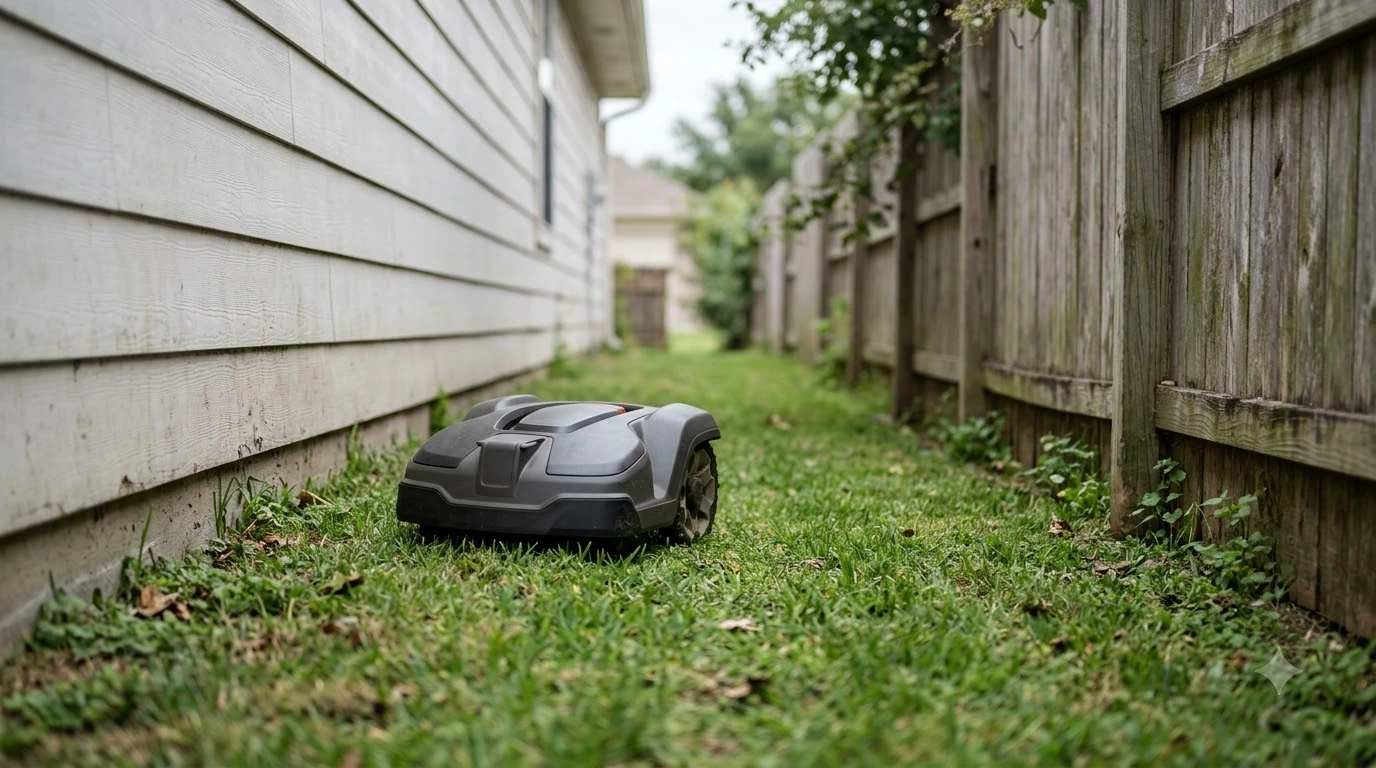

Do robot mowers work on very small lawns? Yes, and the layout usually matters more than the total area. Ecovacs states that robot lawn mowers “work well on small lawns,” and Robomow describes its compact models as ideal for lawns of 300 m² or less. Narrow passages, awkward boundaries and steep slopes are the usual reasons a small yard still causes trouble.
The short answer
- Do robot mowers work on very small lawns: yes. Makers that sell compact models say they suit small lawns, and no source we read sets a minimum yard size.
- Size bands: Dreame’s entry tier covers “small, flat lawns under 1,000m² (0.25 acres).”
- Passages: Husqvarna recommends 2 m (6 ft 6 in) between boundary wires for a passage without a guide wire, and 60 cm (24 in) with one.
- Check first: slope rating, blade quality and whether the mower uses boundary wire or is wire-free.
Do robot mowers work on very small lawns? Size bands by maker
Robot mower makers do not use one shared definition of a small lawn, so the answer depends on which brand’s band you read. The bands below show how far apart they are, and they are a good starting point before you compare specific models.
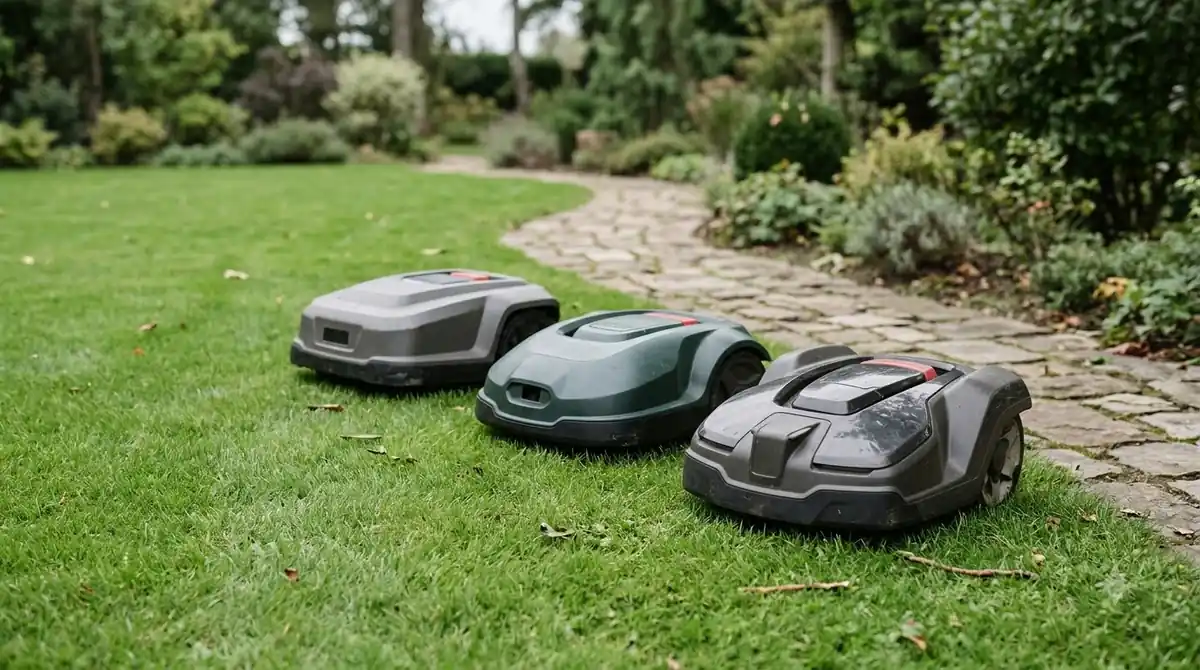
Ecovacs describes small lawns as ranging “from just 1,000 to 10,000 square feet,” and says the range varies by region. The same page puts the average US yard at about 23,301 square feet, which it calls just over half an acre. Robomow’s guidance is stricter: its compact models are described as ideal for lawns of 300 m² or less, which is about 3,229 square feet.
| Source | Stated size band | What it means for a small lawn |
|---|---|---|
| Robomow (blog) | Compact models ideal for lawns of 300 m² or less | Compact models are sized for very small lawns |
| Dreame (buying guide) | Entry tier: small, flat lawns under 1,000 m² (0.25 acres) | Entry-level mowers target small, flat yards |
| Ecovacs (blog, US) | Small lawns from 1,000 to 10,000 sq ft | The range varies by region, so local lawn sizes differ |
| Husqvarna (German page) | Small garden up to 800 to 1,000 m²; Aspire R4 rated up to 400 m² | Capacity figures assume 24-hour operation |
Two points stand out. First, the entry tiers from different makers overlap, so a lawn of a few hundred square meters falls into the entry range almost everywhere. Second, the Husqvarna capacities assume the mower runs around the clock. If you want to avoid mowing at night, the same page advises choosing a model with a larger capacity.
Why very small lawns suit robot mowers
Compact size is the main advantage on a small lawn. The mower covers the area quickly, and its body is narrow enough to reach tight corners without a large footprint.
- Cutting width: Robomow says a narrow cutting width of around 20 cm improves maneuverability in tight, winding gardens. It also notes that narrower widths lower output but leave fewer touch-ups in corners and edges.
- Turning room: Ecovacs lists its GOAT O1000 RTK at 15.7 inches wide and says it can turn in spaces “as tight as 2.3 feet.” That turning figure is from a lab result, and the page says real results vary with grass, lawn size and terrain.
- Battery: Robomow says the 4.3 Ah and 4.9 Ah batteries in its small robots are sufficient for small lawns.
- Time: small areas are mowed quickly, so a small lawn rarely pushes a mower past its runtime.
Runtime is worth checking with a formula rather than the headline number. Robomow suggests multiplying the manufacturer’s rated area by your planned weekly hours, then dividing by the operating time including charging. Obstacles, winding lawns and limited mowing hours all cut real output, so a small lawn usually leaves spare capacity, but a very tight schedule can still matter.
Where small lawns cause trouble
On a small lawn, passages, edges and slope usually cause more problems than total area. Several makers’ sources point to the same issues, so they are worth checking before the square footage.
Husqvarna’s US support page gives the passage figures most buyers need. Without a guide wire, the recommended minimum distance between boundary wires on each side of a passage is 2 m (6 ft 6 in). With a guide wire, the minimum is 60 cm (24 in), and the guide wire itself must sit at least 30 cm (12 in) from the boundary wire. A narrow gap between a bed and a fence may fall below these numbers even when the lawn is small.
Heads up
Robomow warns that many inexpensive robots for small areas “cut corners on the quality of the blades,” which can pluck grass and leave an uneven cut. Look for long-lasting, user-replaceable blades before you buy on price alone.
Edges are a separate issue. Robomow notes that on many small-area designs the blades sit between the drive wheels, so edges often need touch-up. Blades that extend beyond the wheelbase cut edges more fully.
Slope is the other factor. The Husqvarna German page gives a maximum slope capability of 40 percent for the Automower 305, and it advises checking each model’s rating against the steepest part of the garden. Ecovacs gives its GOAT O1000 RTK a climbing limit of 24 degrees. Degrees and percent are different units, so convert before you compare two models.
Boundary wire or wire-free on a small lawn
Boundary wire is harder to install in a small yard, but wire-free models have their own requirements. Ecovacs says that if you use boundary wires, setup “can be more difficult in smaller or awkwardly shaped areas.” Its wire-free models detect the boundary and map the lawn without physical wires.
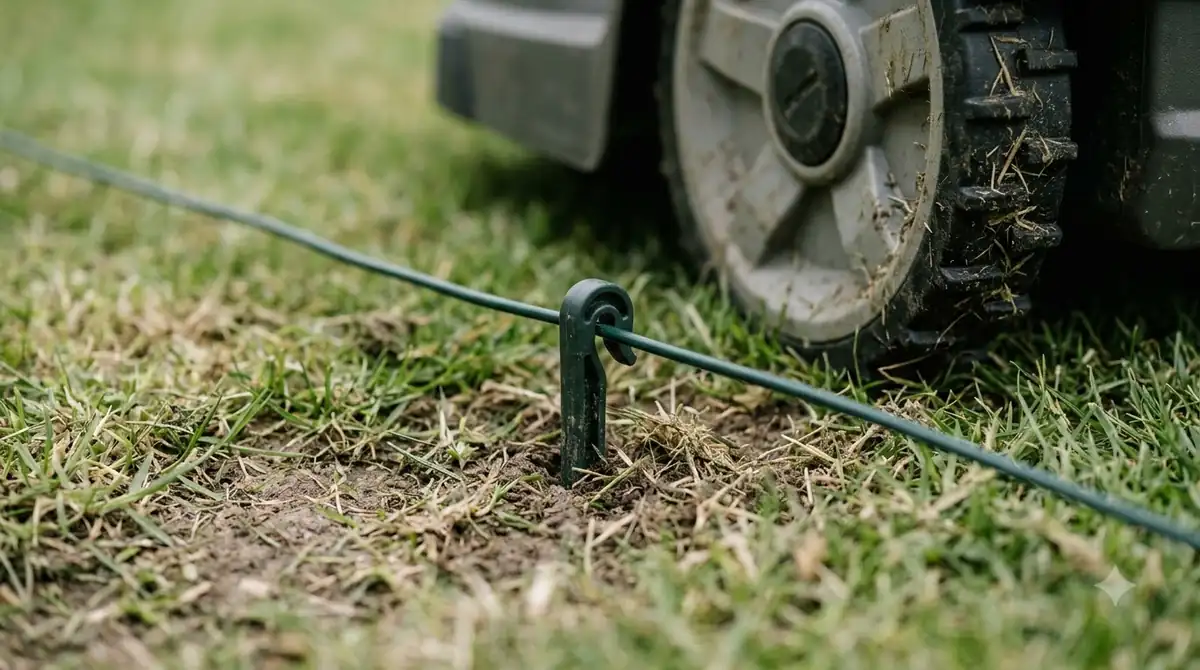
Husqvarna’s German page says the Automower 305 and Aspire R4 rely on a physical boundary wire, which makes them less suitable for owners who often change the garden layout. It also says the Aspire R6V and Automower 308V are less suitable for gardens without WLAN coverage, and that walls and fences can cause signal interference.
Our reading: on a small, fixed-layout yard, a wire-based mower can work well. If the garden changes often or the wire route is hard to lay in tight beds, a wire-free model may be easier to set up. Either way, test the signal where the mower will sit, because a wall or fence between the base station and the lawn can cause problems.
How to check a robot mower for a small yard
Choosing for a small lawn comes down to a few measurable checks. Use the list below to compare models on the same terms.
- Measure the mowing area. Subtract beds, paths and the house footprint from the total lawn, then compare the result with the rated area.
- Add headroom. Dreame’s checklist advises that the rated coverage should exceed the real mowing area by at least 20 to 30 percent. Its coverage section gives a larger buffer of 30 to 50 percent, so the article itself is not consistent on this point.
- Check passage widths. Compare each narrow gap with the 2 m (no wire) or 60 cm (with guide wire) figures.
- Check the steepest slope. Use the rating for the steepest section, not the average.
- Check the blades. Confirm the blades can be replaced and look for a design that extends past the wheelbase for edges.
- Choose wire or wire-free. Decide based on how often the layout changes and whether you can lay a wire route in the beds.
Dreame also notes that coverage ratings are calculated under ideal conditions: a flat, rectangular lawn with no obstacles. A small yard with beds and trees will usually deliver less than its rated figure, so the headroom step matters more than the rating itself.
Frequently asked questions
Do robot mowers work on very small lawns, or is there a minimum size?
No. The Husqvarna German page we read does not state a minimum lawn size. The makers we checked describe bands and capacities instead, with the lowest bands starting from very small lawns. Passage widths and slope usually decide whether a small yard is practical.
Will a robot mower cut a lawn of 300 square meters?
Yes, Robomow describes its compact models as ideal for lawns of 300 m² or less. Check the rated area of the specific model, and add headroom for beds, trees and edges, because real output is usually below the rated figure.
Do robot mowers work with narrow gaps in a small garden?
They can, if the gap meets the maker’s passage rule. Husqvarna recommends at least 2 m (6 ft 6 in) between boundary wires without a guide wire, and 60 cm (24 in) with one. Narrower gaps may need a manual trim or a different route.
Are cheap robot mowers for small lawns worth buying?
They can be, but check the blades first. Robomow warns that many inexpensive small-area robots cut corners on blade quality, which can pluck grass and leave an uneven cut. Replaceable, long-lasting blades and a slope rating that matches your steepest section matter more than the price tag.
Sources
- Ecovacs, robot lawn mower for small lawns (manufacturer): lawn size range, the “work well on small lawns” statement, boundary wire setup and GOAT O1000 RTK specs.
- Robomow, which robotic mower suits small gardens (manufacturer): 300 m² guidance, cutting width, battery figures, blade quality warning and output formula.
- Husqvarna, robotic mowers for small lawns (manufacturer, German page quoted in English): small-garden capacities, 24-hour assumption, Automower 305 slope rating and wire or WLAN cautions.
- Husqvarna support, how to create a passage in a boundary wire installation (manufacturer): passage widths and guide wire distance.
- Dreame, robot lawn mower buying guide (manufacturer): entry-tier size band, ideal-case coverage ratings and headroom advice.
 Up next7 min readBy YardCan a Robot Mower Work in a Yard With Multiple Small Patches?Updated Nov 10, 2026
 9 min readBy YardBest Robot Mower for a Small Backyard in the City: What to Check FirstUpdated Nov 12, 2026
 7 min readBy YardRobot Mower for a Desert Landscaping With Small LawnUpdated Nov 11, 2026
 8 min readBy YardHow Small Can a Yard Be for a Robot Mower?Updated Nov 11, 2026
 8 min readBy YardNavimow vs Mammotion vs eufy Small Yard: Which Published Specs MatterUpdated Nov 12, 2026
 9 min readBy YardDoes a Robot Mower Work in a Yard with Poor GPS Signal?Updated Nov 10, 2026