


The best robot mower for a small backyard in the city is the one that fits your narrowest passage, cutting width and rated area. Manufacturers publish very different limits for passage width and lawn size, so compare spec sheets before comparing brands. As of November 2026, the main differences between models are how they are installed and how much room they need to move around obstacles.
The short answer
- Measure first: your narrowest side gate or strip, plus the real lawn area after beds and paving are removed.
- Wired passage: Husqvarna’s US guidance sets 2 m (6 ft 6 in) between boundary wires without a guide wire, and 60 cm (24 in) with one.
- Cutting width: Robomow lists a cutting width from 18 cm for a 300 m2 garden, a slimmer deck for tight spaces.
- Margin: Robomow says slopes, obstacles and layout can cut rated output by up to 30%, so size up if your yard is busy.
- Wire-free: skips the buried boundary cable, but check the positioning signal where the mower will actually run.
How big a small city backyard is for a robot mower
The best robot mower for a small backyard in the city depends first on size, and robot mower makers define a small lawn differently, so the label on the box is not enough. ECOVACS gives a small lawn range of 1,000 to 10,000 square feet, depending on whether the yard sits in a dense city or the suburbs. That range is wide, which is why the shape of your yard matters as much as its total area.
Other brands use metric bands. Mammotion’s buying guide places small courtyards, townhouses and compact suburban lawns in a band of up to 500 m2, which is about 5,400 square feet by our conversion. Dreame’s entry tier targets small flat lawns under 1,000 m2, or about 10,760 square feet. A city backyard often falls in one of these lower bands, but a long narrow lot can be harder to mow than a larger square one.
ECOVACS also points out that small yards are often close to the house or neighbors, and that even a small yard may have uneven ground or sharp inclines. Those details affect the mower more than the square footage does, so measure the yard as a shape, not just an area.
Choosing the best robot mower for a small backyard in the city
Choose a mower whose rated area is comfortably above your lawn size, because the rating assumes ideal conditions. Robomow says slopes, obstacles, weather, lawn type and garden layout can reduce rated output by up to 30%. A small yard with many beds and a slope can work harder than a larger open lawn.
- Measure the lawn. Subtract beds, patios, decks and hardscape from the total area, then convert to square feet if the spec sheet uses metric.
- Count the obstacles. Trees, raised beds, planters and garden furniture each add turns, and turns cost time and battery.
- Check the slope. Our reading is that a yard with noticeable inclines (see how steep a hill a robot mower can handle) should move up one rated size, since the 30% reduction is the reason for the margin.
- Compare against the spec sheet. Use the rated area for the model (our coverage rating explainer shows how it is built), not the marketing headline, and confirm the number as of today, because manufacturers update their ratings.
How much passage width a wired mower needs
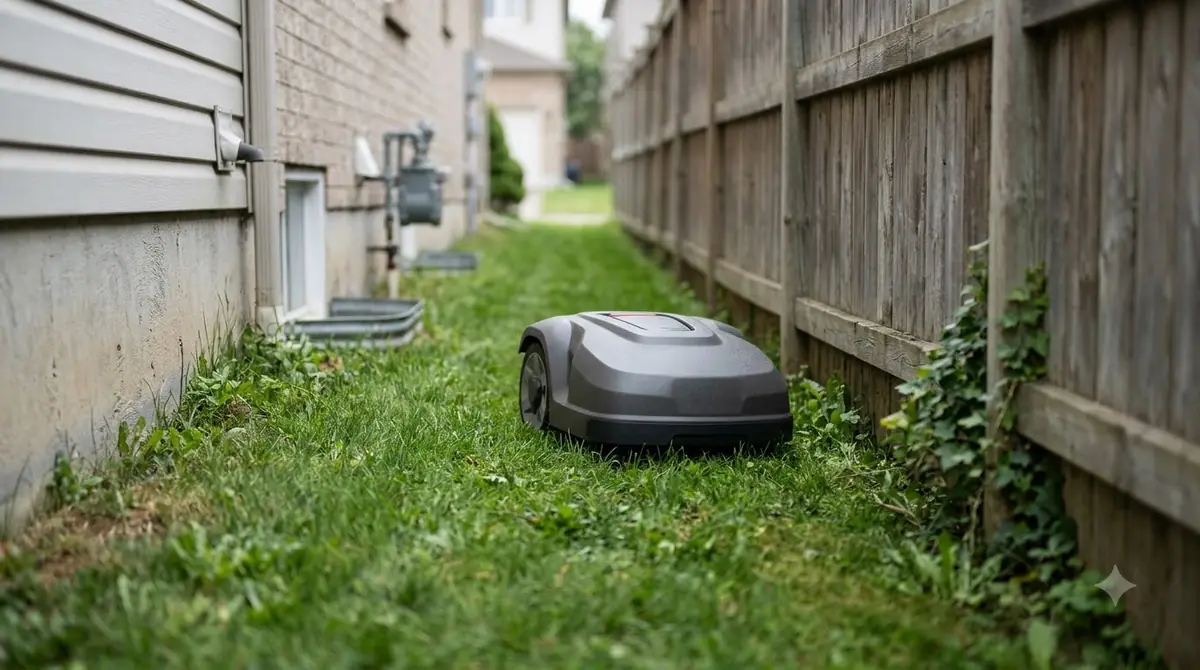
For a small city yard, the side gate or strip often decides whether a robot mower fits at all. Husqvarna’s US support page sets the minimum spacing between boundary wires at 2 m (6 ft 6 in) for a passage without a guide wire. With a guide wire to lead the mower through, the minimum drops to 60 cm (24 in).
| Passage setup (Husqvarna US) | Minimum spacing between boundary wires | What else to check |
|---|---|---|
| No guide wire | 2 m (6 ft 6 in) | Minimum for a passage without guide wire on the models Husqvarna lists |
| With guide wire | 60 cm (24 in) | The guide wire must sit at least 30 cm (12 in) from the boundary wire |
The charging station position also matters. Husqvarna says its mower always runs to the left of the guide wire when facing the charging station, so keep as much free space as possible on that side. Our reading is that a narrow side gate next to a fence leaves little room for that pattern, so measure before you commit to a wired layout. Numbers differ between brands, so use the manual for the exact model you are considering (see also robot mower narrow passage width).
Heads up
These figures come from Husqvarna’s US support page. Other brands publish their own passage minimums, and some are different, so do not assume one brand’s numbers apply to another.
Cutting width and obstacle sensing
For the best robot mower for a small backyard in the city, a narrow deck helps where side strips are only a few feet wide. Robomow’s guidance for small gardens starts at a cutting width of 18 cm, while its guidance for lawns of 2,000 m2 and more goes up to 56 cm. In a small city yard, a slimmer deck usually matters more than a wider one, because the mower spends most of its time turning in tight spots.
ECOVACS warns that a mower with a wide cutting width may struggle with tight corners and paths. Its GOAT O1000 RTK is listed at 15.7 inches wide and able to run along paths as tight as 2.3 feet, but that figure comes from ECOVACS laboratory testing, and the company says actual results may vary with grass type, lawn size and terrain. Treat it as a manufacturer claim, not an independent measure.
Obstacle sensing matters for the same reason. Robomow lists a 360-degree obstacle sensor on its small-lawn models, which is meant to help the mower detect obstacles. Our reading is that this feature is more useful in a cluttered yard than the headline cutting width.
Wire vs wire-free in a small city yard
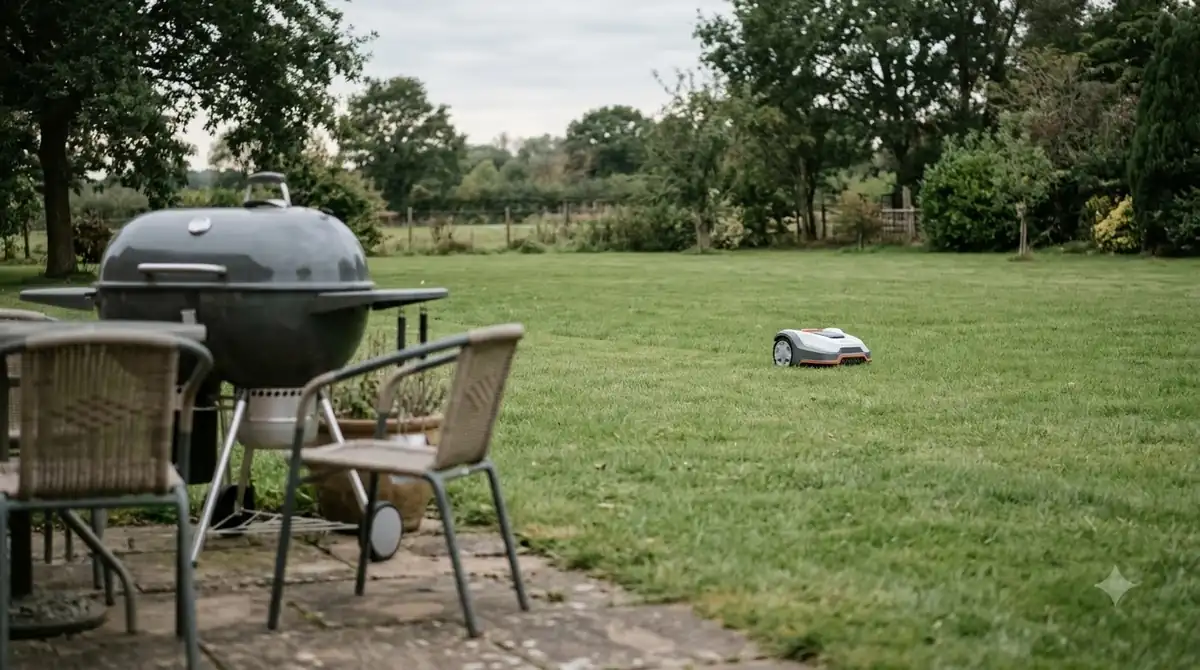
Wired mowers depend on a buried boundary cable and a charging station, and they follow that cable to know where to cut. Wire-free models skip the cable and map the yard through satellite or local positioning (wire-free vs boundary wire compares them). Each approach has a trade-off that matters in a city lot.
| Factor | Wired | Wire-free |
|---|---|---|
| Installation | Buried boundary wire and guide wire | No buried cable, setup through an app |
| Narrow passage | 2 m without guide wire, 60 cm with one (Husqvarna) | Check the manufacturer’s minimum passage width |
| Positioning | Does not depend on satellite signal | Depends on a positioning signal (our reading: may be weaker between buildings) |
Wire-free models are often easier for a small divided yard, because nothing needs to be buried along the fence. The caution is signal. Our reading is that positioning may be less reliable between a house, a fence and a neighbor’s wall than in an open field, and we found no source that measures it (see RTK robot mowers near tall buildings). This guide does not include signal measurements for any model, so check coverage in your own yard before buying.
What to check before you buy
Before you pick the best robot mower for a small backyard in the city, measure the things that decide whether a mower fits. The list below uses only the figures covered above, and each one is a number to confirm on the manufacturer’s spec sheet as of November 2026.
- Narrowest passage: compare it with 2 m or 60 cm (Husqvarna) or the minimum your brand lists.
- Lawn area: subtract beds and hardscape, then compare with the rated area with a margin for slopes and obstacles.
- Slopes: note any incline, since rated output can drop by up to 30% (Robomow).
- Charging station side: keep free space on the side the mower uses to return.
- Cutting width: a slimmer deck helps in tight strips and beside planters.
- Positioning: for wire-free models, check signal where the mower will run.
Frequently asked questions
Is a city backyard too small for a robot mower?
Not automatically. ECOVACS lists small lawns from 1,000 to 10,000 square feet, and Dreame’s entry tier targets flat lawns under 1,000 m2. The deciding factor is usually the narrowest passage the mower has to cross, so measure that before buying.
Do robot mowers handle slopes?
Slopes reduce rated output. Robomow says slopes, obstacles, weather and layout can cut rated output by up to 30%, so size up if your yard has inclines. Check the slope rating on each model’s spec sheet, since brands publish different figures.
How wide should a side gate passage be?
For a wired Husqvarna mower in the US, the minimum is 2 m (6 ft 6 in) between boundary wires without a guide wire, or 60 cm (24 in) with one. Other brands set their own minimums, so check the manual for the model you plan to buy.
Do wire-free robot mowers work between buildings?
This guide does not include signal measurements for any model. Wire-free mowers rely on positioning, which in our reading may be weaker between walls and buildings. Check coverage in your own yard before you buy, and confirm the seller’s return terms in case it does not perform.
If you are shortlisting the best robot mower for a small backyard in the city, start with the narrowest passage and the rated area, then confirm both on the spec sheet of the exact model. A slimmer deck and a 360-degree obstacle sensor help in a busy yard, but they do not replace a measurement. Our reading is that the passage figure decides more purchases than any other number on this page.
Sources
- Husqvarna US support: passage in an Automower boundary wire installation (manufacturer): 2 m and 60 cm passage minimums, guide wire spacing.
- ECOVACS US blog: robot lawn mower for small lawn (manufacturer): 1,000 to 10,000 sq ft range, narrow-area notes, GOAT O1000 RTK width.
- Robomow: which robotic lawnmower is suitable for which lawn size (manufacturer): cutting width by lawn size, obstacle sensor, 30% output reduction.
- Mammotion: how to choose a robot lawn mower (manufacturer): up to 500 m2 size band.
 Up next7 min readBy YardBest Robot Mower for Bahia Grass: Check the Cutting Range FirstUpdated Nov 11, 2026
 8 min readBy YardRobot Mower for Compacted Soil Lawn: 4 Checks FirstUpdated Nov 11, 2026
 9 min readBy YardRobot Mower for Terraced Yard: What to Check FirstUpdated Nov 11, 2026
 8 min readBy YardRobot Lawn Mower for Bumpy Uneven Lawn: What to Check FirstUpdated Nov 11, 2026
 8 min readBy YardCan a Robot Mower Work in a Fenced Backyard?Updated Nov 11, 2026
 7 min readBy YardRobot Mower for a Desert Landscaping With Small LawnUpdated Nov 11, 2026