
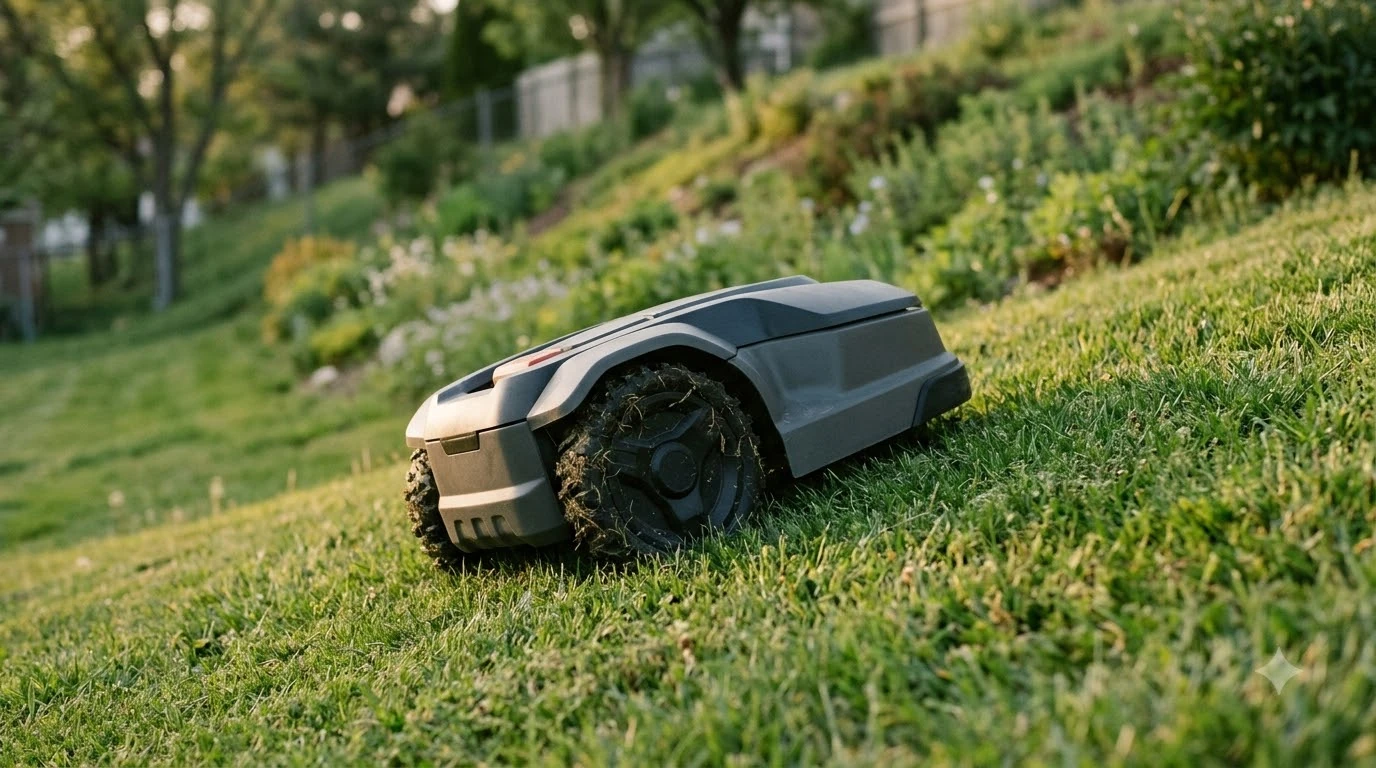

A robot lawn mower for bumpy uneven lawn should be judged on grip and cutting height, because small bumps are usually manageable while deep ruts are not. Slope rating matters too, but it is a separate limit that a bumpy yard does not change. This guide explains what to check on uneven ground before you buy and what to repair first.
The short answer
- Small bumps and shallow dips: usually not a problem, according to Eufy’s uneven-lawn guidance.
- Deep holes and ruts: can make the mower tilt, lose grip or get stuck.
- Grip: deep tread, heavy-duty rear wheels and all-wheel drive help most on rough ground.
- Slope rating: an absolute limit, so a bumpy lawn does not raise it.
- First fix: fill dips and ruts deeper than about 3 cm with soil before the first mow.
How much bumpiness a robot lawn mower can handle
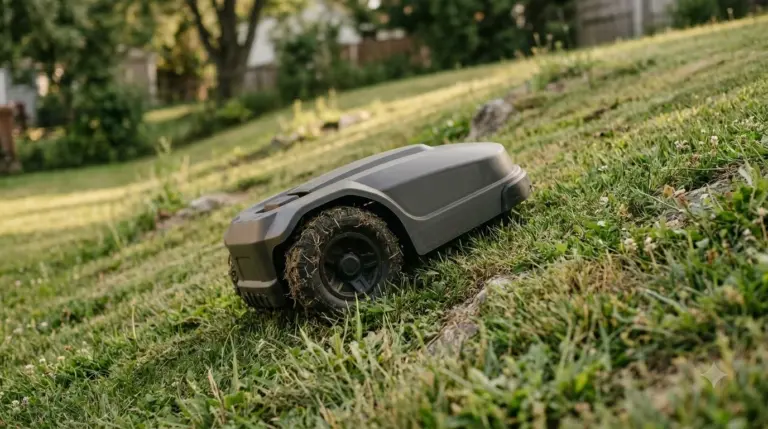
Small bumps, shallow dips and slightly sloped patches are usually not a problem for a robot lawn mower for bumpy uneven lawn use. Anker’s guide says modern mowers usually handle them well. The concern is the deeper hole or rut, which can tilt the mower and cost it grip. Eufy’s guidance says to walk the lawn before setup and look for deep dips, sunken patches, muddy low spots and footpath ruts. Those are the spots to measure first. A drainage dip is the extreme case, covered in our guide on whether a robot mower can mow a drainage ditch.
Eufy’s guidance keeps surface variation under about 3 cm and suggests packing soil into ruts and dips deeper than that. This is vendor guidance rather than an independent test limit, so confirm it in your model’s manual. Our reading is that any dip that catches your foot is worth measuring before you trust a mower to cross it.
Heads up
Most of the bump and slope figures in this guide come from robot mower makers’ guidance, not from independent lab tests. Treat them as starting points and check them against your model’s manual.
Why rough ground causes slip and scalping
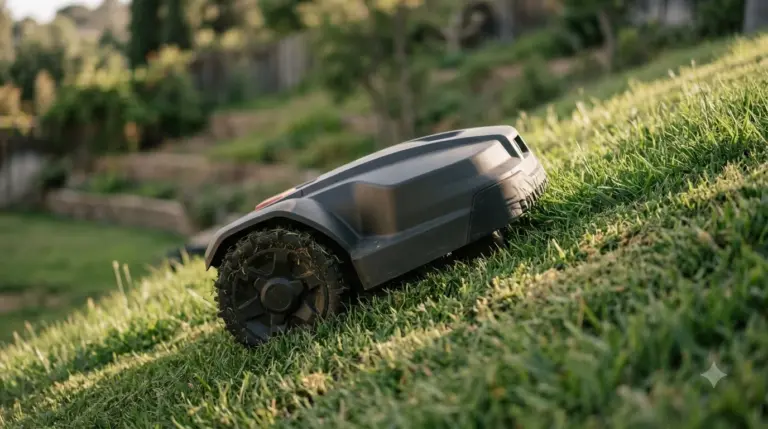
Uneven ground causes three problems: wheels that lose contact, scalped patches and sudden stops. Eufy’s uneven-lawn guide warns that uneven terrain can cause scalping, where the blades cut too low over raised areas. Its FAQ notes that tilt and lift sensors shut the blades down right away for safety, which is why a bumpy lawn can stop a mower mid-run.
Wet grass makes the slip worse. Eufy says damp turf acts like a slippery surface under the tires and that wet grass reduces tire grip, causing the unit to slide sideways or slip downhill. Our reading is that a damp morning is the time to keep the mower away from the steepest and roughest zones until the grass dries. Loose ground adds to the problem, as our guide to whether a robot mower will get stuck on a sandy soil lawn explains.
Which wheel, tread and drive features help on bumps
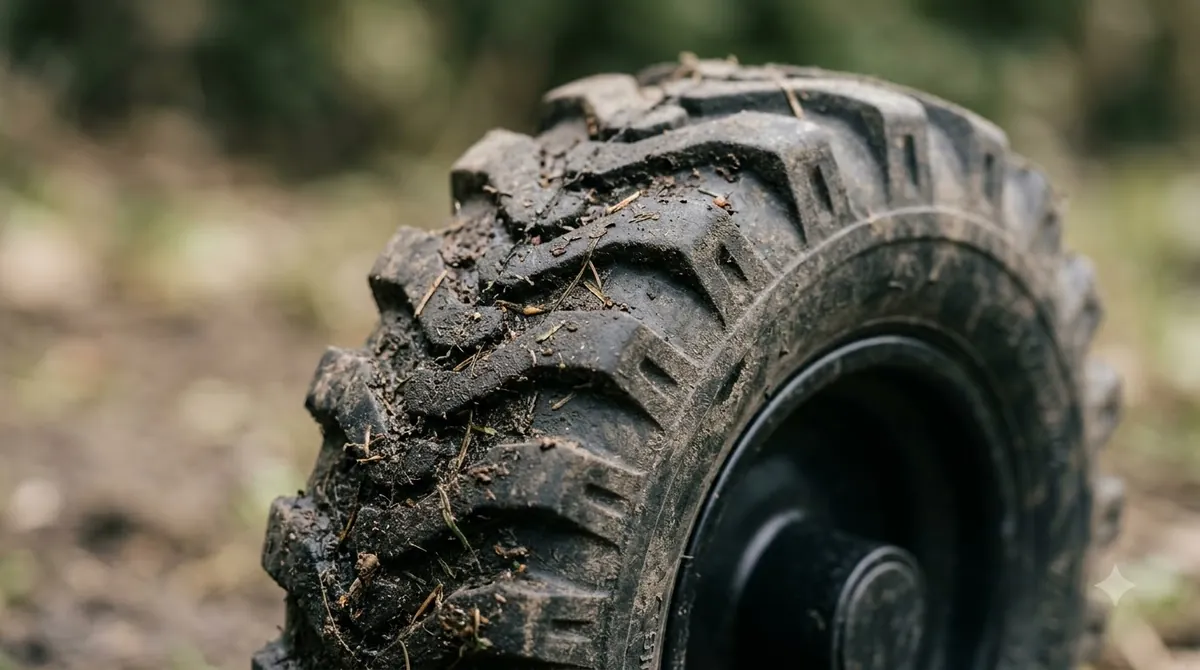
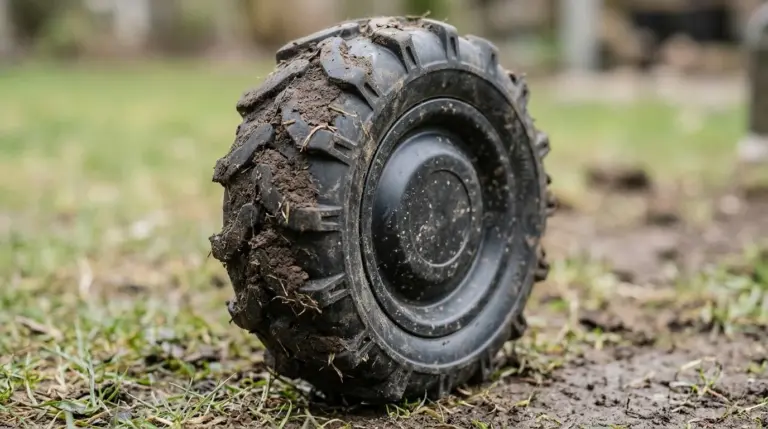
Deep tread, heavy-duty rear wheels, larger wheels and all-wheel drive are the features that help a robot lawn mower for bumpy uneven lawn keep grip. These are general design features, so compare the specific model’s tread and wheel details rather than assuming any one feature guarantees results. For add-on grip, see robot mower traction spikes for slopes.
| Feature | Why it matters on a bumpy lawn | What to check |
|---|---|---|
| Tread depth and pattern | Eufy says deep tread gives grip on dry grass, loose soil and damp sections. | Tread depth and grooves in photos or the spec sheet |
| Rear wheels | Eufy names heavy-duty rear wheels as a source of grip. | Wheel size and whether the rear wheels are listed as heavy-duty |
| Drive type | Anker’s uneven-lawn guide says all-wheel drive usually handles rough ground better. | Two-wheel or all-wheel drive in the model listing |
| Cutting height | Anker lists an adjustable 25 to 75 mm range, which lets you raise the blades on rough zones. | Minimum and maximum height in the spec sheet |
| Tilt and lift sensors | Anker says these shut the blades off instantly on unstable ground. | Confirm the sensors are listed for the model |
Cutting height is the setting most owners overlook on a rough yard. Anker warns that uneven terrain can scalp patches, and advises a higher cut at first on uneven lawns, then lowering it gradually once the lawn is more even. Our reading is that a slightly higher setting on the roughest zones is the safer choice. See the best mowing height for a robot-mowed lawn for height basics.
Slope rating is a separate check on a bumpy lawn
A slope rating sets the steepest incline a mower can climb, and a bumpy lawn does not change that number. Eufy groups its models by slope capability: basic models manage 10 to 25 percent (about 5.7 to 14 degrees), mid-range models go up to 35 percent (19.7 degrees), and advanced all-wheel-drive models reach 70 percent (35 degrees). Eufy describes the rated maximum as an absolute limit, not a target for daily mowing.
Percent and degrees describe the same hill in different ways, and vendor pages do not always convert them consistently. Eufy’s article lists one advanced model as 40 percent (18 degrees), but 18 degrees is about 32 percent. Check the unit on any spec sheet before you compare two mowers, and see our comparison of AWD vs 2WD robot mowers for hills for how drive type interacts with slope. Our reading is that a robot lawn mower for bumpy uneven lawn conditions that are also steep needs both a high rating and good tread, because one does not replace the other.
Fixing dips and ruts before the first mow
Fill low spots with thin layers of soil that match the lawn, and never bury the grass crowns. Ask Extension advises adding thin layers over a low area every week or two, because completely covering the crowns will smother them. For a large low area, the same answer suggests cutting the grass into uniform strips, filling to the strip thickness and replacing the strips.
Match the material to the ground. Ask Extension says sand should only be used to level a lawn when the substrate soil is sandy as well, and that a fully filled low area can be reseeded. Eufy adds that dips and ruts deeper than 3 cm should be packed with soil before the mower runs. Ask Extension adds that topdressing should stop by late September, when you core aerate, apply compost and overseed. If the lawn is only bumpy and has no low spots, the same source says rolling may be enough.
Robot lawn mower for bumpy uneven lawn: what to check before you buy
For a robot lawn mower for bumpy uneven lawn use, check the worst dip, the tread and wheels, the slope units, the cutting height range and the sensors before you buy, then repair the lawn before the first run.
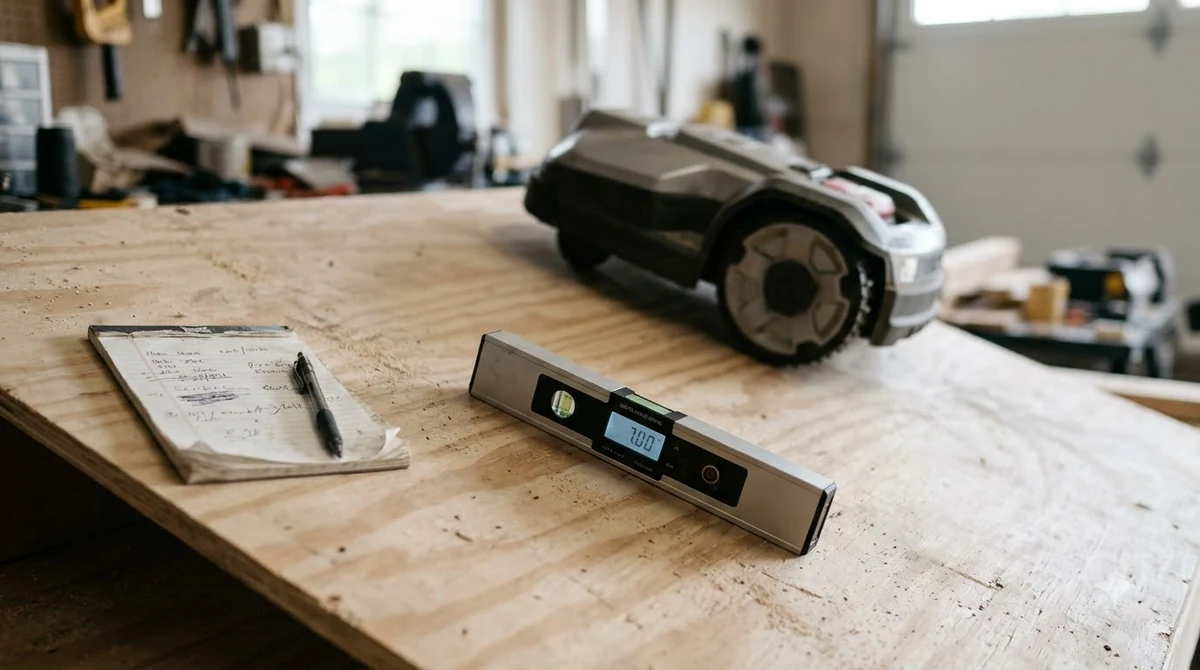
- Measure the worst dip. Lay a straight board across it and check the gap, using Eufy’s 3 cm guidance as the reference point.
- Read the tread and wheel specs. For a bumpy yard, look for deep tread, heavy-duty rear wheels or all-wheel drive.
- Check the slope rating and its unit. Confirm whether the figure is percent or degrees and whether the vendor calls it an absolute limit.
- Check the cutting height range. A range that goes up to 75 mm lets you raise the blades over raised areas.
Frequently asked questions
Can a robot lawn mower handle a bumpy uneven lawn?
Yes for small bumps and shallow dips, which Eufy’s uneven-lawn guidance describes as usually not a problem. Deeper holes and ruts are the cases to fix first, because they can tilt the mower and cost it grip. Check your model’s manual for its own limits.
How deep a dip is too deep for a robot lawn mower?
Eufy’s guidance keeps surface variation under about 3 cm and suggests packing dips and ruts deeper than that. Treat this as vendor guidance rather than an independent limit, and confirm it against your model’s manual before the first run.
Does wet grass make a robot lawn mower slide on a slope?
It can. Eufy says wet grass reduces tire grip and can make a mower slide sideways or downhill. On damp mornings, keep the mower off the steepest and roughest zones until the grass dries.
Do I need all-wheel drive for a bumpy lawn?
All-wheel drive is one feature that helps. Anker’s uneven-lawn guide says larger wheels, deeper tread or all-wheel drive usually handle rough ground better, but none of them guarantees results. Compare tread, wheel and slope specs together with the drive type.
Sources
- Robot lawn mower slope limits (Eufy, vendor guide): slope tiers, rated maximum as an absolute limit, 3 cm guidance, tread and wet grass.
- Do robot mowers work on uneven lawns (Eufy guide, UK edition on the Anker site, vendor): bumps and dips, ruts, scalping, wheels and drive, 25 to 75 mm height, tilt and lift sensors.
- Ask Extension answer 881570: filling low spots and leveling (extension.org network): thin layers, crown warning, strip method, sand rule, timing.
- Ask Extension answer 877901: leveling a lawn with soil (extension.org network): sand rule and reseeding filled low areas.
 Up next8 min readBy YardDo Robot Mowers Work on Bumpy Lawns? What to Know FirstUpdated Nov 11, 2026
 9 min readBy YardRobot Mower for Terraced Yard: What to Check FirstUpdated Nov 11, 2026
 7 min readBy YardBest Robot Mower for Bahia Grass: Check the Cutting Range FirstUpdated Nov 11, 2026
 9 min readBy YardBest Robot Mower for a Small Backyard in the City: What to Check FirstUpdated Nov 11, 2026
 8 min readBy YardRobot Mower for Compacted Soil Lawn: 4 Checks FirstUpdated Nov 11, 2026
 8 min readBy YardRobot Mower on Uneven Lawn: What Works and What FailsUpdated Nov 11, 2026