
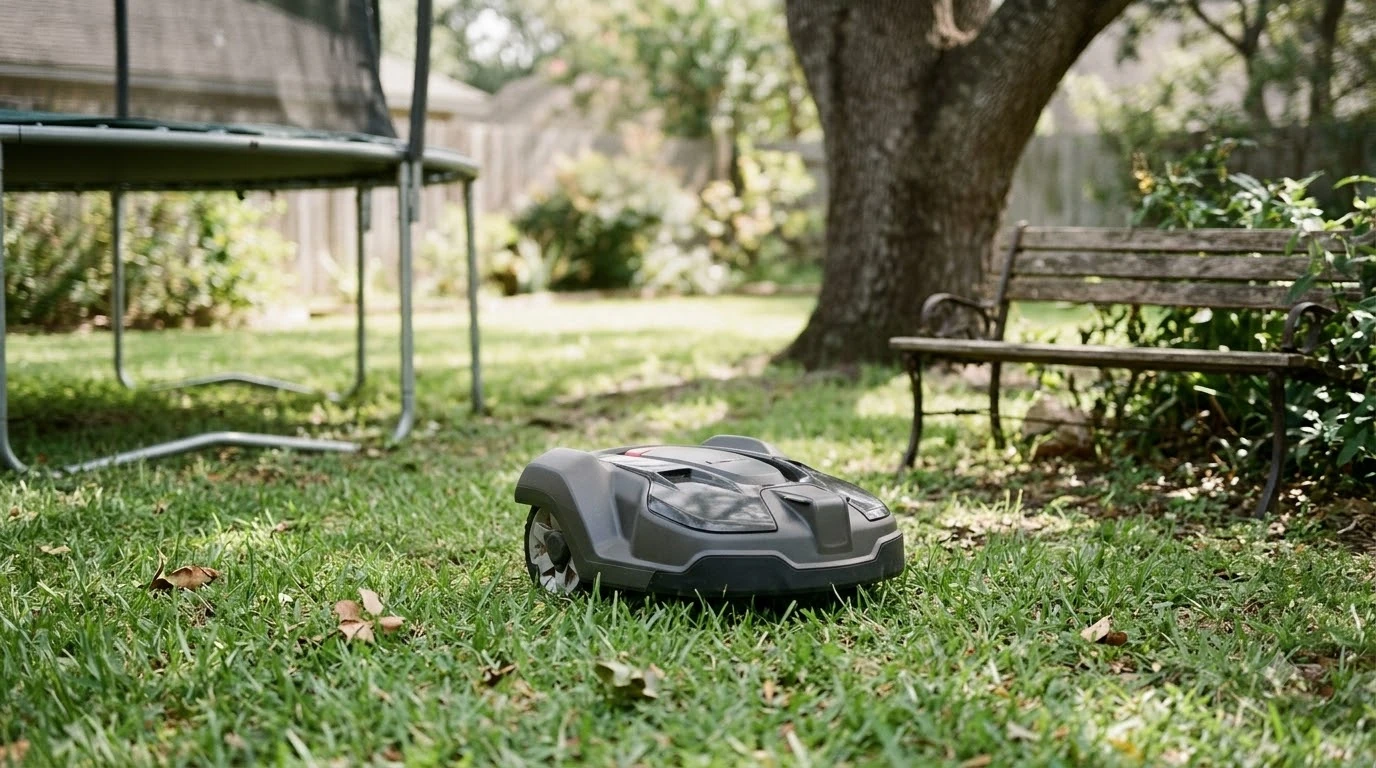

So, can a robot mower work in a fenced backyard? Usually yes. The fence itself does not set the mowing area, though. A boundary wire, a virtual zone or a wire-free map does that, and the fence is the edge you set it against. Clearances and signal limits differ by brand, so the figures below come from manufacturer support pages and should be checked against your own model’s manual.
The short answer
- Wired mowers: run the boundary wire at least 30 cm (12 in) from any guide wire, and never let guide wires cross it.
- FlexiFence zones: keep the zone wire at least 60 cm (24 in) from the work-area boundary, and cap slope inside the zone at 10%.
- Wire-free mowers: walls and trees can weaken satellite signal, and shade can cut it sharply.
- Before you buy: measure the strip between the fence and each bed, and check the slope along the fence line.
Can a robot mower work in a fenced backyard without a boundary wire?
Yes, a fence can serve as the edge, but the sources we read describe the working area being set by a wire or a map, not by the fence itself. The fence still matters as a reference point, because the clearance rules below are measured from the wire and from objects near it.
Husqvarna’s support pages describe a boundary wire that defines the work area, with a guide wire to reach other parts of the yard. Eufy’s wire-free models rely on satellite, vision or LiDAR positioning instead of a buried cable. In both cases, the fence is the physical edge you place the wire or the map against.
Where to run boundary wire along a fence
Keep any guide wire at least 30 cm (12 in) from the boundary wire, and do not let it cross the boundary wire, for example near an island, according to Husqvarna’s guide-wire instructions. The same page shows an example layout in which a guide wire leads the mower through a fence, down a slope and through a narrow passage.
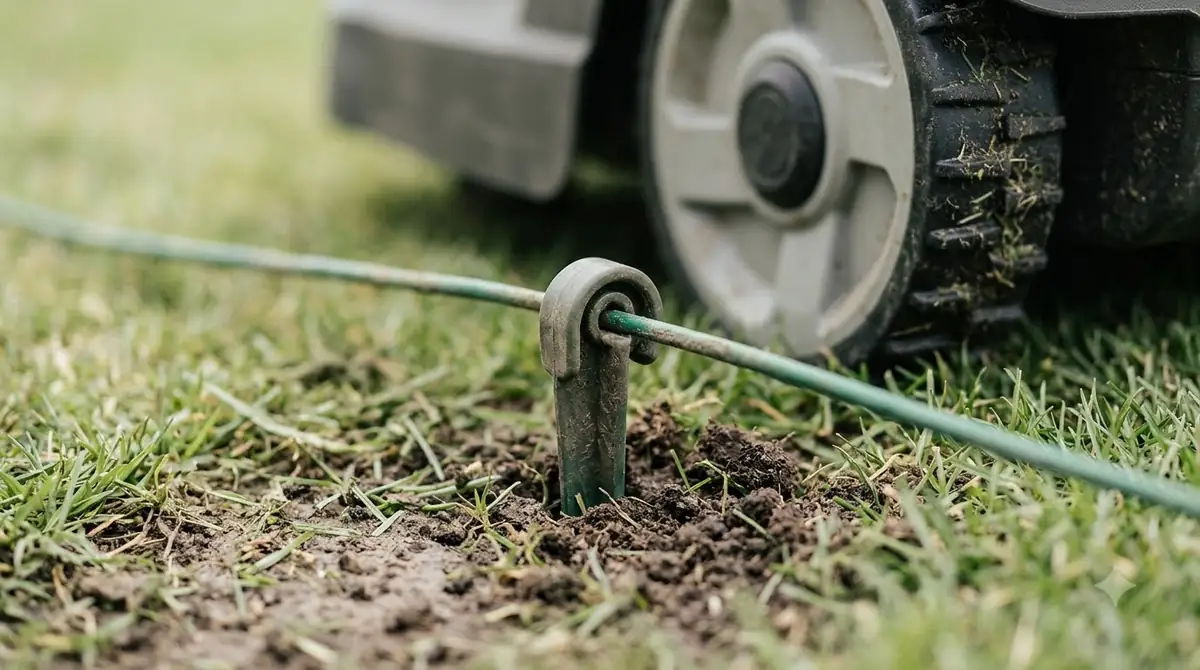
That layout is useful on a fenced lot, because a guide wire is how a wired mower reaches a far corner or a gate. Our reading is that a gate opening should be planned as a deliberate passage with its own guide wire, not left as a gap the mower has to find on its own.
- Lay the boundary wire first, then add guide wires.
- Keep every guide wire at least 30 cm (12 in) from the boundary wire.
- Do not let guide wires cross each other or the boundary wire.
- Plan the gate passage between zones before pegging the wire.
Wired installation is the slow part (see how to install a robot mower boundary wire). Eufy’s Australian guide says a wired setup “typically requires an entire weekend of manual pegging, trenching, and cable burying” in its main text, yet its FAQ gives 2 to 3 hours for a small yard. The two figures do not agree, so treat the time as a range that grows with the length of wire along the fence.
Keeping the mower out of part of the yard
A FlexiFence zone must sit at least 60 cm (24 in) from the work-area boundary wire, and objects inside the zone must stay at least 35 cm (14 in) from the zone wire, according to Husqvarna’s FlexiFence instructions. These are the distances to check when a bed or play area sits close to a fence you want the mower to skip.
| Rule | Husqvarna figure |
|---|---|
| Objects inside the FlexiFence area to its zone wire | At least 35 cm (14 in) |
| Zone boundary wire to work-area boundary wire | At least 60 cm (24 in) |
| Slope inside the FlexiFence area | Maximum 10% gradient |
| Attaching to an existing boundary wire | Not possible, it must stand on its own |
The FlexiFence page describes the zone as keeping the mower out of an area “without installing a permanent boundary wire.” It also refers to the work-area boundary wire in its troubleshooting, so our reading is that FlexiFence suits keeping a mower out of one bed in a fenced yard, not replacing the perimeter of the whole lawn.
Wire-free mowers near a fence
Wire-free mowers navigate with satellite positioning, cameras or LiDAR, and a tall fence or wall can weaken the satellite signal. Can a robot mower work in a fenced backyard that has shaded corners? It depends on sky view more than on the fence. Eufy notes that high boundary walls and multi-storey neighboring buildings can severely degrade GPS and RTK satellite signals, and that in heavily shaded zones signal quality can drop by 30% to 70%. For the sky-view requirement in detail, see whether robot mowers need a clear view of the sky.
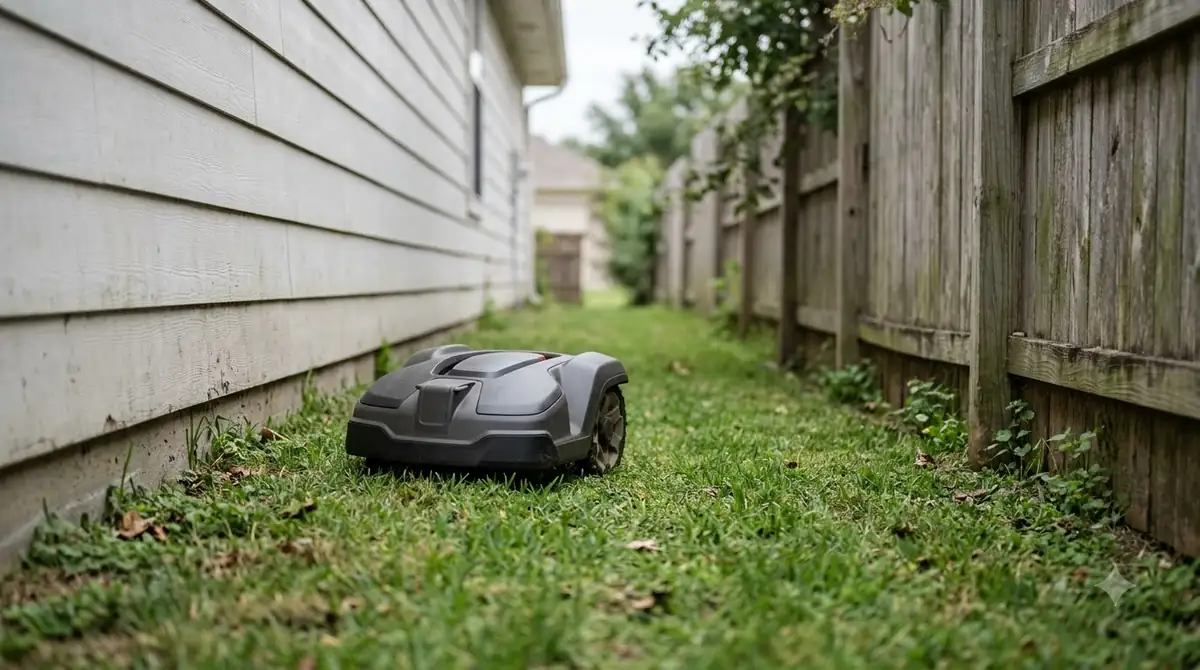
That is the trade-off for a fenced yard, and wire-free vs boundary wire robot mowers compares the two in full. Eufy says wire-free mapping usually takes 30 to 60 minutes, which avoids the trenching of a wired setup. A backyard boxed in by fences, trees and a house may not have a clear sky view, though, and Eufy itself says heavily treed blocks or narrow urban courtyards may suit a boundary wire or a LiDAR unit better.
Our reading is that a narrow side yard between a house and a fence, covered in robot mowers for narrow side yard passages, is the case to test first, because the walls and tree canopy there are the most likely to weaken the signal. If the signal is poor in one corner, a wired loop for that corner may be simpler than a wire-free map for the whole lot.
Slope and terrain along the fence line
Can a robot mower work in a fenced backyard on a slope? Slope limits differ by model, so check the gradient along the fence before you buy. Navimow’s guide lists the maximum slopes below and advises accounting for trees, flowerbeds and fences in the garden layout.
| Navimow model | Slope rating | Angle |
|---|---|---|
| i2 AWD | 45% | 24 degrees |
| i2 LiDAR Pro | 55% | 29 degrees |
| X4 | 84% | 40 degrees |
A fence line often runs along a bank or a drop, which is where the mower works hardest. FlexiFence has a far lower limit of 10%, so a zone should not sit on a bank or drop-off even when the wider yard is within the model’s rating. Our reading is that the rating is a ceiling, not a target, and a steep strip beside a fence is a reason to choose a wired guide route.
Can a robot mower work in a fenced backyard? What to check first
Before you buy or lay wire, measure the usable strip between the fence and each bed or tree, and note where the shade falls through the day. Those three checks usually decide whether a wired or wire-free setup is simpler for your yard.
- Clearance: keep guide wires 30 cm (12 in) from the boundary wire, and FlexiFence objects 35 cm (14 in) from its zone wire.
- Slope: confirm the model’s rating along the fence, and cap FlexiFence zones at 10%.
- Sky view: walls and trees can cut satellite signal, so a shaded fence corner favors a wire.
- Layout changes: a wired lawn needs cable unearthed and re-buried when you move a bed.
Frequently asked questions
Can a robot mower cut right up to a fence?
It depends on the setup. The sources we read do not give one distance a mower can cut to a fence, so place the boundary wire or map using the clearances above and follow your model’s manual for the exact edge.
Do I need a boundary wire if my yard is fully fenced?
Not always. Wire-free models navigate without a buried cable, but Eufy notes that walls and trees can weaken satellite signal. Our reading is that a fully fenced yard with shaded corners may still need a wire in those corners.
How far should the boundary wire sit from a fence?
The Husqvarna pages set 30 cm (12 in) between a guide wire and the boundary wire, and 35 cm (14 in) from objects to a FlexiFence zone wire. The sources we read do not give one boundary-to-fence distance for every brand, so check your model’s manual.
Can a robot mower work in a fenced backyard with trees?
Usually yes, but signal matters. Eufy reports that signal quality can drop by 30% to 70% in heavily shaded zones for wire-free models. Trees near a fence are a reason to compare a wired layout with a wire-free one before buying.
Sources
- Install and use Automower FlexiFence in boundary wire installations (Husqvarna): zone clearances, 10% slope limit, and the rule against attaching to an existing wire.
- How to lay a guide wire in a boundary wire Automower installation (Husqvarna): 30 cm guide-wire spacing and the no-crossing rule.
- Wired vs. wire-free robot lawn mower (Eufy): installation times, signal effects from walls and shade, and layout-change cost.
- Lawnmower wire layout (Navimow): model slope ratings and layout advice on trees, flowerbeds and fences.
 Up next9 min readBy YardBest Robot Mower for a Small Backyard in the City: What to Check FirstUpdated Nov 11, 2026
 8 min readBy YardCan a Robot Mower Work in a Yard With a Detached Garage?Updated Nov 11, 2026
 8 min readBy YardCan a Robot Mower Work in a Yard With Gravel Path Crossings?Updated Nov 11, 2026
 9 min readBy YardCan a Robot Mower Work in a Lawn on Both Sides of the House?Updated Nov 11, 2026
 9 min readBy YardCan a Robot Mower Work in a Yard With a Gate Between Zones?Updated Nov 11, 2026
 8 min readBy YardDo Robot Mowers Work on Bumpy Lawns? What to Know FirstUpdated Nov 11, 2026