
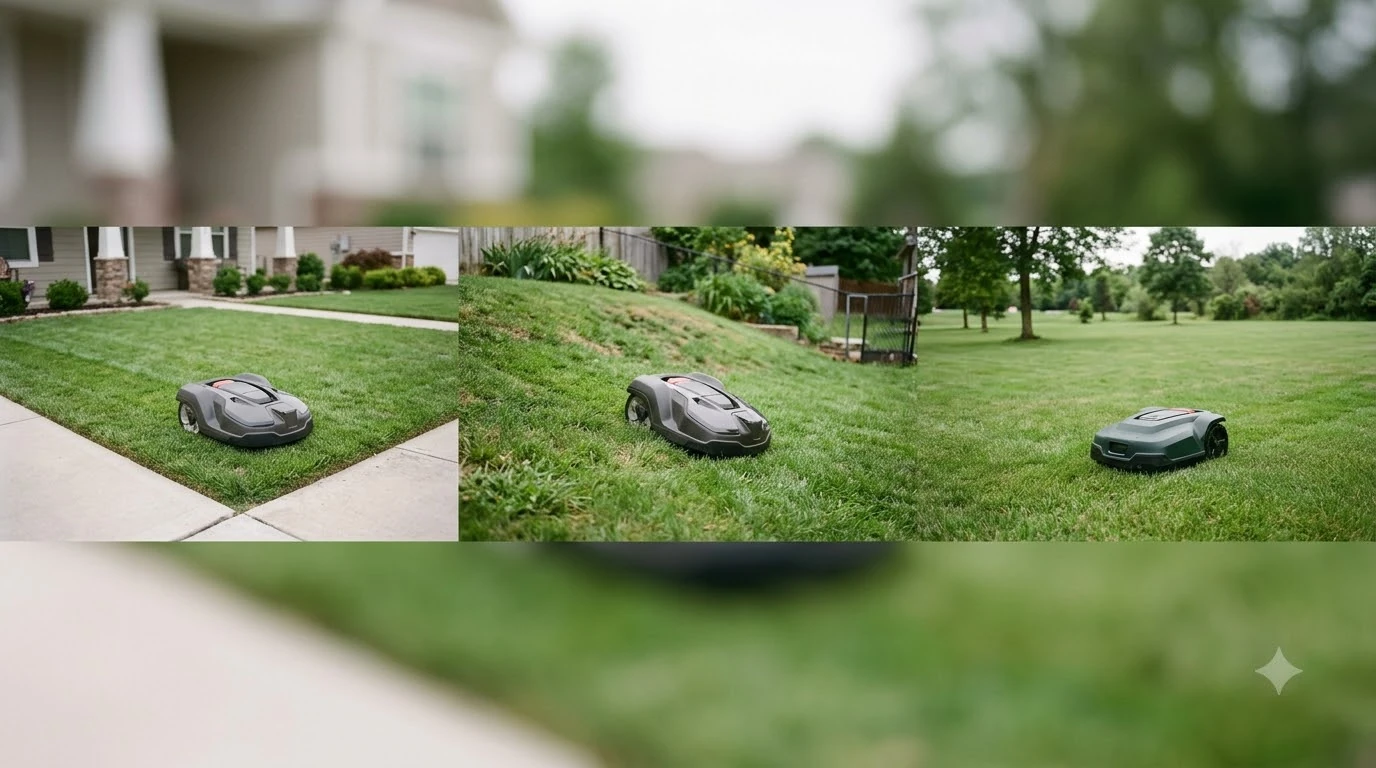

Can a robot mower work in a yard with multiple small patches? Yes, when each patch connects to the main lawn by a passage or an island. A patch reached by a passage, or wired as an island inside the lawn, can share one installation and one charging station. A patch with no driveable route needs its own setup, or the owner has to carry the mower there. Passage widths and island wiring rules differ by brand, so check the manual for your model.
The short answer
- Patches with a passage: the mower can drive to them on one wire, if the gap meets the brand’s minimum width.
- Patches inside the lawn: an island is a wire loop around the obstacle, and its two wires must not cross.
- Disconnected patches: each site needs its own charging station and wire or wire-free setup.
- Tiny patches: the setup cost can outweigh the time saved, so count the work before you buy.
Can a robot mower work in a yard with multiple small patches on one setup?
A robot mower can reach a small patch on its own when a route links it to the main area. The route can be a passage of grass or a drivable path, and the mower then covers both areas on one installation. Robomow describes this as a secondary zone that is smaller than the main zone and joined to it by a pathway. Husqvarna describes the same idea as a secondary area, which it sets up when two lawns are adjacent and joined by one wire.
Patches the mower cannot drive to are a different case, and a yard with multiple small patches often has a mix of both. The mower does not travel between them unless the owner moves it by hand, and that step has to be repeated each time the patches are mowed. Our reading is that a passage is worth the effort whenever the gap allows one, because it removes the manual move from the routine.
How wide must a passage be between two patches?
The required width depends on whether the passage has a guide wire. Husqvarna’s passage guide lists a minimum of 2 m (6 ft 6 in) between the boundary wires when no guide wire is used. With a guide wire, the minimum drops to 60 cm (24 in), and the guide wire must sit at least 30 cm (12 in) from each boundary wire.
Robomow gives a different reference point for a secondary zone. Its guidance says a passage to a separate zone should be wider than 70 cm, and its secondary-zone example describes a passage of about one meter. Those figures come from different brands and wire layouts, so use the number in your own model’s manual rather than mixing them. A narrow gap that is close to the minimum is a common cause of a mower getting stuck in the passage, so leave a margin where the space allows.
For a gap the mower has to cross often, a wider passage with a guide wire is usually the more reliable choice.
What is an island, and how do you wire one?
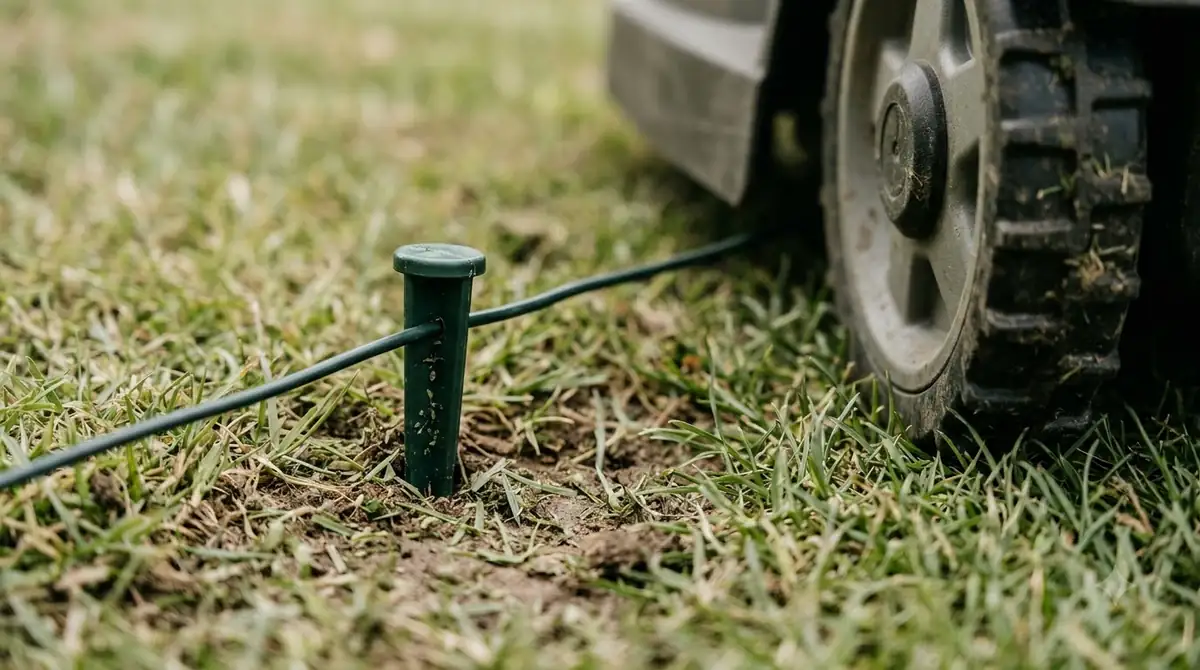
An island is a wire loop that surrounds an obstacle inside the lawn, such as a flower bed, a tree or a pond edge, so the mower can cut around it. A patch of grass that sits inside the lawn can be treated the same way when the obstacle around it is a bed or a path.
Husqvarna’s island guide gives the method in order, and it applies whenever a yard with multiple small patches has an obstacle in the middle of a lawn. Run the wire from the boundary to the obstacle, go around it, and return along a parallel path with the two wires laid close together. The close pair cancels the signal, which lets the mower pass over the island without stopping. The guide also says that the two island wires must not cross, because the mower will not recognise the island and will stop. Check the wire routing before you bury it.
Robomow gives spacing figures that help when you lay the loop. It recommends about 10 cm between the wire and beds, hedges, slabs or paths, and about 35 cm between the wire and walls or tall stones. Husqvarna’s island page does not give a maximum island size, so a size limit from another brand should not be assumed to apply to your model.
When is a patch too separate for one mower?
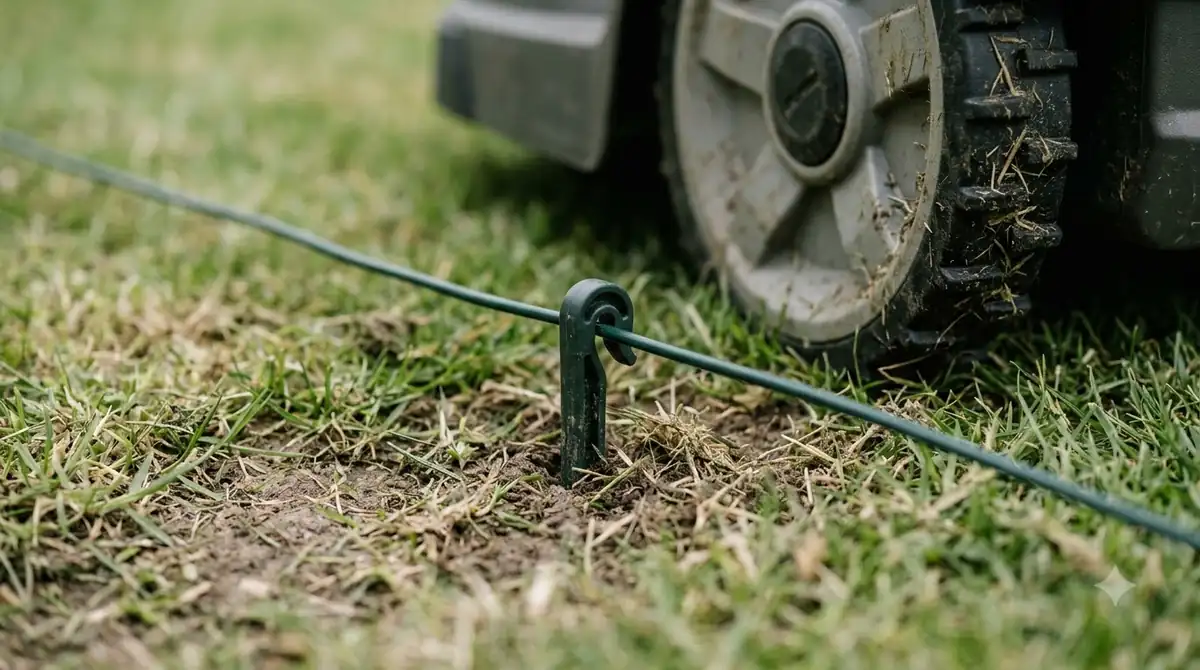
A patch with no passage and no island route counts as a separate site. Husqvarna’s multiple-location guidance says each separate site needs its own charging station and its own boundary wire, or an EPOS wire-free setup on models that support it. Profiles can be switched when the mower is moved from one site to another.
Robomow lists three options for a separate zone with no connection: a separate route, a second charging station, or a signal transmitter. A transmitter is simpler to install, but it is not available on every model, and a second charging station may need to relearn the signal each time the mower docks there. For the full comparison of the two approaches, read about whether a robot mower can mow multiple separate lawns.
Our reading is that a separate patch is often not worth the cost of a second dock and wire if the patch is only a few square meters. The dock, the wire and the placement work can cost more than the mowing time you save.
What to check before you buy or install
Use this table as a checklist when a product page or manual lists the specs. Each row names a number that decides whether a patch layout works.
| Feature | What to look for | Why it matters for small patches |
|---|---|---|
| Passage width | 2 m without a guide wire, 60 cm with one (Husqvarna) | Decides whether the mower can drive to the patch |
| Separate-zone passage | Wider than 70 cm (Robomow) | Sets the minimum gap for a secondary zone |
| Island wires | Must not cross; return wires close together (Husqvarna) | A crossed island stops the mower |
| Wire to beds and paths | About 10 cm (Robomow) | Keeps the mower from cutting into the bed edge |
| Installations | Up to 10 or up to 3 (Husqvarna, by model) | Limits how many separate sites one mower can store |
| Charging stations | One per disconnected site (Husqvarna) | Each unlinked patch needs its own dock |
Before you order for a yard with multiple small patches, measure the gap between each patch and the main lawn, and note the obstacles around them. For the wider trade-off between wire and wire-free systems, see wire-free versus boundary wire setups.
Frequently asked questions
Can a robot mower work in a yard with multiple small patches when one sits in the middle of the lawn?
Yes, if the patch is wired as an island around its obstacle. Husqvarna says the two island wires must not cross, or the mower will not recognise the island and will stop.
Is there a size limit for an island?
Husqvarna’s island guide does not give a maximum size. Check the manual for your model before you lay wire, because limits differ by brand and model.
How narrow can a gap between two patches be?
Husqvarna lists a minimum of 2 m without a guide wire and 60 cm with one. Robomow advises a passage wider than 70 cm for a separate zone. A gap close to these figures is a common cause of the mower getting stuck.
Are very small patches worth a robot mower?
Not always. In a yard with multiple small patches, our reading is that a patch the mower cannot reach by passage or island may cost more in dock and wire setup than the mowing time it saves.
Sources
- How to create islands in an Automower installation (Husqvarna): island wiring steps, no-crossing rule, no size figure.
- How to create a passage in an Automower boundary wire installation (Husqvarna): 2 m and 60 cm minimum passage widths, guide wire spacing.
- Can the robotic lawnmower mow multiple areas or zones? (Robomow): secondary zones, passage width, separate zone options.
- Laying the lawn boundary wire (Robomow): wire spacing from walls, beds and paths, passage width to a separate zone.
 Up next7 min readBy YardBest Robot Mower for Front and Back Yard Multiple ZonesUpdated Nov 13, 2026
 8 min readBy YardDo Robot Mowers Work on Very Small Lawns?Updated Nov 10, 2026
 8 min readBy YardHow Small Can a Yard Be for a Robot Mower?Updated Nov 11, 2026
 8 min readBy YardNavimow vs Mammotion vs eufy Small Yard: Which Published Specs MatterUpdated Nov 12, 2026
 7 min readBy YardCan a Robot Mower Mow Multiple Separate Lawns?Updated Nov 11, 2026
 9 min readBy YardRobot Mower Wheel Ruts and Brown Patches: Causes and FixesUpdated Nov 11, 2026