
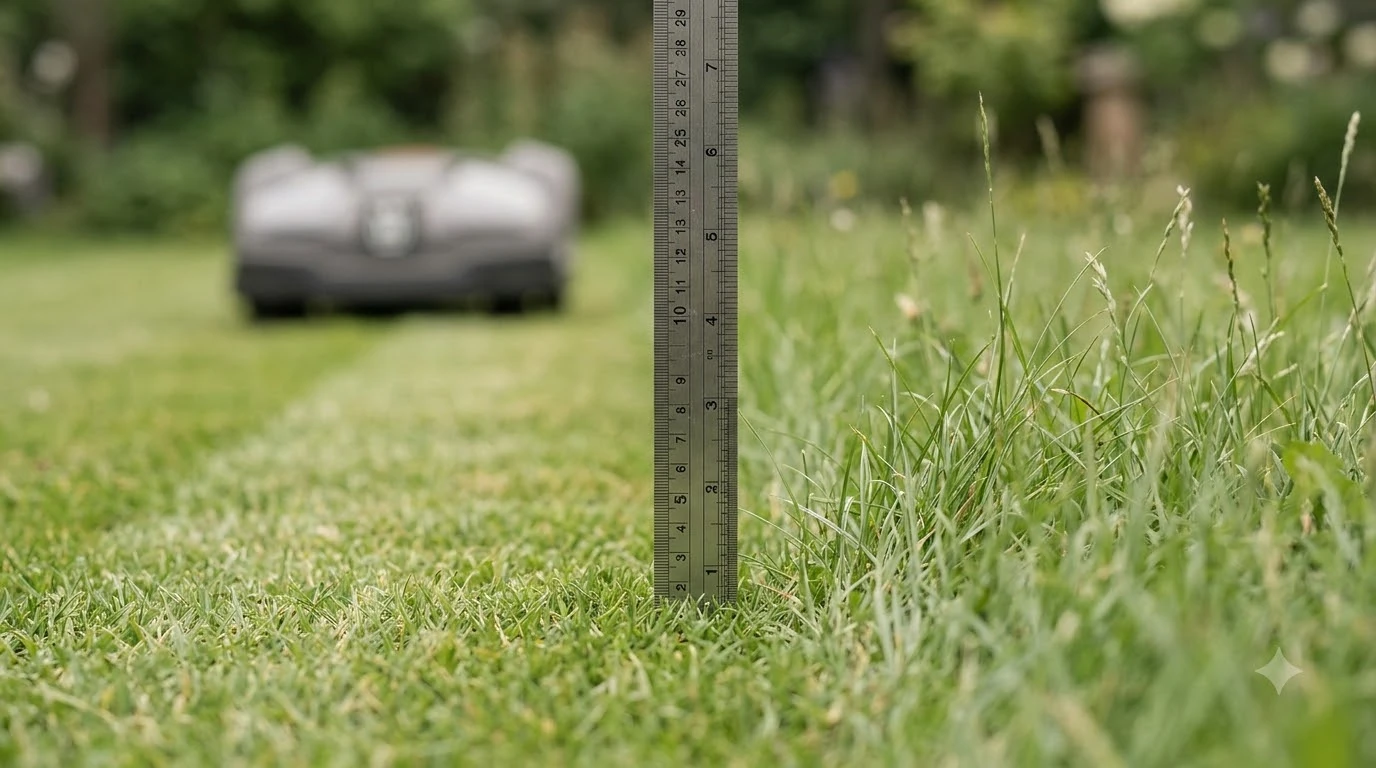

Can a robot mower cut mixed weedy lawn? Yes, but it trims the weeds at the same height as the grass and does not remove them. UF/IFAS research summarized in its Florida guide found that autonomous mowers can reduce overall weed coverage compared with rotary mowers, although creeping weeds such as clover may increase under frequent mowing. Below: what the mower does to each kind of weed, which cutting heights matter, and what to check first.
The short answer
- Grass and weeds: the blades cut anything that grows above the set height, so taller weeds are trimmed along with the turf.
- Weed control: cutting does not pull roots or kill plants, so the mower lowers weed growth but does not clear a weedy lawn by itself.
- Clover: frequent mowing can let clover spread, which UF/IFAS calls a possible positive in a mixed-species lawn.
- Height: match the cut to your grass type, since a cut that is too low favors some weeds.
- Before the first run: set the height, lower the edges and check the blades.
What a robot mower does with weeds in a mixed lawn
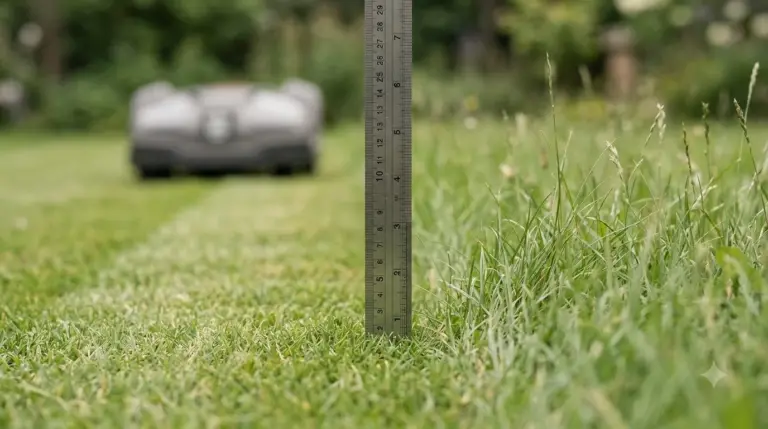
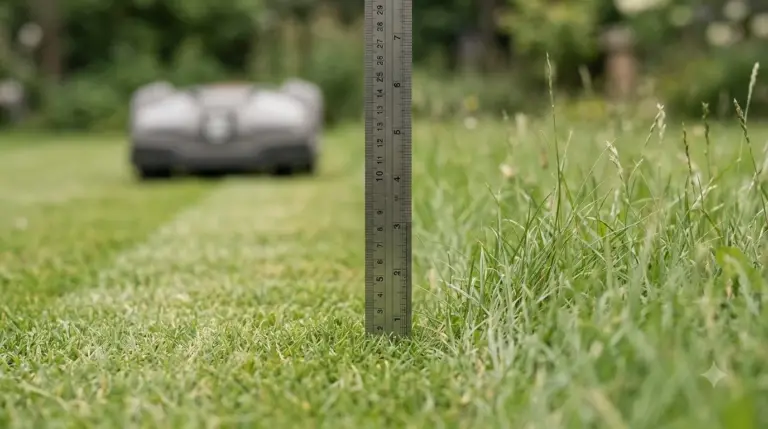
A robot mower cuts every plant that rises above its blade height, whether it is grass or a broadleaf weed. The blades spin on a disk and trim the top growth, so a dandelion or clover stem that sticks up is cut just like a blade of turf. Our reading is that this removes the visible leaves but leaves the root system in place, which means the plant can regrow.
Research gives a fuller picture than the cutting action alone, and it speaks to the practical worry: can a robot mower cut mixed weedy lawn without making it worse?
The UF/IFAS publication ENH1402, by Jaspal Singh, P. Agustin Boeri, J. Bryan Unruh and Alex J. Lindsey, reports that autonomous mowers can reduce overall weed coverage compared with rotary mowers, citing Grossi et al. (2016). That is a comparison of coverage, not a promise that a robot mower clears a weedy lawn. The studies in its reference list that cover weeds (Grossi et al. 2016 and Pirchio et al. 2018a) were run on tall fescue lawns, so our reading is that results on other grasses may differ. The UF/IFAS guide on autonomous mower use is the best starting point for the full comparison.

Why clover and other creeping weeds can spread
Creeping weeds such as clover can increase under frequent mowing, according to UF/IFAS, which adds that this result could be considered positive if a mixed-species lawn is what you want. The same publication says frequent mowing improves turf density, which may reduce some weeds, but can allow low-growing species like clover to spread.
Penn State Extension treats white clover as a warning sign rather than a problem on its own. Its guidance says white clover indicates that the mowing height for turf is lower than desired, and it recommends a height of at least 2 inches, with 3 inches better for some species. If clover shows up across a lawn that is cut often, check the height before you change anything else, and see our robot mower clover lawn guide for the mixed-lawn case. Penn State’s indicator weeds guide lists the clover note and other signals.
How cutting height changes the weed mix
For a mixed lawn, the right height depends on your grass as well as on the weeds. Most autonomous mowers were designed for cool-season grasses, which are typically mowed below 2.5 inches, while St. Augustinegrass needs 2.5 to 4 inches, a range that may exceed the limits of some robot mower models.
| Lawn situation | Height the source gives | Where it comes from |
|---|---|---|
| Cool-season grass, general | Typically below 2.5 inches | UF/IFAS ENH1402 |
| St. Augustinegrass | 2.5 to 4 inches | UF/IFAS ENH1402 |
| Lawn with white clover | At least 2 inches, 3 inches better for some species | Penn State Extension |
A UF/IFAS study reported in June 2026 ran a robot mower set at 2.4 inches on St. Augustinegrass and found denser, healthier turf than on conventional weekly mowing. The coverage of weeds was not part of those findings, so the study tells you about turf quality, not weed control. For settings by grass type, see what height a robot mower should cut grass. UF’s news report on the study gives the details.
What weed types tell you about the soil
Some weeds point to soil conditions rather than to the mower, so a robot mower will not fix a lawn that these weeds signal. Penn State Extension lists several indicator weeds in its guide.
- Dandelion, chickweed and plantain: compacted or heavy soils.
- Crabgrass and prostrate knotweed: acid soils.
- Crabgrass: low-fertility soil.
- Dandelion: soil that is too fertile.
Our reading is that a robot mower that runs more often does not change any of these conditions. If the same weeds keep coming back, a soil test from your local extension office is a better next step than a new mowing schedule.
Where a robot mower has trouble in a weedy lawn
Can a robot mower cut mixed weedy lawn that is flat, open and free of obstacles? That is the case it handles best. UF/IFAS lists several limits: robot mowers may struggle in complex landscapes with many obstacles, and raised beds or borders can leave grass along the edges taller, which then needs string trimming. Irrigation heads can make the mower unstable and cause damage.
Heads up
UF/IFAS says blade sharpness declines with use and recommends replacing blades every six to eight weeks during the growing season. Sharp blades reduce leaf damage, so an old blade can make a weedy lawn look worse.
The same publication lists lawns that are less suitable for these mowers:
- Very large or complex landscapes.
- Lawns that require a higher mowing height.
- Areas with frequent debris or uneven terrain.
Can a robot mower cut mixed weedy lawn? What to check first
Before the first run on a mixed lawn, set the height for your grass, lower or trim the edges, and check the blades. These steps shape how the mower handles weeds, and they cost little time compared with fixing a lawn that was cut at the wrong height for months.
- Set the height for your grass. Use the ranges in the table above, and do not cut lower just to hide weeds.
- Lower the edges. UF/IFAS recommends lowering raised beds and borders so the mower can reach the edge grass.
- Check the blades. Replace them every six to eight weeks during the growing season; our robot mower blade sharpening or replacement guide explains the choice.
- Watch for clover and tall patches. If clover spreads, check the cutting height before anything else.
- Plan for the weeds the mower cannot remove. Cutting does not pull roots, so decide how you will handle those weeds separately.
Frequently asked questions
Will a robot mower kill weeds?
No. The UF/IFAS publication describes robot mowers reducing overall weed coverage compared with rotary mowers, which is a different result from killing weeds. Cutting removes the visible top growth, so weed removal is a separate job.
Can a robot mower cut mixed weedy lawn without spreading clover?
It can. UF/IFAS says creeping weeds such as clover may increase under frequent mowing. Penn State links white clover to a mowing height that is lower than desired, so check the height first. Whether a robot mower can cut mixed weedy lawn without feeding clover depends largely on that setting.
What height should I set for a mixed lawn?
It depends on the grass. UF/IFAS gives typical cool-season heights below 2.5 inches and 2.5 to 4 inches for St. Augustinegrass. Penn State recommends at least 2 inches where clover is a concern.
Do dull blades matter on a weedy lawn?
Yes. UF/IFAS says blade sharpness declines with use and recommends replacing blades every six to eight weeks during the growing season, because sharp blades reduce leaf damage.
Sources
- UF/IFAS Extension, Autonomous or Robotic Mower Use on Florida Lawns (ENH1402) (university extension): weed coverage, clover, cutting heights, blade replacement and limits.
- UF news, robot mowers and St. Augustinegrass, June 2026 (university): 2.4 inch cutting height and turf quality.
- Penn State Extension, Indicator weeds provide insight into growing a better lawn (university): white clover, soil indicator weeds.
 Up next8 min readBy YardDo Robot Mowers Work on Bumpy Lawns? What to Know FirstUpdated Nov 11, 2026
 9 min readBy YardHow Do I Know If a Robot Mower Will Work in My Yard?Updated Nov 11, 2026
 7 min readBy YardCan a Robot Mower Cut Perennial Ryegrass? What the Sources SayUpdated Nov 11, 2026
 7 min readBy YardCan a Robot Mower Cut Fine Fescue? Heights and What to CheckUpdated Nov 11, 2026
 9 min readBy YardCan a Robot Mower Cut Zoysia? Height and LimitsUpdated Nov 11, 2026
 8 min readBy YardCan a Robot Mower Cut Cool Season Grass?Updated Nov 11, 2026