
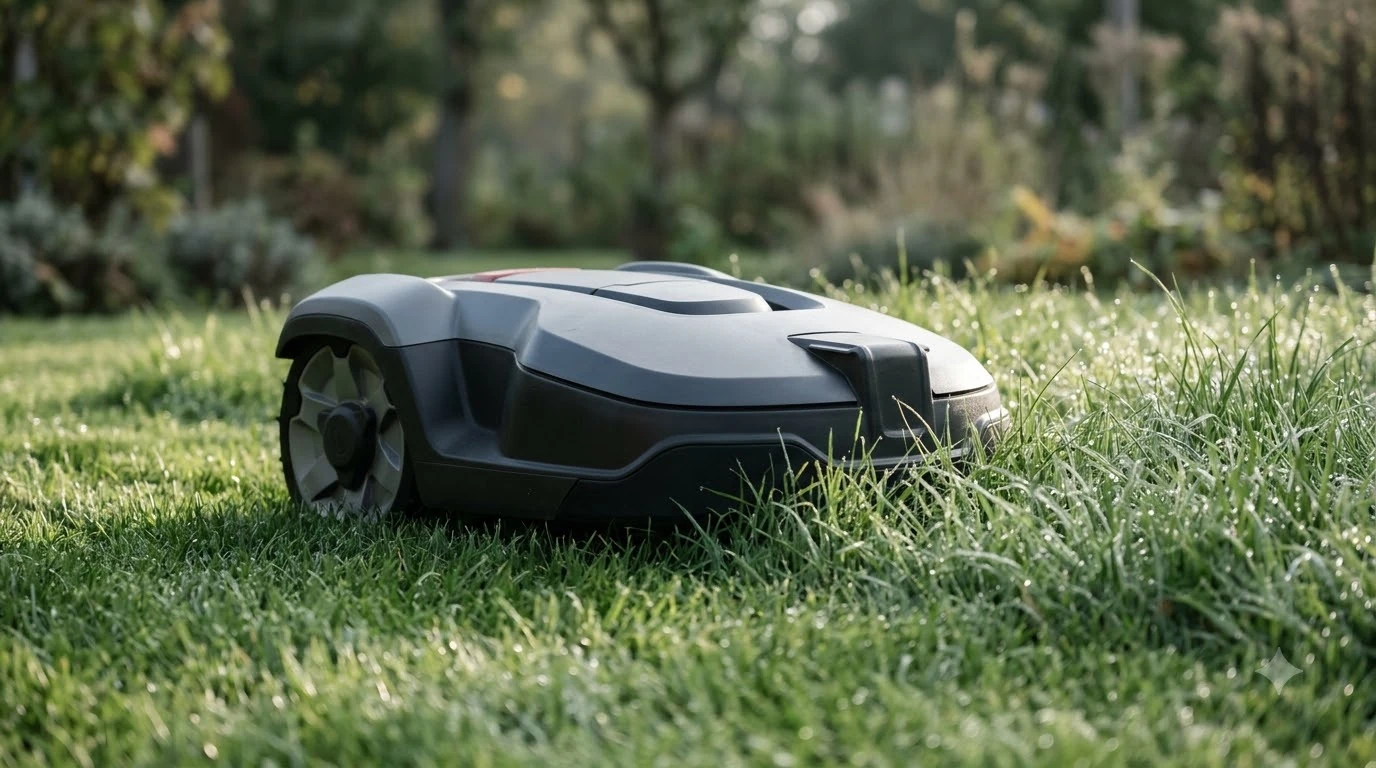

Can a robot mower cut cool season grass? Yes, as long as the mower’s highest cutting setting reaches the height your lawn needs. UC IPM sets Kentucky bluegrass, perennial ryegrass and tall fescue between about 1.5 and 3 inches. Summer heights run higher, and that is where many robot mowers fall short.
The deciding factor is cutting height, not brand. Spring and fall heights mostly fit typical robot ranges, while summer heights often do not.
The short answer
- Common cool-season types: Kentucky bluegrass, perennial ryegrass and tall fescue.
- Set heights: 1.5 to 3 inches depending on the grass, per UC IPM.
- Summer: Iowa State Extension gives Kentucky bluegrass 3 to 3.5 inches from June to August.
- Robot range: many models cut 20 to 60 mm, about 0.8 to 2.4 inches, per Robomow.
- What to check: the highest setting on the spec sheet, not the lowest.
Can a robot mower cut cool season grass types?
Yes, a robot mower can cut Kentucky bluegrass, perennial ryegrass and tall fescue when its setting covers their UC set heights of 1.5 to 3 inches. Cool-season grasses grow most actively in spring and fall, when temperatures are mild and growth is steady. UF/IFAS adds that most autonomous mowers were designed for cool-season grasses, which are typically mowed below 2.5 inches.
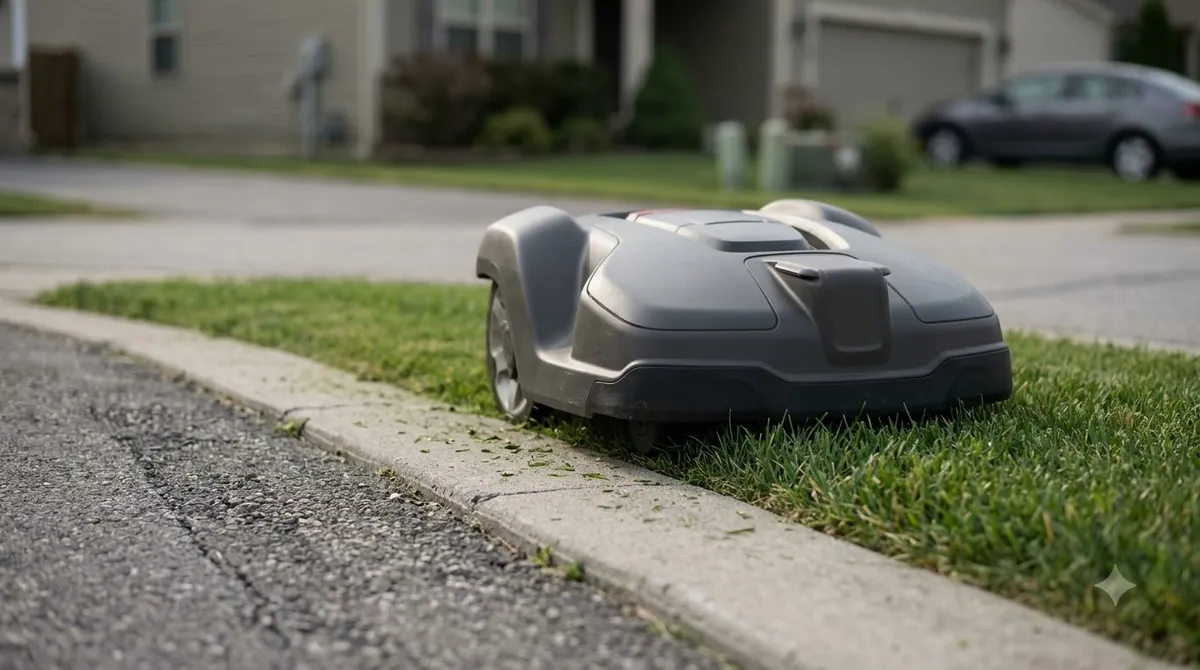
The table lists two heights for each grass. The set height is where you adjust the mower, and the mow-when height is the point at which the grass has grown enough to cut. UC IPM gives both for each type.
| Grass | Set height | Mow when grass reaches |
|---|---|---|
| Kentucky bluegrass | 1.5 to 2.5 inches | 2.25 to 3.75 inches |
| Perennial ryegrass | 1.5 to 2.5 inches | 2.25 to 3.75 inches |
| Tall fescue | 1.5 to 3 inches | 2.25 to 4.5 inches |
The same UC page sets red fescue at 1.5 to 2.5 inches and hard fescue at 2.5 inches, so the fine fescues sit in the same band as the grasses above. UC Healthy Lawns’ guide to mowing cool season grasses also says to remove no more than one-third of the height at one mowing.
What cutting height does a robot mower reach?
The adjustment range is the limit, and it differs by model. Robomow, a robot mower maker, says many robotic lawnmowers have a cutting height of 20 to 60 millimeters, while other models range from 20 to 100 millimeters. It adds that no robot on the market mows a lawn shorter than 15 millimeters.
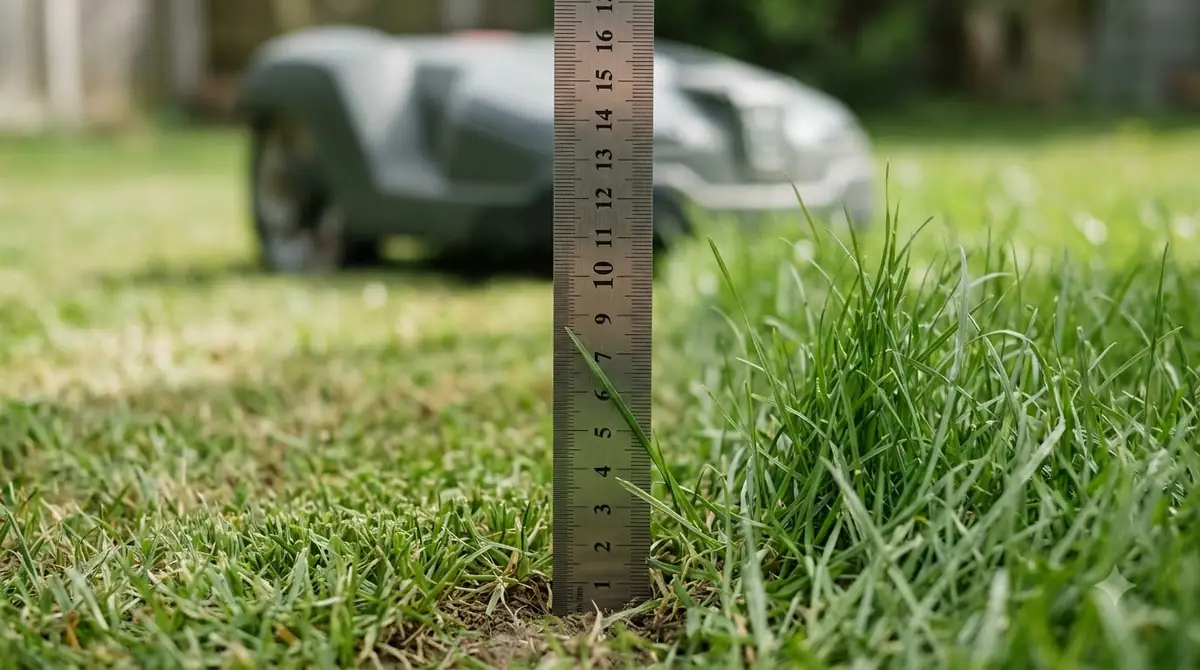
Those figures are in millimeters, so the list below converts them to inches. Treat the conversion as a rough guide, not a spec for any one model.
- 20 to 60 mm: about 0.8 to 2.4 inches, typical for many models.
- 20 to 100 mm: about 0.8 to 3.9 inches, found on other models.
- 15 mm: about 0.6 inches, the lowest cut Robomow says any robot makes.
UC IPM’s set heights of 1.5 to 3 inches fit inside the typical range. Iowa State’s 2.5 to 3 inches for bluegrass in spring and fall is already above the 2.4 inch top of a 20 to 60 mm mower, so even those seasons need a spec check. Robomow’s cutting height guide is a manufacturer source, so compare its figures with the spec sheet of the model you are considering. Our reading is that the highest setting is the number to compare, because it caps how tall the mower can leave the grass.
Why summer heights are the hard part
Summer is where cool-season lawns get harder to match. Iowa State Extension puts Kentucky bluegrass at 3 to 3.5 inches from June to August, which is above the top of the 20 to 60 mm range that many robot mowers offer. Heat and dry weather slow growth and stress the turf, so the advice is to cut taller.
| Season | Kentucky bluegrass mowing height (Iowa State Extension) |
|---|---|
| Spring and fall | 2.5 to 3 inches |
| June to August | 3 to 3.5 inches |
Tall fescue follows the same pattern. Clemson HGIC lists 3 to 3.5 inches for tall fescue in summer, and the University of Tennessee Extension gives 2.5 to 3.5 inches as the optimum for hot, dry conditions. Both sources point the same way: taller in heat. Our robot mower lawn care calendar shows how the seasons line up.
UC IPM adds two points. It says to mow less often in summer when growth slows, and to cut on the higher end of the range to build turf that handles drought, heat, traffic, shade and pests.
None of this means the answer is no for summer lawns. It means a mower whose top setting is 2.4 inches cannot leave Kentucky bluegrass at 3 inches, so asking can a robot mower cut cool season grass in July really means asking about the top setting.
What the research shows so far
Research on robot mowers and cool-season turf is still early. A University of Connecticut trial reported that tall fescue and Kentucky bluegrass showed the best quality and color at a 2.25 inch cut. It tested cutting heights of 1.25, 2.25 and 3.25 inches, and UConn Today describes the work as ongoing, with the best results “so far” in a middle range of 2 to 2.5 inches.
No single trial tells you how a specific mower will perform on your lawn. Our reading is that the trial supports a middle cut around 2 to 2.5 inches for these two grasses, and that you should confirm your mower’s range before relying on it.
How to check whether a robot mower can cut cool season grass
So, can a robot mower cut cool season grass on your lawn? To settle it, compare the highest setting on the spec sheet with the summer height of your grass. A robot mower cannot leave the lawn taller than its top setting, so work through these steps before you buy or adjust a mower. For general settings, see what height a robot mower should cut grass.
- Identify the grass. Check the sod or seed label, or ask the installer. Kentucky bluegrass, perennial ryegrass and tall fescue have different set heights, so the type sets your target height.
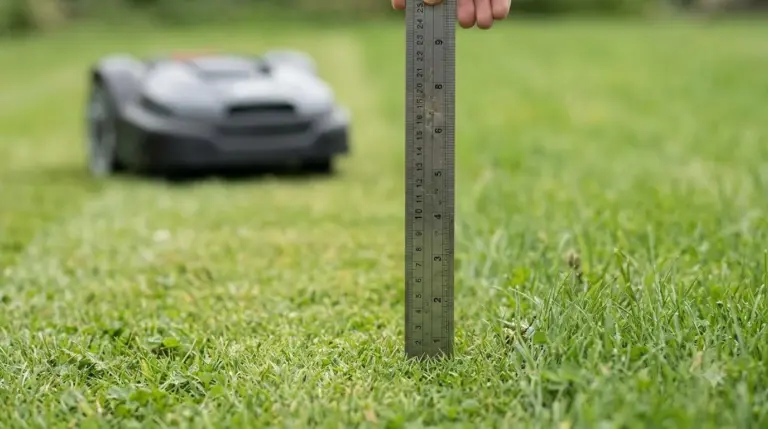
- Compare the top setting. Convert the highest cutting height on the spec sheet to inches. A top of 60 mm is about 2.4 inches, which sits below the 3 to 3.5 inch summer height for Kentucky bluegrass.
- Plan the mowing frequency. UC IPM says to mow regularly in spring, less often in summer, and more often again in fall. Our reading is that a mower that runs more often removes less grass per cut, which keeps each cut within the one-third rule.
- Cut high on new lawns. UC IPM says to cut on the higher end of the range when mowing a new lawn for the first time. Start near the top of your target range, then lower the setting only after the lawn has filled in.
Read the top setting first. A mower that tops out below your summer height will keep the grass shorter than you want in heat, and no amount of adjusting changes that. Choose a model whose range covers your grass, then fine-tune from there.
Frequently asked questions
Can a robot mower cut cool season grass like tall fescue?
Yes, if its highest setting reaches the height you want. UC IPM gives tall fescue a set height of 1.5 to 3 inches and a mow-when height of 2.25 to 4.5 inches. Clemson HGIC lists 3 to 3.5 inches for summer, so check that the mower’s top setting covers the summer number. On fescue, that top setting is the number to read first.
Is 2.25 inches the right height for robot-mowed bluegrass?
It can work, but it depends on the mower’s range. UConn’s ongoing trial found 2.25 inches gave the best quality and color for Kentucky bluegrass so far, and the results are not final. UC IPM sets Kentucky bluegrass at 1.5 to 2.5 inches. Our reading is that 2.25 inches is a reasonable middle starting point, then adjust by watching the lawn.
Why do sources give different heights for the same grass?
Sources describe different climates and seasons, so the answer to “can a robot mower cut cool season grass” shifts by region. UC IPM gives set and mow-when ranges, Iowa State Extension separates spring, fall and summer, and Clemson and Tennessee give seasonal or regional optima. Choose the source that matches your region, and confirm with your local extension office.
Should a robot mower cut cool-season grass shorter in fall?
No, the sources do not call for a lower cut in fall, and the same top-setting check applies. UC IPM says growth picks up again in fall, so mowing becomes more frequent. Iowa State Extension gives Kentucky bluegrass 2.5 to 3 inches in spring and fall, so keep the height in that band.
Sources
- Mowing Cool Season Grasses (UC Healthy Lawns, UC IPM): set and mow-when heights, the one-third rule, mowing frequency, and cutting higher for new lawns, heat and shade.
- UConn research shows autonomous mowers make the cut (UConn Today): trial heights and early results for tall fescue and Kentucky bluegrass.
- What is the correct mowing height for my lawn in summer? (Iowa State University Extension and Outreach): Kentucky bluegrass heights by season.
- Mowing Lawns, Factsheet 1205 (Clemson Home and Garden Information Center): tall fescue summer and winter heights.
- Turfgrass Maintenance: Mowing, W161-I (University of Tennessee Extension): optimum tall fescue ranges for cool and hot conditions.
- What is the ideal cutting height for a robotic lawnmower? (Robomow): typical robot cutting ranges in millimeters.
 Up next9 min readBy YardBest Robot Mower for Warm Season Grass: 2026 ChecklistUpdated Nov 11, 2026
 8 min readBy YardHow Often to Mow Bermuda Grass by SeasonUpdated Nov 11, 2026
 8 min readBy YardCan a Robot Mower Cut Centipede Grass? Heights and LimitsUpdated Nov 11, 2026
 9 min readBy YardCan a Robot Mower Cut Thick Southern Grass?Updated Nov 11, 2026
 9 min readBy YardWhat Happens If You Cut Grass Too Short?Updated Nov 11, 2026
 10 min readBy YardCan a Robot Mower Cut St. Augustine Grass?Updated Nov 11, 2026