
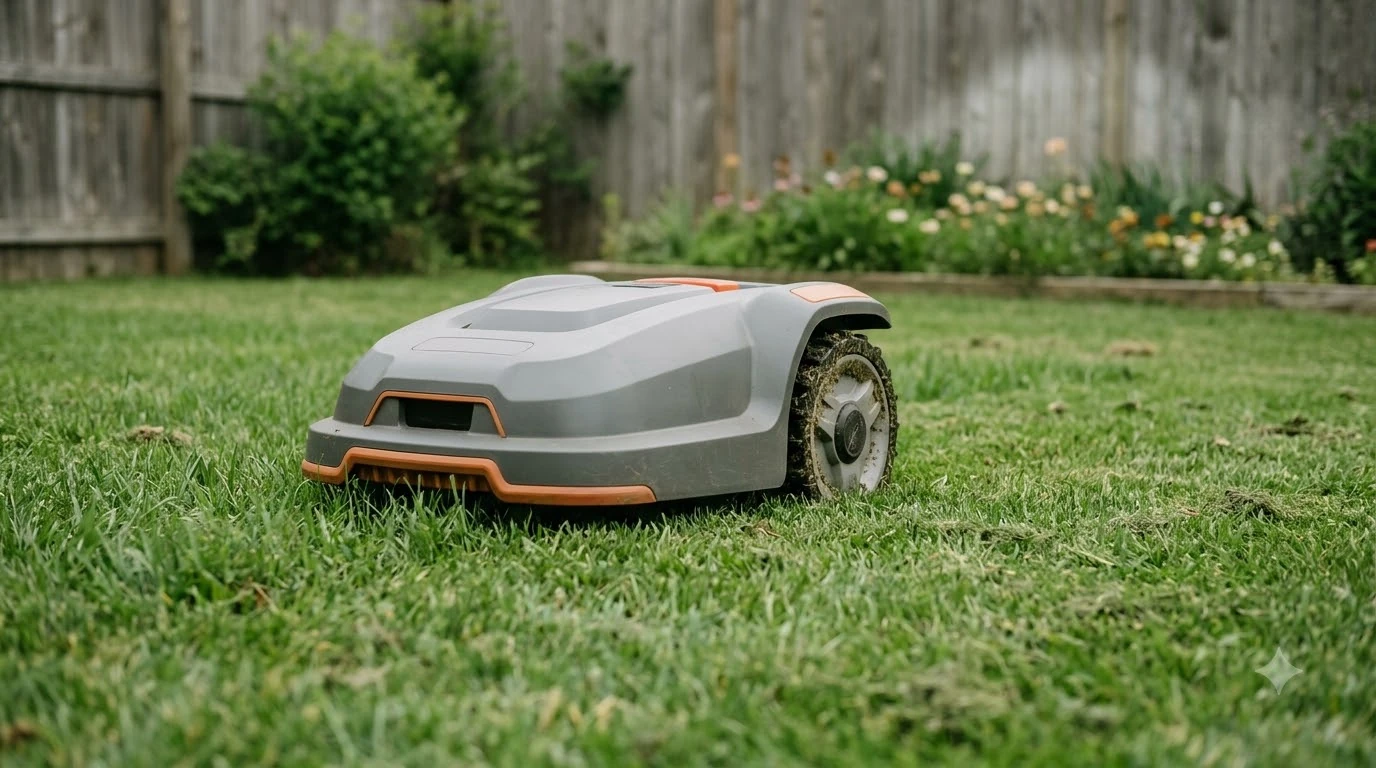

Worx Landroid Vision pros and cons come down to one trade: no boundary wire to bury, but a navigation system you have to trust. The Vision line uses cameras or cloud-based RTK instead of a perimeter wire, which reviewers consistently list as its main advantage. The same reviews flag a random mowing pattern, short battery life on the M600 reviewed, and weak handling of leaves and sticks.
The short answer
- Main pro: no boundary wire to install, and the Vision AI models need no RTK antenna either.
- Main con: the mowing pattern is random, so coverage takes longer than with a wire-guided mower.
- Debris: reviewers report weak handling of leaves, sticks, and overgrowth.
- Charging base: it needs a flat, dedicated spot with clear space in front and a clear view of its QR code.
- Warranty: 2 years on the unit, 3 years if you register within 30 days, and 1 year on the battery.
What the Landroid Vision name covers
The Landroid Vision name covers two different navigation systems, so check the model code before you compare Worx Landroid Vision pros and cons across reviews. Vision AI models use cameras and do not need a mapping step, and Worx says they need no boundary wires, RTK antennas, or radio beacons. The Vision Cloud models use centimeter-level RTK positioning from the cloud, with no antenna on your property. If you are still choosing a model, our guide to which Worx Landroid model to buy compares the range.
Model names and lawn ratings also vary by market. On the US Landroid page, the WR220 Vision AI is listed for lawns up to 1/2 acre, while the Vision Cloud models run from 1/4 acre (WR310.1 and WR341) to 1 acre (WR340). A UK review of the Vision AI M600 (WR206E) gives a rating of up to 600 m2. Read the rating for your exact model code, not the family name.
Worx Landroid Vision pros reviewers report most often
The most repeated pro is the lack of a perimeter wire. Worx’s EU page for the Vision AI line calls it “the only robotic mower that needs no installation,” although the charging base still has to be placed and the zones still have to be set up.
Obstacle handling and edge work come next. Expert Reviews, in its review of the M600, lists “Intelligently avoids obstacles” and “Good edge management” as pros, and says the mower dodged an array of dog toys and turned around rather than running over the reviewer’s feet. The Worx Vision AI page says the mower “identifies and respects anything that’s not grass or leaves,” though that is a brand claim.
Cut quality is the third pro. A Reviewed reviewer of the WR340 lists “Excellent mowing quality,” “Quiet operation,” and “Easy app controls.” Our reading is that these three are worth weighing only after you have checked the lawn size and the charging base layout.
The cons and where they show up
The most common con is coverage efficiency. Expert Reviews describes the M600’s path as “random,” and says it needs more time to cover a lawn than a wire-guided mower. The same review found that most of a 100 m2 lawn was cut on the first outing, but some longer tufts remained after several mows. If you want a tidy stripe pattern, this is the first trade-off to weigh before you buy.
Battery life is the second con. Expert Reviews lists “Short battery life” as a con for the M600 but gives no runtime figure, so check the runtime for your model in the official manual before you buy. For fault-finding after purchase, see our notes on common Landroid Vision faults and checks.
Heads up
Debris is the weakest area in the reviews. The WR340 reviewer says the mower will “either navigate around those larger objects or roll over them and flick them rather than mulch them.” Yards with many pinecones, sticks, or acorns need regular cleanup.
Wooded and overgrown areas are the third con. The same WR340 review says the mower has trouble in wooded sections, where sticks, pinecones, and acorns collect. The WR340 review’s list of cons also includes “Not for overgrowth,” so tall grass should be cut down before the mower starts.
The fourth con is space. The WR340 reviewer says the charging mat needs “a dedicated, flat spot with access to the lawn,” and that the mower “can require babysitting.” The reviewer also says it got stuck a few times over several days, which was easy to reset.
Installation: charging base and zones
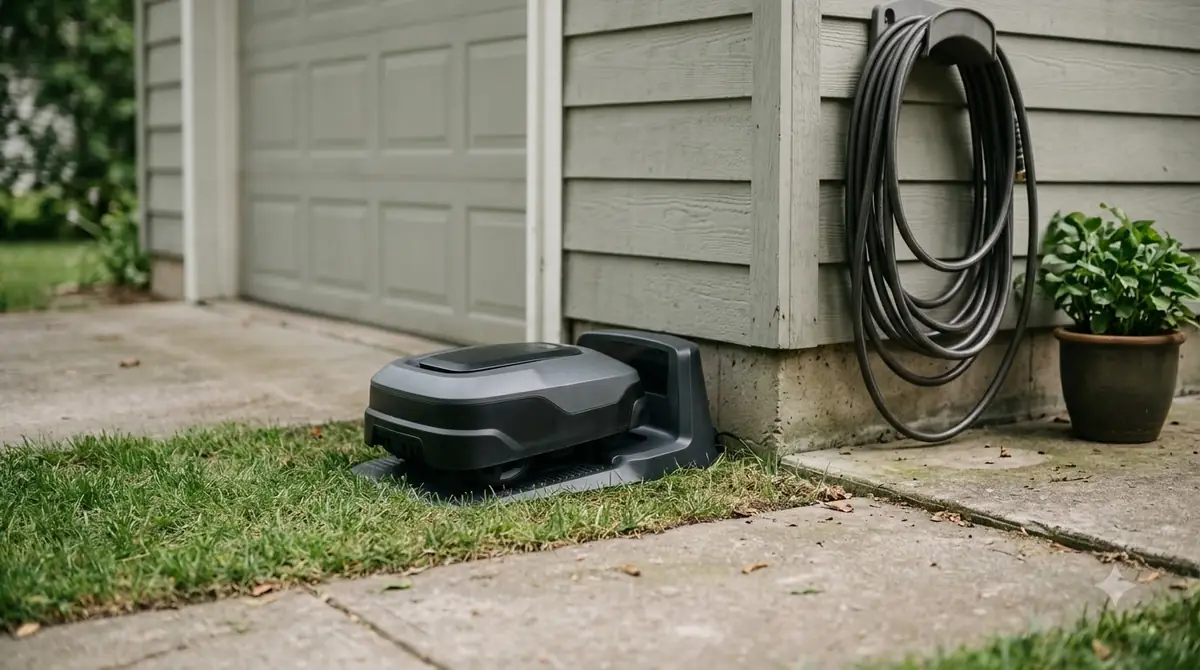
Setup centers on the charging base, not on wire. Worx’s wiki says the base needs flat ground, a straight 2 m path in front of it, and at least 1.5 m of clearance behind it when it sits on the lawn side. A flat, hard surface is recommended, and on a hard surface you fix the base down with plugs and screws. For the full walkthrough, see our guide to setting up the Landroid Vision.
The Vision mower does not use Wi-Fi or Bluetooth to find the base. It reads the base’s QR code with its camera, so the code must stay clean and visible. Worx says the mower travels anti-clockwise along the lawn boundary to find the base, so the base should face the direction the mower approaches from. A Worx troubleshooting page says the camera must be able to recognize the QR code while the mower searches for the base.
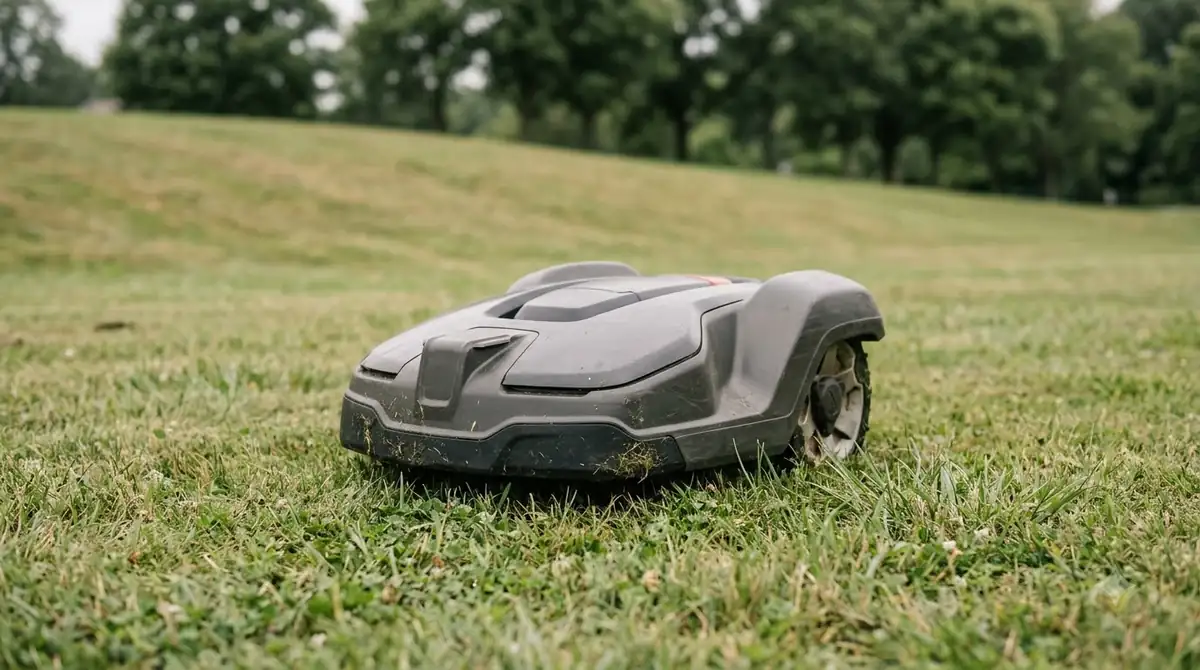
Multi-zone setups use RFID tags. Worx’s zone guide says each zone should be wider than 2 m, the path between zones should be shorter than 6 m, and any step along that path should be under 3 cm. Each tag sits 50 to 60 cm from the lawn edge, more than 1.5 m from the front and rear boundaries, with no obstacles within 1.5 m of it. Worx’s multi-zone setup guide lists these rules, and the zone will not be mowed unless its schedule is set in the app.
Setup time is a point reviewers praise. The Expert Reviews reviewer calls the M600 “one of the easiest robot lawn mowers I’ve tested to set up,” while noting that a base station is still needed. The main work is therefore placing the base and checking the camera’s view of its QR code, not running wire around the yard.
Slope and step claims are model-specific, so the trade-offs depend on the exact model. Worx says the WR341 Vision Cloud 4WD is built “for slopes and steps,” but the US lineup page gives no numeric slope rating for any Vision model. If your lawn has a steep section, ask for the slope figure in the model’s manual before buying, since the reviews above do not test it.
Warranty and registration
Warranty is part of the Worx Landroid Vision pros and cons for buyers who keep a mower for years. Worx’s warranty statement gives the unit a 2-year warranty, and the battery a 1-year warranty. Registration extends the unit warranty to 3 years, but the page requires registration within 30 days of purchase. Without it, only the 2-year term applies. Blades, wheels, and other accessories are excluded, and so is damage from pressure washers, steam, or running water. Worx’s warranty statement has the full terms, which can differ by region.
Worx Landroid Vision pros and cons: who it suits
The Worx Landroid Vision pros and cons matter most for a yard where a boundary wire is the main obstacle to buying a robot mower, and where the lawn falls inside the rated size for the model. Our reading is that it fits a single, open lawn with a flat, sheltered spot for the base. Tree-lined yards with fallen sticks and pinecones are a poor match, given the debris reviews.
Buyers who want the most predictable stripe pattern, or who have a lot of overgrowth, should compare a wire-guided mower before deciding, and can start with our list of alternatives to the Worx Landroid or the Worx Landroid Vision against the Husqvarna 115H. The Worx Landroid Vision AI page itself says “Vision AI doesn’t need boundary wires, RTK antennas or radio beacons,” so the trade is clear: less setup, more reliance on the mower’s sensing and navigation.
Frequently asked questions
Does the Worx Landroid Vision need a boundary wire?
No. Worx says the Vision AI models need no boundary wires, RTK antennas, or radio beacons. The Vision Cloud models use RTK positioning from the cloud and also have no antenna to install on your property.
Is the Landroid Vision good at avoiding obstacles?
Reviewers report good obstacle avoidance. Expert Reviews says the M600 turned around when it detected objects in its test, and Worx says the Vision AI identifies anything that is not grass or leaves. Both are reports or brand claims, so check how your own yard behaves.
How long is the Landroid Vision warranty?
Worx gives the unit 2 years, and 3 years if you register within 30 days of purchase. The battery has a 1-year warranty. Blades, wheels, and damage from pressure washers or running water are not covered.
What are the main Worx Landroid Vision pros and cons?
The main pro is that no boundary wire is needed. The main cons are a random mowing pattern, weak debris handling and a need for a flat charging spot. Warranty is 2 years, or 3 with registration within 30 days.
What is the main weakness of the Landroid Vision?
Reviewers most often point to the random mowing pattern, which takes longer to cover a lawn, and to weak handling of debris such as leaves, sticks, and pinecones. Expert Reviews also lists battery life as short on the M600 it reviewed.
Sources
- Worx Landroid lineup (Worx): model codes, lawn sizes, and navigation method for the Vision AI and Vision Cloud models.
- Worx Landroid Vision AI page (Worx): no boundary wire, RTK antenna, or beacon claims, and the obstacle and edge wording.
- Worx Landroid Vision charging base guide (Worx): flat, hard surface and clearance distances.
- Worx Landroid Vision troubleshooting: cannot find the charging base (Worx): QR code, camera, and Wi-Fi or Bluetooth limits.
- Worx Landroid Vision multi-zone setup (Worx): zone width, path length, and RFID tag placement.
- Worx warranty statement (Worx): unit, battery, registration, and exclusions.
- Worx Landroid Vision M600 WR206E review (Expert Reviews): listed pros and cons, obstacle and edge findings, and rated lawn size.
- Worx Landroid Vision WR340 review (Reviewed): pros and cons on debris, wooded areas, charging space, and babysitting.
 Up next7 min readReviews & CompareWorx Landroid Vision Review: 5 Models, Specs and Worth ItUpdated Nov 11, 2026
 7 min readReviews & CompareDreame A1 Pro Review: Specs, Pros and ConsUpdated Nov 11, 2026
 8 min readReviews & CompareWorx Landroid Vision Problems and ComplaintsUpdated Nov 11, 2026
 8 min readReviews & Compareeufy E15 vs Worx Landroid Vision: Lawn Size, Slope and SpecsUpdated Nov 11, 2026
 10 min readReviews & CompareSegway Navimow i105N vs Worx Landroid Vision: Which Fits Your LawnUpdated Nov 11, 2026
 9 min readReviews & CompareHusqvarna Automower 115H vs Worx Landroid Vision: SpecsUpdated Nov 11, 2026