
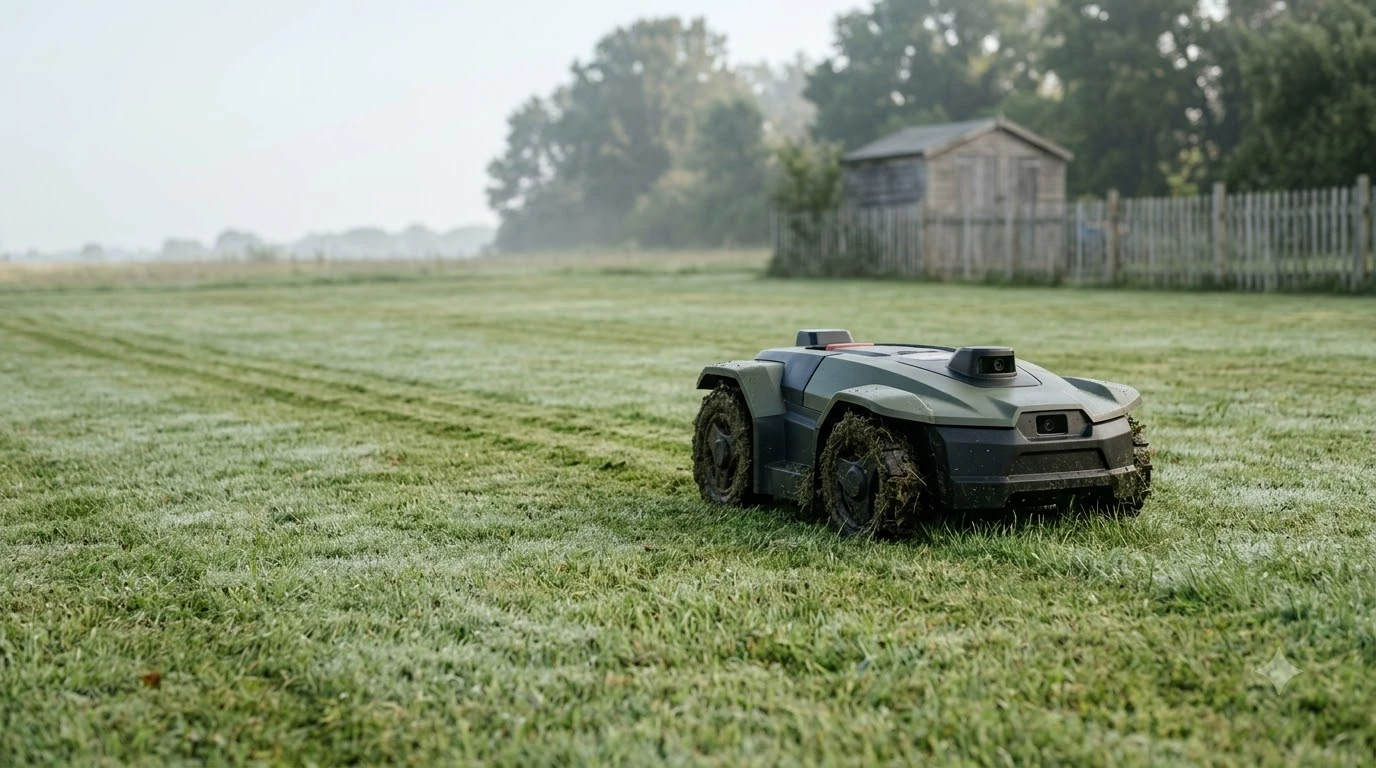

The best robot lawn mower with dual blades depends on your grass, not on the blade count alone. Dual-blade decks are marketed for a finer cut and better mulching, but we found no independent test data comparing them with single-blade robot mowers. This guide covers what the sources say, where they disagree, and what to check before you buy.
The short answer
- Dual blades are a design claim. Published sources describe finer clippings and better mulching, but none offer measured robot-mower results.
- Cutting edges matter more. Husqvarna lists 2 cutting edges on its Classic blades and 4 on its Endurance blades.
- Upkeep costs more. SlashGear says two blades take longer to sharpen and cost roughly double to replace.
- Wet and thick grass is disputed. Sources and vendors disagree, so check the maker’s stated limits.
What a dual-blade robot lawn mower is
A dual-blade robot mower has two cutting blades on its deck instead of one. Yarbo describes its deck as having dual 20-inch blades for a wider cutting width, which is a vendor claim. SlashGear notes that general mower designs place two blades either stacked on top of each other or side by side on the underside of the deck. The layout matters less than the cutting edges and the deck width on the spec sheet.
More blades do not automatically mean more cutting power. Mowrator says a single blade rotates slightly faster than a dual-blade blade set, because the two blades share the same power. That is a general mower claim, and the article gives no figure for it.
What the evidence says about cut quality
No independent test we found compares dual-blade and single-blade robot mowers on cut quality, grass health, or battery use. SlashGear says stacked blades cut the grass twice and produce finer clippings, but it presents this as design reasoning, not as a measured result. The same article says dual blades may reduce clumping in thick lawns, which it also does not measure.
Sharpness matters whatever the blade count. Clemson HGIC notes that a dull blade turns the leaf tip brown at the point of impact and shreds leaf tissue, which weakens the grass. Clemson’s mowing guidance applies to general mowers, so treat it as a principle rather than a robot-specific spec.
Our reading is that a sharp single blade and the best robot lawn mower with dual blades can both give a clean cut, because sharpness decides more than the count. The difference depends on the specific deck, so compare the maker’s data for the model you are considering.
Cutting edges count more than blade count
Husqvarna’s blade specifications count cutting edges per blade, not blades per mower, and that is the number to compare when you shop. Each blade line also lists an edge hardness and a set size.
| Husqvarna blade line | Cutting edges per blade | Edge hardness |
|---|---|---|
| Classic blades | 2 | 58 HRC |
| Endurance blades | 4 | 61 HRC |
Husqvarna sells the Classic blades in 9, 45, and 300 piece sets. For the Endurance line, the company says its blades last more than twice as long as its Long Life Safety Blades, which is a vendor claim with no test data on the page.
Our reading is that edge count tells you how long a blade lasts and how often you can flip it, but it does not show which design cuts better on a lawn.
How mulching and clipping size compare
Mulching blades cut clippings into very small pieces that fall into the lawn. Clemson HGIC describes this as a way to return the clippings to the turf rather than bag them. Yarbo’s comparison page says its dual-blade system offers limited mulching support in tall or dense grass compared with traditional mulching blades. That is a vendor statement, and the page gives no clipping size figure.
Mowrator says dual-blade mowers are better for mulching, while the Yarbo page describes its own mulching as limited in dense grass. The sources do not agree, so the mulching advantage remains unproven for robot mowers. If mulching is your priority, see the best robot mower with mulching blades for a separate look at that feature.
Wet and thick grass: the sources disagree
Sources do not agree on whether dual blades handle wet grass better, so treat the claim as unproven for your lawn. Mowrator says dual-blade mowers are better for cutting wet grass and says single blades may struggle with thick or wet grass. SlashGear says dual blades may reduce clumping in thick lawns, which it does not measure.
Yarbo states that performance is best on dry grass, which runs against the wet-grass claim, although it says its Pro version handles wet, overgrown grass without clogging. Our reading is that wet and thick grass are hard conditions for any robot mower, so check the manufacturer’s stated limits for those conditions rather than relying on the blade count.
Maintenance, blade replacement and cost
Two blades usually mean more upkeep, so learn the signs of dull robot mower blades early. SlashGear says sharpening dual blades takes a longer process and that replacement blades cost double or somewhat more. It gives no price figures, so compare the replacement set prices for your model.
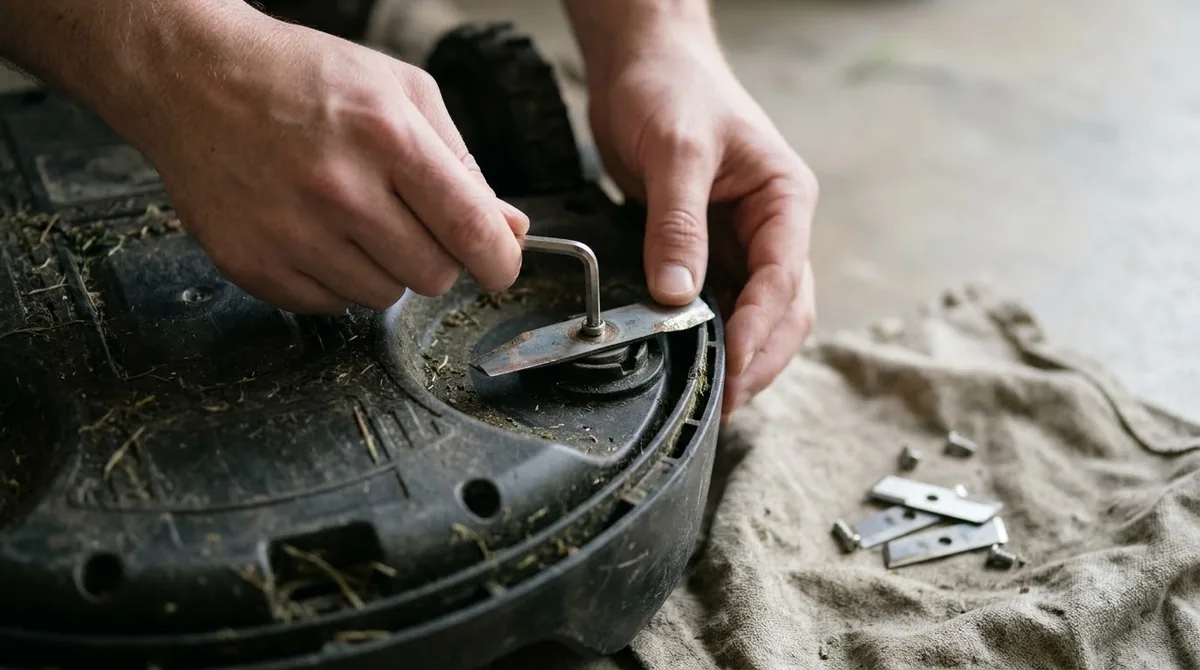
Husqvarna’s support article gives its own schedule. Main disc blades on its Automower models need changing every 3 to 6 weeks under normal conditions, and EdgeCut blades every 9 to 12 weeks when used for edge cutting only. Husqvarna also says to replace the screws each time the blades change and to avoid mixing blade types. For model-specific steps, see how to change Husqvarna Automower blades.
- Weight: SlashGear says dual-blade mowers are in many cases heavier than single-blade models, with no weights given.
- Battery: Mowrator says dual blades may drain electric batteries faster, an unmeasured claim.
- Clogging: Mowrator says dual-blade mowers may clog if not maintained.
How to choose the best robot lawn mower with dual blades
Choose by specifications and maintenance first, because the blade count alone does not show cut quality. Four checks cover most of what the sources support.
- Count the cutting edges per blade. Compare the edge count and hardness in the maker’s spec, not the blade count on the marketing page.
- Check the deck width against your passages. Yarbo says its wide deck gives faster coverage, a vendor claim, so measure the narrowest gap in your yard first.
- Look up the replacement schedule and part numbers. Blade sets differ by model, and the cost of a full dual-blade set is the figure to compare.
- Read the grass limits in the manual. Look for stated limits on height, wet grass, and dense grass, and rely on those over general marketing.
Our reading is that the best robot lawn mower with dual blades suits owners who want the maker’s claimed finer cut and accept higher upkeep. Owners with a simple, dry lawn may find a well-maintained single-blade mower meets the same needs for less work.
Frequently asked questions
Is a dual-blade robot lawn mower better than a single-blade one?
We found no independent test data that shows this. Sources describe dual blades as giving a finer cut and better mulching, but these are design claims or vendor statements. Cut quality depends on sharpness, cutting edges, and the grass you have, so the best robot lawn mower with dual blades is not settled by blade count alone.
How many cutting edges does a robot mower blade have?
It depends on the blade line. Husqvarna lists 2 cutting edges on its Classic blades and 4 on its Endurance blades. Blade count and cutting edge count are different numbers, so check the spec for your exact model.
How often should robot mower blades be replaced?
Husqvarna says main disc blades on its Automower models need changing every 3 to 6 weeks under normal conditions. EdgeCut blades last 9 to 12 weeks when used for edge cutting only. Conditions vary, so check your model’s support page.
Do dual blades cost more to maintain?
SlashGear says replacing dual blades costs double or somewhat more, and that sharpening takes longer. It gives no price figures. Compare the replacement set prices for your model before you decide, since they change over time, and weigh sharpening or replacing robot mower blades against each other.
Sources
- Dual vs Single Blade Lawn Mowers (SlashGear): general claims on layout, cut, weight, and replacement cost; no measured data.
- Dual Blade vs. Single Blade Lawn Mowers (Mowrator): rotation speed, wet grass, battery, and clogging claims; no measured data.
- Mulching blades vs standard blades (Yarbo, vendor): dual 20-inch blades, mulching limits, and dry-grass performance.
- Automower Classic blades (Husqvarna): 2 cutting edges, 58 HRC, pack sizes.
- Automower Endurance blades (Husqvarna): 4 cutting edges, 61 HRC, vendor lifetime claim.
- How and when to change the blades on your Automower (Husqvarna support): blade intervals, screws, mixing blades.
- Mowing Lawns (Clemson HGIC): dull blades and mulching clipping description.
 Up next8 min readBest Robot MowersBest Robot Lawn Mower With Edge Trimming: What the Figures ShowUpdated Nov 11, 2026
 8 min readBest Robot MowersBest Robot Mower with Mulching Blades: What to Check Before You BuyUpdated Nov 11, 2026
 8 min readBest Robot MowersHow Often to Replace Robot Mower BladesUpdated Nov 11, 2026
 8 min readBest Robot MowersRobot Mower Maintenance Checklist: Cleaning, Blades, and StorageUpdated Nov 11, 2026
 7 min readBest Robot MowersBest Robot Lawn Mower for Florida Lawns: 6 ChecksUpdated Nov 11, 2026
 8 min readBest Robot MowersMost Powerful Robot Lawn Mower: What the Specs Really MeasureUpdated Nov 11, 2026