
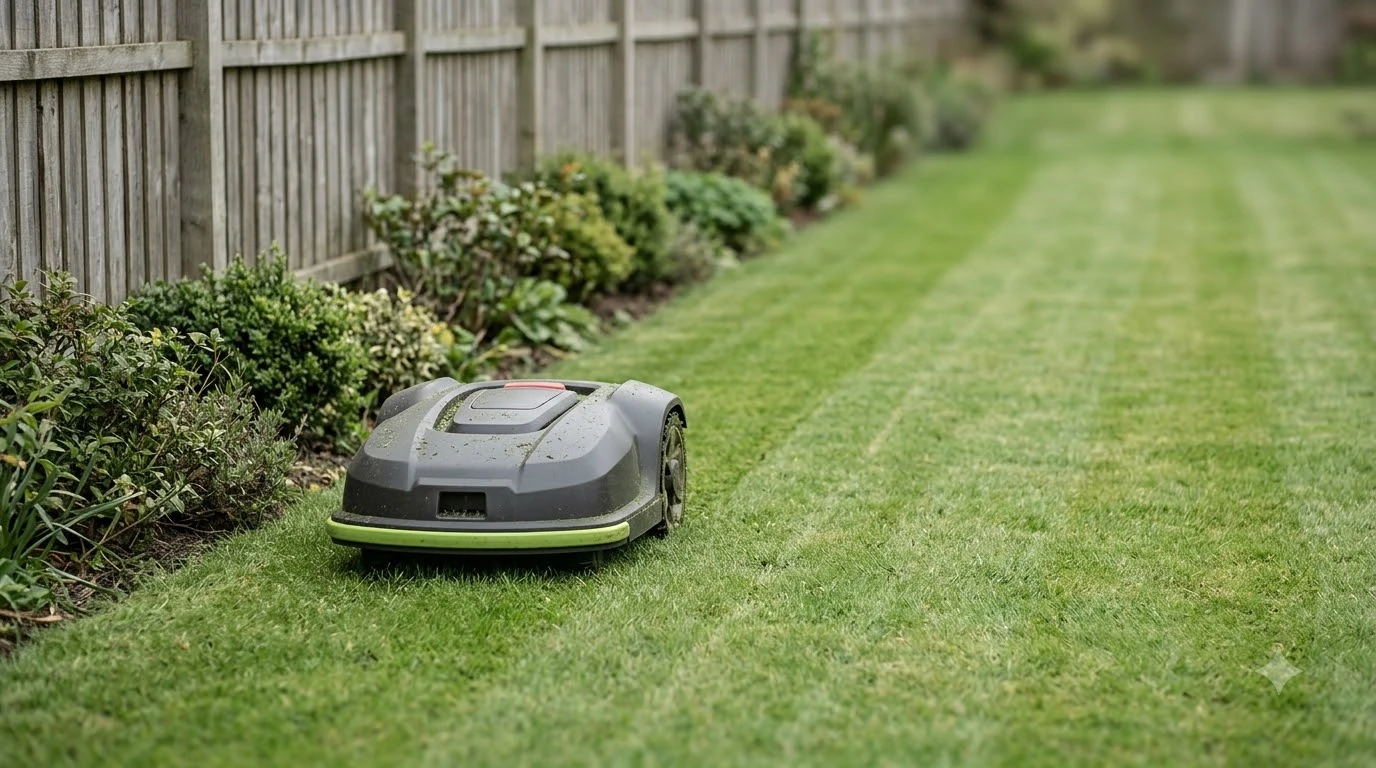

How fast does a robot mower cut? Most robot mowers travel at roughly 0.5 to 2 mph (about 0.2 to 0.9 m/s), according to one consumer guide. The one measured figure we could read from a published study is 0.52 m/s, about 1.2 mph, for a fixed mowing pattern. Travel speed is only one input: cutting width, run time per charge, and the schedule you set decide how long a lawn takes. The numbers below are as of Nov 2026.
The short answer
- Consumer guide range: robot mowers move at about 0.5 to 2 mph, which Eufy describes as moving more slowly than the other mower types it compares.
- Measured figure: 0.52 m/s (about 1.2 mph) for the vertical pattern in a 2025 path-tracking study, with 98.57 percent coverage reported for that pattern.
- Conversion: 1 mph equals 0.447 m/s, so 0.5 to 2 mph is about 0.22 to 0.89 m/s.
- What decides the total: speed, cutting width, and runtime per charge together. Speed alone does not tell you how many hours a lawn takes.
How fast does a robot mower cut in practice?
Travel speed is the distance the mower covers per second while it is moving. It is not the same as how fast the grass gets cut, because a robot does not cut in a straight line for the whole session. It turns at edges, backs away from obstacles, and crosses the lawn in a pattern so the cut is even. A figure of 0.5 to 2 mph is therefore a ceiling for movement, not a rate of lawn coverage.
Eufy’s consumer guide gives the range “about 0.5 to 2 mph” for robot mowers, and says these mowers move more slowly than the other types it compares. That is a general statement for the category. It does not name a model, and it does not say whether the figure is a maximum setting or an average over a session. Read it as a broad range, not a product spec.
The study figure is more specific. A 2025 paper on tracking robot mower trajectories reports that the vertical mowing pattern had the highest speed, at 0.52 m/s, with an efficiency of 0.77. The same paper gives coverage of about 98.57 percent for the vertical pattern, 97.05 percent for the horizontal pattern, and 96.71 percent for the diagonal pattern. The paper is a software test of path patterns on a set of runs. It is not a product rating, and the excerpt we could read did not name the mower model or the cutting width.
For a practical sense of scale, 0.52 m/s is about 1.9 km (1.2 miles) of travel per hour of running. That is our arithmetic from the study figure, and it measures distance moved, not lawn cut. Most of that distance is the mower repeating a pattern over the same ground.
How speed turns into mowing time
Speed alone does not tell you how long a lawn takes. The standard estimate combines speed with cutting width on a robot mower. Mammotion’s blog gives the formula as acres per hour equal to mower speed in mph times cutting width in inches, divided by 124. The divisor of 124 is taken from an Exmark version of the formula and includes an 80 percent efficiency factor for turns and overlap. Total theoretical time in minutes is then lawn area in acres divided by acres per hour, times 60.
Eufy uses a similar form: mowing time is roughly lawn area divided by the product of mower speed and mower width. Both sources describe these as estimates for conventional mowers. Neither publishes a robot cutting width in the pages we read, so the formula gives a shape, not a robot-specific answer.
As an illustration only, take a hypothetical 20-inch cutting width and a speed of 1 mph. That gives 20 divided by 124, or about 0.16 acres per hour, so roughly 6 hours of cutting time per acre. Change the width or speed and the time changes in direct proportion. Check the spec sheet of the model you are looking at for its real width, because the formula is only as good as those inputs.
Why run time per charge matters more than speed
How fast does a robot mower cut in a real session? For most homeowners the limit is not how fast the mower moves but how long one charge lasts and how much area it covers in a session. Navimow’s i Series page lists mowing area per charge of 125 square meters for the i205 AWD and 250 square meters for the i208 AWD. Those figures are about 0.03 and 0.06 acres per charge, by our conversion. A yard of half an acre therefore needs several charges, and the mower returns to the dock to recharge between them.
Our guide to how often a robot mower needs to charge and a look at robot mower battery life cover that side in more detail.
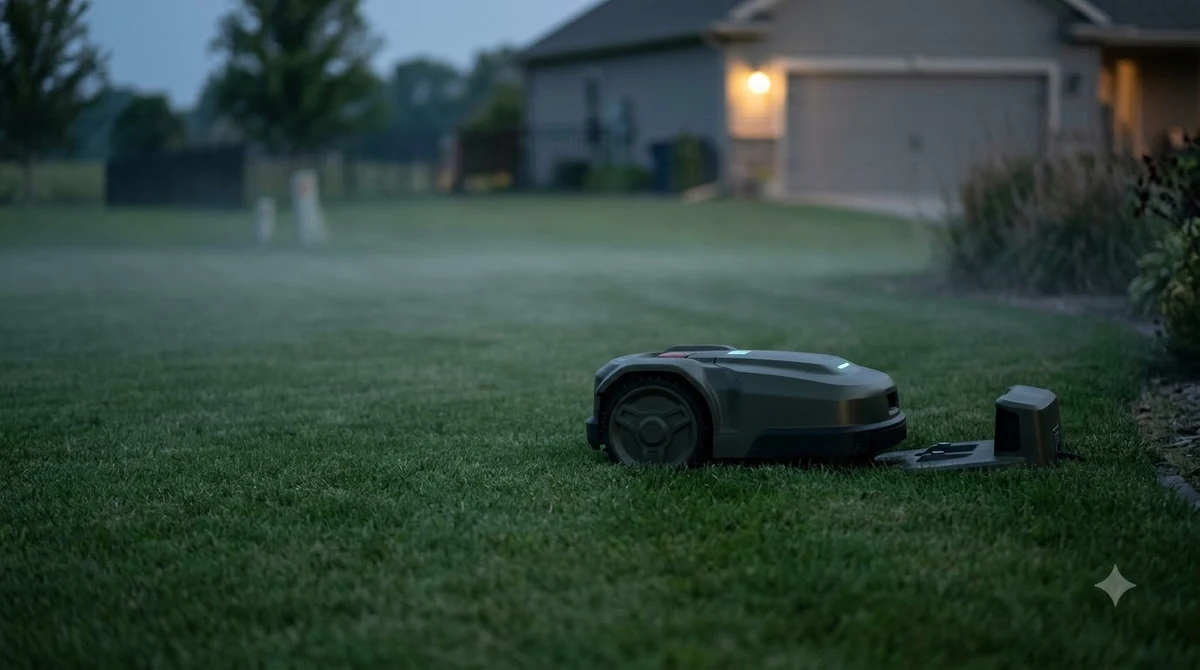
Mammotion lists up to 215 minutes of runtime per charge for its LUBA 3 AWD. The blog notes that robot runtime should not be compared directly with the time a push or riding mower spends operating. The same blog gives a theoretical cutting time built on the 124 divisor, which is a useful baseline but not a guarantee for any single robot.
Husqvarna’s robotic mower page gives rated mowing capacities rather than speeds. Its Automower 410 iQ is listed at up to 0.5 acres, the 420 iQ at up to 1 acre, and the 440 iQ at 2 acres, each with a stated tolerance of plus or minus 20 percent. A capacity rating combines the mower’s speed, width, and run time into one number. It is a better guide to fit than speed alone, and our explainer on robot mower coverage ratings shows how to read it.
Heads up
Capacity ratings and per-charge areas are manufacturer figures. They assume a lawn shape and grass condition the maker chose, and a complicated yard with tight corners, beds, or slopes will take longer than the rating suggests.
How slopes and shape change the picture
How fast does a robot mower cut on a slope? Speed on a slope is not given in the sources we read. What they do give is slope capability. Navimow lists a slope rating of 45 percent (24 degrees) for its i205 AWD, i208 AWD, and i208 LiDAR, and 55 percent (29 degrees) for its i210 LiDAR Pro and i220 LiDAR Pro. Husqvarna’s page says its 435 iQ AWD navigates slopes up to 70 percent. These are grade limits, not speed figures. If your yard is steep, our guide on how to choose a robot mower for slopes is the next read.
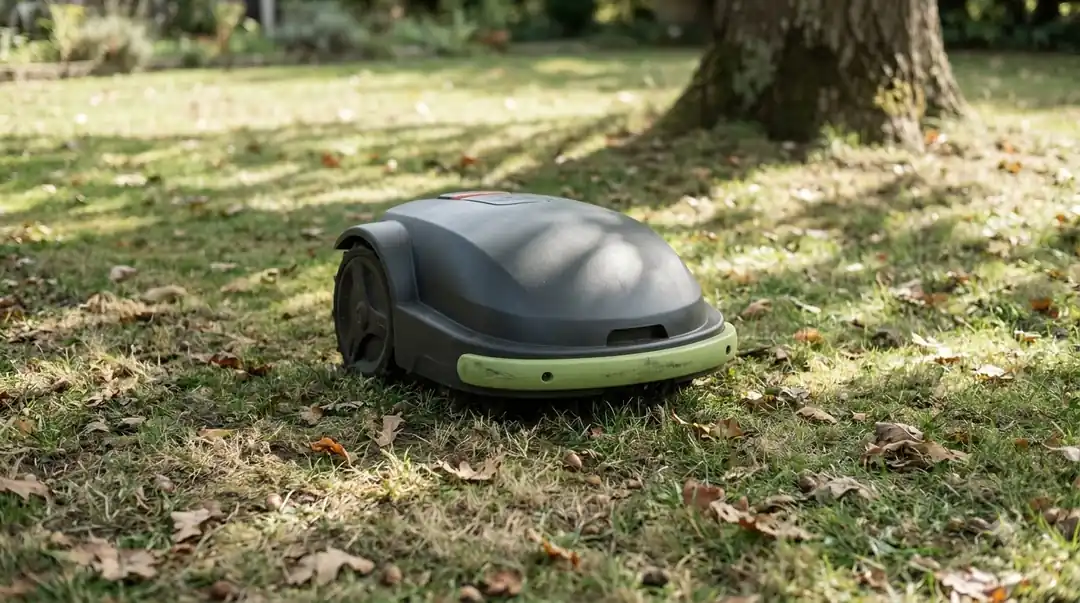
Shape matters as much as speed. A long narrow lawn with many turns uses more of a session on turning and edges than a wide open rectangle, so its effective coverage rate is lower even at the same travel speed. Our reading is that the time estimate is most reliable for a simple, open lawn and least reliable for a yard with many beds and tight corners.
What to check on a spec sheet
So how fast does a robot mower cut on the model you want? When you compare models, these are the figures that turn speed into an answer you can use. Use the manufacturer’s own pages, because consumer guides often round or mix categories.
- Travel or mowing speed. Look for a unit (m/s or mph) and whether it is a maximum or an average.
- Cutting width. Needed for the time formula. If the page does not list it, ask the maker.
- Runtime per charge. Compare this with the area per charge, not with a push mower’s run time.
- Rated area and tolerance. A capacity with a plus or minus range should be read as a range.
- Slope rating. Given as a percent and degrees; confirm it on the model you plan to buy.
Frequently asked questions
How fast does a robot mower cut in mph?
A consumer guide from Eufy gives about 0.5 to 2 mph for robot mowers. A 2025 path study measured 0.52 m/s, which is about 1.2 mph, for one pattern. Check the model’s own spec sheet for the figure it publishes.
Is 0.52 m/s fast for a robot mower?
It is within the range consumer guides give, which is why it reads as typical rather than fast. It is one measured value from a path study, not a rating for any product.
How long does a robot mower take to cut an acre?
The standard formula gives time from lawn area, speed, and cutting width. With a hypothetical 20-inch width at 1 mph, the arithmetic gives about 6 hours per acre. Real robots spread that time over several charges and days.
Does speed matter more than run time per charge?
For most yards, run time and area per charge matter more, because they decide how many charges and days a lawn needs. Speed sets how far the mower moves in each minute of that run.
Sources
- Eufy lawn mower blog (manufacturer): robot mower speed range of 0.5 to 2 mph and the mowing-time formula.
- Mammotion blog on mowing time (manufacturer): acres-per-hour formula with divisor 124, and LUBA 3 AWD runtime of up to 215 minutes per charge.
- Tracking Long-Distance Systematic Trajectories of Different Robot Mower Patterns (2025 study): vertical pattern speed 0.52 m/s, efficiency 0.77, coverage by pattern.
- Segway Navimow i Series specs (manufacturer): mowing area per charge, rated area, and slope ratings.
- Husqvarna robotic mowers (manufacturer): rated mowing capacities with plus or minus 20 percent tolerance and slope capability.
 Up next7 min readLearnCan a Robot Mower Cut Your Foot? What the Sources SayUpdated Nov 11, 2026
 9 min readLearnHow Long Does the Mammotion LUBA 3 Battery Last?Updated Nov 11, 2026
 8 min readLearnHow Often Does a Robot Mower Need to Charge?Updated Nov 11, 2026
 7 min readLearnHow Much Does a Robot Mower Weigh?Updated Nov 11, 2026
 7 min readLearnDoes a Robot Mower Work With a Dog in the Yard?Updated Nov 11, 2026
 7 min readLearnWhat Does RTK Stand for on a Robot Mower?Updated Nov 11, 2026