
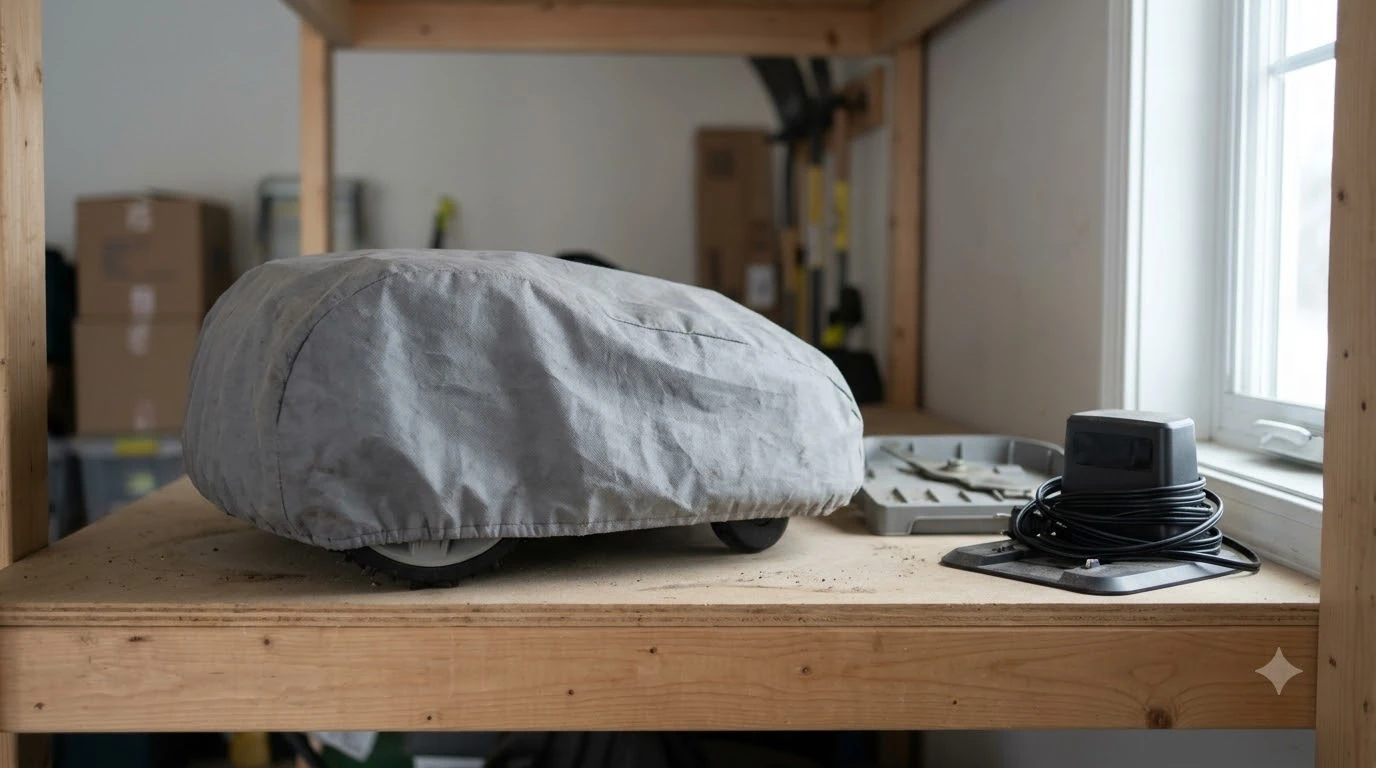

A robot mower in cold climates can run only inside its maker’s temperature limits. For the Husqvarna Automower, operation is rated from 0 to 50°C (32 to 122°F), and the mower will not start outside that range. Frost, snow and freezing batteries each need their own rules, so this guide sets out what manufacturer support pages say, as of 2026-11-09.
The short answer
- Operating range: Husqvarna rates its Automower from 0 to 50°C (32 to 122°F).
- Frost: mowing is usually unnecessary below about 8°C (40°F), when grass more or less stops growing.
- Frost Guard: on models with a temperature sensor, a reading of 5°C (41°F) or below at start time delays mowing by one hour.
- Snow and ice: no manufacturer snow-depth limit was found, but keep the battery away from snow, ice and damp floors.
- Storage: bring the mower indoors to a dry place above freezing, and follow your model’s charge rule.
Can a robot mower work in cold weather?
Yes, a robot mower in cold climates can work, but only within the range the manufacturer sets. Husqvarna separates three numbers that readers often mix up: the range for mowing, the range for charging, and the range for storage. Each one has its own limit, so a mower can be safe to store in a place where it cannot charge.
| Use | Husqvarna Automower limit |
|---|---|
| Operation | 0 to 50°C (32 to 122°F) |
| Charging | 0 to 45°C (32 to 113°F) |
| Storage | 0 to 50°C (32 to 122°F) |
The charging limit is the one to watch in a cold snap, because the mower cannot recharge outside it, and it is a few degrees narrower than the operating range at the warm end. Below 0°C, none of the three Husqvarna ranges applies. Check the table in your own manual, because other brands publish different figures. Husqvarna’s temperature guide lists these limits for its Automower models.
Robot mower in cold climates: frost and the 8°C rule
Mowing is usually unnecessary once the air falls below about 8°C (40°F), according to Husqvarna, because grass more or less stops growing at that point. Frost makes this worse. Husqvarna says grass is extra sensitive to wear when frost covers the garden, so running a mower over it can wear the turf.
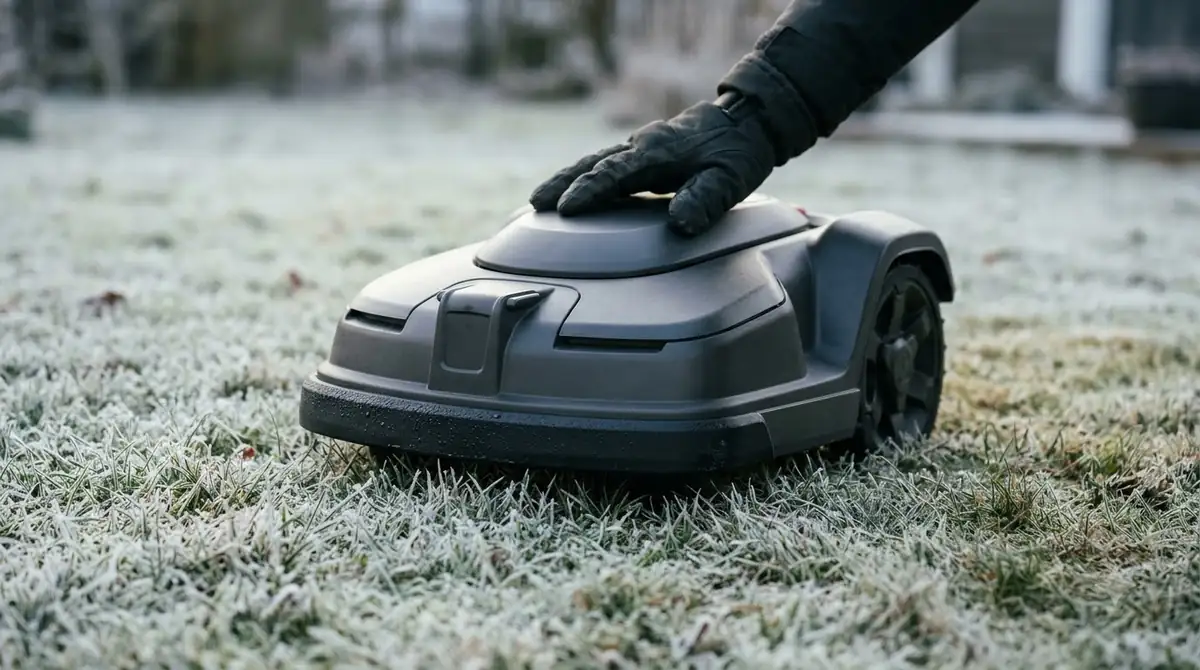
Husqvarna’s Frost Guard feature handles this automatically on models with a temperature sensor. The mower stays parked when the reading is 5°C (41°F) or below at its scheduled start time, and it delays the start by one hour. While parked, it checks the temperature every hour and begins mowing only when the reading is above 5°C.
- Sensor models: Frost Guard works from the temperature reading.
- Models without a sensor: Husqvarna offers a Frost Guard Smart Routine instead, if the mower has Wi-Fi or mobile connectivity (see whether robot mowers need Wi-Fi or cellular).
- Our reading: for a robot mower in cold climates, a schedule that stops mowing in late autumn matters more than a single frost check.
Frost Guard is a setting, not a substitute for a schedule. Check whether your model supports it before you rely on it through the first hard frost.
Snow and ice
No manufacturer snow-depth limit was found for robot mowers, so this guide cannot give a safe figure. The guidance that exists is about keeping equipment dry. Mammotion’s Canadian winter guide advises keeping batteries away from snow, ice and damp floors (rain has its own rules, covered in do robot mowers work in the rain), and it says to wait until all snow has melted and the ground is no longer frozen before the mower is used again.
The power supply should also stay in a dry, frost-free place. Husqvarna’s winter storage guide says to disconnect the power supply and store it in that kind of location, and to keep the mower in a dry environment above freezing. For a snowy yard, that usually means taking the mower and the charging station off the lawn before the first heavy snowfall.
Charging and the battery in the cold
For general battery lifespan, see how long robot mower batteries last. For a robot mower in cold climates, charging is the step most likely to damage a battery in winter. Mammotion’s winter guide says never to charge batteries in freezing conditions, and it warns that exposure to sub-zero temperatures can permanently damage lithium-ion batteries. The Husqvarna charging range of 0 to 45°C gives the same practical answer: charge indoors, or wait for milder weather.
Charging from a cold garage needs care too. Our reading is that a garage that drops below freezing overnight is a poor place to charge, so plan to charge the mower during the day or move the charging station to a space that stays above freezing.
Winter storage: where to keep it and how charged
Store the mower indoors in a dry place above freezing. Husqvarna’s winter guide says it strongly advises indoor storage in a garage, shed or basement at temperatures above 0°C (32°F). Fully charge the mower and switch it off before storage, and keep the charging station in the same protected place.
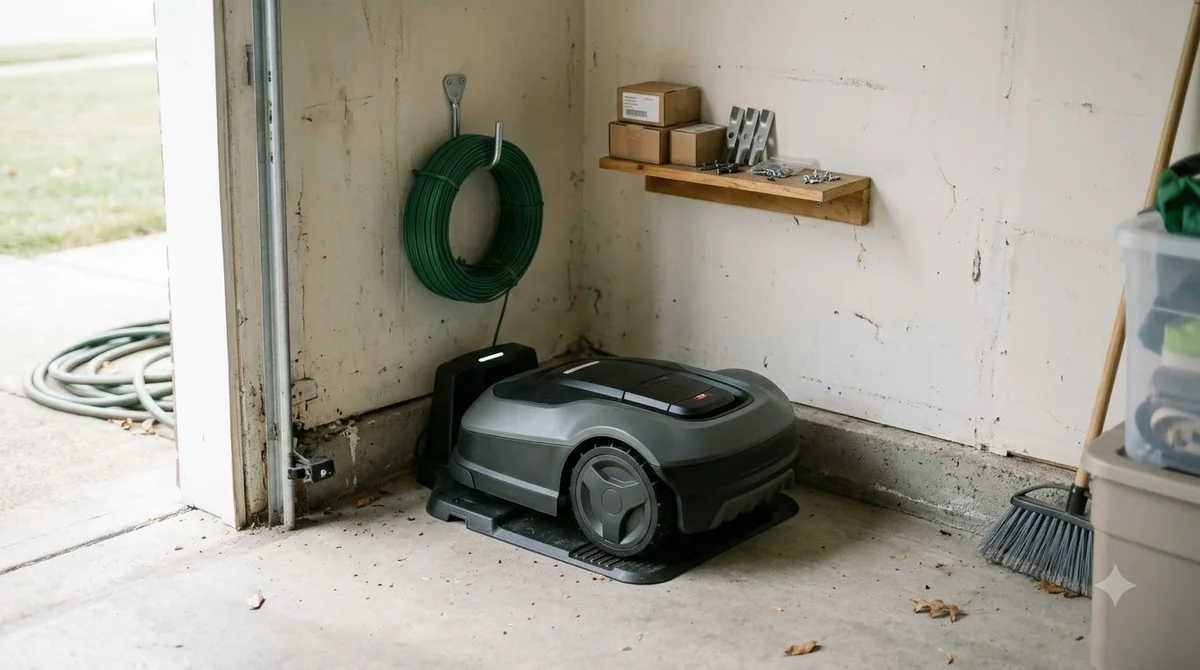
The charge rule is where brands disagree. Here are the figures from the manufacturer pages we read:
| Source | Storage temperature | Charge before storage |
|---|---|---|
| Husqvarna winter storage guide | Dry, indoors, above 0°C (32°F) | Fully charged, then switched off |
| Mammotion support page (US) | -10 to 40°C (14 to 104°F); move indoors below -10°C (14°F) | At least 80% |
| Mammotion winter guide (Canada) | 5 to 20°C ideal; removable battery 5 to 15°C | 40 to 60% for a removable battery |
The Mammotion pages do not agree on the charge level, which is why the model manual should decide. Husqvarna also says most models need no charging during storage, though some older models need a top-up every three months. For a longer routine, see our guide to winterizing a robot mower and the winter storage steps. Husqvarna’s winter storage guide gives the storage steps for its mowers.
Heads up
Some brands publish a different storage charge level from the one above. If your manual names a number, follow it over any figure in this guide.
When to stop mowing in autumn
The right stop date depends on your local climate, not the calendar, so a mower in a northern region may need to stop weeks earlier than one in a mild region. Mammotion says northern and prairie regions often need to stop earlier in autumn than milder areas. Our reading is that once overnight temperatures fall below freezing and stay there, the mower should be parked.
Stopping too late carries real costs. Mammotion warns that it raises the risk of frost damage, soil compaction and drive system wear. It also points to concealed frost under wet grass, which is easy to miss in the early morning. Our reading is that a conservative stop date beats a late one, since the lawn recovers more easily from an early pause than from a frozen cut.
Frequently asked questions
Can a robot mower in cold climates mow in snow?
No manufacturer snow-depth limit was found in the pages we read. The guidance is to keep the battery and charging equipment away from snow and ice, and to wait until the snow has melted and the ground is no longer frozen before you use the mower again.
Does a robot mower need to be stored indoors for winter?
Husqvarna strongly advises indoor storage in a dry place above freezing. Mammotion says to bring the mower indoors once the outdoor temperature falls below -10°C (14°F). A garage, shed or basement usually keeps the mower inside both limits.
Do all robot mower brands use the same winter storage charge?
No. Mammotion’s US support page says at least 80%, while its Canadian guide gives 40 to 60% for a removable battery. Husqvarna says to charge fully before storage. Follow the charge level in your own model’s manual.
Is mowing frosty grass harmful?
Husqvarna says grass is extra sensitive to wear when frost covers the lawn. Frost Guard on sensor-equipped models keeps the mower parked when the reading is 5°C (41°F) or below.
Sources
- At what temperature can I use, charge and store my Automower robotic lawn mower? (Husqvarna): operating, charging and storage ranges, and the 8°C mowing guidance.
- Protect your lawn with Automower Frost Guard options (Husqvarna): the 5°C threshold, the one-hour delay and sensor requirement.
- Complete winter storage guide for your Automower robotic lawn mower (Husqvarna): indoor storage above freezing, full charge before storage.
- Winter Storage (Mammotion support): storage range of -10 to 40°C and the 80% charge rule.
- Robot lawn mower winter maintenance guide (Mammotion Canada): snow and ice exposure, charging below freezing, and autumn stop timing.
 Up next8 min readBy YardRobot Mower for a Hot Humid Climate: What to CheckUpdated Nov 11, 2026
 8 min readBy YardRobot Mower for Tall Fescue Lawns: Height Limits That MatterUpdated Nov 11, 2026
 9 min readBy YardRobot Mower for Hillside Lawn: Ratings and LimitsUpdated Nov 11, 2026
 9 min readBy YardCan a Robot Mower Cut Zoysia? Height and LimitsUpdated Nov 11, 2026
 9 min readBy YardRobot Mower for a Sloped Front Yard: Limits, Edges and SetupUpdated Nov 11, 2026
 8 min readBy YardCan a Robot Mower Cut Centipede Grass? Heights and LimitsUpdated Nov 11, 2026