
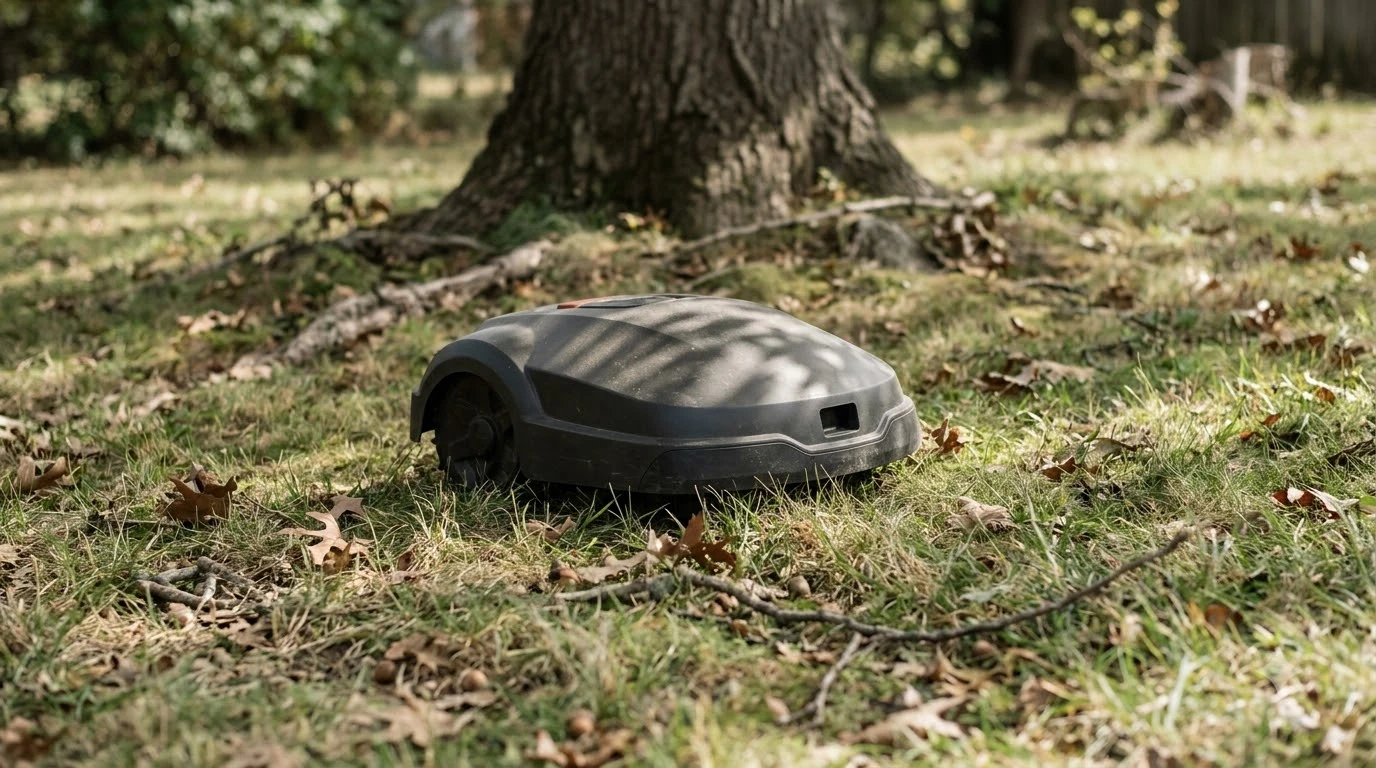

There is no single best robot mower for a yard with tree roots, but the choice depends on two separate problems. Exposed roots are a physical obstacle that the boundary wire has to route around. Tree canopy is a navigation problem that can weaken GPS or RTK positioning. Check both before you buy, because a mower that handles one may struggle with the other.
The short answer
- Roots at or near the surface: plan the boundary wire around them, and remove sharp objects that could damage the wire.
- Heavy canopy over the lawn: RTK-only navigation may degrade. Vendors of LiDAR and vision models describe these systems as less affected by tree cover, though that is their own claim.
- Shaded turf: grass under roots often struggles on its own, so expect extra watering and a realistic mowing area.
- Before you buy: confirm the model’s navigation method, wire installation needs, and the manufacturer’s guidance on obstacles.
Why tree roots matter to a robot mower
For the best robot mower for a yard with tree roots, start with the roots themselves. Roots that rise above the soil create a small step that a robot mower can climb, catch on, or strike with its blades and wheels. The concern is less about the mower itself and more about the boundary wire and the cutting deck. Husqvarna’s installation tips advise that you remove rocks and sharp objects from the ground because they may break the wire over time. Our reading is that roots pushing through the soil under the wire path could cause the same kind of damage.
Our reading is that roots are a layout problem first. Before you choose a model, walk the yard and mark every root that sits within a few inches of grass. Those are the spots where the wire path matters most, and where a bumpy transition could cause the mower to get stuck or miss a patch.
How tree cover affects navigation
Canopy changes how a robot mower knows where it is, which is why it helps to understand how an RTK robot mower works before you buy. Mowrator, a vendor of RTK-based mowers, explains that trees block, weaken and reflect satellite signals, and that reflections make position harder to judge. The article gives this as a mechanism, not as test data, so treat it as the vendor’s explanation rather than a measured result.
Lymow, another vendor, states that RTK performance may degrade under very dense canopy and that a vision-based system can take over for up to 10 minutes when GPS weakens. Ecovacs, which sells LiDAR and RTK models, says that an RTK base station needs an open, unobstructed area and that its LiDAR models are unaffected by shade or structures. Those are three companies describing their own products (see how a LiDAR robot mower works for the basics), so the useful step is to ask each manufacturer how its navigation behaves under your specific trees.
Heads up
None of these sources published independent test data for a yard with tree roots. Read the numbers as claims to verify, and ask the seller for a trial period or a return policy that covers your yard.
Laying the boundary wire around roots
Most wire-guided mowers can run a perimeter that avoids a root zone, but the wire has to be placed carefully. Husqvarna’s tips say the boundary wire can be placed about 1 to 20 cm (3/8 to 8 in) into the ground. The same guidance says burying is recommended if the lawn is uneven or if you want to hide the wire. Our reading is that burying the wire near roots may help keep it stable, but digging around roots can damage them, so plan the trench path before you cut. Our guide to whether to bury or peg boundary wire weighs both options.
Wire installation is also a time cost. Lymow lists a wired install at 4 to 8 hours, which is a vendor estimate for an average yard and can be much longer if roots force a detour. Budget extra time for a yard with many roots, and sketch the wire route on paper first.
When you shop for the best robot mower for a yard with tree roots, a practical way to plan is to list each root zone, decide whether the mower should cut through it, avoid it, or leave it as an island, and then route the wire to match, as in our guide to how to lay boundary wire around obstacles. Our reading is that the more roots you have, the more the install schedule matters.
Shade and root competition in the turf
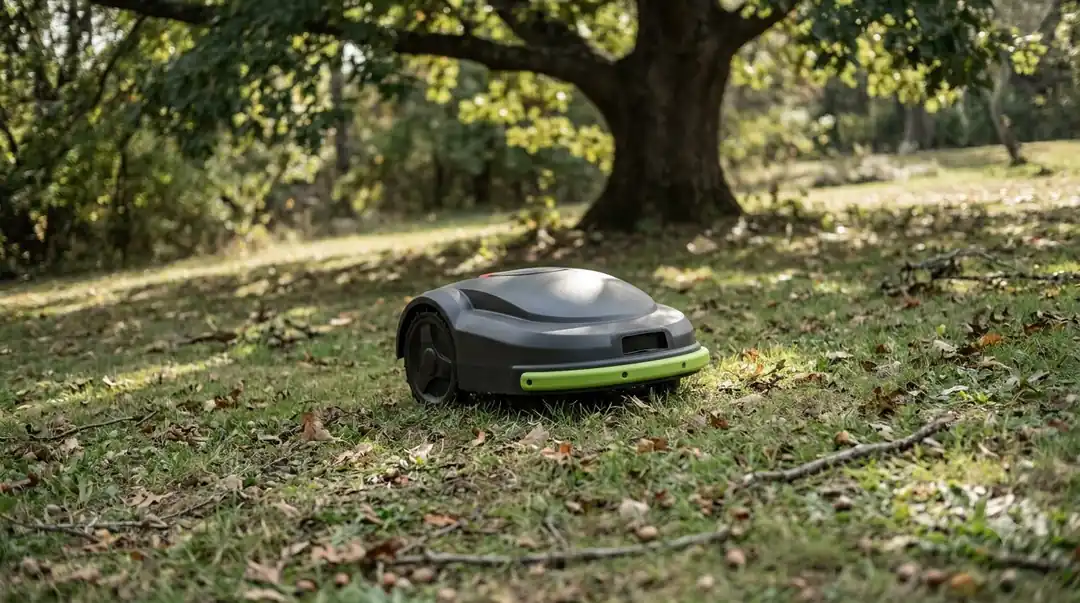
Trees affect the lawn as well as the mower. The University of Florida IFAS extension states that heavily shaded areas are generally not recommended for turfgrass and suggests other ground covers, shade-tolerant plants or mulch in those spots. That guidance matters because a patch of thin, weak grass near a trunk can look like a mowing problem when the real issue is the turf.
Mississippi State Extension notes that shaded turf may require additional water because of tree root competition. In other words, the grass and the tree are fighting for the same water. A robot mower will not fix that, so the lawn needs a plan for watering and, in heavy shade, a different plant mix. Our guide to mowing height for shade grass covers the cutting side.
Our reading is that a clean mowing area is easier to achieve when the turf under the canopy is healthy. Thin, bare patches can make the mower’s path look worse, and they can also make a boundary harder to see.
What to check before you buy the best robot mower for a yard with tree roots
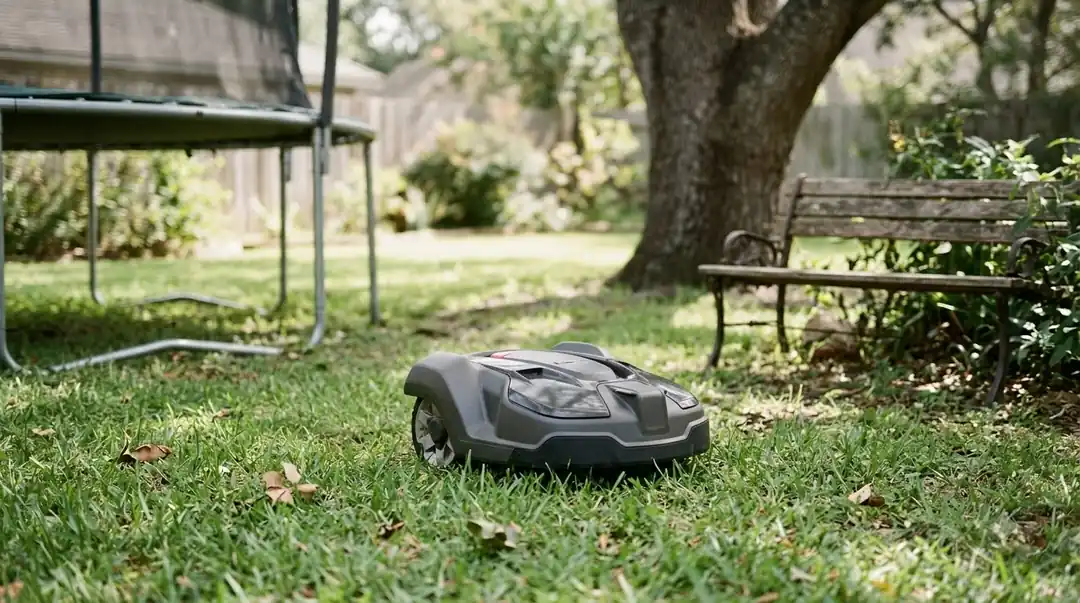
Use the table below as a checklist when you compare models for a yard with tree roots. Ask the manufacturer for the specific guidance on your yard type, not only the general spec sheet.
| What to check | Why it matters with tree roots | What to ask |
|---|---|---|
| Navigation method | Canopy can weaken GPS or RTK signal | How does it behave under dense trees, and what fallback does it use? |
| Base station placement | RTK base needs an open area | Where can the base go in a yard with trees? |
| Wire installation | Roots force detours and extra trenching | How long is a wired install for a yard like mine? |
| Obstacle guidance | Roots near the surface can damage the wire or deck | What does the manual say about exposed roots and wire depth? |
| Turf condition | Shade and root competition thin the grass | What lawn care steps does the manufacturer recommend under trees? |
The table is a starting point, not a ranking. The best robot mower for a yard with tree roots may not suit another yard, and the best fit depends on how many roots you have and how much canopy covers the lawn.

Who each option suits in a yard with tree roots
Our reading is that a wire-guided mower suits a yard where roots are few and the wire path can be planned around them. A vision or LiDAR model may suit a yard with heavy canopy and many roots, but it still needs a clear plan for the wire or the navigation, and its claims should be checked against the manufacturer’s manual. An RTK-only model is harder to justify in a shaded yard unless the seller can show how it works there.
If your yard has both heavy canopy and many roots, the best robot mower for a yard with tree roots is usually the one whose navigation and wire plan are both documented in writing. Consider the model with the most conservative claims and the clearest guidance in writing, and avoid buying on a single feature.
Frequently asked questions
Can a robot mower run over tree roots?
It depends on the root height and the model. Roots that stick up can catch the wheels or deck, and sharp objects can damage the boundary wire. Plan the wire around roots and check the manual for the manufacturer’s guidance.
Does tree cover stop RTK from working?
Vendors say dense canopy can weaken RTK signal. Mowrator explains that trees block and reflect satellite signals. Ask the manufacturer how the model behaves under your trees, because no source here provides independent test data.
Should the boundary wire be buried near roots?
Husqvarna’s tips say the wire can sit 1 to 20 cm into the ground and that burying is recommended if the lawn is uneven or you want to hide the wire. Dig carefully near roots so you do not damage them.
Why is the grass thin under trees?
Heavy shade limits turfgrass, and Mississippi State Extension notes that shaded turf may need extra water because of tree root competition. Thin turf can make the mowing area look worse, so treat the lawn as well as the mower.
Sources
- Husqvarna, tips to prevent wire break (manufacturer): rocks and sharp objects, 1 to 20 cm wire depth, burying advice.
- UF/IFAS EDIS EP072 (university extension): heavy shade and turfgrass alternatives.
- Mississippi State Extension P2892 (university extension): root competition and extra water in shade.
- Mowrator, RTK signal loss under trees (vendor): how canopy affects GPS.
- Lymow, RTK vs wire setup (vendor): dense canopy, vision fallback, wired install time.
- Ecovacs, LiDAR vs RTK (vendor): base station placement and LiDAR claims.
 Up next8 min readBy YardHow Does a Robot Mower Handle Tree Roots?Updated Nov 10, 2026
 7 min readBy YardWill a Robot Mower Get Stuck on a Lawn With Tree Roots?Updated Nov 13, 2026
 8 min readBy YardRobot Mower for Yard With Heavy Tree Canopy: What to CheckUpdated Nov 11, 2026
 6 min readBy YardBest Robot Mower for a Yard with Maple Trees: What to CheckUpdated Nov 14, 2026
 8 min readBy YardWhere to Place RTK Antenna in a Yard With TreesUpdated Nov 11, 2026
 7 min readBy YardBest Robot Mower for a Yard with Lots of TreesUpdated Nov 18, 2026